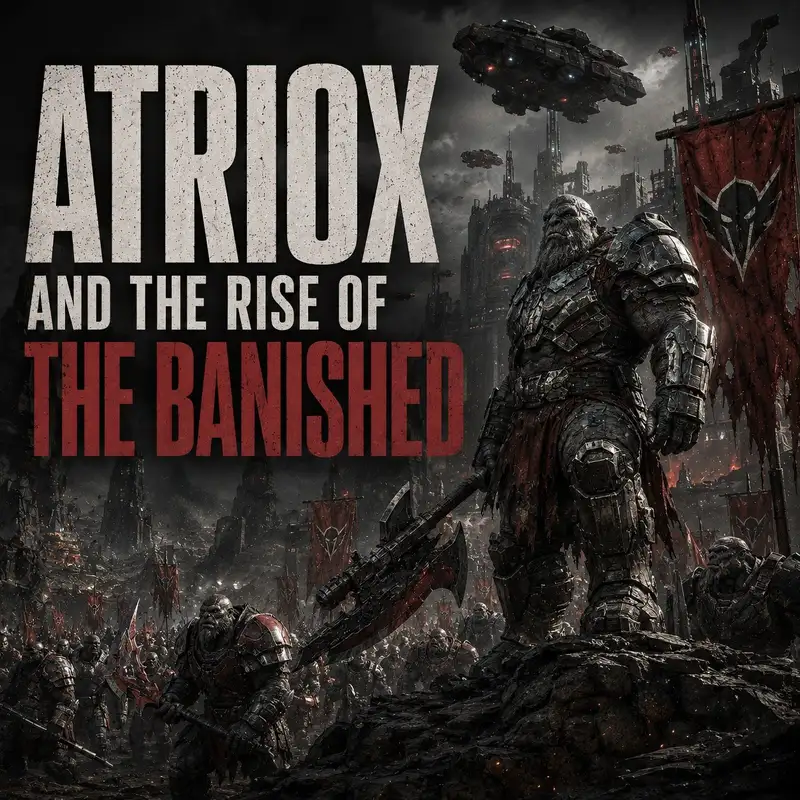
Atriox and the Rise of the Banished
On Algolis in twenty-five forty-nine, a Sangheili executioner drove a bloodblade toward the face of a kneeling Jiralhanae prisoner. Atriox caught the weapon with his right hand. He rose, turned the blade against the officer who had sentenced him, and killed him before the assembled warriors could react. The execution had been intended to remove a dangerous soldier without creating a martyr. It instead gave every Jiralhanae watching a decision about who deserved their loyalty.
Decimus and the other Jiralhanae made their choice immediately. They attacked the Sangheili guards and left the compound under Atriox’s command. The group was small, hunted, and surrounded by an empire fighting a war across many systems. It possessed no capital, no shipyard, and no recognized political authority. What it did possess was a leader who understood exactly how the Covenant had spent the lives of his people, and who had just demonstrated that obedience was no longer inevitable.
The central question is how that mutiny became the Banished, a power capable of occupying the Ark, ambushing the United Nations Space Command Infinity, and contesting Zeta Halo. The answer is not that Atriox defeated the Covenant in open war. He survived by refusing to fight on the Covenant’s terms. He built a mobile confederation around plunder, negotiated loyalty, technical adaptation, and personal authority. That system was flexible enough to expand after the empire collapsed and violent enough to reproduce many of the abuses it claimed to reject.
Atriox had not begun as an untrained laborer thrown suddenly into battle. He served as a Stalker and spent time with the Bloodstars, specialists charged with hunting human Spartans and other difficult targets. Escharum, who later became one of the Banished’s senior war chiefs, had been his teacher. Atriox learned Covenant reconnaissance, special operations, and the politics surrounding elite units. He also learned that skill did not protect a Jiralhanae warrior from being treated as expendable when imperial commanders found sacrifice convenient.
During the Human-Covenant War, Atriox’s pack was repeatedly sent against fortified human positions in groups of forty. These assaults cleared breaches for follow-on forces, but usually killed every Jiralhanae committed. Atriox returned alone from one such mission, then survived the same kind of employment again. His reputation grew because he kept walking back from battles that had been designed to leave no survivors. To his brothers, that looked like strength. To the Sangheili officers above him, it began to look like political danger.
The High Prophet of Truth understood the problem. Atriox was useful precisely because he could survive missions that destroyed other warriors. His survival also encouraged the Jiralhanae to ask why those missions were being ordered. When Atriox openly questioned Covenant doctrine and the waste of his pack, the leadership authorized his removal. The killing had to appear lawful and limited. An obvious political execution could turn a discontented soldier into a symbol. The Covenant’s solution was administratively careful and operationally disastrous.
Atriox’s rebellion offered more than anger. It offered an explanation. The Covenant had not honored Jiralhanae strength. It had exploited that strength while keeping the species dependent on San’Shyuum authority, Sangheili command, and imperial technology. Atriox did not ask his followers to replace one prophet with another. He asked them to fight for rewards, survival, and choices they could call their own. The first Banished warriors followed because they had seen him endure the same expendability imposed on them.
The early organization survived through movement. Banished raiders struck Covenant training camps, depots, transports, and isolated installations, taking vehicles, weapons, fuel, and personnel before a larger response could arrive. Atriox avoided holding territory that would force him to defend a fixed position against an empire with deeper fleets and industrial capacity. Stealth, reconnaissance, and selective violence mattered more than ceremonial conquest. Every successful raid supplied the next raid while denying the Covenant the decisive battle it wanted.
Later United Nations Space Command accounts described the Covenant as unable to contain Atriox even at the height of its power. That judgment captured the myth without describing the method. The Banished were not defeating the entire imperial military. They were presenting too few fixed targets, choosing engagements with material gain, and withdrawing before punishment could be concentrated. The Covenant was also consumed by its genocidal campaign against humanity and its own internal rivalries. Atriox survived inside those competing priorities.
Force was not the only instrument. Atriox repeatedly created situations in which defeated opponents could choose service after their previous command had failed them. He offered fuel, pay, supplies, protection, and continued authority over crews that might otherwise scatter. The offer was rarely made between equals, and refusal could be fatal. Even so, it let the Banished absorb functioning formations without rebuilding them one soldier at a time. A Covenant revivalist needed converts. Atriox needed assets that could move and fight immediately.
His political program widened the recruitment pool. The Banished rejected the Great Journey and did not require members to accept a shared religion. Atriox also rejected the idea that the Sangheili-Jiralhanae feud should determine every alliance. A useful warrior, technician, pilot, smuggler, or shipmaster could serve regardless of species, provided that service increased Banished power. This was not equality in a civilian sense. It was a mercenary principle that treated capability as more valuable than inherited caste.
That approach became visible when a Silent Shadow unit boarded one of Atriox’s vessels after the Great Schism. The Sangheili assassins had been hunting Jiralhanae in revenge for the massacres committed during the schism. Atriox argued that he had not served Truth’s betrayal and that revenge produced no useful reward. Their leader refused. Several members of the unit killed him and joined Atriox instead. The incident turned former enemies into recruits and demonstrated that the Banished could absorb specialists whom a species war would otherwise waste.
The acquisition of the assault carrier Enduring Conviction showed the same method at naval scale. Atriox allowed Shipmaster Let ’Volir to capture him, then used the meeting to expose the shipmaster’s vulnerable position. Let ’Volir’s crew had a powerful vessel but uncertain allegiance, limited fuel, and no reliable future after the Covenant’s collapse. Atriox offered provisions, continued service, and survival for the crew. The carrier broke from its formation and became the Banished flagship. The decisive weapon in the operation was logistics.
A captured carrier alone did not create a fleet. The Banished built relationships with shipyards, clans, workshops, smugglers, and resource holders across former Covenant space. Some allies traded land and industrial access for protection against rivals. Workshops modified inherited Covenant designs without waiting for religious approval. Later Banished dreadnoughts were assembled from heavily altered Covenant hulls, while foundries and drop-bases allowed those ships to place an occupation economy directly onto a planet’s surface. Salvage gradually became production.
That industrial system was still a war economy rather than a complete state. It could strip wrecks, reopen mines, refuel captured vessels, and fabricate brutal equipment near the front. It did not guarantee stable law, civilian services, or equal distribution among member clans. Workshops answered patrons, and commanders protected the supply chains that enriched them. Banished logistics were effective because they were tied directly to conquest. The arrangement became less reliable whenever a campaign stopped producing resources worth dividing.
The organization supporting that growth was deliberately loose. Atriox stood at the top as warmaster. Beneath him, war chiefs such as Decimus and later Escharum coordinated major campaigns, while legionmasters, chieftains, shipmasters, keeps, packs, and affiliated clans retained broad control over their own followers. At the fleet level, major leaders known collectively as the Eight included Jiralhanae, a Sangheili kaidon, and a Kig-Yar war-queen. The arrangement allowed expansion without requiring every recruit to enter one standardized bureaucracy.
Autonomy came with constant competition. Banished commanders fought for spoils, rank, and Atriox’s favor. Spies and personal enforcers watched senior leaders for disloyalty. A commander who delivered resources could gain authority quickly. A commander who failed could lose forces, status, or life with comparable speed. This was a harsh merit system shaped by clan politics rather than an impersonal professional service. It encouraged initiative, but it also made cohesion dependent on leaders strong enough to prevent ambition from becoming civil war.
Atriox’s personal history helped hold those competitors together. Banished ritual presented his survival, rebellion, and victories as a common origin for warriors who otherwise shared little. Escharum later turned that history into combat trials meant to teach recruits that endurance itself was belonging. The movement rejected prophets while developing its own founding legend. Atriox did not claim divinity, but his reputation performed some of the same political work by making loyalty to one leader appear synonymous with freedom from every other one.
The movement’s claim of freedom therefore had severe limits. Banished Unggoy could rise above positions denied to them under the Covenant, yet other Unggoy were drawn from thrall colonies or indoctrinated for suicide attacks. Huragok were valuable engineers, but some were imprisoned in painful control harnesses. Lekgolo colonies could be allied partners or expendable components inside unstable machines. Atriox had once rejected a device for controlling Yanme’e because the Covenant treated warriors as tools. The organization bearing his name did not consistently preserve that principle.
The fall of the Covenant in twenty-five fifty-two created the opportunity that transformed the Banished from raiders into a regional power. Imperial depots lost their ministries. Shipmasters lost recognized superiors. Garrisons and workshops needed patrons. Large numbers of former soldiers had weapons and no government able to pay, feed, or direct them. Covenant successor factions offered renewed faith or local rule. Atriox offered employment, spoils, and access to an expanding military market.
The Banished also moved beyond former Covenant society. Human criminals, smugglers, mercenaries, and Insurrectionist groups offered intelligence, trade routes, technical skills, and access to Forerunner systems that recognized human Reclaimers. Banished chieftains cultivated influence inside human enterprises and Jiralhanae colonies alike. The New Colonial Alliance eventually entered the confederation under Ilsa Zane. Atriox did not require humans to be forgiven for the war. He required them to be useful and subordinate.
This is why the Banished were not simply another Covenant remnant. Jul ’Mdama and similar leaders used Covenant symbols to restore religious authority. Atriox treated the old empire as a warehouse, labor pool, and cautionary example. He kept whatever worked, discarded the theology, and encouraged workshops to alter sacred technology for practical use. His followers could serve for belief in him, loyalty to a clan, profit, coercion, or the opportunity to settle an old score. The organization did not need one motive as long as its members moved toward the same target.
Late in twenty-five fifty-eight, Atriox carried a Banished expedition to Installation Zero Zero, the Ark. Only part of the wider confederation went with him. The broader fleets and clans remained active in the Milky Way. That distribution limited the force available at the Ark, but protected the Banished from losing everything in one campaign. Atriox’s objective was appropriately ambitious. Control of the Ark’s foundries offered access to Forerunner industry and the ability to influence the construction of Halo installations.
The initial operation succeeded. Banished forces overwhelmed the human research presence, seized facilities, and established extraction and occupation sites across the immense installation. The Ark rewarded the Banished approach because it contained resources, portals, machinery, and scattered objectives too numerous for one conventional front. Atriox could place autonomous commands around valuable sites and let each exploit what it found. The weakness was that those commands could also be isolated, deceived, or destroyed before support arrived.
The arrival of the Spirit of Fire in March of twenty-five fifty-nine tested the Banished against an enemy Atriox had not planned to face. The human colony ship was old, lacked a working slipspace drive, and carried forces that had been missing for decades. It also brought experienced commanders, Spartan Twos, conventional troops, and a crew with no route of retreat, then recovered the logistics artificial intelligence Isabel from the Ark. Atriox initially treated the ship as another small force that could be intimidated or contained. Captain James Cutter declined the role assigned to him.
Within days, the Banished lost Decimus, Enduring Conviction, and the newly constructed Installation Zero Nine. The Spirit of Fire did not win through superior fleet strength. Its personnel attacked the systems connecting Banished positions, exploited the Ark’s Sentinel defenses, and turned local Forerunner machinery against the carrier. Atriox still retained substantial ground forces, but his plan to dominate the Ark had been disrupted. The campaign revealed that decentralized occupation created many profitable nodes and many points an adaptive enemy could break.
A later Flood outbreak demonstrated a different kind of resilience. Voridus disobeyed orders and breached the ruins of High Charity, releasing surviving Flood forms. Atriox redirected forces away from the human campaign, ordered containment, and accepted the loss of ground rather than allow a Gravemind to form. Banished troops and the Ark’s Sentinels destroyed the developing intelligence and sealed the breach. The response was costly, but strategically correct. A commander driven only by pride might have continued fighting the humans until both armies were consumed.
Atriox then reestablished contact with the Milky Way and ordered Escharum to locate a portal complex beneath Reach. Banished forces recovered Forerunner crystal fragments from the keyship Anodyne Spirit to open the Ark side. In October of twenty-five fifty-nine, the portal opened. Atriox returned with a small group of senior followers while thousands of Banished troops remained on the Ark. He had gone there seeking a decisive source of power and returned without controlling it. The confederation survived because its strength had never been confined to his expedition.
The next enemy could not be raided or ignored. Cortana demanded that Atriox submit to Created rule. He refused. On November eighth, twenty-five fifty-nine, Guardians shattered Doisac and devastated the Oth Sonin system. The punishment destroyed the Jiralhanae homeworld for the defiance of one leader and displaced a species already divided by clan conflict. Cortana intended the attack to demonstrate that resistance was futile. It gave the Banished a loss around which nearly every Jiralhanae grievance could be organized.
Doisac’s destruction changed Banished strategy. Resource acquisition and power remained central, but survival now required secure territory, industrial depth, and a home that could not be removed by another ruler’s ultimatum. The Ark and Zeta Halo offered more than ancient weapons. They offered defensible environments, foundries, transportation systems, and symbols capable of uniting displaced followers. Atriox’s promise that the Banished would bow to no master gained credibility precisely because another master had destroyed their world.
Atriox and Escharum concentrated forces for Zeta Halo while War Chief Severan retained command over fleets remaining elsewhere. Banished intelligence learned that Infinity was preparing a strike against Cortana. The resulting ambush on December twelfth did not depend on a ceremonial fleet duel. Dreadnoughts attacked from prepared positions, rammed the flagship, and delivered boarding forces against hangars and internal routes. Infinity’s firepower mattered less once the ship could no longer maneuver, launch, communicate, or organize an orderly defense.
Atriox personally defeated John One One Seven during the assault and cast him into space. He then confronted Cortana inside Zeta Halo’s systems. The Weapon had already locked her down, leaving the Created ruler unable to summon the power that had destroyed Doisac. Cortana answered by destroying the Silent Auditorium, fracturing part of the ring, and sending the installation through slipspace. Atriox was believed dead. The Banished had won the opening battle and lost the leader around whom the victory had been organized.
Escharum continued the campaign. Banished dreadnoughts deployed drop-bases, artillery, foundries, prisons, and repair sites across the ring, turning captured ground into immediate military infrastructure. Human survivors were hunted, separated, and denied a secure logistical center. The House of Reckoning converted prisoners into training material and propaganda. This occupation doctrine reflected the organization’s evolution from raiders. The Banished no longer arrived only to steal what could be carried away. They could build enough industry in place to exploit a world while fighting for it.
The wider confederation remained active beyond Zeta Halo. Banished forces continued holding parts of the Ark, invaded Suban for its rare crystal resources, attacked the Spartan academy on Nysa, and maintained links to human mercenaries and criminal markets. These operations were not all directed minute by minute from one headquarters. They were conducted by clans and commanders pursuing shared advantage under the Banished name. That autonomy made the organization difficult to decapitate and difficult to control.
By late May of twenty-five sixty, the Master Chief had killed Escharum and several senior Banished commanders on Zeta Halo. Local leadership began to fracture, while Severan served as the strongest coordinating authority for fleets outside the ring. Atriox, however, had survived Cortana’s explosion and reached the sealed cylixes holding the Endless. The surviving record does not yet establish when he will resume open command, how much of the Banished knows he lives, or what bargain he intends to make with the prisoners he sought.
Atriox succeeded where many Covenant successors failed because he built for uncertainty. Religion was optional. Species identity could be negotiated. Captured technology could be modified. Clans could retain internal authority. Ships could be purchased with fuel instead of conquered through annihilation. Raids supplied workshops, workshops supported fleets, and fleets opened new resources. Most importantly, the Banished could survive the loss of a base, a carrier, a homeworld, or even temporary contact with its founder.
The same design remains its greatest weakness. The Banished promise freedom from old masters while demanding submission to Atriox and the commanders who speak in his name. They reject Covenant caste but preserve coercion, forced labor, and expendability. Their autonomous clans create resilience until spoils disappear and succession becomes contested. Atriox rose because he understood that the Covenant had confused obedience with strength. Whether the Banished can survive his final absence will depend on whether he built an institution, or only a larger army waiting for him to return.