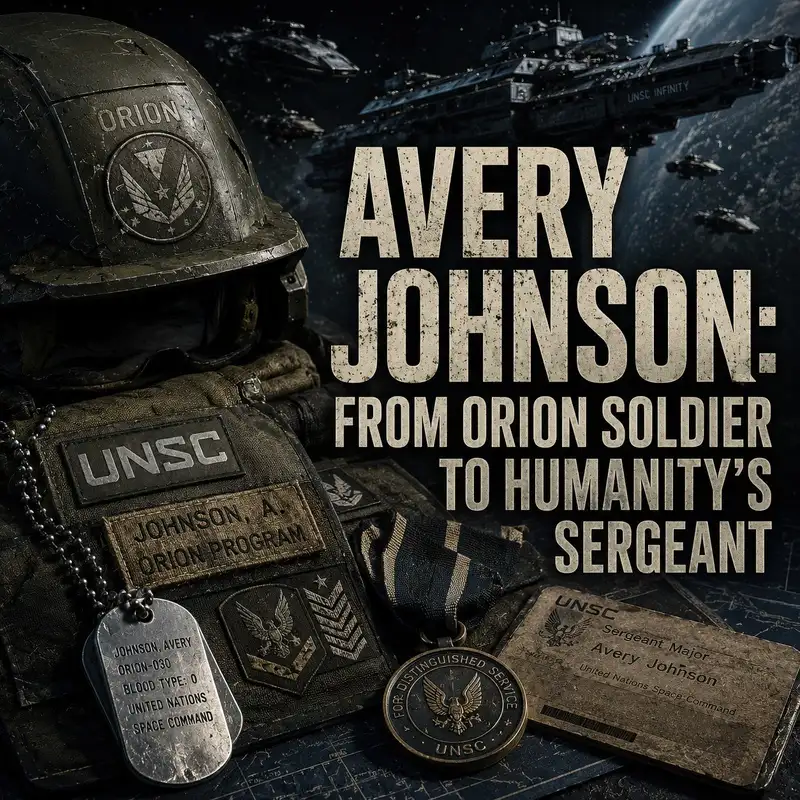
Avery Johnson: From ORION Soldier to Humanity’s Sergeant
The evacuation plan on Harvest depended on seven space elevators, an orbital station called the Tiara, and militia recruits who had expected to train against human insurgents. Instead, they faced an alien warship, infantry species they had never studied, and weapons that turned ordinary cover into molten debris. Staff Sergeant Avery Johnson could not give them better equipment or summon a fleet. He could only make frightened civilians and part-time soldiers function long enough for the population to escape.
How did an ORION operator become the enlisted leader who seemed to stand for humanity’s war effort? That was the work Johnson performed throughout his career. He translated strategic disasters into immediate tasks that people could understand. Hold this route. Move those civilians. Cover that landing zone. Keep the officer alive. Get the Spartan to the objective. His public image later became a cigar, a booming voice, and speeches delivered at a volume normally associated with artillery. The record beneath the performance is more important. Johnson became humanity’s sergeant because he represented the senior noncommissioned officer at his best: experienced, adaptable, close to the troops, and willing to tell exceptional soldiers what they still needed to learn.
Avery Junior Johnson was born in Chicago in twenty-four seventy-four and entered military service as a young man. His career began before the Covenant War, when the principal security problem facing the Unified Earth Government was rebellion across the colonies. Political inequality, economic pressure, distance from Earth, and heavy-handed government responses had produced movements ranging from peaceful separatism to armed insurgency. The military wanted small units capable of finding and striking rebel leadership before unrest expanded into a wider civil war.
Project ORION was one answer. The program selected adult volunteers from the military and attempted to improve them through intensive training, biochemical augmentation, and experimental equipment. ORION personnel received enhancements to strength, endurance, perception, learning, and motor performance. The procedures were painful, the results uneven, and the long-term effects serious for some participants. The program never produced the integrated armor and human system later achieved by the Spartan Two project. Johnson was enhanced, but he was not a Mjolnir-armored Spartan and should not be treated as one wearing Marine fatigues.
ORION did make him an unusually capable special operator. Johnson trained in precision shooting, close-quarters combat, orbital insertion, reconnaissance, and direct action. In twenty-five zero two, he returned to Harvest as part of Operation KALEIDOSCOPE. From a concealed firing position, he assassinated Jerald Ander, leader of the planet’s Secessionist Union. The mission was tactically clean. The political result was less decisive. Removing a leader did not remove the conditions that had produced separatism, and Harvest would later become famous for a threat no counterinsurgency forecast had considered.
The program was shut down in twenty-five zero six after high costs, unmet expectations, institutional scandal, and the cumulative problems associated with its methods. Johnson returned to conventional Marine service, though nothing about his experience was conventional. The Office of Naval Intelligence concealed ORION records behind medical explanations and classification. His augmentations remained useful, but they did not replace ammunition, armor, transport, or recovery. Johnson could perform beyond the normal human standard. He could still be wounded, exhausted, trapped, or killed.
By twenty-five twenty-four, Johnson was a staff sergeant fighting under Operation TREBUCHET. On Tribute, he and Staff Sergeant Nolan Byrne led Marines against a suspected insurgent bomb-making site. The raid illustrated the moral pressure of the conflict. Intelligence was incomplete, the threat to civilians was real, and commanders were prepared to use coercive methods to obtain information quickly. A hostage crisis that followed left Byrne and Johnson divided over a moment of hesitation and its consequences. Johnson carried into the Covenant War the experience of fighting enemies who looked human, spoke human languages, and sometimes stood among civilians.
He returned to Earth for leave already worn down by those operations. There he learned that his last close family relation had died without him. Grief, alcohol, and an encounter with law enforcement threatened to end his career in disgrace. A transfer to Harvest intervened. The assignment looked like professional exile: train a colonial militia on a quiet agricultural world while the Office of Naval Intelligence investigated stolen freighters and possible rebel activity. It became the opening battlefield of the Human-Covenant War.
Johnson and Byrne were valuable on Harvest because they understood more than marksmanship. They knew how to turn civilians into a unit, how to identify leaders, how to impose routines, and how to make training difficult enough that combat would not be the first time recruits experienced confusion. Their relationship was strained, but the colony needed both men. The militia required instructors who could teach weapons, movement, communications, and discipline while working around the secrecy of an intelligence operation whose supporting personnel did not know the full purpose.
The first alien contact did not arrive as a formal invasion. Kig-Yar raiders had been intercepting human shipping while searching for objects their Covenant instruments identified as Forerunner relics. Johnson and Byrne used a bait vessel to trap the attackers. The encounter became the first officially recorded armed clash between human forces and the Covenant. Johnson pursued the enemy aboard its ship and survived the vessel’s destruction because Byrne extracted him before the situation became unsurvivable. Augmentation helped. So did another Marine arriving at the right time.
That distinction followed Johnson for the rest of his life. He survived events that killed nearly everyone around him, but survival was rarely solitary. Pilots, medics, Marines, Spartans, artificial intelligences, and alien allies repeatedly kept the chain intact. The legend favored the man who walked away. The operational record shows a network of people who made walking away possible.
Harvest’s defenders soon faced the Jiralhanae vessel Rapid Conversion. Attempts at communication failed amid incompatible objectives, religious assumptions, and escalating violence. Johnson’s militia could not defeat the Covenant in orbit. Its realistic mission became delay and evacuation. The Tiara linked Harvest’s space elevators and provided the path by which much of the population could leave. Johnson, Byrne, the militia, the artificial intelligences Sif and Mack, and civilian personnel kept that system operating under attack.
Harvest was still lost. Its surface was attacked and later devastated, and the colony became the opening symbol of a war that would consume human worlds for nearly twenty-seven years. Yet the evacuation mattered. A strategic defeat did not make every local action meaningless. Johnson’s first major contribution against the Covenant was not destroying an enemy empire. It was buying enough time for civilians to live beyond the fall of their world. The war began with him performing the most basic duty of a sergeant: turning panic into organized movement.
His experience made him valuable when humanity attempted its first major counteroffensive. In twenty-five twenty-six, senior commanders selected Johnson for Operation SILENT STORM because he had fought the Covenant and because he understood augmented soldiers. The Spartan Twos assigned to the operation were physically extraordinary and tactically gifted, but they were still fifteen years old. Their education had been conducted inside a closed program. They knew how to fight. They had far less experience working with conventional formations that did not share their speed, communications habits, or lifelong cohesion.
Johnson was not placed over John One One Seven as a conventional commander. He was there to advise, teach, and help integrate the Spartans with the Black Daggers, an Orbital Drop Shock Trooper battalion. He changed training exercises so the larger force could challenge the Spartans through coordination rather than individual skill. He also helped officers understand that the Spartans were not simply faster Marines who could be inserted into an ordinary plan. Their capabilities required different timing, support, and command relationships.
When Colonel Marmon Crowther proposed a boarding plan that did not use the Spartans effectively, John objected and Johnson supported him. That mattered. A teenage classified soldier challenging a colonel could sound like indiscipline. A veteran sergeant translating the objection into professional military terms gave the concern institutional weight. Johnson helped conventional command trust John without pretending rank had disappeared. He later supported John’s promotion to Master Chief Petty Officer and warned him about the danger of always leading from the front.
That warning captured Johnson’s view of leadership. Courage was necessary, but a commander who repeatedly placed himself at the point of greatest danger could become a liability if the force depended on him. John’s instinct was to accept personal risk before assigning it to others. Johnson understood the virtue and the cost. A leader had to be visible without making the mission hostage to his survival. The advice came from a man whose own career would repeatedly place him in exactly that contradiction.
Operation SILENT STORM also demonstrated Johnson’s limits. During the attack on Zhoist, Insurrectionist infiltrators betrayed the human task force. Johnson fought his way through the compromised prowler and used a distress beacon to expose the traitors to the Covenant. He was then left drifting in space with failing suit systems, nearly frozen and suffocating before rescue. The mission succeeded, but not because he was indestructible. It succeeded because he understood the enemy’s reactions, improvised under isolation, and remained alive long enough for others to recover him.
The decades that followed rarely placed Johnson at the center of official histories, but they made him the soldier seen in twenty-five fifty-two. He fought across a retreating human frontier, survived long deployments and cryogenic transits, and learned how Covenant species behaved under pressure. At Paris Four, he helped save civilians during another colonial disaster. He had spent nearly his entire adult life inside the machinery of counterinsurgency and interstellar war.
At Reach, Johnson led a Marine team on orbital Gamma Station while Covenant forces overwhelmed the system. John and Linda Zero Five Eight reached the station to destroy navigation data that could expose Earth and helped extract Johnson’s unit. He escaped aboard the Pillar of Autumn. The ship’s escape jump carried its survivors to Installation Zero Four, where Johnson again had to organize Marines after a strategic plan collapsed. Reach was gone, command was fragmented, and the new objective was an artificial ring no one understood.
Johnson’s speeches on the ring were theatrical because theater has a military use. Troops separated from their fleet, surrounded by Covenant forces, and stranded on an unknown structure did not need a lecture on strategic uncertainty. They needed confidence, a clear enemy, and the belief that their unit could still act. Johnson used humor, insult, volume, and personal example to create momentum. The performance was not the whole man. It was one of the tools he carried.
That tool could not protect his squad from the Flood. Johnson accompanied Captain Jacob Keyes into a containment facility after evidence suggested the Covenant had located a weapons cache. The unit instead released or encountered an enemy that turned casualties into additional attackers. Johnson watched Marines become infected and had to kill former comrades before they killed him. He fought his way out of the facility alone.
His survival later produced one of the most persistent false stories in his record. Johnson was not immune to the Flood. The supposed condition called Boren’s Syndrome was connected to an intelligence cover story concealing his ORION augmentation history. He survived because he resisted infection long enough to escape, aided by enhanced physiology, experience, and extraordinary fortune. Treating him as biologically immune weakens the event. He was in danger. The Flood could have taken him, and nothing in his medical record offered humanity a simple cure.
Johnson escaped the destruction of Installation Zero Four with a small group of survivors and rejoined John and Cortana. He helped capture a Covenant ship, return to Reach, and assemble the improvised force that conducted Operation FIRST STRIKE. Johnson proposed attacking the Unyielding Hierophant, a Covenant command station supporting a force preparing to strike Earth. Spartans carried out the central sabotage, while Johnson remained with the damaged human ship and Cortana. His contribution was judgment: identifying that escape alone would leave Earth facing an assembled fleet.
He reached Earth in time to be promoted to sergeant major and receive the Colonial Cross. The ceremony aboard Cairo Station was interrupted by the Covenant, which was appropriate to the year and inconvenient for everyone responsible for scheduling. Johnson moved immediately from public recognition to station defense, then joined Commander Miranda Keyes aboard In Amber Clad. In New Mombasa, he led Marine deployments, supported recovery efforts, and delivered armor to help John break the Covenant advance.
In Amber Clad followed the Prophet of Regret through slipspace to Installation Zero Five. On Delta Halo, Johnson commanded dropship movements and later accompanied Keyes into the quarantine zone to recover the Activation Index. They were captured during the struggle around the Library and became prisoners of Tartarus. The Covenant’s internal purge then created an alliance no prewar planner would have considered credible.
Johnson, Keyes, and their Marines joined forces with Thel ‘Vadam and Sangheili rebels to stop Tartarus from firing the ring. Johnson commandeered a Scarab, used it to breach the route to the control room, and provided precision fire that stripped Tartarus’s shields so the Arbiter could kill him. The man who had fought the Jiralhanae at Harvest now helped a Sangheili end a Jiralhanae attempt to activate Halo. His adaptability was political as well as tactical. He did not require trust to become friendship before cooperation could begin.
Back on Earth, Johnson helped connect intelligence, command, and front-line action. He questioned a captured Huragok about the Covenant excavation near Voi, recovered John after his return from the Forerunner dreadnought, defended Crow’s Nest, and moved troops and vehicles through the fighting in Kenya. He had become the human noncommissioned officer most familiar with Halo systems, Covenant leadership, the Flood, and the newly allied Sangheili. That did not give him perfect information. It made him unusually useful whenever separate organizations needed to act before their staffs agreed on terminology.
At the Ark, Johnson again led conventional forces beside Spartans and Sangheili. He helped establish the landing zone, moved Marines and armor forward, and commanded one of the assaults against the towers shielding the Prophet of Truth. His force was overrun. His Marines were killed, and Johnson was captured because Truth needed a human to activate the Halo Array.
Miranda Keyes attempted a rescue and found herself surrounded. Johnson understood the strategic problem immediately. If Truth retained a living human prisoner, he could force activation. Johnson urged Miranda to deny him that capability even at the cost of both their lives. She hesitated, and Truth killed her. Johnson was then forced to activate the system before John and the Arbiter stopped the firing sequence. It was one of the clearest failures in his career, not because he lacked courage, but because courage could not restore a lost tactical position or save a commander who had entered it alone.
The discovery of a replacement Halo above the Ark created one final option against the Flood. Cortana possessed the Index data needed to fire it. The ring was incomplete, and its monitor warned that immediate activation would destroy the installation and damage the Ark. Waiting would give the Flood time to consolidate. Johnson chose immediate action. The decision was technically destructive and strategically understandable. A perfect weapon available later was less useful than an unstable weapon available before the enemy escaped.
Three hundred forty-three Guilty Spark turned on the human and Sangheili force to protect the unfinished ring. Its attack mortally wounded Johnson. Even then, he used the remaining charge in his Spartan Laser to weaken the monitor and passed the weapon to John. He also returned Cortana’s data chip and made clear that he would not survive the evacuation. The ring fired, tore itself apart, devastated the local Flood presence, and damaged the Ark. Johnson died at the end of the same war whose first battle he had fought on Harvest.
His career should not be reduced to survival, speeches, or proximity to the Master Chief. Johnson was captured, overrun, wounded, and unable to save people he cared about. Harvest fell. Marines died under his command. Miranda Keyes was killed in front of him. His decisions sometimes depended on support arriving in time, and sometimes it did not. Those failures make his leadership credible. Soldiers trusted him not because he promised control over war, but because he remained useful when control had already been lost.
His ORION augmentations mattered. They extended his physical performance, improved his chances in combat, and helped him survive conditions that would have killed an ordinary Marine. They did not explain why officers listened to him, why Spartans accepted his advice, or why troops followed him into positions they understood might not hold. Those outcomes came from professional authority earned across decades. Johnson knew the difference between giving a speech and giving a plan. He usually supplied both.
His friendship with John reflected that authority. Johnson was one of the few conventional soldiers who could correct the Master Chief without competing with him. He had seen John as an adolescent operator, helped him work with larger formations, and later fought beside him as an equal in experience if not capability. John could do things Johnson could not. Johnson understood people and institutions John had never been allowed to experience normally. Each filled gaps in the other’s education.
The United Nations Space Command later named the Avery J. Johnson Academy of Military Science in his honor. The choice was fitting. Johnson’s legacy was attached not to a battleship or a weapon, but to a place where experienced personnel trained the next generation of Spartans. In twenty-five sixty, the hidden academy on Nysa was attacked by the Banished and ultimately considered a total loss, though key personnel escaped. Even the memorial institution inherited the pattern of his life: training interrupted by invasion, a defensive position that could not be held, and survival measured by the people extracted rather than the buildings left standing.
Avery Johnson became humanity’s sergeant because his career connected almost every form of its war. He began as an augmented counterinsurgent, returned to Harvest first as an assassin and later as a defender, helped teach the Spartans how to serve beside conventional troops, carried Marines through the Covenant War, accepted an alliance with former enemies, and died trying to deny the Flood a future. The cigar and the voice made him recognizable. The deeper symbol was continuity. When strategy failed, fleets vanished, or commanders died, Johnson gave the survivors the next task and made them believe it could still be completed.