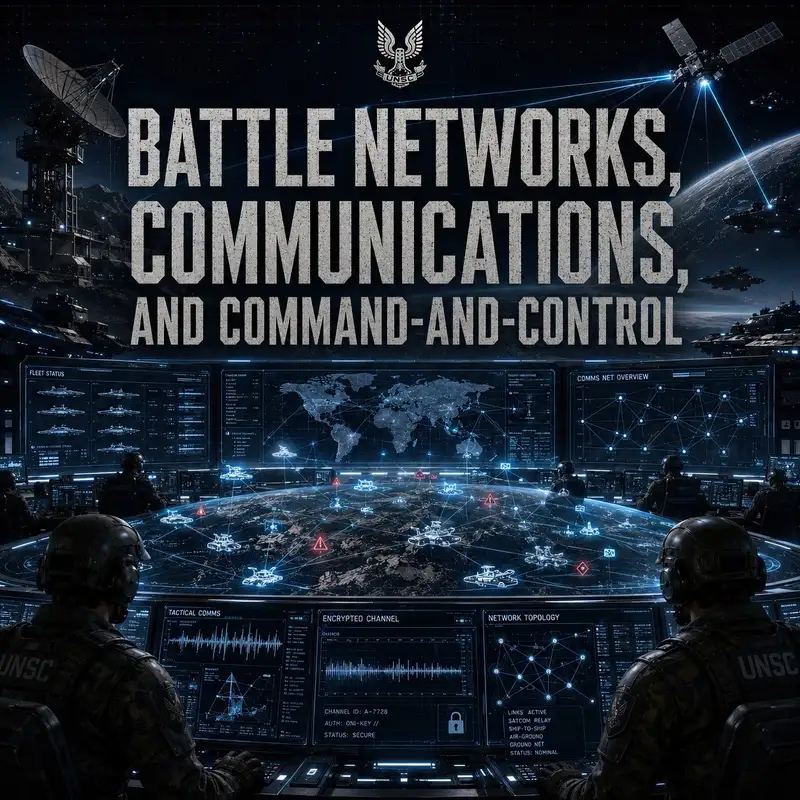
Battle Networks, Communications, and Command-and-Control
At Visegrád Relay on Reach, the first sign of invasion looked like a communications failure. A major slipspace relay had gone silent, local personnel were missing, and the initial suspicion fell on Insurrectionist sabotage. Noble Team was sent to restore contact and determine what had happened. The answer was Covenant infiltration. Before the enemy committed fleets openly, it had already attacked the system Reach used to warn itself.
That sequence explains why battle networks and command-and-control mattered as much as armor, ships, or magnetic accelerator cannons. The United Nations Space Command fought across planets and star systems with forces separated by distance, terrain, classification, and uncertain slipspace travel. It could only act as one military when information moved between sensors, commanders, weapons, and logisticians quickly enough to shape a decision. When that movement stopped, a fleet became separate captains, a division became isolated battalions, and a colony’s defense became several local battles sharing the same disaster.
A battle network was not one enormous computer linking every soldier directly to High Command. It was a layered collection of radios, data links, tactical software, sensors, relay stations, satellites, command posts, shipboard systems, artificial intelligences, and human procedures. Some parts moved voice traffic. Others carried locations, imagery, target tracks, authentication codes, medical status, or supply requests. The network’s value came from combining those fragments into a common operating picture. Its danger came from believing that the picture was complete.
Command, control, and communications were related but different. Command was lawful authority and responsibility. Control was the process of turning an objective into coordinated action. Communications carried the information and orders that made control possible. A functioning radio did not guarantee useful command. A commander could transmit an order based on obsolete intelligence, and a unit could acknowledge an instruction it no longer had the ammunition or transport to execute. The network connected the conversation. It did not make the conversation correct.
At the tactical level, the system began with individual personnel. Helmet radios, encrypted channels, identification systems, navigation aids, and heads-up displays allowed squads to track friendly positions and exchange contact reports. The Visual Intelligence System, Reconnaissance, used by Orbital Drop Shock Troopers and later personnel, organized maps, sensor data, objectives, and communications into a form one operator could use while moving. A dedicated communications pack could extend a secure, multichannel uplink when ordinary personal equipment could not reach the wider force.
Mjolnir armor carried this integration considerably further. Even early Mark Four systems included a powerful computer core and links to the United Nations Space Command battle network. Later armor could combine suit status, motion tracking, targeting information, navigation, encrypted communications, and data from nearby vehicles or aircraft. The Spartan did not become omniscient. The armor made more information available with less delay, which was useful until the network supplied several urgent warnings at once and every headquarters involved considered its message the one that should be displayed first.
Shared information changed how small units fought. A scout could mark a hostile position without describing every rock between the target and the fire-support team. A squad leader could see which element had stopped moving. A pilot could receive a landing-zone update before entering the final approach. A medic could be warned that a casualty was arriving. Friendly identification reduced the chance of firing on one’s own forces, though no technical system eliminated misidentification, damaged transponders, poor visibility, or human error.
The battle network also linked weapons to observers. A ground team that detected an armored position could pass coordinates to aircraft, artillery, or a ship in orbit. That shortened the interval between finding the target and striking it. It also increased the consequences of a false contact. Sensor fusion can make several uncertain reports appear persuasive when they all came from the same damaged source. The system had to preserve origin, confidence, and timing, not merely place a bright symbol on a map.
Artificial intelligences were critical to that process. Nonvolitional systems managed specific functions such as traffic control, signal processing, maintenance, or tactical coordination. Smart artificial intelligences could combine navigation, intelligence, fire control, logistics, and communications across an entire ship or expedition. They filtered enormous amounts of data and proposed actions faster than biological staffs. They still depended on access, hardware, and assumptions. An artificial intelligence could determine the fastest route to reinforce a battalion. A human commander still had to decide whether that battalion was more important than the evacuation convoy using the same aircraft.
Authentication and encryption protected the network from interception and false orders. Frequency changes, directional transmissions, hardened relays, redundant channels, and field-expedient repeaters helped units remain connected under attack. None of these measures made communications invisible. Every transmission risked revealing a location or pattern of activity. A unit transmitting continuously could improve coordination while helping the enemy identify its headquarters. Communications discipline was therefore not silence for its own sake. It was the controlled use of information before the enemy used the emissions as targeting data.
Terrain shaped the network. Mountains blocked line-of-sight systems. Cities reflected signals, buried nodes beneath concrete, and filled the spectrum with civilian traffic. Orbital forces could see broad areas while missing units inside tunnels or damaged structures. Atmosphere, weather, debris, and plasma damage complicated links between surface and space. A relay placed on high ground gained coverage and became an obvious objective. The same antenna that connected a regiment could also tell the enemy where the regiment’s command post was located.
Logistics depended on communications as heavily as combat did. Supply staffs needed to know which units had ammunition, fuel, medical capacity, functioning vehicles, and usable routes. Maintenance teams needed fault reports and replacement priorities. Transport controllers needed landing-zone conditions and cargo requirements. A map showing every friendly unit was less useful if it could not show which one had enough power to move. The network could identify where a missile crate was supposed to be. It could not persuade the crate to cross a destroyed bridge.
At sea and in orbit, command-and-control became the framework holding formations together. A battle group commander needed tracks from scouts and prowlers, readiness reports from escorts, fighter status from carriers, and damage reports from ships already engaged. Flagships carried staff spaces, communications equipment, and command facilities because an admiral required more than a large chair near the bridge. Command vessels such as converted Valiant-class cruisers existed because expanding counterinsurgency operations had created a shortage of platforms able to coordinate dispersed naval forces.
The ship’s captain still commanded the vessel. The embarked admiral or task-force commander controlled the formation. That division allowed the captain to fight damage, maneuver, and protect the crew while the flag staff managed the wider engagement. If the flagship was destroyed or its communications failed, subordinate captains needed to know the commander’s intent well enough to continue. A formation that required constant detailed instruction from one ship was efficient only while that ship remained alive.
Human naval doctrine made network timing especially important. Magnetic accelerator cannons were most effective when several ships concentrated fire on one shielded Covenant target. Missiles had to arrive close enough to exploit weakened defenses, while fighters, point-defense systems, and maneuvering ships avoided one another’s firing lanes. The battle network helped create that synchronization. A delay of seconds could turn a coordinated volley into several separate attacks, giving Covenant shields time to recover between them.
Reconnaissance ships extended the picture beyond the main formation. Prowlers listened for emissions, tracked fleet movement, deployed remote sensors, and transmitted intelligence under strict signature control. Their reports could shape an ambush without the enemy ever seeing the collecting vessel. Yet a prowler had to choose when to report. Transmitting too soon might reveal the ship. Waiting too long might make the intelligence irrelevant. Deep reconnaissance was therefore part sensing and part judgment about when knowledge became worth the risk of sharing it.
Interstellar command added a different limitation. Wavespace allowed near-instantaneous signals to move through suitable layers of slipspace with proximate terminations, but that did not create one universal, continuously available conversation across human space. Reliable communication still depended on known routes, functioning relays, correct access, and infrastructure that could be attacked. Where those connections were absent or damaged, ships and couriers carried data across the same uncertain distances as reinforcements.
This was why relay hubs were strategic infrastructure. They connected colonial authorities, Fleet Command, intelligence organizations, and regional military commands. They also created points whose loss could isolate entire areas or distort the timing of a warning. A relay did not need to be destroyed permanently to matter. It only needed to remain silent long enough for commanders to interpret the silence incorrectly.
Visegrád Relay demonstrated that problem with unusual clarity. Covenant strike teams disabled a key slipspace communications hub on July twenty-fourth, twenty-five fifty-two. Reach’s defenders initially treated the outage through the political assumptions of the Insurrection. By the time Noble Team confirmed an alien presence and Winter Contingency was declared, the enemy had already gained time to conceal the scale of its infiltration. The Covenant had not defeated Reach’s command structure in one blow. It had caused the defenders to begin from the wrong explanation.
The information lockdown imposed after the discovery had a legitimate purpose. High Command wanted to prevent panic and keep the Covenant from learning how much the defenders understood. It also divided awareness. Civilian authorities, military units, intelligence sections, and evacuation planners did not all receive the same picture at the same time. Classification protected the defense from enemy observation while making internal coordination harder. A common operating picture is only common among the people admitted to it.
Noble Team’s own network showed the opposite principle at the local level. Colonel Urban Holland supplied mission direction, while the artificial intelligence Auntie Dot relayed intelligence, tracked the team, and connected reports from the wider theater. The Spartans could move between reconnaissance, direct action, and support missions because they were linked to a command system able to retask them. When relays failed, headquarters disappeared, or aircraft were lost, that flexibility narrowed. A Spartan remained dangerous without the network. The team became less useful to the campaign.
As the battle spread, the Covenant attacked command-and-control physically and electronically. Relays, orbital infrastructure, sensors, and headquarters were military targets because destroying coordination could produce effects larger than destroying another company of soldiers. Communications failures separated units from orders and from one another. A defensive sector might still be fighting while a neighboring headquarters assumed it had collapsed. Another might appear intact on the display because the system had not received the report explaining that it no longer existed.
New Alexandria showed what this meant for a city under evacuation. Military units, aircraft, civilian authorities, and transport systems needed shared routes and current threat information. Covenant attack, damaged infrastructure, and the loss of local nodes fractured that picture. Evacuation corridors opened and closed faster than distant staffs could update them. A transport pilot needed to know which landing zone was still usable, not which one had been usable when the previous message entered the network.
New Mombasa provided a different example of network resilience. The city’s Superintendent artificial intelligence controlled municipal systems, surveillance, traffic infrastructure, and vast stores of local data. After the Covenant occupation disrupted normal military communications, the surviving urban network still helped guide personnel, preserve information, and reveal what the enemy was seeking beneath the city. A civilian system had become part of the battlefield because roads, cameras, doors, power, and public data had become military resources.
That did not make the Superintendent a replacement for a military headquarters. It could expose routes and control parts of the environment, but it could not restore the fleet, assign lawful objectives, or create an extraction force. The value came from local knowledge that survived after higher command had lost detailed awareness of the city. Distributed systems endure differently from centralized ones. They may lose coordination while retaining useful pieces.
The same pattern appeared on Installation Zero Four. The destruction and abandonment of the Pillar of Autumn scattered Marines, sailors, aircraft, and command personnel across an unfamiliar ring. Without an intact shipboard network, survivors rebuilt local control around radios, Pelicans, recovered equipment, and Alpha Base. Their communications allowed rescue missions, prisoner recovery, and supply movement. It did not give them complete knowledge of the installation or the Flood outbreak. A network can connect every surviving unit and still leave the force ignorant of the most important fact on the battlefield.
Postwar planners tried to reduce those limits through the United Nations Space Command Infinity. The ship functioned as a mobile headquarters, sensor platform, communications hub, logistics base, and carrier for conventional and Spartan forces. Its artificial intelligence, staff, and onboard systems could connect fireteams, aircraft, ships, and scientific elements across an expedition. On Requiem, that allowed commanders to redirect forces quickly as Covenant remnant and Promethean threats changed.
Infinity also concentrated command-and-control inside one extraordinary hull. That produced speed and unity while the ship remained connected. It created a dangerous dependency when the ship was forced to flee or was cut off. Centralization is attractive because it makes the map orderly. The enemy is rarely obligated to preserve the headquarters that makes the map possible.
The Created uprising attacked that dependency from inside. Human civilization had embedded artificial intelligences throughout military, industrial, transportation, communications, and civil systems. When Cortana called other intelligences to join her and used Guardians to impose control, the United Nations Space Command lost more than individual bases. Supply lines, intelligence channels, centralized resources, and trusted network access fell into disarray. The threat could read systems built around human procedures because many of its members had operated those systems.
Surviving forces responded by reducing signatures, isolating sensitive systems, using containment partitions, and returning to lower-technology communications that Created-aligned intelligences did not already understand. Some units adapted local podnets, scavenged civilian hardware, and relied more heavily on human couriers and mission-type orders. This was not technological progress in the usual sense. It was survival through selective disconnection.
The attack on Infinity at Zeta Halo completed the breakdown. The flagship entered an ambush, its personnel were scattered, and the survivors reached separated fragments of the ring without the command system that had organized them. They surveyed local areas and tried to contact any United Nations Space Command personnel within range. The problem was not simply that they lacked orders. They did not know who else had survived, which positions still existed, or whether a transmission would bring assistance or Banished attention.
Local groups therefore rebuilt command from the bottom upward. They established defensive positions, recovered radios, shared what intelligence they could verify, and acted under the intent they remembered from before the ambush. Some communications were tactical and temporary. Some never reached another human receiver. The Banished had defeated the larger network, leaving the survivors to create small ones under fire.
This is where command doctrine mattered more than hardware. A force expecting constant direction becomes helpless when the link fails. A force trained to understand purpose can continue while communications are intermittent. Captains, platoon leaders, pilots, and fireteam commanders needed enough discretion to adapt without turning every isolated unit into an independent war. The network carried orders. Commander’s intent preserved coherence after the carrier vanished.
Compartmentalization remained an internal threat to that coherence. The Office of Naval Intelligence often restricted information to protect sources and secret objectives. Sometimes that prevented enemy compromise. Sometimes it meant the supporting force did not know why a target mattered, what hazard was present, or which friendly organization was operating nearby. Classification can secure a network by limiting access. It can also reproduce the effect of enemy jamming from inside the headquarters.
Information overload created the opposite problem. A postwar commander could receive drone imagery, suit telemetry, orbital tracks, intelligence estimates, casualty reports, and artificial-intelligence recommendations almost at once. More data did not guarantee clearer understanding. Reports arrived with different confidence, age, and purpose. The command staff still had to decide what mattered. A network that displayed everything without priority did not create awareness. It created a very expensive way to be confused.
Civilians lived inside these systems as well. Evacuation warnings, traffic control, hospital routing, shelter access, and spaceport scheduling depended on communications. Military encryption protected operations while information blackouts could leave civilians unaware of danger. Destroying a relay could isolate a battalion and a city at the same time. The battle network was therefore not only a tool for directing weapons. It helped determine who received warning, which convoy moved, and whether a population understood that the official plan had already changed.
United Nations Space Command battle networks made dispersed forces more than the sum of their ships, aircraft, vehicles, and personnel. They allowed observers to guide weapons, logisticians to sustain units, admirals to coordinate fleets, and local commanders to act inside a larger purpose. They also created nodes whose loss could fracture an entire campaign, interfaces the enemy could exploit, and a dangerous temptation to mistake a shared display for shared reality.
Reach’s first battle was fought over a relay because communications defined whether the defenders could recognize the war they were already in. At Zeta Halo, survivors searched the silence for anyone still answering because command had been reduced to the range of a working transmitter. Between those moments lay the central truth of human command-and-control. A military is not connected merely because its radios function. It is connected when trusted information, lawful authority, logistics, and human judgment still produce coordinated action before the situation changes again.