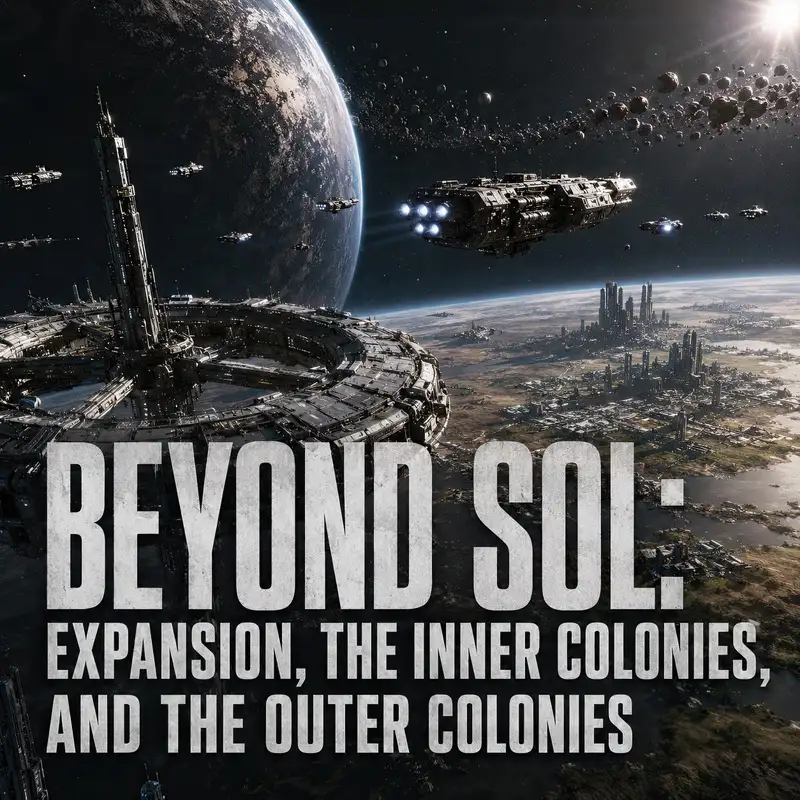
Beyond Sol: Expansion, the Inner Colonies, and the Outer Colonies
The Odyssey left orbit above Luna carrying more than settlers, troops, and terraforming machinery. It also carried a political assumption. A government centered on Earth believed it could establish communities across interstellar distances and continue to govern them as parts of one human order. When the ship reached Epsilon Eridani in twenty-three sixty-two and began the settlement that became Reach, the engineering problem was formidable. The political problem was merely postponed. Humanity had learned how to leave the Solar System. It had not yet learned how to make distance harmless.
Expansion beyond Sol is often remembered as a technological triumph, and it was. The deeper question is why that triumph divided human space into the Inner Colonies and the Outer Colonies, then placed increasing strain on the government that had created both. The answer lies in the interaction of population, transportation, economics, administration, military power, and identity. Humanity did not simply spread across a map. It built a core and a frontier, connected them through trade, and then discovered that economic dependence did not guarantee political loyalty.
The pressure to expand had accumulated for generations. Humanity had already established settlements on Luna, Mars, the Jovian moons, asteroids, and orbital habitats. Those achievements created new industries and living space, but they did not fully solve overcrowding, ecological stress, famine, or political unrest. The conflicts that culminated in the Interplanetary War from twenty-one sixty-four through twenty-one seventy had demonstrated that colonies did not automatically remain obedient extensions of Earth. The Unified Earth Government emerged from that era promising order, while the United Nations Space Command retained the military institutions created to impose it. Long before alien contact, human expansion was already tied to security.
The decisive breakthrough came in twenty-two ninety-one with the Shaw-Fujikawa Translight Engine. By allowing ships to enter slipspace, the drive made interstellar settlement practical. Practical did not mean easy. Human slipspace travel remained expensive, variable, and imperfect. Ships did not cross the stars as though moving between neighboring ports. Transit took time. Arrivals could not be coordinated with absolute precision. Messages and decisions moved through an interstellar network shaped by ships, navigation data, communications infrastructure, and delay. The drive reduced the tyranny of distance. It did not repeal it.
The Unified Earth Government understood that colony ships alone would not create a functioning interstellar state. In twenty-three ten, it established the Colonial Administration Authority and the Colonial Military Authority. The first was intended to plan, administer, and represent the colonies. The second was intended to defend them from piracy, raiding, disorder, and other dangers that followed commerce into deep space. Their creation decades before the great exodus reveals how seriously Earth approached the project. Expansion was not a collection of private voyages. It was a state-directed effort supported by law, bureaucracy, military planning, and enormous capital investment.
On January first, twenty-three sixty-two, the Odyssey departed Luna as the capstone of decades of preparation. It carried troops and terraforming equipment to Epsilon Eridani, where it settled Reach. The vessel was later deconstructed on the surface. That detail captures the material reality of colonization. A colony ship was not merely transportation. It could be a warehouse, power source, construction reserve, communications hub, and temporary government center. Once committed, much of its value remained with the new settlement. The voyage could not be treated like a naval patrol that simply returned to port after completing its orders.
Later Phoenix-class colony ships refined this approach. They carried colonists, prefabricated starter units, hydroponic systems, terraforming machinery, and the infrastructure needed to establish a self-supporting community. On Harvest, the colony ship Skidbladnir was dismantled, and its fusion reactor helped power the settlement of Utgard. The ship’s systems and artificial intelligences became part of the colony’s daily operation. Expansion therefore depended on a chain of industrial choices made long before departure. Every settlement required hulls, drives, trained crews, engineers, medical staff, agricultural specialists, security personnel, replacement parts, and enough equipment to survive mistakes that Earth might not learn about for months.
Terraforming did not make every destination into a second Earth, and it did not do so quickly. Early planners preferred worlds that were already habitable or could be made useful without generations of environmental engineering. Other settlements survived inside controlled habitats while machines altered soil, atmosphere, water, or local agriculture. A colony could exist on an official chart while remaining one failed reactor, contaminated crop, or missed supply ship away from disaster. That vulnerability shaped the relationship with the core. Assistance from Earth or an Inner Colony could be lifesaving. Dependence on that assistance also gave distant institutions leverage over local decisions.
The first major wave of settlement produced what became known as the Inner Colonies. Between twenty-three sixty-two and twenty-three ninety, two hundred and ten human-occupied worlds entered various stages of settlement and terraforming. The word worlds covered more than Earthlike planets. It included moons, asteroids, habitats, industrial sites, and other permanent footholds. Because faster-than-light travel was still costly and new, prospective colonists faced demanding physical and psychological screening. The first-wave settlers were selected as people capable of surviving isolation, uncertainty, and severe technical demands. Over time, that selection process encouraged the belief that the Inner Colonies represented humanity’s elite.
The Inner Colonies benefited from timing as much as talent. They received early investment, favorable routes, established infrastructure, and decades in which to accumulate wealth. Habitable or readily terraformable worlds attracted cities, corporations, shipyards, refineries, universities, communications nodes, and military installations. Trade routes grew denser around them. Each successful settlement lowered the cost of supporting the next. By twenty-three ninety, the population burden across human space had largely stabilized, and the first colonies were becoming centers of production rather than fragile outposts waiting for rescue.
Reach became the clearest expression of that transformation. It began as an extrasolar settlement and developed into the principal military center of human space, with major shipyards, training facilities, industrial capacity, and strategic infrastructure. Reach was not important merely because it was close to Earth by the standards of human slipspace travel. It was important because decades of investment made it difficult to replace. Warships could be constructed and supported there. Personnel could be trained there. Commands could coordinate from there. The colony became part of the machinery through which the Unified Earth Government protected every other colony, even when those colonies did not view that protection as neutral.
Success accelerated expansion. As travel, terraforming, and settlement methods improved, the requirements imposed on later colonists became less restrictive. New communities could be planted farther from the established core and for a wider range of purposes. By twenty-four ninety, human-controlled space encompassed more than eight hundred worlds and outposts across the Orion Arm. That figure did not mean eight hundred replicas of Earth. It included strong industrial planets, modest agricultural settlements, mining stations, research sites, relay facilities, moons, and small communities whose continued survival might depend on a single transport schedule.
These later and more distant settlements became the Outer Colonies. The label is useful, but it can mislead. Human space did not form two perfect rings around Earth. The distinction combined settlement history, travel time, infrastructure, wealth, and political position. An Outer Colony was generally farther from Earth in practical terms and more weakly integrated into the institutions of the core. Some were remote because of geography. Others were remote because routes were poor, traffic was limited, or the government’s presence rarely extended beyond a small administrative office and an occasional patrol ship.
The Outer Colonies were never one type of society. Harvest was an agricultural world whose food production supported populations far beyond its own settlements. Other colonies existed around mines, refineries, manufacturing sites, scientific projects, or strategic waypoints. Some were founded by communities with strong cultural or religious identities. Some mixed people from many parts of Earth and the Inner Colonies. Some were effectively governed by corporations. Others developed powerful local governments, labor movements, militias, or separatist organizations. To officials studying supply tables, they could appear as categories of output. To the people living there, they were homes with histories, obligations, and political interests of their own.
The economic relationship between the two regions was reciprocal, but it was not equal. The Inner Colonies supplied manufactured goods, advanced technology, military equipment, investment, and administrative services. The Outer Colonies supplied food, fuel, minerals, and other raw materials on which the core increasingly depended. This division could be efficient. It could also become dangerous. The worlds controlling finance, shipbuilding, government, and military command held greater influence over the terms of exchange than the settlements providing bulk resources. Inner colonists could view the frontier as a collection of resource sites. Outer colonists could view the same system as extraction without proportional authority.
Interstellar shipping became the circulatory system of this arrangement. Freighters moved food and ore inward, then returned with machinery, electronics, medicines, and manufactured goods. Passenger ships carried specialists, officials, soldiers, workers, and families. Relay stations and ports turned certain systems into unavoidable junctions. A world could possess valuable resources and still remain poor if it lacked reliable transport, refining capacity, or bargaining power. Naval planners saw these routes as lines of communication to be protected. Colonists experienced them more personally. A delayed convoy could raise prices, halt construction, postpone medical treatment, or leave a militia without spare parts.
Distance intensified every disagreement. A policy drafted on Earth might be reasonable in a central office and unworkable at a remote settlement. A colonial administrator could request guidance and receive an answer after the situation had changed. A patrol responding to piracy, sabotage, or civil unrest might arrive with obsolete intelligence. A governor facing crop failure or industrial disruption could not assume that replacement equipment would appear on schedule. Slipspace allowed the government to reach the colonies, but it often reached them late. In interstellar administration, delay is not merely inconvenient. It transfers power to whoever is present when the decision must be made.
The Colonial Administration Authority was designed to bridge that distance. It managed population, employment, infrastructure, law, and the relationship between local governments and the Unified Earth Government. Its charter recognized that colonies retained a degree of sovereignty. Formally, human space was not supposed to be a collection of occupied territories. Yet formal sovereignty competed with the practical authority of bureaucrats, corporations, military commands, and transport networks. A colony might elect local leaders while depending on distant officials for shipping access, investment, security, and legal recognition. Independence on paper could feel limited when every vital connection passed through institutions controlled elsewhere.
Defense produced the same contradiction. The Colonial Military Authority was created to protect colonial space, while the United Nations Space Command remained the larger military instrument of the central government. Over time, the colonial military became concentrated in the Outer Colonies and recruited heavily from their populations. Its personnel often identified with the frontier they served. The United Nations Space Command, meanwhile, expanded its influence over strategically important systems and gradually encroached on the colonial military’s responsibilities. From Earth, this could look like necessary standardization. From the frontier, it could look like the core replacing a locally rooted force with one more directly controlled from above.
Neither organization could provide uniform protection across hundreds of systems. Inner Colonies received denser military coverage because they contained major populations, shipyards, command facilities, and industries the government considered indispensable. Many Outer Colonies relied on smaller colonial units, local militias, private security, or their own ability to endure until help arrived. This was not simply favoritism. Concentrating forces around critical infrastructure is a defensible military choice. It was also a political message. The government’s map identified some worlds as assets that had to be held and others as spaces where risk could be accepted.
By the late twenty-fifth century, entire generations had been born beyond Sol. For them, Earth was the ancestral center of human civilization, but not necessarily home. Their loyalties were shaped by local schools, settlement stories, industries, climates, family networks, and memories of who had arrived during a crisis. A colonist on a distant agricultural world could spend a lifetime supporting the core without ever seeing it. That experience did not automatically produce separatism. Many colonists valued interstellar trade, common law, military protection, and membership in a larger human community. It did make obedience harder to justify when the benefits seemed distant and the demands immediate.
Corporate government complicated the picture further. A company that financed settlement could provide transport, equipment, employment, and technical expertise that no small community could obtain alone. It could also dominate housing, wages, policing, and access to essential services. When a corporation effectively became the government, disputes over labor or resources became political conflicts. The Unified Earth Government might intervene to preserve order or commerce, while local residents saw an outside authority protecting the arrangement that caused the grievance. Not every corporate colony failed, and not every protest became rebellion. The structure simply created several ways for an economic dispute to become a question of sovereignty.
The central government faced a real strategic dilemma. Earth and the Inner Colonies depended on Outer Colony resources. Allowing major suppliers, routes, or relay networks to secede could weaken the entire human economy and fragment common defense. Yet efforts to preserve unity through regulation, military presence, and administrative control often intensified the belief that the colonies were valued for what they produced rather than for the people who lived there. The more dependent the core became on the frontier, the more forcefully it tried to secure the relationship. The more forcefully it acted, the less legitimate that relationship appeared to many colonists.
This tension eventually produced peaceful independence movements, political resistance, sabotage, terrorism, counterterrorism, and open insurgency. The Insurrection was not inevitable, and it was never a single unified cause. Some colonists wanted reform within the Unified Earth Government. Some wanted complete independence. Some armed groups targeted military and government facilities. Others killed civilians. Government forces answered with policing, intelligence operations, military deployments, and, in some cases, catastrophic violence. By twenty-four ninety-one, the Carver Findings warned that colonial instability could collapse the government and produce a destructive civil war. Senior commanders increasingly treated a political crisis as a military problem, which made military solutions easier to authorize and political compromise harder to sustain.
The expansion system also shaped human military power in ways that would later prove essential. The colonies provided recruits, food, fuel, metals, shipyards, training areas, and strategic depth. A fleet based only in Sol could not have defended an interstellar civilization. Reach and other Inner Colonies became naval and industrial anchors. Outer Colonies extended surveillance, commerce, and access across the Orion Arm. Yet the same breadth dispersed ships and forced commanders to choose which routes, worlds, and convoys deserved protection. Strategic depth is useful only if the defender has the mobility, intelligence, and force structure to exploit it. Otherwise, depth becomes a sequence of isolated positions.
When the Covenant attacked Harvest in twenty-five twenty-five, it struck an Outer Colony at the edge of the system Earth had built. The early disaster exposed every weakness produced by distance. Communications were incomplete. The first investigating vessels operated with little understanding of the threat. Reinforcements had to cross interstellar space. The enemy could destroy one colony before the wider government understood that a war had begun. During the years that followed, the Outer Colonies absorbed much of the initial Covenant advance. Their loss bought time for the core, but time was purchased with communities that had already spent generations questioning whether the core valued them equally.
The distinction between Inner and Outer Colonies then became a wartime allocation problem. Ships were concentrated around industrial centers and major strongholds. Some frontier systems received assistance. Others could not be reinforced before the Covenant arrived. The logic was militarily understandable and politically devastating. A government facing extinction must protect the capacity to continue fighting. A colony facing annihilation experiences that decision as abandonment. The Human-Covenant War did not erase the older colonial argument. It placed it under orbital bombardment, then left the survivors to remember which worlds had been defended, which had been evacuated, and which had been written off.
Human expansion beyond Sol succeeded beyond the ambitions of its planners. It relieved population pressure, created new societies, generated immense wealth, built the industrial base of an interstellar military, and transformed humanity from a Solar civilization into a power spread across the Orion Arm. It also created a hierarchy between an established core and a resource-producing frontier, then attempted to govern both through institutions whose authority weakened with every additional light-year of practical distance.
That is why the Inner and Outer Colonies mattered before the Covenant ever appeared. They were not merely regions on a strategic map. They were the political geography of human power. Reach showed what sustained investment could build. Harvest showed how completely a colony could become part of the wider economy. The colonial authorities showed that administration and representation were not the same as consent. The military showed that protection could preserve unity while also undermining it.
The most revealing image is not a fleet or a capital city. It is a colony ship dismantled on a distant world, its reactor powering homes that Earth would later classify as part of the frontier. The people living beside that reactor were no longer temporary settlers. They were citizens of a place created by human expansion, dependent on the wider civilization but entitled to judge it. Humanity crossed beyond Sol by learning to move ships through slipspace. It became divided when its institutions continued to treat distance as an engineering problem after distance had become a political identity.