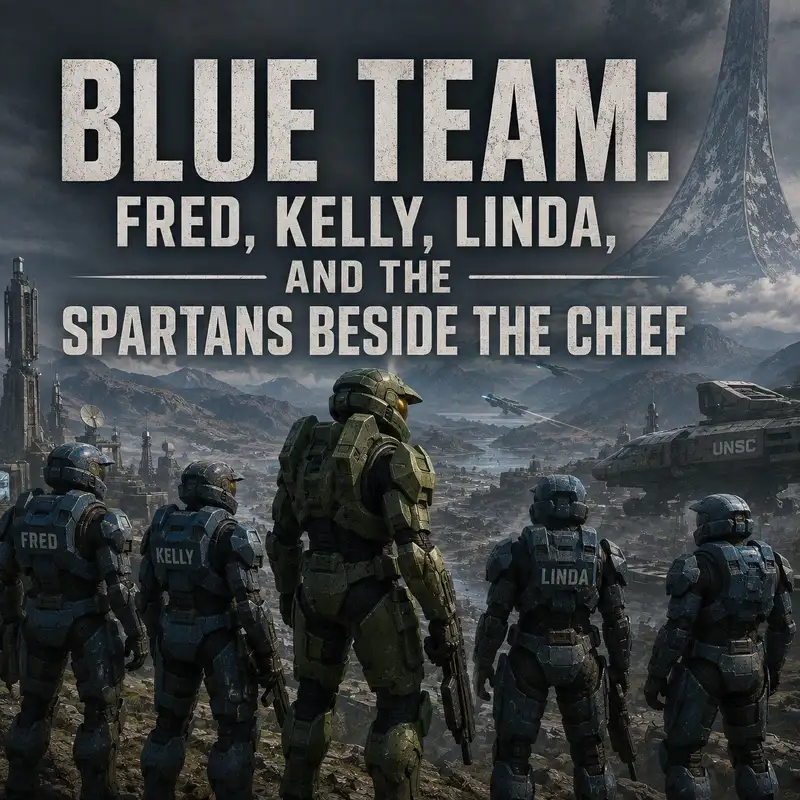
Blue Team: Fred, Kelly, Linda, and the Spartans Beside the Chief
The order from the United Nations Space Command Infinity was direct. Blue Team was to return from the research station Argent Moon and leave the search for Cortana to another unit. John One One Seven refused. Fred One Zero Four, Kelly Zero Eight Seven, and Linda Zero Five Eight had only moments to decide whether they were still following a lawful mission or following the man who had led them since childhood. They chose John. That decision carried them to Meridian, Genesis, and imprisonment by Cortana. It also revealed both the greatest strength and the most dangerous weakness of Blue Team: its members trusted one another more deeply than most military institutions could comfortably regulate.
Blue Team is often described as the Master Chief and the Spartans beside him. That description is understandable, but operationally backward. John became the Master Chief the galaxy recognized because he rarely fought as an isolated super-soldier. He learned to lead within a team whose other members could command, scout, strike, observe, and survive without constant direction. Fred provided continuity of command. Kelly gave the team speed and initiative. Linda extended its reach through reconnaissance and precision fire. They did not merely make John look more capable. They made him more capable, while preserving a unit that could continue when he was missing, wounded, or assigned elsewhere.
The first complication is that Blue Team was never a permanently fixed four-person formation. Spartan Two team colors were mission arrangements as much as permanent identities. Personnel shifted according to objectives, availability, injury, and command requirements. The earliest Blue Team formed during training around John, Kelly, and Samuel Zero Three Four. Fred and Linda became recurring members, while Fhajad, Kurt, James, William, Grace, Arthur, and Solomon served at different times. Spartan Threes were later incorporated temporarily. The familiar roster of John, Fred, Kelly, and Linda became the best-known version, not the only legitimate one.
That flexibility began with training on Reach. The children selected for the Spartan Two program were taught that individual excellence had value only when converted into team success. John’s early instinct was to finish first. Chief Petty Officer Franklin Mendez taught him that crossing a line alone could still mean failure. Kelly and Samuel became his first close teammates, and the lesson hardened into a habit. Blue Team learned to divide problems without dividing purpose. One Spartan could move ahead, another could cover, and another could improvise an exit, but the mission was judged by whether the team and objective reached the end together. The program called this cohesion. For the children involved, it also became family.
Their first operational mission, Operation Talon in twenty-five twenty-five, placed that family inside the political violence the program had been created to suppress. Blue Team infiltrated the rebel habitat of Eridanus Secundus and captured former United Nations Space Command colonel Robert Watts. The mission demonstrated stealth, disciplined violence, and extraction under pressure. It also established a lasting pattern. The unit could solve a difficult tactical problem with remarkable efficiency, while the political causes surrounding it remained beyond their authority. Capturing one insurgent leader did not settle colonial grievances. It proved that the Office of Naval Intelligence possessed a team capable of reaching people who believed they were unreachable.
The Covenant arrived before the Spartans had time to become adults. At Chi Ceti Four, John, Kelly, and Samuel boarded the alien vessel Unrelenting using newly issued Mjolnir armor. They destroyed the ship, but damage to Samuel’s armor prevented his escape. He remained aboard to ensure the demolition succeeded. The victory gave humanity critical evidence that the Covenant could be hurt. For Blue Team, it established a more intimate truth. Superior training and armor did not guarantee extraction. The team could complete its objective and still leave one of its own behind. Samuel’s loss became part of the unit’s private culture long before the wider public knew Spartans existed.
Fred’s role developed from that culture of loss and responsibility. He was not simply John’s replacement when John was absent. Fred was a highly capable generalist, close-quarters fighter, planner, and natural commander who could read a deteriorating situation without ideal information. He was less interested in attention than John’s growing public legend, which made him useful in an organization where the best deputy is often the person least tempted to turn deputy status into competition. Fred could take command of Spartans, conventional personnel, or mixed units and make the arrangement function. Blue Team’s continuity depended heavily on that ability.
Kelly’s speed is usually treated as her defining physical trait, but speed by itself is only a measurement. Its military value lies in what it permits. Kelly could reconnoiter farther, shift between threatened sectors, close with an enemy before a defense settled, and reach a wounded teammate quickly. She combined that mobility with rapid reflexes and close-quarters skill. Blue Team used her as a scout and maneuver element, not as a ceremonial sprinter in expensive armor. Her fierce loyalty made her willing to move first. It also meant that once the team committed to a course, she was unlikely to abandon it.
Linda’s reputation as a sniper is accurate but incomplete. A sniper’s most important product is not always a casualty. It is information, control, and time. Linda could identify movement before the team was exposed, deny an enemy a route, remove a commander or weapons operator at the decisive moment, and provide overwatch while others crossed open ground. She was comfortable operating at distance or temporarily alone, giving Blue Team a wider tactical footprint than four people should have possessed. Her calm balanced a unit built around violent movement. Fred could organize the fight, Kelly could accelerate it, and Linda could see what the others could not.
John’s leadership connected those specialties. He did not need Fred, Kelly, and Linda to become lesser versions of himself. He needed them to remain distinct. Their shared training allowed short instructions, gestures, and movement to carry meaning that a newly assembled unit would need time to explain. Mjolnir sensors and communications helped, but technology did not create that understanding. Decades of exercises, losses, and repeated missions created a common mental model. Each Spartan anticipated what the others were likely to do and positioned accordingly. To an observer, the result could look like instinct. It was really accumulated experience operating faster than formal conversation.
Early Covenant operations forced Blue Team to apply that trust within larger joint formations. During Operation Silent Storm and the fighting that followed, the Spartans worked alongside prowler crews, Orbital Drop Shock Troopers, Marines, intelligence officers, and commanders who did not always understand what the classified teenagers could do. Blue Team could infiltrate ships and destroy critical targets, but it still needed transport, navigation, fire support, intelligence, and extraction. Its effectiveness increased when conventional units understood how to employ it and decreased when secrecy prevented coordination. The Office of Naval Intelligence had created an extraordinary capability and classified it so thoroughly that supporting personnel sometimes discovered its limitations during combat.
The war repeatedly demonstrated the difference between a Spartan victory and a strategic victory. On Jericho Seven, Blue Team and other Spartan formations accomplished their ground missions against Covenant forces. Human naval forces still lost control of the space around the planet, and the Spartans had to evacuate before glassing began. Blue Team could destroy local positions and manipulate enemy movement. It could not replace a fleet, repair surviving ships, or keep Covenant capital vessels from reaching firing positions. The pattern repeated throughout the war. The team often won the engagement directly in front of it while humanity lost the colony, system, or ships needed to defend the next objective.
The fall of Reach in twenty-five fifty-two shattered the familiar shape of the unit. John took a small Blue Team consisting of Linda and James Zero Zero Five to Gamma Station, where navigation data aboard the United Nations Space Command Circumference had to be destroyed under the Cole Protocol. Fred led the remaining twenty-two Spartans toward the planet’s surface to protect the generators supporting Reach’s orbital defense platforms. Kelly served with Fred in Alpha-Red. Strategic necessity separated the people most accustomed to fighting together and gave Fred responsibility for the largest concentration of Spartan Twos ever committed to one collapsing battlefield.
At Gamma Station, James was blown into space after his maneuvering system was damaged, and Linda was struck by plasma fire during the extraction. She returned to the Pillar of Autumn clinically dead and was placed in cryogenic suspension. On the surface, Fred and Kelly fought through a catastrophe that killed or scattered many of their classmates. They helped preserve the orbital defenses for as long as possible, protected Catherine Halsey, and searched for a way off a world already being consumed from above. Reach showed that Blue Team was not protected by narrative importance. Its members survived through armor, skill, support, and chance, while other Spartans with comparable training did not.
The survivors reunited during Operation First Strike, but Blue Team did not simply return to the iconic four-person roster. John led Fred, Linda, William, and Grace against the Covenant command-and-control station Unyielding Hierophant. Kelly had been removed by Halsey and taken toward Onyx. Grace died during the sabotage mission. Other personnel sacrificed themselves to turn the station’s destruction into a larger blow against the Covenant force gathering for Earth. Blue Team completed an operation of enormous value, but it did so as part of an improvised force built from Spartans, naval survivors, captured technology, and people who knew they were unlikely to return.
Onyx proved that Fred, Kelly, and Linda did not require John to remain Blue Team. They responded to the crisis there, reunited with Kurt Zero Five One, and fought alongside Spartan Threes whose recruitment, training, and operational history differed sharply from their own. William was killed during the battle. Before sacrificing himself to allow the others to reach safety, Kurt gave Fred a field commission as a lieutenant, junior grade, and placed Blue Team under his command. Inside the shield world, Fred and Kelly accepted surviving Spartan Threes into the team. The decision treated Spartan identity as a matter of demonstrated trust and service, not exclusive ownership by one generation.
When the survivors returned to normal space in twenty-five fifty-three, John was believed dead and the Covenant War was over. Fred commanded Blue Team through a different operating environment. On Gao, the unit became entangled in the hunt for a Forerunner ancilla, local murders, an independent government suspicious of United Nations Space Command motives, insurgent sympathizers, and the Keepers of the One Freedom. This was not a raid against a clearly marked enemy. It required intelligence assessment, restraint, negotiation, and extraction from a political situation becoming more hostile by the hour. Fred’s command record matters because he led through ambiguity, not merely through fire.
The Spartan Threes were eventually reassigned, leaving Fred, Kelly, and Linda as Blue Team’s enduring core while John remained absent. They conducted classified postwar operations against Covenant remnants and other threats on the edges of human space. Those missions rarely entered public memory because they lacked the clean symbolism attached to the Master Chief. They also prove Blue Team was an institution rather than one man’s entourage. Fred maintained command. Kelly and Linda continued their specialized roles. The team absorbed new intelligence, enemies, and political restrictions while the United Nations Space Command tried to rebuild a military whose industrial base had been badly damaged.
John returned in twenty-five fifty-seven and eventually rejoined them. The command relationship that followed was unusual. Fred held an officer’s commission and had commanded the team for years, yet often deferred tactical leadership to John, whose authority inside Blue Team remained unmatched. This was not a tidy arrangement for a personnel manual. It worked because both men understood the difference between formal rank, mission command, and earned trust. Fred did not defend his status by obstructing John. John did not diminish Fred to remain the team’s central leader. Their flexibility prevented hierarchy from becoming friction, though it relied on personalities that regulation could not manufacture.
The mission to Argent Moon exposed the cost of that flexibility. After Blue Team destroyed the compromised research station, Infinity ordered the Spartans home. John instead pursued Cortana’s signal. Fred, Kelly, and Linda followed even though their evidence was incomplete and their orders were clear. Their loyalty was understandable and operationally dangerous. A military depends on teams whose members will not abandon one another under fire. It also depends on those teams remaining answerable to lawful command. Blue Team’s cohesion had become so strong that the unit could move beyond institutional control as one body. The trust that reduced hesitation in combat also reduced hesitation before disobedience.
On Meridian and Genesis, the team discovered that Cortana intended to impose peace through the Guardians and the Created. Blue Team rejected her plan, but it could not prevent the uprising. Cortana imprisoned the Spartans, and Fireteam Osiris had to free them. The outcome matters because it strips away the comforting idea that experience always produces correct judgment. John’s personal connection to Cortana shaped the decision to go absent without leave. Fred, Kelly, and Linda followed because their connection to John was stronger than their connection to the remote chain of command. Their loyalty preserved the team. It also carried all four members into a trap.
Blue Team’s return to Reach in October twenty-five fifty-nine showed the unit at its most mature. Wearing Generation Three Mjolnir armor, John, Fred, Kelly, and Linda infiltrated their ruined training world to recover assets hidden in Halsey’s old Castle Base laboratory. The mission supported the plan to create the artificial intelligence later known as the Weapon. It required covert insertion, cooperation with local militia, movement through terrain reshaped by glassing, and combat against Banished occupation forces. Fred also received critical intelligence from Veta Lopis concerning the Keepers of the One Freedom and Atriox. Blue Team was retrieving strategic capability and carrying intelligence between compartmentalized operations.
The mission succeeded, but success came with an uncomfortable qualification. Blue Team recovered the cryogenic containers needed for Halsey’s plan, helping make the later operation against Cortana possible. The Banished followed the disturbance to the Forerunner complex beneath Reach and opened a portal that allowed Atriox to return from the Ark. One side’s special operation enabled a future advantage. The same operation helped the enemy achieve one of its own strategic goals. This was not proof that Blue Team had failed. It was proof that even the best special operations unit acts inside a contested system where the enemy observes, adapts, and exploits the path opened by someone else.
Shortly before Infinity moved against Cortana at Zeta Halo, command separated John from the rest of Blue Team and assigned Fred, Kelly, and Linda another classified mission. The decision removed John’s established support structure during one of the most sensitive operations of his career. Infinity was then ambushed by the Banished. The exact fate and location of Fred, Kelly, and Linda remain unconfirmed. In June twenty-five sixty, John believed they might still be somewhere on the fractured ring, but belief is not an after-action report. Their absence is part of Blue Team’s current history, not a resolved casualty record.
As an operational unit, Blue Team’s strength came from complementary competence. Fred made command survivable when John was absent and gave John a deputy capable of challenging a problem without challenging for attention. Kelly controlled tempo, turning distance and reaction time into tactical weapons. Linda controlled exposure, seeing, fixing, and shaping threats before the assault element reached them. John integrated those functions and accepted responsibility for the whole. None of the four was interchangeable. Their training gave them a common foundation, but specialization made the team more than four armored riflemen approaching the same target from slightly different directions.
Their shared history also imposed costs. Blue Team’s members were abducted as children, trained inside a closed institution, and taught to place mission and team above almost every civilian relationship. That produced cohesion few conventional units could match. It also narrowed the circle of people whose judgment they instinctively trusted. Following John to Meridian was not an isolated lapse disconnected from their upbringing. It was the predictable extreme of a system that made the team their family, workplace, moral reference point, and principal source of identity. The United Nations Space Command benefited from that bond for decades and then discovered it could not always direct where the bond would lead.
Blue Team still depended on a much larger force. Mjolnir armor required maintenance, power, technical support, and replacement components. The Spartans required intelligence, ammunition, transport, medical care, communications, and extraction. Their missions were enabled by ship crews, pilots, artificial intelligences, engineers, Marines, soldiers, and personnel who held positions the Spartans could pass through but not permanently occupy. Blue Team could destroy a command node or recover a classified asset. It could not govern a colony, manufacture a fleet, or protect every supply line. Its record is extraordinary partly because so many other people created the conditions under which four Spartans could reach the decisive point.
Fred, Kelly, and Linda are therefore not supporting characters in the military history of John One One Seven. They are evidence that the Master Chief’s legend rests on a collective method. Fred carried command when John disappeared. Kelly carried momentum when the team risked being fixed in place. Linda carried awareness beyond the limits of the assault element. Each preserved a part of Blue Team that John alone could not provide. The public symbol favors one green armored figure because symbols benefit from simplicity. Real operations do not. They depend on overlapping skills, trusted deputies, disciplined initiative, and someone watching the route that the most visible soldier cannot see.
The best way to understand Blue Team is not as the Master Chief followed by three exceptional Spartans. It is as a military family whose members learned to distribute responsibility before they understood what the program intended to make them. That bond survived Samuel’s death, Reach, John’s absence, the end of the Covenant War, Cortana’s betrayal, and the return to their ruined home. It made them one of the most effective small units in human history. It also made them capable of choosing one another over the institution they served. The Master Chief became a symbol standing alone. John One One Seven became the soldier behind that symbol because Blue Team taught him that no one finishes the mission alone.