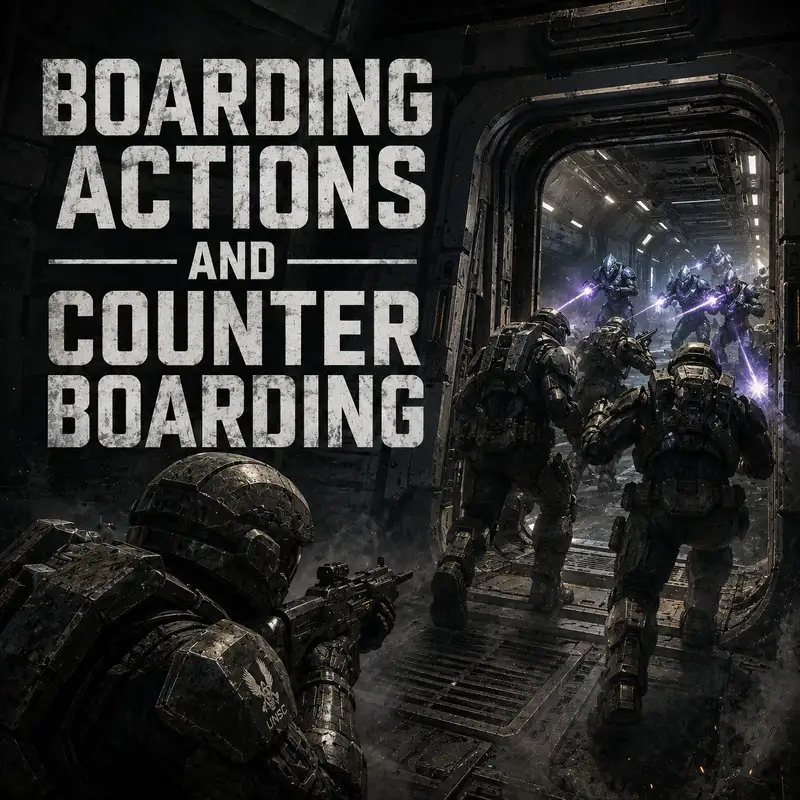
Boarding Actions and Counterboarding
Cairo Station’s tactical display showed a Covenant fleet pressing Earth’s defenses, but the immediate threat was smaller and more dangerous. Boarding craft had attached themselves to the orbital-defense network, and enemy teams were already moving through stations built around weapons capable of destroying capital ships. Athens and Malta vanished after antimatter charges detonated inside them. Cairo had found its own bomb before it exploded, but finding the device did not make the station secure. The enemy was already beyond the armor, beyond the main gun, and inside the command structure.
Boarding actions survive in an age of magnetic accelerator cannons and plasma lances because destruction is not always the mission. A commander may need prisoners, navigation data, technology, an intact reactor, a captured ship, or a weapon disabled before it can fire again. Sometimes the target is too valuable to destroy. Sometimes its exterior defenses are too strong. Sometimes a small team carrying one demolition charge can accomplish what a fleet cannot. Boarding is the attempt to convert access into control, or at least into enough disruption that control no longer matters.
The term covers several different operations. An assault boarding party enters a hostile vessel to seize or disable it. A special-operations team may infiltrate briefly, complete one task, and withdraw without trying to hold anything. A rescue force boards to recover prisoners. A prize crew attempts to operate a captured ship. Counterboarding is the defensive effort to contain, isolate, and destroy intruders before they reach critical systems.
The most difficult part is often reaching the hull. A warship is moving, maneuvering, and surrounded by sensors and point-defense weapons. The boarding craft must match relative velocity, cross the final distance, survive defensive fire, and establish a seal or breach. The target may roll to deny a stable approach or place the attackers inside another weapon’s field of fire.
Different forces solved the access problem in different ways. Covenant teams used specialized boarding craft, insertion pods, dropships, and direct docking against stations or ships. Human forces relied on Pelicans, captured craft, thruster packs, airlocks, hangar approaches, and whatever access the mission offered. Gravity lifts created another route when a Covenant ship was operating above the surface. None of these methods was automatically quiet. Cutting through a hull, forcing an airlock, or placing a transport inside a hangar generally produced the sort of signature defenders had designed alarms to notice.
The breach changes the physical problem. Outside is vacuum and relative motion. Inside is pressure, gravity, fire, electrical damage, narrow passageways, and a crew that knows the terrain. A boarding team must preserve its own atmosphere while preventing the target from venting the compartment. Sealed armor helps, but not every Marine, sailor, or alien soldier is equipped for extended vacuum exposure. A damaged suit can turn a minor wound into a fatal one.
Interior combat is fought at short range, with poor sight lines and very little room for error. Passageways channel movement. Hatches become choke points. Maintenance spaces create routes that may not appear on ordinary deck plans. Hangars and engineering compartments open into larger volumes where defenders can establish overlapping fires. Weapons selected for an open battlefield may be disastrous near a reactor, pressure bulkhead, ammunition magazine, or control conduit.
The boarding team’s objective determines how much damage it can accept. A force trying to destroy the ship may use explosives aggressively and move directly toward propulsion, power, or the reactor. A force trying to capture the vessel must preserve those same systems. A rescue team may need to avoid depressurizing the section containing prisoners. An intelligence team wants navigation archives, communications records, or an artificial-intelligence core intact. The closer the mission comes to capture, the more the attackers must fight carefully inside a machine designed to punish carelessness.
The bridge is an obvious objective, but it is not a magical control point. A ship can have distributed engineering controls, local weapons stations, security lockouts, compartment-level authority, and an artificial intelligence capable of denying commands. The bridge may direct the vessel while engineering still controls power and propulsion. First Lieutenant Melissa McKay later proved the point aboard the Truth and Reconciliation by severing the primary control linkage between the bridge and engineering. The bridge remained occupied. The ship ceased to be a prize.
Other objectives may matter more. Engineering can deny propulsion or overload power systems. A hangar provides access for reinforcements and evacuation. Communications spaces can isolate the vessel from its fleet. Shield controls can expose the ship to friendly fire. Navigation databases can reveal colonies, routes, and staging areas. Weapon-control rooms can silence a gun without destroying the hull.
Information is therefore decisive. Human boarders entering a Covenant vessel confronted unfamiliar architecture, alien interfaces, curved passageways, gravity lifts, and signage that did not help them. Covenant forces entering human ships faced more recognizable compartment logic but still needed to identify the right routes and systems. Ship schematics, captured records, sensor scans, and artificial-intelligence support could shorten the search. Without them, the team might win several firefights and still move farther from the objective.
The defender begins with the advantage of the map. Internal sensors can track breaches, pressure loss, motion, weapons discharge, and damaged doors. Security teams know which compartments can be sealed and which routes lead to command spaces. Damage-control personnel understand the ship’s hidden arteries better than most combat troops. A captain can reroute power, lock hatches, shut down lifts, or abandon sections that no longer justify the casualties required to hold them. Counterboarding begins by turning the ship from an invaded workplace into a controlled defensive zone.
That transformation is difficult during a fleet engagement. The same officers managing boarders may also be fighting external fires, launching escape craft, maintaining shields, and responding to reactor damage. Communications can fail just as security teams need a common picture. Smoke, decompression, dead power, and civilian personnel complicate movement. A ship may possess enough Marines to defeat the intruders in isolation, but not enough time to do so before the next plasma strike arrives. Counterboarding is never separate from the larger battle. It is the battle brought inside.
Compartmentalization is the defender’s main tool. Intruders can be trapped behind blast doors, forced into predictable routes, or cut off from their entry craft. Where the design and situation permit, threatened compartments can be depressurized, although that choice risks friendly personnel and equipment. Local defenders can establish successive blocking positions while damage-control teams preserve power and atmosphere elsewhere. The aim is not always to kill every boarder immediately. It is to prevent them from reaching the system that would make every later defense irrelevant.
Shipboard Marines and security personnel carry the visible burden, but sailors and technical crews are part of counterboarding as well. Engineers may keep doors powered, restore sensors, or prevent sabotage. Medical teams establish casualty points in compartments that may become threatened minutes later. Flight crews move aircraft away from compromised hangars. Artificial intelligences can track intruders, guide defenders, and deny access to systems.
The boarding of the Unrelenting near Chi Ceti Four in twenty-five twenty-five gave the Spartan Twos one of humanity’s earliest lessons in boarding alien ships. John, Kelly, and Sam reached the vessel and carried demolition weapons into its interior. They were operating with almost no institutional knowledge of Covenant ship design and no mature doctrine for fighting the enemy at close range. The mission succeeded because the Spartans adapted quickly, found a way to destroy the ship from within, and accepted risks that conventional planners would have considered severe even by wartime standards.
Sam’s armor was breached during the fighting, leaving him unable to survive the return through vacuum. He remained aboard and ensured the explosives destroyed the Unrelenting. Humanity gained proof that a Covenant warship could be boarded and killed. Blue Team lost one of its original members. The operation established the enduring arithmetic of boarding actions. The target may be worth a ship, a fleet, or a world. The people inside still pay at corridor distance.
Operation Red Flag expanded that idea into strategy. The plan called for Spartans and supporting forces aboard the Pillar of Autumn to board a Covenant flagship, seize navigation data, use the captured vessel to reach the Covenant’s political center, and abduct a Hierarch. The objective was leverage, not destruction. Humanity could destroy individual enemy ships and remain on the path toward extinction. Capturing a senior Prophet might create a bargaining position or reveal the empire’s vulnerabilities. Reach fell before the operation could begin as intended, which was a concise reminder that elaborate boarding plans remain dependent on the fleet surviving long enough to deliver the boarders.
Operation Upper Cut at Reach used a more limited objective with greater immediate effect. Spartan B Three One Two and Jorge Zero Five Two boarded the Covenant corvette Ardent Prayer, seized it, and used the ship to carry an improvised slipspace-drive weapon toward the supercarrier Long Night of Solace. The corvette was not the ultimate prize. It was access. By controlling a vessel the Covenant expected to approach, the human team bypassed defenses that a direct attack could not defeat.
The operation destroyed the supercarrier, but the improvised trigger failed. Jorge stayed behind and activated the weapon manually. The boarding action achieved an operationally important kill and cost Reach one of its most experienced Spartans, while the arrival of a much larger Covenant force soon overwhelmed the local advantage. Boarding had solved the problem assigned to it. It had not solved the campaign. That difference is easy to lose when the explosion occupies the whole sky.
At Installation Zero Four, the Pillar of Autumn experienced boarding from the defender’s side. The cruiser had escaped Reach, arrived in an unknown system, and immediately faced a superior Covenant fleet. Enemy teams entered while the ship was under external attack and preparing evacuation. Marines and naval personnel fought through compartments as Captain Jacob Keyes tried to preserve Cortana, protect navigation data, and get survivors off the vessel. Counterboarding could not restore the cruiser to a secure combat condition.
The same survivors soon reversed roles. The Master Chief led Marines onto the Covenant cruiser Truth and Reconciliation to recover Captain Keyes. Destroying the ship would have killed the prisoner. The assault therefore moved through a gravity lift, hangars, corridors, detention spaces, and command areas toward a precise human objective. The mission succeeded because the boarding force did not need to capture the whole cruiser. It needed to enter, locate Keyes, and leave with him before the Covenant could concentrate enough defenders.
Later, Orbital Drop Shock Troopers assaulted the damaged Truth and Reconciliation and captured the vessel along with the Prophet of Stewardship. Major Antonio Silva saw a captured Covenant cruiser as transport, intelligence treasure, technological prize, and proof of victory. He also intended to take it to Earth. The ship was infected by the Flood, its security was uncertain, and its return risked violating the Cole Protocol by revealing humanity’s homeworld. McKay destroyed control of the vessel rather than allow the prize to become an extinction route. Successful boarding had created a danger greater than the ship’s original guns.
After Alpha Halo’s destruction, the Master Chief and other survivors captured the Covenant flagship Ascendant Justice. Cortana’s presence made it possible to operate systems that human crews did not fully understand, but the captured ship remained damaged, contested, and difficult to sustain. It provided mobility and firepower during Operation First Strike, then became part of the plan that destroyed the Unyielding Hierophant. The episode showed the difference between seizing a vessel and possessing a repeatable capability. Humanity had captured a ship. It had not captured the industrial system required to maintain a fleet of them.
The Battle for Earth brought the logic back to Cairo Station. Covenant warships could have tried to batter every orbital platform from outside, but the stations’ magnetic accelerator cannons made that expensive. Boarding teams carried antimatter charges past the main armor and placed them where the platform could not survive the detonation. Athens and Malta were destroyed from within. Cairo’s defenders found and removed their bomb, but the loss of neighboring stations opened a gap in the defense grid. A few successful boarding teams accomplished what a much larger frontal attack might have failed to do.
Cairo also demonstrates what effective counterboarding looks like under pressure. The station detected the breach, committed defenders, preserved command functions, located the demolition device, and prevented its detonation. None of those steps required every intruder to be defeated first. The priority was the bomb. Once the charge was removed, the station remained a functioning weapon and command post. Counterboarding succeeded because the defenders understood which enemy action would produce the irreversible result.
The Heart of Midlothian showed a darker outcome. An elite Covenant boarding party killed the ship’s crew, leaving Sergeant Michael Baird as the surviving human capable of acting with the vessel’s artificial intelligence. Recapturing the ship was no longer realistic. Protecting humanity’s navigation data under the Cole Protocol became the mission. Baird’s final action denied the enemy the vessel and its information. Counterboarding sometimes ends with restoration. Sometimes it ends with a deliberate decision that nothing aboard will be captured alive or intact.
Boarding remained useful after the Covenant War because new enemies inherited many of the same vulnerabilities. At the Ark, Jerome Zero Nine Two boarded the Banished carrier Enduring Conviction with the artificial intelligence Isabel. They did not attempt to fight the entire crew or sail the carrier away. Isabel entered the ship’s systems, fired its energy projector against the Ark, and provoked a Sentinel response that destroyed the vessel. The boarding team used the target’s own capability to create a kill that the Spirit of Fire could not have achieved through conventional ship-to-ship fire.
The fall of the United Nations Space Command Infinity at Zeta Halo demonstrated the opposite. The Banished launched a precision ambush against a flagship already worn down by more than a year of flight from the Created. External strikes hit the ship while boarding forces, led in part by Atriox, compromised the hangar bays. That combination attacked the Infinity’s ability to coordinate, launch craft, reinforce compartments, and evacuate in an orderly way. The boarding action was not an afterthought following the naval victory. It was part of the method used to produce it.
The Infinity carried Spartans, Marines, sailors, technicians, contractors, and civilians. Defending every compartment while the ship was being rammed, boarded, and evacuated was impossible. Local counterboarding actions still saved people and delayed Banished teams. They did not restore a coherent ship-wide defense once command, mobility, and hangar access were collapsing together. A flagship can contain exceptional personnel and still be defeated when the attacker creates more critical failures than those personnel can reach.
Boarding parties require a command plan as disciplined as any amphibious assault. The force needs a clear objective, an entry point, supporting fires, communications, casualty procedures, and extraction. Reinforcements must know where the breach is and whether the passage remains usable. The boarding commander must decide what to do if the ship jumps to slipspace, changes course, begins self-destruct, or loses atmosphere.
Equipment must match the environment. Sealed armor, breaching tools, cutting charges, portable sensors, electronic warfare equipment, compact weapons, medical gear, and demolition systems all compete for limited carrying capacity. Ammunition resupply is difficult once the entry craft is cut off. Wounded personnel may have to be moved through ladders, lifts, and narrow hatches. Alien weapons can provide emergency ammunition but introduce unfamiliar controls and maintenance. Boarding rewards versatility, but every extra tool adds mass to personnel already fighting in confined spaces.
The defender faces its own logistical decisions. Weapons and armor must be available near likely breach points, not locked in an armory several sealed compartments away. Security teams need drills with engineering and damage control, because a firefight can create fires, power loss, and pressure failures faster than the enemy does. Escape craft must remain accessible without giving boarders an open path into the hangars. Ship design cannot prevent every breach. It can decide whether one breach becomes a ship-wide collapse.
Artificial intelligence changes the contest without making it automatic. A human smart artificial intelligence can map routes, control doors, monitor life support, and attack hostile systems. Covenant and Banished networks can resist, isolate, or deceive that intrusion. A captured interface may grant access to one subsystem and nothing else. Isabel’s success aboard Enduring Conviction was exceptional because she combined technical access with an operational plan that exploited the Ark’s Sentinels. It was not proof that any artificial intelligence could board any ship through software alone.
Biological threats make counterboarding even more severe. The Flood does not need a bridge team or lawful command authority. It needs hosts, biomass, and time. A vessel cleared of visible combat forms may still contain infection vectors in sealed compartments, ventilation systems, or bodies. The Truth and Reconciliation became a warning that capture and quarantine cannot be separated. A prize crew that boards an infected ship may become the means by which the infection reaches another fleet or world. In that case, the final defensive measure may be destruction rather than recapture.
Boarding actions succeed when they exploit the fact that a ship is not a solid weapon. It is a network of compartments, crews, computers, reactors, magazines, hangars, and command relationships protected by an exterior hull. A boarding force tries to bypass that hull and attack one decisive link. Counterboarding tries to keep the link functioning long enough to isolate the breach, complete the mission, or deny the enemy its prize. Both are contests of information and time fought at distances where strategic consequences fit through a single hatch.
Athens and Malta were not defeated because their guns were weak. The Unrelenting was not destroyed because three Spartans could outfight an entire fleet. The Infinity did not fall because every defender failed. In each case, the boarding force reached the part of the target where a small number of people could create an effect far larger than themselves. That is why boarding remains rational in Halo’s naval wars. The largest ship in the formation may still depend on one door staying closed, one bomb being found, and one exhausted security team arriving before the corridor beyond it becomes the battlefield that decides everything.