Canon, the Silver Timeline, and the Best Way Into Halo
Combat Evolved reached players, a novel had already explained where the Master Chief came from, why Reach mattered, and how the Pillar of Autumn arrived at the edge of an impossible ring. Halo: The Fall of Reach was published before the first game. That production decision established something important from the beginning. Halo was never designed as a story contained only inside playable missions. Its wars would be recorded through games, novels, comics, audio dramas, intelligence reports, reference works, animation, and live action, with each medium showing parts of the conflict the others could not.
That breadth creates opportunity and confusion in equal measure. A newcomer can encounter two versions of Reach, several portrayals of the Master Chief, armor that belongs to alternate universes, television characters whose histories contradict the games, and multiplayer events that may be canonical, partly canonical, simulated, or simply cosmetic. The useful question is not whether everything carrying the Halo name belongs to one perfectly flat record. It does not. The useful question is which continuity a story belongs to, what kind of evidence it provides, and where a new listener can enter without turning recreation into archival work.
Halo’s principal continuity is usually called core canon. It includes the main games, canonical novels, comics, short fiction, audio dramas, official intelligence material, reference books, Halo Waypoint stories, and selected live-action and animated productions. The word selected matters. Publication under the brand does not automatically give every advertisement, armor coating, deleted scene, crossover item, or production concept the same historical status. Core canon is a connected fictional history assembled across media, not a warehouse in which every object with a logo is placed on the same shelf.
The games remain the most visible part of that history because they place the audience inside decisive events. Halo: Combat Evolved lets the player discover Installation Zero Four through John One One Seven’s limited battlefield perspective. Halo Two and Halo Three widen the war through human and Sangheili viewpoints. Later campaigns move into Forerunner, Created, and Banished conflicts. The games establish major actions through cinematics, dialogue, environments, terminals, intelligence entries, and playable objectives. They do not show every unit, civilian, support organization, or command decision present in the historical event.
The novels were not an expansion added after the setting became successful. They were part of Halo’s foundation. The Fall of Reach gave the Spartan Two program, the United Nations Space Command, Catherine Halsey, Reach, and the wider Covenant War a depth the first game did not have room to explain. Halo: The Flood later retold the Installation Zero Four campaign while adding Covenant, Marine, Orbital Drop Shock Trooper, and survivor perspectives beyond the Master Chief’s route. First Strike connected the destruction of the ring to the defense of Earth. The books did not merely decorate the games. They supplied operations, institutions, and consequences the playable viewpoint could not see.
This means Halo does not operate under a simple rule that the newest game automatically erases every older novel. Apparent conflicts require examination. The best-known example is the fall of Reach. Eric Nylund’s novel and the later Halo: Reach game emphasize different groups, locations, and portions of the same planetary catastrophe. Their dates and sequences created real continuity pressure. Revised texts, official data drops, reference material, and later stories supplied corrections and connective tissue. The result is not perfectly effortless, but both works remain part of the core record rather than one being discarded because the other arrived with a larger marketing campaign.
Revised editions matter for the same reason. Early books were written before later creators had defined every date, rank, technology, and campaign detail. New editions corrected factual errors and adjusted references that no longer aligned with the established chronology. A reader comparing an original printing with an updated omnibus may therefore find differences that are editorial repairs rather than evidence of two separate timelines. Canon research occasionally depends on checking the edition, which is less glamorous than boarding a Covenant ship but considerably safer.
Source perspective matters as much as publication date. A novel may place the audience inside a character’s thoughts. A game may show what one combatant physically encounters. An Office of Naval Intelligence file may contain classified facts, deliberate omissions, or institutional bias. A Covenant record may interpret technology through religious doctrine. A Forerunner testimony may reflect political rivalry or damaged memory. A reference book can summarize the best current official synthesis while still describing mysteries the setting has not resolved. Canon is not only a list of events. It is also a record of who knew what and when they knew it.
No single medium possesses permanent automatic superiority over all others. A cinematic may establish the visible result of a battle, while a novel explains the orders, supporting units, and casualties outside the camera’s view. A later reference entry may reconcile both. Newer material can correct an old factual error without invalidating the entire older story. The proper approach is evidentiary rather than tribal: determine what each source actually establishes, where its perspective is limited, and whether an official revision has changed the record. Canon is less a ladder than a joint staff whose departments occasionally submit incompatible maps.
Gameplay introduces another layer of interpretation. The player can survive damage, carry selected weapons, find ammunition at useful intervals, restart after death, and cross compressed terrain within the length of a mission. Those systems create a playable experience. They do not establish exact casualty numbers, weapon abundance, travel time, or the number of enemies one soldier canonically killed. Cooperative duplicates, difficulty settings, respawning equipment, multiplayer damage values, invisible boundaries, and map scale are not military records.
That does not make gameplay irrelevant to canon. Objectives, dialogue, cinematics, environmental storytelling, named locations, and officially framed outcomes can establish history. The abstraction lies in how the audience performs the action, not necessarily in whether the action occurred. John reached the control room. Noble Team defended Reach. The Arbiter stopped Delta Halo from firing. The exact route, weapon sequence, and number of troops encountered may be shaped by the needs of the game. A historian of the setting separates the event from the interface used to experience it.
Visual design requires similar restraint. Anniversary graphics, new armor models, redesigned weapons, and changing art direction do not always represent an in-universe replacement. Sometimes a later production is showing the same object with greater detail or a different artistic interpretation. Other times the story does introduce a new mark, variant, manufacturer, or field modification. The distinction must be established through the fiction rather than assumed from appearance alone. A higher-resolution rifle is not automatically a new procurement program.
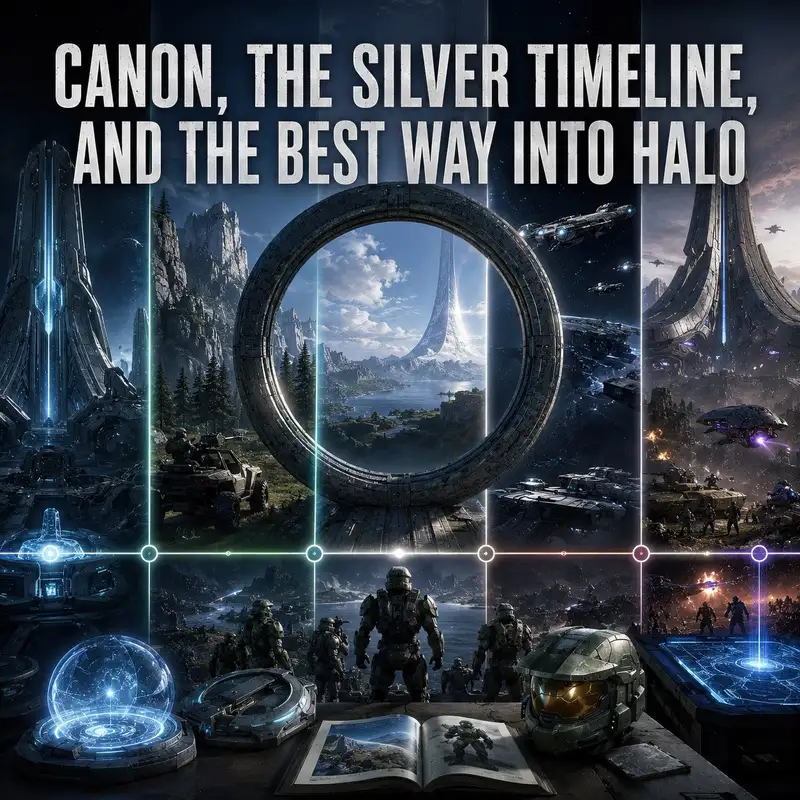
The Silver Timeline is the largest and clearest separate continuity. The television adaptation uses familiar foundations: Spartans, the Covenant, Halsey, the Master Chief, Reach, Forerunner artifacts, and humanity’s war for survival. It deliberately changes relationships, chronology, institutions, character histories, and the route by which major events occur. Silver Team is not Blue Team under different lighting. Its John One One Seven is not a missing chapter from the game character’s biography. Its version of Halsey, the Keyes family, the Spartan program, Covenant politics, and the search for Halo belongs to the television branch.
That separation is not a judgment that the Silver Timeline is counterfeit Halo. It is an adaptation built to tell a serialized television story with its own dramatic structure. It can explore themes from the core setting while changing the circumstances around them. The mistake is not watching it. The mistake is carrying a Silver-specific fact into a discussion of core canon without identifying the transfer. A viewer can enjoy both versions, just as a military historian can compare two campaign studies, provided the covers remain attached to the correct files.
Not every live-action Halo production belongs to Silver. Halo Four: Forward Unto Dawn and Halo: Nightfall remain connected to core canon. Forward Unto Dawn gives Thomas Lasky a history before his service aboard Infinity and places the Covenant War inside the experience of cadets who do not yet understand the enemy. Nightfall follows Jameson Locke before his later Spartan service. Medium alone does not determine continuity. The Paramount television series is Silver because it was officially created as a separate branch, not because live action is automatically noncanonical.
Halo also offers entry points for listeners who do not want to begin with a controller or a shelf of novels. Canonical audio dramas place intelligence operations, propaganda, and civilian experience at the center. Waypoint Chronicles are available in readable and, for many stories, audio forms. Forward Unto Dawn introduces the Covenant War through cadets rather than through an already famous Spartan. These works can open the setting effectively because they keep the field of view narrow. The listener learns one crisis, one institution, and one group of people before being asked to understand one hundred thousand years of galactic history.
Fractures occupy another clearly marked category. These are divergent Halo universes or timelines that recast familiar themes through different histories and aesthetics. Tenrai imagines a world shaped through a samurai-inspired lens. Entrenched builds a dieselpunk conflict. Firewall explores a future connected to Created ambitions through a divergent framework. Their armor, organizations, and events do not become core-canon history merely because they appear inside Halo Infinite. They are deliberate alternate possibilities, not classified equipment quietly issued to the Master Chief between missions.
Multiplayer material requires case-by-case judgment. Some multiplayer seasons, intelligence entries, maps, and narrative events are framed as events within core canon. Some are simulations used for training. Some cosmetics have canonical manufacturers and development histories. Others belong to Fractures, crossovers, or visual customization without a claim that one particular Spartan wore that exact combination in a historical operation. The safest rule is not to reject multiplayer lore or accept every cosmetic literally. It is to check the official framing of the specific item or event.
Concept art, cut dialogue, unused missions, and developer notes are valuable for production history but do not automatically describe events that occurred in universe. They can reveal what creators considered, why a design changed, or how a story evolved. They become core history only when later official material adopts them. Halo’s ongoing Digsite work has recovered old material and, in selected cases, brought elements into canon through new framing. Recovery is not automatic confirmation. An archived model is evidence of development until an official story gives it a place in the galaxy.
The best entry into Halo therefore depends on what kind of experience the newcomer wants. For someone who wants to play, the most reliable route is to begin with Halo: Combat Evolved and proceed largely in release order. The first campaign was designed to teach the audience what humanity, the Covenant, and Halo are through discovery. Halo Two and Halo Three then expand the political and military scale. Starting with a later prequel can provide more chronology, but it also assumes knowledge that gives its losses and revelations much of their weight.
Release order is usually stronger than strict chronological order because Halo’s mysteries were revealed over time. A chronology beginning with the Precursors, ancient humanity, the Forerunners, and the firing of the Array places the setting’s most complex material before the listener has a reason to care about it. Starting with Halo: Reach because it occurs before Combat Evolved is perfectly workable, but the tragedy of Reach carries greater force after the audience understands what its fall means to the war. Chronology is excellent for a second journey. It is a demanding first tour.
The central game route is straightforward without being exclusive. Combat Evolved, Halo Two, and Halo Three form the original campaign arc. Halo Three: ODST and Halo: Reach widen the human cost and military perspective. Halo Four, Halo Five: Guardians, and Halo Infinite continue the Master Chief’s story into the Forerunner, Created, and Banished eras. The Halo Wars games provide a more strategic view and become especially important to understanding the Spirit of Fire and the Banished. A newcomer does not need to consume every branch before continuing. The universe was built to widen around the main road.
For a reader, The Fall of Reach remains one of the strongest starting points, particularly for anyone drawn to military science fiction. It explains the Spartan program, human expansion, naval warfare, Reach, and the chain of events leading toward the first ring. Contact Harvest is an excellent alternative for someone more interested in first contact, colonial tension, Avery Johnson, and the political formation of the Covenant war. Ghosts of Onyx opens the Spartan Three program and the hidden costs of wartime planning. The Forerunner Saga is essential ancient history, but it is usually more rewarding after the listener understands why Halo, the Flood, and the Mantle matter to later civilizations.
Readers entering through the current era can begin with a focused story, but context still helps. The Rubicon Protocol follows survivors of the Infinity’s defeat during the six months before John returns to action on Zeta Halo. It works because its characters are also learning the local battlefield under pressure. Even so, Halo Infinite provides the larger frame for the Banished occupation, Cortana’s end, and the Weapon. The most useful expanded-universe books do not require the reader to memorize an encyclopedia before chapter one. They provide enough local orientation while rewarding anyone who recognizes the deeper connections.
Reference works serve a different purpose. The Halo Encyclopedia offers a broad core-canon synthesis across games, books, comics, and other media. Halo Waypoint’s Canon Fodder articles, Chronicles, intelligence entries, and official book guide provide updates, clarifications, and short-form fiction. These are excellent tools once a question exists. They are less effective as a substitute for narrative. Reading a database from Precursors to Zeta Halo may produce considerable knowledge and very little sense of why any decision mattered to the people making it.
Community reference sites, videos, timelines, and discussions are valuable navigation aids. They can identify an obscure short story, locate an official clarification, or explain why two dates appear to conflict. They are still secondary tools. A precise claim should be traced back to the game, book, comic, intelligence entry, revised edition, or official canon statement that supports it. Fan calculations can illuminate scale, but they do not become canonical weapon yields or ship measurements through repetition. The safest researcher uses the community as reconnaissance and the official source as confirmation.
A practical method is to choose one anchor and one companion. A new player can begin with Combat Evolved, then read The Fall of Reach to understand the soldiers and institutions behind the arrival at Halo. A new reader can begin with The Fall of Reach, then play Combat Evolved to experience the discovery its final chapters approach. Someone drawn to the Covenant can pair Halo Two with Contact Harvest or Broken Circle. Someone drawn to Zeta Halo can pair Halo Infinite with The Rubicon Protocol. The companion should deepen the same question rather than open six unrelated fronts.
Completionism is the least efficient opening strategy. Halo’s interconnected stories reward broad knowledge, but most were written to function around a primary conflict and a manageable cast. A newcomer does not need to read every earlier novel before playing a later campaign, and publication order should not become a clearance requirement. When a story depends heavily on prior events, a short orientation is usually enough to begin. The deeper references remain available for a return visit, which is a more pleasant arrangement than assigning homework before anyone has seen the ring.
When contradictions appear, the reader can use a simple intelligence discipline. First identify the continuity: core, Silver, Fracture, simulation, or production material. Then identify the source type: game event, character viewpoint, official report, reference summary, or later recollection. Check the edition and publication date. Ask whether later official material corrected or reconciled the detail. Separate what is shown from what is inferred. Most disputes become manageable once evidence stops being treated as one undifferentiated pile.
Some questions will remain unresolved, and that is not a failure of research. Halo contains missing records, propaganda, damaged artificial intelligences, religious interpretation, political concealment, and ancient witnesses with reasons to manipulate the truth. A responsible canon account should state when the exact sequence is unknown or when two interpretations retain support. It should not invent certainty merely because a clean timeline looks attractive. The Office of Naval Intelligence has already demonstrated what happens when a tidy briefing becomes more important than the evidence.
The best way into Halo is therefore not to begin with everything. Begin with a strong story inside the continuity you intend to follow. For most players, that means Combat Evolved and release order. For military-science-fiction readers, The Fall of Reach is an equally strong door. Treat the Silver Timeline as its own adaptation, Fractures as deliberate alternate worlds, gameplay as a historical experience shaped by abstraction, and reference works as maps rather than replacements for the journey.
The Pillar of Autumn’s arrival at Installation Zero Four remains the ideal image. The game places the audience aboard the escaping ship and lets the ring appear beyond the viewport. The Fall of Reach explains the war, institution, and sacrifice that brought the ship there. The Flood shows what happened elsewhere while the Master Chief moved toward the control room. Three records examine one crisis at different scales. Halo becomes easier to understand when those voices are not forced to compete for ownership of the event, but allowed to reveal the parts of the war each was built to see.