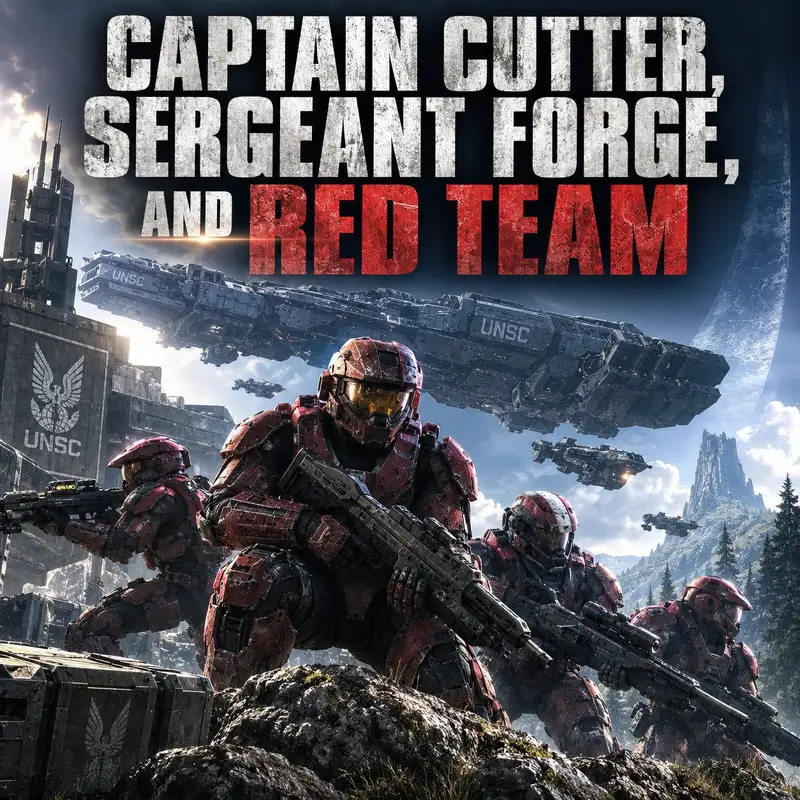
Captain Cutter, Sergeant Forge, and Red Team
On March twenty-eighth, twenty-five fifty-nine, Red Team entered an abandoned human research outpost on the Ark expecting to recover survivors. Instead, Jerome Zero Nine Two, Alice One Three Zero, and Douglas Zero Four Two met Atriox. The Banished warlord dismantled their attack, crushed Douglas’s helmet, and left the Spartans scattered. Their armor amplified speed, strength, protection, and awareness. Their training was among the best humanity had ever produced. Neither fact prevented a tactically superior enemy from taking them apart.
Captain James Cutter received the result aboard a ship that had no slipspace drive, no reliable route home, and no supporting fleet. Sergeant John Forge, the ground commander who had once supplied the ship with its most aggressive battlefield judgment, had been dead for twenty-eight years. Cutter could not replace Forge, repair the strategic situation, or make Red Team invincible. He could do what he had always done. Define the mission, use the people he still had, and force a stronger enemy to solve more problems than it expected.
The effectiveness of the Spirit of Fire’s command team came from three different forms of authority. Cutter represented operational command. He connected intelligence, logistics, aerospace forces, ground units, and strategic purpose. Forge represented the experienced noncommissioned officer at the point of contact, where plans met terrain and the enemy refused to cooperate. Red Team represented concentrated combat power, able to reach objectives that conventional formations could not. Their success did not come from one heroic personality. It came from the way those roles reinforced one another. Why did that combination keep working when the ship was isolated and its enemies held nearly every technological advantage?
Cutter’s ship was an appropriate place for that system to develop. The Spirit of Fire began as a Phoenix-class colony vessel, designed to carry people, equipment, and infrastructure needed to establish settlements. The Navy converted it into a support ship with hangars, workshops, supply capacity, ground vehicles, aircraft, and embarked troops. It could deploy a combined-arms force and sustain operations better than many dedicated combat ships. It was not built to trade fire with Covenant capital vessels. Calling it a warship was accurate. Calling it a front-line cruiser would have made the engineering department unnecessarily nervous.
James Cutter had come through navigation, logistics, and command rather than the culture of aggressive fleet combat. He understood that a ship’s value was not measured only by its main battery. Transport capacity, repair spaces, communications, medical support, and the ability to put organized forces on a planet could determine whether a campaign continued after the first exchange of fire. Cutter had declined opportunities that might have led to more prestigious commands. He remained with the Spirit of Fire, its crew, and a style of service built around making other formations effective.
That choice shaped his command personality. Cutter was disciplined without confusing discipline with silence. He allowed specialists to speak in their own professional language and expected them to challenge assumptions before those assumptions became casualties. Serina, the ship’s smart artificial intelligence, could analyze deployments and coordinate systems at machine speed. Professor Ellen Anders could interpret alien technology that naval officers barely understood. Forge could identify what ground troops needed before a formal staff process caught up. Red Team could explain what a Spartan assault might accomplish and what even Mjolnir could not make safe.
John Forge was less comfortable inside formal boundaries. He had joined the Marine Corps young, demonstrated unusual tactical ability, and repeatedly damaged his own career through insubordination. He was arrested, demoted, and prevented from following the normal path toward higher rank. Some of those disciplinary problems followed decisions that saved personnel. Others reflected a temper and willingness to strike at authority when judgment failed him. Forge was not a misunderstood officer trapped in a sergeant’s uniform. He was an excellent combat leader whose self-control did not always match his instincts.
That distinction made him useful to Cutter. A commander does not need every subordinate to think alike. Cutter needed Forge close enough to the fight to recognize opportunities, but inside a command relationship strong enough to turn those opportunities into coordinated action. Forge could lead Marines, work with armored and aviation units, and speak to Spartans without treating them as either machines or celebrities. He understood that exceptional personnel still needed clear objectives, supporting fires, ammunition, transport, and extraction.
Red Team brought another complicated history. Jerome, Alice, and Douglas had been selected for the Spartan Two program as children, but their bodies initially failed the augmentation process. They were classified among the washouts, a term efficient enough for paperwork and brutal enough for everything else. Later medical intervention rehabilitated and reaugmented them. They returned to active service in Mjolnir armor, not as incomplete Spartans, but as soldiers who had survived both the program’s intended transformation and its failure.
Jerome became the team leader. He combined direct physical capability with enough restraint to keep the formation from becoming three independent attacks moving in roughly the same direction. Alice showed a particularly strong preference for direct action and an equally strong refusal to abandon captured personnel. Douglas supplied experience and steadiness within a team whose missions often changed after insertion. Their most important advantage was not that any one of them could dominate an ordinary infantry engagement. It was that they trusted one another well enough to divide a battlefield without losing a common picture.
In early twenty-five thirty-one, the Spirit of Fire joined the final phase of humanity’s long effort to retake Harvest. The world had been the site of first contact with the Covenant and had become a contested system rather than a restored colony. When Covenant forces uncovered a Forerunner site beneath the surface, Forge led the reconnaissance that confirmed the enemy was searching for more than military terrain. Anders determined that the relic pointed toward another human world, Arcadia.
Cutter chose pursuit because the Covenant’s interest in Forerunner technology could not be separated from the wider war. Human commanders still knew little about the enemy’s religious objectives, but they had enough evidence to understand that ancient sites changed Covenant behavior. The Spirit of Fire left Harvest and followed the threat. That decision carried a support vessel, its embarked troops, its Spartans, and much of its logistical reserve away from friendly concentration and toward a colony already under attack.
At Arcadia, Red Team performed the role for which a persistent Spartan unit was especially valuable. The Spartans reinforced evacuation routes, broke defended positions, and helped conventional forces move civilians toward transport. Forge coordinated ground action while Cutter and Serina managed the larger deployment from orbit. Army units, Marines, pilots, armor crews, and civilian authorities still carried most of the defensive burden. Red Team could open routes and destroy critical targets. It could not evacuate a city by itself.
The campaign escalated when the Covenant established a protected excavation and deployed a massive experimental Scarab. Red Team and the wider ground force breached the defensive network and destroyed the machine before it could become fully operational. The result was a significant local victory, but the Covenant still achieved one of its main purposes. The Arbiter Ripa ‘Moramee abducted Anders and withdrew toward an unknown destination. The Spirit of Fire now faced the decision every pursuit force eventually encounters: preserve what it has, or follow the enemy beyond the point where support is guaranteed.
Cutter followed. The choice endangered the ship and crew, but it was not simply an emotional rescue mission. Anders possessed sensitive knowledge, and the Covenant’s effort to seize her confirmed that her expertise mattered to whatever waited at the destination. Allowing the enemy to retain both the scientist and the information she could unlock risked consequences far beyond one missing civilian. Cutter accepted the operational risk because the strategic uncertainty was worse.
The destination was Shield World Zero Four Five Nine, a Forerunner construct containing an artificial internal environment and a fleet of ancient warships. If the Covenant gained control of that fleet, humanity’s already poor naval position could become impossible. The Spirit of Fire had no nearby reinforcements and no established route for communicating what it had found. Cutter therefore had to act with the force present, even though the force had been assembled for support and planetary operations rather than an independent campaign inside an unknown megastructure.
This was where the relationship among Cutter, Forge, and Red Team reached its clearest form. Cutter kept the overall objective focused on denying the fleet and recovering Anders. Serina coordinated sensors, deployments, and the ship’s limited resources. Forge led conventional ground personnel through a battlespace whose geography violated normal assumptions. Red Team struck protected objectives, fought Sangheili forces, and created access for the larger formation. Anders, once recovered, supplied the technical understanding required to turn Forerunner systems against the Covenant plan.
The final solution was destructive because control was no longer realistic. The Spirit of Fire’s slipspace drive could be used to trigger a catastrophic reaction in the shield world’s internal star. Removing the drive meant sacrificing the ship’s only means of interstellar travel. Failure meant leaving the Covenant with a Forerunner fleet. Success meant escaping the destruction in a vessel that could no longer return home under its own power. Cutter approved the operation because the mission had become denial rather than recovery.
Forge and Red Team carried the drive toward the core. Ripa ‘Moramee and his guard intercepted them. The confrontation is often remembered because an unaugmented Marine sergeant killed a physically superior Arbiter with the Sangheili’s own weapon. That outcome should not be converted into a general claim that armor and augmentation did not matter. Forge survived long enough to exploit an opening during a team fight. Red Team defeated the surrounding guard and created the conditions in which one decisive action became possible.
Someone still had to remain and activate the drive manually. Forge took that responsibility and sent Red Team back toward extraction. The decision preserved three Spartans and ensured the device detonated. It also left his daughter, Rion Forge, with decades of uncertainty about whether her father and the Spirit of Fire had died. Strategic sacrifice appears cleanest in the moment before the casualty reaches a family that was never part of the briefing.
Forge’s death completed the mission, but it did not turn him into a substitute Spartan. His value had always been different. He could work across the boundary between command intent and battlefield improvisation. He knew when to disobey a bad method without abandoning the objective. At the shield world, that habit reached its disciplined form. He did not reject Cutter’s plan. He accepted the part of it that could not be delegated safely and gave the remaining force time to escape.
The Spirit of Fire cleared the collapsing construct, but the victory removed the ship from the war it had helped preserve. Without a slipspace drive, Cutter could not report the Forerunner fleet, return his troops to human space, or seek repair at a naval yard. The crew entered cryogenic suspension while the ship drifted. In February twenty-five thirty-four, the United Nations Space Command formally declared it lost with all hands. Humanity continued fighting for another eighteen years without knowing what Cutter, Forge, and Red Team had prevented.
The drift was not entirely peaceful. In twenty-five thirty-seven, Serina awakened Jerome and Anders when a Flood outbreak threatened the ship. Cutter remained in cryogenic suspension while the artificial intelligence and Spartan managed a crisis that could not be allowed to spread through the crew. The incident demonstrated that the command system Cutter had built could function without him at its center. It also placed more strain on Serina as she approached the end of a smart artificial intelligence’s operational life. She later initiated final dispensation, leaving records and contingency work for a crew she knew would wake without her.
The isolation also froze the crew’s military context. For most of those aboard, the Covenant War paused in twenty-five thirty-one. When the ship was drawn to the Ark in March twenty-five fifty-nine, they awakened to learn that the Covenant had collapsed, humanity had survived, and nearly everyone they knew had aged or died. Serina was gone after reaching the end of her operational life. Their equipment was decades old. Their doctrine had been developed in the opening years of a war whose final campaigns they had never seen.
The enemy waiting on the Ark was not the Covenant. The Banished combined Jiralhanae leadership, Sangheili naval skill, mercenary recruitment, captured technology, and an economy based on salvage, raiding, and coercion. Atriox’s forces had defeated the human research presence and occupied key installations before the Spirit of Fire arrived. Cutter possessed no current intelligence on the faction. The artificial intelligence Isabel, traumatized by the destruction of her research team, became his principal source.
Red Team’s first encounter with Atriox prevented the crew from mistaking old experience for complete preparation. Jerome, Alice, and Douglas attacked as a coordinated Spartan unit and still lost. Douglas suffered severe injury. Alice became separated behind enemy lines. Jerome carried Douglas back rather than continue an engagement that no longer served the mission. Their withdrawal was not failure of nerve. It was recognition that the Banished leader had already won the immediate fight.
Cutter’s response demonstrated why the Spirit of Fire remained dangerous. He did not build a plan around defeating Atriox personally. He began attacking the systems that allowed the Banished to hold the Ark. Ground forces established footholds, disrupted resource collection, recovered prisoners, and contested access to Forerunner sites. The ship’s workshops and stores supported a campaign that depended on repair, fabrication, salvage, and careful expenditure. An old colony vessel was once again valuable because the conflict required more than a gun platform.
Alice operated as a guerrilla commander while separated from the ship. She rescued captured personnel, assembled local combat power, and struck Banished positions from inside their occupied territory. The campaign echoed Forge’s greatest strength. She acted without waiting for perfect communications, but her actions remained connected to Cutter’s operational purpose. Initiative was useful because it expanded the plan rather than replacing it.
Jerome later boarded the Banished carrier Enduring Conviction with Isabel. The objective was not to defeat the carrier through conventional naval fire, which the Spirit of Fire was poorly equipped to provide. Isabel entered the ship’s systems and fired its energy projector against the Ark. The installation’s Sentinels responded to the damage and tore the carrier apart. Cutter’s force destroyed the Banished flagship by combining Spartan insertion, artificial-intelligence access, and the Ark’s own defensive response. It was precisely the kind of victory an inferior force required: indirect, difficult to repeat, and dependent on the enemy leaving one critical system exposed.
Douglas recovered and Red Team reunited during the effort to deny the Banished control of a newly constructed Halo. Anders intended to use the ring’s movement toward the galaxy as a way to seek help, while Cutter’s forces held the launch area against Atriox. The operation succeeded in removing the installation from immediate Banished control. It did not bring Anders home. A Guardian intercepted the ring after it entered slipspace, separating her from the Spirit of Fire and leaving Cutter without another irreplaceable specialist.
The war on the Ark continued because destroying a flagship and denying one Halo did not remove the Banished presence. Cutter had to use Orbital Drop Shock Troopers, Hellbringers, Marines, pilots, engineers, Spartans, and former Insurrectionists such as Morgan Kinsano as parts of one force. Red Team remained the tip of the spear, not the entire weapon. By October twenty-five fifty-nine, Jerome, Alice, and Douglas were still operating on the Ark against Banished forces and other groups seeking control of the installation.
Forge’s absence remained visible in that campaign, even when no one mentioned him. Cutter had lost the sergeant who once translated broad intent into ground-level momentum. Red Team had lost the unaugmented soldier who fought beside them without treating their capabilities as a reason to stand back. The crew preserved parts of his leadership through practice. Rescue the people who can still be reached. Deny the enemy what cannot be held. Use initiative before communications delay turns opportunity into a report about what might have been done.
Cutter, Forge, and Red Team were effective because none of them solved the same problem. Cutter decided what the force had to accomplish and balanced risk across the ship, crew, and campaign. Forge recognized when the battlefield required a decision faster than the chain of command could produce one. Red Team applied exceptional force at the objective, then withdrew when exceptional force was no longer enough. The arrangement worked because authority could move without purpose becoming confused.
Their record also shows what leadership could not overcome. The Spirit of Fire could destroy a shield world and still become stranded. Forge could complete the mission and still leave his family without an answer. Red Team could break defended positions and still be defeated by Atriox. Cutter could deny the Banished a flagship and a Halo without controlling the Ark or finding a route home. Tactical brilliance preserved options. It did not manufacture reinforcements, modernize the ship, or end the larger war.
The Spirit of Fire survives as an old support vessel fighting beside ancient machinery at the edge of the galaxy. Its captain still works from a command table. Its sergeant remains at the center of a shield world destroyed decades earlier. Its Spartans continue moving between landing zones, prisoners, and objectives that stronger forces believe they already own. Cutter gave the force direction. Forge gave it initiative. Red Team gave it reach. Together, they proved that an isolated command does not need to be stronger everywhere. It needs to recognize the one place where disciplined action can still change what the enemy is allowed to win.