Captain Keyes, the Truth and Reconciliation, and the Ground War
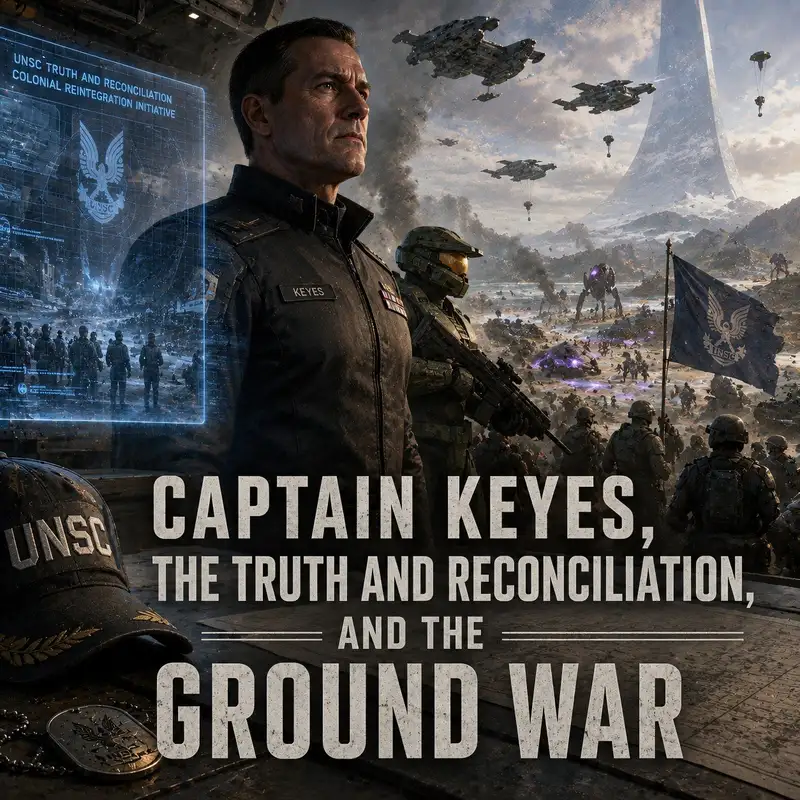
The first major human assault on Installation Zero Four was launched to recover one officer. Captain Jacob Keyes was being held aboard the Covenant battlecruiser Truth and Reconciliation, a damaged warship suspended above a plateau and surrounded by ground defenses. The surviving force from the Pillar of Autumn had no fleet, no secure rear area, and only a fragmented command network. Major Antonio Silva could continue organizing the troops without Keyes. What he could not replace was the senior officer who knew the Autumn’s condition, understood the intelligence carried from Reach, and possessed the authority to decide whether the survivors should hide, escape, or attack. Recovering Keyes was therefore not a ceremonial rescue. It was an attempt to restore command before the ground war became a collection of unrelated last stands.
The problem had begun during the evacuation of the Pillar of Autumn on September nineteenth, twenty-five fifty-two. Keyes ordered the cruiser abandoned after Covenant boarders penetrated the ship and its ability to remain in orbit collapsed. Lifepods, dropships, and Orbital Drop Shock Trooper pods scattered across the ring. Each landing group arrived with only the weapons, medical supplies, radios, and leadership that survived the descent. The Autumn itself crashed elsewhere on the installation, preserving valuable matériel but becoming a fixed and obvious target. Human personnel had reached the surface. They had not arrived as an organized expeditionary force.
Keyes landed with members of his bridge crew and a Marine security element. They were isolated, pursued, and operating without a reliable picture of friendly positions. One junior officer, Ensign Ellen Dowski, argued that surrender offered a better chance of survival. Keyes rejected the proposal, but the group’s movement and internal tension ended with Dowski separated from the others and later captured. She identified Keyes to the Covenant. The alien troops executed most of the remaining party and took the captain alive for interrogation. The decision made military sense from their perspective. Keyes commanded the only human warship to reach the ring and might know why it had come, what information it carried, and where other human worlds could be found.
The Covenant transferred him to the Truth and Reconciliation. The ship was a Ket-pattern battlecruiser in the Fleet of Particular Justice, commanded by Shipmaster Lat ‘Ravamee and carrying the Prophet of Stewardship. It had fought the Pillar of Autumn during the arrival over the ring and had been badly damaged by Cortana’s fire-control solutions. Unable to continue normal fleet operations, it held position roughly three hundred meters above the surface while repairs proceeded. A capital ship forced close to the ground is vulnerable compared with one maneuvering freely in space. It is still a capital ship. Its weapons, sensors, hangars, security troops, communications, and gravity lift made it a fortress whose walls happened to float.
The Truth and Reconciliation also served a political purpose. The Prophet of Stewardship had already restricted the fleet’s use of heavy plasma weapons near Halo, fearing damage to a sacred Forerunner installation. That restraint helped the Autumn’s survivors reach the surface and continued to shape operations below. Covenant commanders possessed orbital superiority but could not always employ it without religious approval. A human force fighting from caves, mesas, and Forerunner structures benefited from that contradiction. The Covenant could dominate the sky and still be required to capture selected objectives intact.
While Keyes was imprisoned, Silva assembled the largest surviving human concentration at Alpha Base. The position occupied a mesa containing Forerunner structures and defensible approaches. First Lieutenant Melissa McKay helped direct the ground effort, while the military artificial intelligence Wellsley managed communications, tactical data, and automated systems. Marines, shock troopers, Navy personnel, pilots, and technicians arrived from separate landing sites and had to be turned into functioning units. The base needed medical areas, ammunition control, landing zones, observation posts, prisoner handling, and routes to the Autumn’s wreck. Silva’s command remained officially combat effective, which on Alpha Halo meant it had enough people and equipment to attempt the next dangerous task before the last one was fully repaired.
Alpha Base gave the survivors a center, but it did not solve their command problem. Silva was an experienced Orbital Drop Shock Trooper officer and the senior available ground commander. Keyes remained the captain of the Autumn and the senior naval authority among the survivors. Their responsibilities overlapped because the ship’s crew was now fighting ashore. The legal chain of command pointed toward Keyes. The practical chain of command ran through Silva, McKay, Wellsley, and the officers physically controlling troops at the base. Rescuing the captain promised to reunite authority with the force. It also risked many of the personnel needed to keep that force alive.
Cortana provided the intelligence that made the rescue possible. By penetrating Covenant communications, she confirmed that Keyes had survived and identified the ship holding him. The battlecruiser’s damage created an opportunity. It could not simply depart when attacked, and its low position allowed a boarding force to reach the gravity lift from the surface. The Covenant still controlled the approaches and could reinforce from above. The assault therefore depended on darkness, surprise, precision fire, and a small force able to move faster than the defenders could reorganize.
John-One One Seven led the attack with Marines and shock troopers. Their first task was not to storm the entire ship. It was to cross the plateau, defeat the security perimeter, and reach the gravity lift before the Covenant understood the purpose of the raid. Snipers and infantry reduced exposed positions while the boarding party moved through ravines and defended ground. Once inside the lift, the raiders surrendered the advantages of open terrain. They entered an alien warship whose doors, internal sensors, atmosphere controls, and reinforcement routes belonged to the enemy.
Boarding actions are often described as infantry combat aboard a ship. The description is accurate but incomplete. Every corridor is also part of a machine. Doors can isolate units. Gravity can change. Hangar controls can trap aircraft. Damage-control systems can vent compartments or seal the attackers away from their objective. The human force had no complete deck plan and no technical team capable of taking control of the battlecruiser. Cortana could interpret systems and guide movement, but she was operating through limited access while the Covenant crew still held the vessel. The objective was extraction, not conquest.
The raiders fought through the lift bay and interior security zones, located the detention area, and freed Keyes with several other prisoners. The captain had used his confinement to gather information. He learned that the Covenant called the ring Halo and regarded it as a weapon of extraordinary religious importance. The intelligence changed the campaign immediately. Until that point, the human ground force had three obvious goals: regroup, protect sensitive information, and find a means of escape. Keyes now had reason to believe the installation itself could determine the wider war. The ground campaign became an intelligence race against an enemy that already considered the objective sacred.
Extraction remained the immediate problem. The rescue force had penetrated a battlecruiser without capturing its propulsion or securing the route back through the gravity lift. Keyes and the Marines therefore seized a Covenant Spirit dropship and escaped aboard enemy transport. That choice was not simply dramatic improvisation. The ship’s own aircraft were the fastest way out of its security envelope. The Covenant had designed the Spirit to pass through its hangars, approach its formations, and operate within its air-defense network. For a few minutes, captured equipment provided the authentication and mobility the raiders lacked.
The raid succeeded because it was narrow. Human forces did not attempt to destroy the Truth and Reconciliation, rescue every captive, or hold part of the ship. They recovered the senior commander, collected intelligence, and withdrew before the Covenant could bring the full vessel against them. The battlecruiser survived. Its crew remained capable of repair and later operations. Tactical success restored Keyes without eliminating the platform that had imprisoned him. That unfinished result would shape the remainder of the campaign.
Keyes returned to Alpha Base and resumed senior command, while Silva continued directing much of the ground defense. Their force now had a headquarters, a recognized commander, and a strategic question. If Halo was a weapon, the survivors had to learn how it worked before the Covenant did. Keyes ordered John and Cortana to locate the Silent Cartographer, a map facility believed to reveal the ring’s control center. The assault committed scarce Pelicans, Marines, weapons, and vehicles to an offensive mission when concealment might have preserved them longer. Keyes accepted the risk because hiding on a ring controlled from orbit offered no durable future. Knowledge was the only asset that might create a different outcome.
The wider ground war supported that search. McKay led efforts to recover supplies from the crashed Pillar of Autumn while the Covenant was distracted by the raid on the Truth and Reconciliation. Salvage teams secured Warthogs, Scorpion tanks, ammunition, food, medical stores, and other matériel, then fought through Covenant ambushes while returning to Alpha Base. These convoys mattered as much as the more visible assaults on Forerunner facilities. A map room could reveal the control center. It could not feed wounded Marines, fuel aircraft, repair vehicles, or replace rifle magazines. The survivors could pursue Halo’s secrets only because other troops kept the ordinary machinery of war functioning.
Covenant forces repeatedly attacked Alpha Base and the routes connecting it to the Autumn. Their objective was not merely to kill isolated humans. The base allowed the survivors to combine intelligence, transport, heavy weapons, and leadership. Destroying it would reduce the human force to separated groups that could be hunted individually. Silva and McKay used the mesa’s defenses, Wellsley’s battlenet management, and recovered equipment to preserve the position. The fighting showed the proper place of John’s operations within the campaign. The Spartan struck the objectives conventional forces could not reach efficiently. Conventional forces held the base, moved supplies, defended landing zones, and created the conditions that allowed him to strike again.
Keyes’s command after the rescue was aggressive. He had just watched Reach fall, lost the Autumn as a functioning warship, and discovered an installation the Covenant valued beyond ordinary military logic. Waiting promised encirclement. His orders sought information, leverage, and initiative. The Silent Cartographer operation located the control room. John then carried Cortana into the installation’s systems while human and Covenant ground forces fought across the surrounding terrain. Keyes’s decision had produced a real intelligence success. It also divided the surviving force across Alpha Base, the Autumn, the control-room approach, and other reconnaissance missions. Every offensive action consumed transport and communications that could not be replaced.
The most consequential decision was Keyes’s choice to investigate a reported Covenant weapons cache personally. The target lay inside a Forerunner facility in a swamp region. Covenant activity suggested that something important had been found there, and Keyes had strong reason to believe the installation contained weapons or control systems capable of changing the campaign. Sending a subordinate would have preserved the captain but delayed his access to whatever intelligence the team recovered. Taking direct command promised faster judgment at the objective. It also placed the senior surviving officer, much of his command knowledge, and his neural authorization codes inside an unknown structure with limited support.
The decision is sometimes reduced to a naval captain carelessly leading infantry into a bunker. That judgment is too easy. Keyes had combat experience, the human force was short of qualified leaders, and the discovery of Halo had made every Forerunner site potentially strategic. The Covenant had already entered the facility, which made speed appear more important than caution. Yet the risk remained disproportionate. Keyes had been rescued at high cost precisely because his command authority mattered. He then placed that authority inside a mission whose intelligence was based on enemy activity and incomplete interpretation. The official record offers no evidence that the team possessed biological-containment equipment, quarantine planning, or a clear extraction method if the facility held something other than weapons.
The Covenant had breached the containment site before the human team understood its purpose. Inside were Flood specimens preserved by the Forerunners. Infection forms attacked Covenant and human personnel, converting bodies into combat forms and turning casualties into additional enemy strength. The tactical assumptions of the ground war collapsed. Against the Covenant, a killed defender generally remained a casualty. Against the Flood, the same body could become a weapon, a source of memory, and a means of opening doors or operating equipment. A confined facility filled with dead soldiers was not cleared terrain. It was raw material.
Keyes and his personnel were overwhelmed. Some humans escaped the initial outbreak, but the captain was infected and absorbed into the parasite’s developing intelligence. The Flood recognized that he carried information more valuable than the physical strength of another combat form. He knew human command procedures, the capabilities of the Autumn, and the location of strategic systems the Cole Protocol existed to protect. The parasite concentrated him within a Proto-Gravemind and began extracting memory. Keyes resisted by holding to identity, duty, and repeated service information, but resistance could delay the process rather than reverse it.
The Flood moved Keyes back to the Truth and Reconciliation because the battlecruiser offered what Alpha Base and the grounded Autumn could not: a realistic route away from the ring. The ship was damaged, but Covenant personnel were repairing it, and its slipspace systems remained strategically valuable. The vessel that had first served as Keyes’s prison became the parasite’s prospective escape craft. Covenant forces understood the same danger. They fought to retake the cruiser and requested its destruction rather than allow the Flood to leave Installation Zero Four. Religious restraint had once preserved the ship near Halo. Biological containment now made destroying it the safer option.
The ground war consequently converged on the same battlecruiser for a second time. John and Cortana returned to recover Keyes or, if rescue proved impossible, retrieve the captain’s neural implants. Those implants contained the authorization needed to overload the Pillar of Autumn’s fusion drives and destroy the ring. The mission’s purpose had inverted. The first raid sought a living commander who could direct the campaign. The second sought command codes from a man the Flood had made unrecoverable. The Truth and Reconciliation was no longer a Covenant fortress with a coherent crew. It was a contested ecosystem of Covenant survivors, Flood forms, damaged systems, and security forces trying to prevent one another from controlling the ship.
John reached the bridge and found Keyes incorporated into the Proto-Gravemind. There was no medically plausible extraction and no time for quarantine or study. He recovered the neural interface directly and left the ship. The action is remembered for its physical brutality, but its military meaning is colder. Command authority had become data. Keyes’s experience, judgment, and identity could not be saved. The access codes embedded in his implants still had operational value. The ground force had reached the stage where the captain’s last contribution was permission to destroy his own ship.
Silva then made one final attempt to convert the Truth and Reconciliation into an evacuation solution. With Alpha Base compromised and the ring approaching destruction, his shock troopers assaulted the battlecruiser through its hangar and gravity lift. They captured the vessel with surprisingly limited losses and took the Prophet of Stewardship prisoner. From Silva’s position, the achievement offered everything the survivors lacked: a slipspace-capable ship, advanced Covenant technology, a politically valuable captive, and enough room to carry personnel away from Halo. Capturing the cruiser looked like the first complete human victory of the ground campaign.
First Lieutenant McKay saw the problem Silva had discounted. The ship had been infested by the Flood. No boarding force could prove that every compartment, conduit, access shaft, or surviving body was clean. Taking the cruiser toward Earth risked carrying the parasite into humanity’s most important system. The voyage would also violate the purpose of the Cole Protocol by connecting an enemy vessel and its surviving systems to Earth. A captured battlecruiser was an extraordinary prize. It was also a possible extinction event with engines.
McKay destroyed the control connection between the bridge and engineering. The Truth and Reconciliation crashed, killing Silva, McKay, the boarding force, their prisoners, and the Flood forms still aboard. Her decision denied the human survivors their best apparent escape route because the route could not be separated from the threat inside it. The same ship had twice offered salvation. First it offered the recovery of Keyes. Then it offered evacuation from Halo. In both cases, control of the hull was temporary. The strategic danger remained larger than the tactical success.
Captain Keyes shaped the ground war because his rescue restored command and his intelligence redirected the survivors toward Halo’s control systems. His aggressive decisions prevented the human force from waiting passively for destruction and helped uncover the installation’s purpose. The same urgency also led him into a containment facility without the knowledge or precautions the threat required. His strengths and failure came from the same source. Keyes believed initiative could create options where none existed. Against the Covenant, that instinct repeatedly worked. Against the Flood, movement into the unknown created an option for the enemy.
The Truth and Reconciliation became the physical center of that contradiction. It was a damaged warship, a prison, a command post, an intelligence target, a boarding objective, a Flood nest, and finally an evacuation vessel too dangerous to use. The human ground campaign never securely controlled orbit, yet its most important operations revolved around one ship hanging just above the surface. The battle for Alpha Halo was not decided by who captured the cruiser. It was decided by who understood when the cruiser had to be denied to everyone.
The final image is not Keyes commanding from a bridge. It is the Truth and Reconciliation falling toward the ring after McKay severed its controls. Inside were the remains of the command structure the survivors had fought to rebuild, the enemy they had tried to exploit, and the parasite that made escape unacceptable. Keyes had turned scattered survivors into an offensive force. The ship that held him turned every later victory into a containment problem. On Installation Zero Four, the ground war succeeded only when its last usable road off the battlefield was deliberately destroyed.