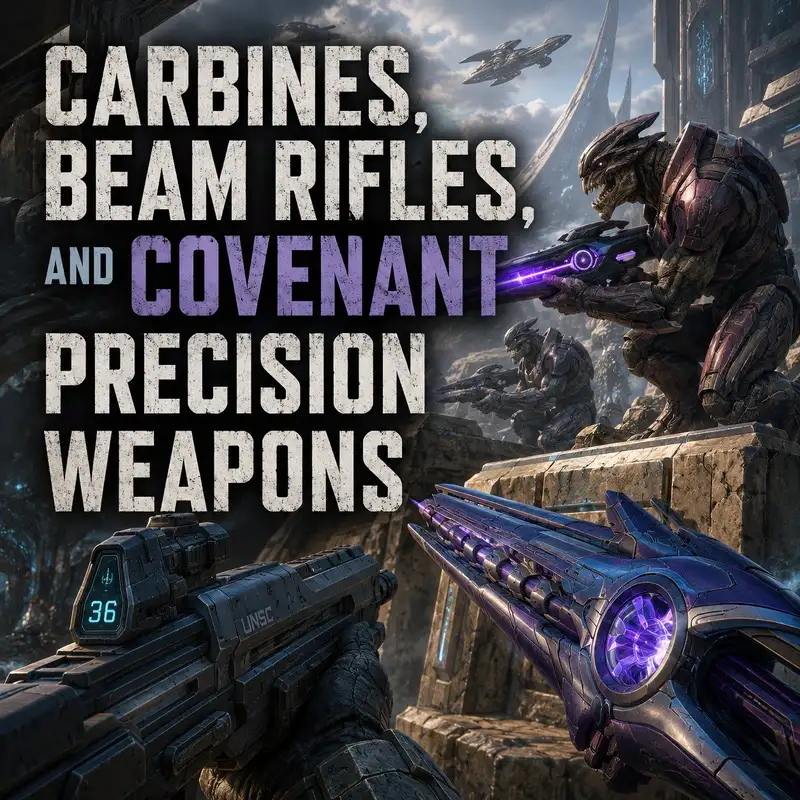
Carbines, Beam Rifles, and Covenant Precision Weapons
Pirate King Krith did not need to defeat a Covenant fleet to challenge the empire. He needed one exposed San’Shyuum official, a firing position, and a heavily modified beam rifle. His assassination of a Precentor turned long-range marksmanship into a political act. The weapon later called Krith’s Left Hand became a symbol among Kig-Yar who imagined life outside Covenant control. Precision fire could remove a battlefield target. It could also embarrass a ministry, inspire rebellion, and prove that authority remained vulnerable at a distance.
The Covenant’s precision arsenal developed around that larger truth. Plasma rifles were devastating at close and medium range, but their bolts traveled slowly enough to be seen and became less useful as distance increased. Energy swords required the warrior to close with the enemy. Heavy weapons could destroy a position, but not always without destroying everything around it. Commanders still needed weapons able to identify and strike one important target across open ground. The carbine, beam rifle, focus rifle, and needle rifle answered that need in different ways.
They were not variations of one universal service rifle. Each used a different ammunition or energy system, imposed a different heat and supply burden, and favored different kinds of users. Sangheili weaponsmiths carried forward traditions formed in conflicts long before the Covenant existed. Kig-Yar marksmen brought patience, visual acuity, commercial networks, and their own military cultures. Covenant ministries then distributed those capabilities through an imperial hierarchy that assigned equipment by species, rank, mission, and political trust. Precision was technical. Access to precision was political.
The Vostu-pattern carbine was the closest Covenant equivalent to a human battle rifle or designated marksman weapon. United Nations Space Command intelligence classified it as the Type Fifty-One Carbine. Iruiru Armory developed the design from older Sangheili marksman rifles and deliberately adapted it for use by several species. That adaptation mattered. Many Covenant weapons reflected Sangheili anatomy and martial tradition. The carbine was intended to move beyond one warrior culture and become a practical imperial weapon.
Unlike most familiar Covenant small arms, the carbine did not fire plasma. It launched physical, caseless projectiles at high velocity. The standard magazine held eighteen rounds, and a low-power optic supported accurate semiautomatic fire across several hundred meters. The weapon therefore gave a Covenant formation something its plasma rifles could not provide efficiently: a fast projectile, a flatter engagement, and repeated precision without the long cooling cycle of a dedicated beam weapon.
The ammunition was physically small and medically unpleasant. Covenant carbines used radioactive compounds protected during flight and released when the projectile struck. The immediate wound combined penetration with radiation injury and toxic contamination. A target who survived the impact could still deteriorate rapidly without treatment. Human medics therefore faced a casualty whose external wound might appear manageable while the material carried into the body continued doing damage. The carbine was a precision rifle and, in effect, a compact hazardous-material delivery system.
This ammunition also revealed a different side of Covenant logistics. Plasma weapons consumed stored energy. Carbines consumed manufactured projectiles and magazines. Those rounds had to be produced from suitable radioactive material, sealed, transported, and issued without poisoning the people handling them. The Covenant possessed the industrial controls to make such ammunition routine. Human forces could capture a loaded carbine and use it. They could not assume the nearest human depot could provide safe replacement magazines.
The carbine’s visible projectile trail created another trade. A marksman gained speed and accuracy compared with ordinary plasma, but repeated fire could reveal the firing point. The shooter still needed concealment, alternate positions, and discipline. The weapon’s semiautomatic action encouraged deliberate shots, yet its magazine allowed a user to support an assault or defend a position when the engagement accelerated. It occupied the middle ground between a plasma rifle’s volume and a beam rifle’s specialized reach.
Kig-Yar and Sangheili both used carbines, although not for identical reasons. A Kig-Yar marksman could exploit range, cover, and patience while remaining outside the most dangerous part of a firefight. A Sangheili warrior could carry the weapon as a symbol of professional skill and use it while commanding troops whose plasma arms covered closer distances. Unggoy and other species also appeared with precision weapons under particular circumstances. Covenant force assignment was never as simple as one species receiving one permanent battlefield role.
The particle beam rifle sat farther toward specialization. The most familiar wartime design, the Sulok-pattern beam rifle, was another product of Iruiru Armory. It accelerated ionized particles into a narrow beam capable of striking personnel and equipment at long range. To human observers, the effect looked immediate. A bright line connected the shooter and target, armor burned, shields collapsed, and the marksman’s position became a priority for every surviving weapon in the area.
The beam rifle did not use a detachable ammunition magazine in the human sense. Its internal power supply supported a limited number of full-energy shots. Rapid fire built heat quickly, forcing the system to vent and cool before it could fire again. The user could deliver a second shot when necessary, but treating the weapon like an automatic rifle produced an involuntary pause at exactly the moment a sniper least wanted one. Advanced technology had not abolished fire discipline. It had installed the lesson inside the weapon.
Heat shaped the beam rifle’s tactical rhythm. A skilled marksman selected a target, fired, observed the result, and either relocated or prepared a follow-up shot. Against a shielded opponent, the first discharge might remove protection while the second reached armor or flesh. Against a vehicle or emplacement, repeated hits could damage exposed components. The rifle’s narrow effect reduced some of the blast risk associated with heavy weapons, but missed shots and thermal damage still made the area behind the target important.
The weapon’s signature was difficult to conceal. Its beam revealed direction, and the discharge carried enough energy to attract attention from sensors as well as eyes. A beam rifle team therefore depended on position, timing, and the confusion created by the larger battle. Firing from a rooftop over an advancing formation was useful until human marksmen, artillery, aircraft, or a Spartan located the rooftop. The first shot belonged to the sniper. The second belonged to whichever side understood the first quickly enough.
Kig-Yar service made the beam rifle notorious among human troops, but describing every Kig-Yar as a sniper mistakes a military specialization for a species. Kig-Yar societies included traders, ship crews, raiders, mercenaries, infantry, political leaders, and families. Some individuals developed exceptional fieldcraft and entered specialized Covenant units. The Jha’kaar was an elite and clandestine sniper organization. Service in such a formation could expose its members to resource caches, information hubs, and restricted worlds that ordinary troops never saw.
That organization demonstrates that Covenant sniping was more than placing an accurate weapon in the hands of a convenient infantry type. Precision personnel supported reconnaissance, counter-reconnaissance, security, assassination, and the protection of strategic resources. A sniper observing a route might report a human convoy without firing. A marksman assigned to a reliquary could protect the site from raiders. A covert team could remove a political target whose death served a ministry. The rifle was one element of an intelligence and security function.
Precision work also required observers and communications. The rifle’s optic could magnify the target, but the wider formation still had to identify priority threats, pass locations, and prevent friendly troops from crossing the firing line. Kig-Yar spotters, Sangheili officers, sensor operators, and local scouts could all contribute. The marksman’s shot was the visible action. The intelligence that made the shot useful often came from someone whose name never entered the battle report.
Covenant optics were integrated with the user’s equipment rather than built around human assumptions. Range information, target tracking, and combat-harness links improved the shooter’s ability to engage quickly. Those systems could still be degraded by smoke, damage, electronic interference, or incomplete intelligence. A magnified image answered where the target was. It did not answer whether the target was a commander, a decoy, or the only technician capable of operating a captured installation.
This uncertainty gave precision fire strategic weight. Killing the wrong officer could reveal that the Covenant misunderstood the human chain of command. Killing the right one could delay an evacuation, break a defense, or remove the person coordinating orbital fires. Assassination could also create martyrs, succession struggles, and retaliation. Covenant ministries understood the utility of a distant shot, but they could not guarantee the political result after the target fell.
Sangheili specialists also used beam rifles. Their greater strength made the long, heavy weapon easier to handle, while active camouflage and advanced combat harnesses improved access to concealed positions. For a Sangheili, precision fire did not necessarily conflict with a culture that celebrated close combat. Martial traditions contained scouts, assassins, special-operations personnel, and fleet security forces as well as sword-bearing officers. Honor was interpreted through institutions and circumstances, not through a universal requirement to stand where the enemy could conveniently shoot back.
Custom beam rifles became personal and political objects. Krith’s Left Hand was a modified Zubo-pattern rifle tied to the reputation of a Kig-Yar pirate king. Other commanders and marksmen obtained weapons altered for greater charge, faster follow-up fire, improved optics, or different heat behavior. These variants were not evidence that every Covenant sniper received a bespoke masterpiece. They showed what patrons, artisans, and powerful users could produce inside an empire where access depended on influence as much as formal tables of equipment.
The focus rifle offered another solution to long-range fire. Rather than delivering one short particle-beam discharge, it projected a sustained energy beam that the operator kept on target. The result was closer to precision suppression. A brief contact could damage shields or force movement. Maintaining the beam concentrated more energy and increased the chance of a kill. The shooter traded the beam rifle’s sudden impact for the ability to correct aim while firing and keep pressure on an exposed target.
That made the focus rifle useful against moving personnel, light vehicles, and positions where the enemy had to be denied freedom of movement. It could sweep across a firing point, discourage a Marine from leaning around cover, or strip shielding while other Covenant troops advanced. The continuous beam also advertised the shooter’s location with remarkable generosity. Heat accumulated during sustained use, so the operator had to balance tracking time against an approaching cooling cycle.
Kig-Yar Skirmishers and Sangheili personnel used focus rifles during the fighting on Reach. The weapon fit units that moved through broken terrain, watched long avenues of approach, and supported assaults from elevated positions. It did not replace the beam rifle because suppression and single-shot elimination were different tasks. A commander who wanted one distant officer killed chose differently from a commander who wanted an entire doorway unusable for several seconds.
The needle rifle extended blamite ammunition into the precision role. It fired larger Subanese crystal shards at higher speed than the familiar Needler and used controlled semiautomatic fire at medium and long range. Several successful impacts could still produce a supercombine detonation. The marksman therefore combined accuracy with cumulative effect. One shard wounded. A short series of well-placed shards could turn the target into the center of an explosion.
The needle rifle’s advantage was not merely greater damage. It forced a shielded target to treat every impact as the beginning of a sequence. A soldier who remained exposed after the first hit risked receiving enough additional shards for the material to react. The weapon encouraged the shooter to keep fire on one target and encouraged the target to break line of sight immediately. Precision and psychological pressure arrived together.
Its logistical burden followed the crystal back to Suban. Blamite came from a unique known source, then required extraction, preparation, transport, and distribution. A Covenant fleet could carry needle rifles and ammunition across the empire because it had access to mines, forges, and shipping. A stranded remnant could continue using the weapon only while its stock lasted or while new trade connections reached it. The empire’s collapse turned a standard precision system into a resource-security problem.
The carbine, beam rifle, focus rifle, and needle rifle therefore created a layered engagement. Carbines delivered repeated high-velocity shots. Beam rifles removed high-value targets. Focus rifles suppressed and tracked. Needle rifles punished exposure through cumulative crystal effects. Plasma weapons still dominated close combat, and heavy arms handled vehicles and fortifications. Precision weapons did not form a separate war. They made the rest of the Covenant formation more effective.
A well-organized unit could use that layering to control movement. Beam fire forced leaders and heavy-weapons crews into cover. Carbine marksmen engaged anyone attempting to reposition. Focus rifles denied exposed routes. Plasma infantry advanced behind the pressure. Needlers and needle rifles punished troops who stayed visible too long. The target experienced several different flight times, signatures, and damage mechanisms at once. Human soldiers could learn the characteristics of each weapon. They still had to identify which one was creating the immediate problem.
Human countermeasures began with survival. Units used smoke, hard cover, suppressive fire, route changes, and rapid movement between protected positions. Snipers and designated marksmen searched for beam signatures and carbine trails. Machine guns forced likely firing points down while maneuver elements moved. Aircraft, artillery, and vehicle weapons could destroy a sniper position when the tactical situation allowed. That final condition mattered. A Marine platoon beneath Covenant orbital control did not possess artillery simply because doctrine recommended it.
Energy shielding changed the exchange without making precision fire harmless. Mjolnir could absorb an initial hit that might kill an unshielded soldier, giving a Spartan a moment to move or return fire. Covenant marksmen understood shielding because their own forces used it. They could concentrate shots, wait for another weapon to weaken the target, or attack during a recharge interval. Precision doctrine was not built around the expectation that every important target remained unprotected.
Active camouflage complicated both sides. A concealed marksman gained time to observe and fire, but thermal output, weapon discharge, movement, damaged equipment, and opposing sensors could expose the position. Camouflage reduced visibility. It did not remove the need for a route into the hide or a route out. A sniper who fired from perfect concealment and then discovered the extraction path was occupied had completed only the most obvious part of the mission.
Maintenance separated battlefield capture from lasting capability. A human armorer could clean a carbine, inspect accessible components, and sometimes return a damaged weapon to use. Beam and focus rifles depended on power regulation, thermal systems, optics, and materials outside ordinary human supply. Needle rifles required blamite. Covenant forces possessed Huragok, artisans, and forge personnel able to sustain technologies that frontline users did not fully understand. Human possession of one intact weapon did not reproduce that support structure.
The same problem appeared inside the Covenant after the Great Schism. Fleets, keeps, pirate groups, and successor factions inherited weapons, magazines, power cells, and trained marksmen. They did not inherit equal access to Iruiru Armory, Suban, skilled technicians, or approved patterns. Some groups maintained older arms. Others commissioned new variants or combined surviving designs. The arsenal fragmented because the political system and the supply system fragmented together.
Iruiru Armory itself continued to matter. Its engineers had shaped both carbine and particle-beam development, and postwar relationships allowed its work to reach new patrons. Banished procurement often relied on personal connections, shadow contracts, salvage, and coercion rather than Covenant ministries. The Banished could obtain a weapon pattern without accepting the religion that once controlled it. They still had to pay, threaten, transport, or manufacture whatever kept that pattern firing.
The postwar Mosa-pattern carbine and specialized arms such as the Blood of Suban reflected this new environment. Artisans revised old concepts, altered ammunition, and built weapons for narrower users. Covenant precision technology had escaped imperial uniformity. That freedom encouraged innovation, but it also reduced standardization. A masterpiece carried by one warrior did not solve the ammunition needs of a battalion.
The Banished Stalker Rifle carried the precision-energy tradition into the conflict on Zeta Halo. It was Covenant-sourced technology adapted to Banished requirements and used as a long-range plasma weapon. Its heat cycle, visible discharge, and specialized role showed continuity with older precision systems, while its distribution showed political change. The weapon no longer served a ministry claiming sacred authority. It served an organization willing to acquire whatever made occupation more effective.
Covenant precision weapons succeeded because they did not ask one technology to do everything. The carbine solved the weakness of slow plasma at range. The beam rifle offered decisive single-target energy. The focus rifle sustained pressure. The needle rifle combined accuracy with blamite’s cumulative detonation. Their users turned those mechanisms into reconnaissance, assassination, security, and battlefield support.
They also exposed the limits of the empire that fielded them. Different ammunition, power systems, heat behavior, manufacturers, and species requirements complicated supply. Religious authority and political patronage shaped access. Skilled units could be deployed to protect strategic interests or misused to protect a ministry’s influence. When the Covenant collapsed, the weapons survived, but the centralized system that had made them ordinary did not.
Krith’s assassination captured both sides of that history. A beam rifle built within the Covenant’s technological order allowed a Kig-Yar rebel to strike one of that order’s political officials. The empire had created a precision capability and distributed enough knowledge for a skilled outsider to turn it against imperial authority. Long after ministries fell and fleets divided, the carbine round, the beam, and the crystal shard continued crossing battlefields. Precision outlived the government that had organized it, because a weapon can retain its purpose after the people who defined its loyalty are gone.