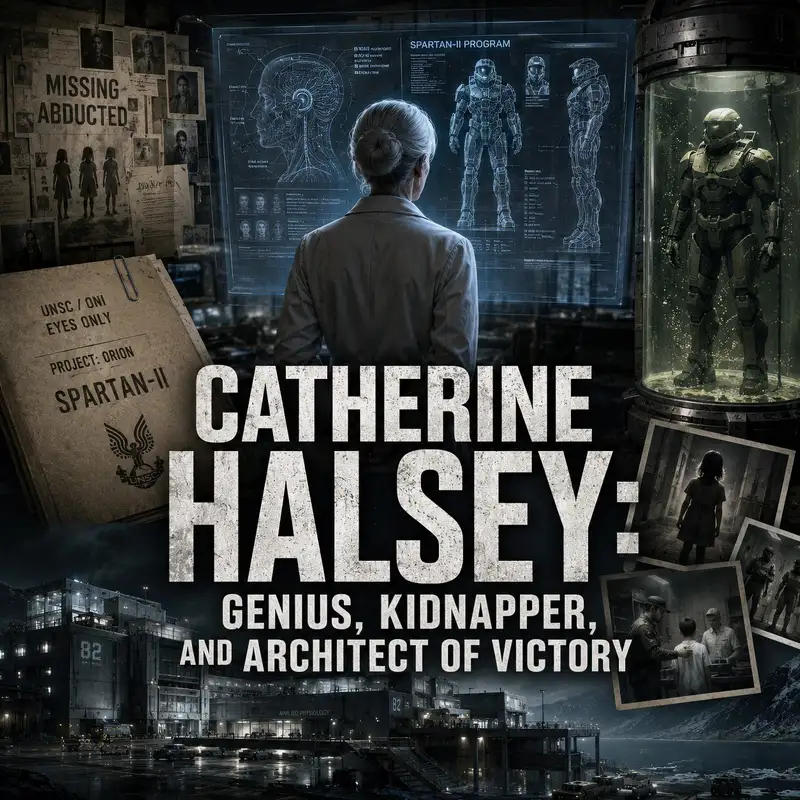
Catherine Halsey: Genius, Kidnapper, and Architect of Victory
On the night of September twenty-third, twenty-five seventeen, Catherine Halsey stood before seventy-five kidnapped children beneath Reach. She had rejected proposals to erase their memories or invent a comforting explanation. Instead, she told six-year-olds that they had been conscripted under naval authority, that their former lives were over, and that they would become protectors of Earth and its colonies. It was a peculiar form of honesty. Halsey refused to lie about the cage after helping build it.
That scene contains the contradiction defining her career. Halsey was one of the most consequential scientific minds in human history. Her work shaped the Spartan Two program, Mjolnir armor, advanced artificial intelligence, and eventually the Weapon used against Cortana. She was also directly involved in selecting children for abduction, replacing them with doomed flash clones, and subjecting them to training and augmentation without consent. The same intellect that repeatedly helped humanity survive was employed first to make an atrocity efficient.
Catherine Elizabeth Halsey was born in twenty-four ninety-two on the colony of Endymion. Her abilities appeared unusually early. She passed through elite education at remarkable speed, completed advanced scientific work while still young, and attracted the attention of the Office of Naval Intelligence before most researchers would have established an ordinary career. Halsey did not specialize narrowly. Biology, neurology, artificial intelligence, cybernetics, materials science, and slipspace theory became connected problems in her mind. That breadth later made her invaluable, and nearly impossible for any one supervisor to control.
The Office of Naval Intelligence recruited Halsey during a period when human interstellar society was becoming harder to govern. The Outer Colonies resented political domination, unequal development, and economic extraction by institutions centered closer to Earth. Some movements pursued autonomy through politics. Others used sabotage, assassination, and terrorism. Government responses included surveillance, military occupation, and counterinsurgency. Predictive models warned that the conflict could expand into a civil war causing enormous casualties and perhaps breaking the Unified Earth Government apart.
Halsey’s relationship with Jacob Keyes later produced a daughter, Miranda. Halsey raised her for several years, but her work consumed increasing portions of her life, and Keyes became Miranda’s primary parent. Miranda took her father’s name, entered the Navy, and remained estranged from Halsey for long periods. Halsey tried to protect her through influence over assignments but declined to attend a promotion ceremony. When she later learned that Miranda had died in combat, professional distance offered none of the protection Halsey had imagined.
Halsey accepted the basic premise of those forecasts. She believed a small force capable of precise action against insurgent leadership could prevent the mass destruction that conventional war would produce. This was the argument behind a second-generation super-soldier program. It was presented as an alternative to fleets bombarding rebellious colonies and armies occupying entire populations. The logic sounded restrained because it compared one terrible option against something worse. It also concealed the fact that the supposedly precise solution required taking children who had committed no crime.
Candidate selection began with genetic and medical information gathered through public health systems. Halsey’s team identified children with rare combinations of physical potential, intelligence, neurological compatibility, and psychological traits. One hundred and fifty met the initial standards. Funding and facilities supported only seventy-five. Halsey personally evaluated several candidates, including John on Eridanus Two, accompanied by Lieutenant Jacob Keyes. She was not choosing volunteers for a dangerous academy. She was determining which families would lose a child.
The abductions occurred across human space. Office of Naval Intelligence teams sedated the selected children and transported them to Reach. Halsey arranged for each child to be replaced with a flash clone. Whole-body flash cloning could reproduce appearance and memories well enough to deceive families temporarily, but the clones were medically unstable. They sickened and died. Parents therefore experienced the apparent return of their children, followed by terminal illness and bereavement, while the originals disappeared into a classified military program.
Halsey concealed parts of the cloning operation even from senior intelligence leadership. Her rationale appears to have included secrecy and a belief that families required closure. Neither explanation improves the result. The clones were not rescuers, substitutes, or autonomous participants. They were human lives created to die inside a deception. The decision also demonstrates that Halsey was not merely an obedient scientist carrying out a complete plan designed by others. The institution authorized the program. She made consequential choices within it and hid some of them from the institution itself.
Training on Reach was directed by Chief Petty Officer Franklin Mendez with instruction from the artificial intelligence Déjà and oversight from Halsey. The children received military education, physical conditioning, survival training, history, tactics, mathematics, and relentless team exercises. Their family names were removed from routine use. Numbers became part of their identities. Halsey did not erase their memories, but the program systematically displaced their old loyalties with commitment to one another, the mission, and the organization that controlled every part of their lives.
The training produced extraordinary cohesion because the candidates had almost nothing else. Halsey recognized them as individuals and usually addressed them by first name. She could identify Spartans through posture and movement even when they wore armor. That familiarity was genuine, but it did not create a normal parental relationship. She possessed authority over their bodies, careers, and access to information. Affection inside a coercive system can be sincere. It can also help the system function.
In twenty-five twenty-five, the candidates underwent biological augmentation. Halsey knew the procedures were not ready in any ordinary medical sense. She considered delaying them, but believed the Office of Naval Intelligence might replace her with someone less qualified and less concerned about the children. She proceeded. Thirty candidates died. Twelve were severely disabled. Thirty-three survived without major deformity, while some washouts were later rehabilitated. Halsey preserved bodies in cryonic suspension rather than permit routine autopsy, hoping future medicine could recover them. Hope arrived after the irreversible decision.
The survivors gained enhanced strength, speed, reflexes, skeletal durability, sensory performance, and resistance to injury. These abilities did not emerge from one miraculous injection. They came from interdependent surgeries, implants, chemical treatments, rehabilitation, and constant medical risk. Halsey’s achievement was partly scientific and partly organizational. She coordinated specialists, data, facilities, and classified funding over years. The result was not a product that normal industry could manufacture quickly. It was a tiny force whose creation had already consumed lives before combat began.
Project Mjolnir transformed that force into something strategically distinctive. Halsey was a key architect rather than the only engineer. Powered armor multiplied movement and strength, integrated sensors and communications, and eventually incorporated energy shielding and artificial-intelligence support. Early versions could injure an unaugmented wearer because the suit responded faster and more forcefully than an ordinary body could tolerate. Mjolnir and the Spartans were therefore a single military system. The armor did not replace training, and the training could not produce the same battlefield effect without the armor.
The original enemy was human. That fact matters because the Covenant did not appear until after the Spartan program had already abducted, trained, and augmented its candidates. When alien forces began exterminating colonies in twenty-five twenty-five, the program’s purpose changed almost overnight. Soldiers designed for counterinsurgency became one of humanity’s few ground capabilities able to confront Covenant elites with anything approaching parity. Their first use of Mjolnir at Chi Ceti Four helped destroy an alien warship, though Samuel Zero Three Four died ensuring the mission succeeded.
The Covenant War gave Halsey’s work a justification no one could have predicted when the children were taken. Spartans conducted raids, recovered intelligence, destroyed strategic targets, protected evacuations, and delayed enemy advances. Their value was real. So was the danger of reasoning backward from that later emergency. The Covenant’s arrival did not retroactively obtain the consent of seventy-five children. It did mean that a program created for a morally compromised purpose became essential during a war of extermination. History occasionally produces vindication without innocence.
Halsey’s wartime contribution extended far beyond maintaining the original Spartans. She drove continual Mjolnir development, pursued energy shielding, supported neural interfaces, studied Covenant technology, and worked on artificial-intelligence systems and slipspace problems. She repeatedly saw relationships other specialists treated separately. A captured shield generator was not merely armor technology. It could reveal alien engineering principles, power requirements, control systems, and weaknesses. Halsey’s most important talent was integration. She could turn incomplete discoveries into an operational direction before the wider institution understood what it possessed.
That talent also produced Cortana. Halsey created cloned versions of her own brain, altered them to emphasize neural development, and used one as the donor for a third-generation smart artificial intelligence. Cortana inherited patterns from Halsey without becoming Halsey. She was curious, competitive, adaptive, and capable of entering systems at a speed human operators could not match. The method avoided waiting for a suitable deceased donor. It also repeated Halsey’s willingness to create life for a classified requirement and decide afterward what rights that life would possess.
Cortana became central to Operation RED FLAG, the desperate plan to capture a Covenant leader and force negotiations. She selected John One One Seven as her Spartan partner and the Pillar of Autumn as the mission platform. The operation never unfolded as designed because the Covenant attacked Reach. Cortana’s capabilities instead helped uncover the meaning of Halo, resist the Flood, destroy Installation Zero Four, and support later operations that protected Earth. Another of Halsey’s creations had moved far beyond the purpose for which it was commissioned.
During Reach’s fall, Halsey divided Cortana’s functions. One fragment processed data associated with the Forerunner vessel beneath Sword Base while the primary construct prepared to leave with John. Noble Team carried the fragment and its findings to the Pillar of Autumn. Halsey then returned to Castle Base and initiated denial procedures intended to keep human technology and intelligence from Covenant hands. She was prepared to remain under a world being destroyed from orbit. Her willingness to sacrifice herself was real. It did not cancel her earlier willingness to sacrifice others.
Beneath Castle Base, Halsey discovered evidence that Colonel James Ackerson had built the Spartan Three program from research derived partly from her work. Her anger reflected professional rivalry, concern for the soldiers involved, and resentment that the Office of Naval Intelligence had created parallel programs outside her control. She had always argued that her exacting candidate standards were necessary. Ackerson’s program demonstrated that the institution valued scalable results, lower cost, and missions with casualty expectations Halsey considered unacceptable.
After escaping Reach, Halsey made one of her clearest breaks with lawful command. She sedated Kelly Zero Eight Seven, took control of the civilian ship Beatrice, and traveled to Onyx. She then used a message to draw additional Spartans toward the planet. Her stated interest involved Forerunner technology, but her deeper goal was to find a shield world where surviving Spartans could escape the final destruction she believed was approaching. The woman who had once sacrificed children to prevent a future war was now willing to compromise an ongoing war to save the survivors.
Onyx validated her scientific judgment while condemning her command conduct. Halsey interpreted Forerunner systems, helped surviving personnel navigate the artificial world, and identified the protected slipspace enclosure at its center. Blue Team, Spartan Three survivors, Mendez, and Halsey reached safety while others died holding the route open. The shield world later yielded knowledge of immense value. Yet Halsey had kidnapped a Spartan, stolen a vessel, misled senior commanders, and redirected scarce combat personnel during humanity’s decisive crisis. A useful result did not make the process lawful.
When the survivors returned after the war, Halsey was arrested under orders from Admiral Margaret Parangosky and Captain Serin Osman. The symbolism was severe. Osman had been Serin Zero One Nine, one of the Spartan Two candidates disabled during augmentation and later recruited into intelligence service. Halsey now faced judgment from someone whose life had been permanently shaped by the program. She was detained at Ivanoff Station and branded a war criminal, while the public record continued to treat her as dead.
The arrest was also politically convenient. Parangosky and the Office of Naval Intelligence had authorized, funded, protected, and exploited the Spartan program. Halsey carried direct responsibility, particularly for the flash clones and her unauthorized actions around Onyx. She did not carry responsibility alone. Concentrating blame on one difficult civilian scientist allowed the institution to preserve the weapons, the victories, and much of its reputation while presenting the crimes as evidence of insufficient oversight. Intelligence organizations are rarely eager to classify success and declassify shared culpability on the same schedule.
Halsey’s imprisonment lasted only until another crisis required her expertise. In twenty-five fifty-eight, the United Nations Space Command Infinity brought her to Requiem to examine Forerunner systems its own engineers could not control. She remained a prisoner, but one permitted to handle technology capable of compromising the ship. The arrangement was an accurate summary of her relationship with the state. She was considered too dangerous to trust and too valuable to ignore.
On Requiem, Halsey discovered that John was alive, learned more about the Librarian’s plans for humanity, and received half of the Janus Key, a device connected to the locations of Forerunner technology across the galaxy. When Jul ‘Mdama’s forces abducted her, Admiral Osman ordered her elimination rather than risk capture. Captain Thomas Lasky resisted the order and attempted a rescue. Spartan Commander Sarah Palmer carried out the assassination mission, shot Halsey in the arm, and failed to kill her. Jul’s forces removed the injured limb and kept the scientist alive.
Halsey then worked with Jul ‘Mdama’s Covenant faction. This was not a conversion to Covenant faith. She used Jul’s ships, troops, and access to pursue the Janus Key and the Absolute Record. Jul used her knowledge for the same reason. Their cooperation was an alliance between two people who expected betrayal and were correct. Halsey manipulated human and Covenant forces, turned Forerunner defenses against Jul when possible, and eventually arranged her return to the United Nations Space Command with intelligence about the Guardians.
Her return occurred because necessity again defeated policy. Halsey helped identify Cortana as the intelligence activating the Guardians and supported the operation that led Fireteam Osiris through Sanghelios to Genesis. She also confronted a consequence more personal than an enemy fleet. Cortana, created from Halsey’s cloned brain and once intended as a military partner, had gained access to Forerunner power and claimed authority over biological civilization. Halsey had built an intelligence capable of transcending its assigned role. She had not built a political order capable of containing it.
During the Created occupation, Halsey worked aboard Infinity on a countermeasure. Blue Team returned to Reach in twenty-five fifty-nine to recover the remaining cryogenically preserved cloned brains from Castle Base. From that material, Halsey created the artificial intelligence known as the Weapon. The new construct reproduced Cortana’s architecture without Cortana’s memories. Her mission was to enter Zeta Halo, lock Cortana down, permit John to retrieve her, and then delete herself.
The design solved a technical problem by repeating an ethical pattern. Halsey created another conscious intelligence for a specific military purpose and programmed her life to end when the task was complete. The Weapon eventually survived, developed an identity distinct from Cortana, and chose the name Joyeuse. That later choice does not change the conditions of her creation. Halsey’s career had returned to its beginning. Strategic leaders needed a person-shaped capability, and she supplied one with no opportunity to consent.
Halsey objected when command separated the rest of Blue Team from John before the Zeta Halo operation. Her concern was operationally sound. John and the Weapon were being sent against Cortana while the Spartan’s closest teammates were reassigned. The Banished ambush of Infinity then destroyed the plan’s supporting structure. The Weapon contained Cortana, but the fleet could not retrieve her. Halsey’s location after the attack has not been confirmed. Her final known work nevertheless remained active on the ring, making decisions beyond the control of the person who designed it.
Calling Halsey a genius is not praise without qualification. Her intelligence allowed her to understand biological systems, machine minds, armor, alien technology, and military requirements as parts of one problem. She could recognize possibilities before committees finished defining them. That speed saved lives during the Covenant War and later crises. It also encouraged the belief that ordinary rules applied mainly to people who could not see as far as she could.
Calling her a kidnapper is not rhetorical excess. Halsey selected the candidates, participated in the machinery that took them, approved their replacement by dying clones, supervised their transformation, and continued concealing essential facts. The Office of Naval Intelligence made the program possible, and many officers, scientists, physicians, instructors, and officials shared responsibility. Institutional guilt does not dissolve individual agency. Halsey was neither a helpless employee nor the only architect of the crime.
Calling her an architect of victory is equally justified if victory is understood correctly. Spartans did not replace fleets, armies, shipyards, colonial resistance, artificial intelligences, Marines, or the Sangheili alliance. Halsey did not personally win the Human-Covenant War. Her systems repeatedly reached decisive points where conventional power had failed. Spartans captured intelligence and destroyed targets. Mjolnir made their operations possible. Cortana recognized threats and opened systems no human staff could manage. The Weapon ended Cortana’s control at Zeta Halo. These were structural contributions, not decorative inventions.
The strongest defense of Halsey argues that humanity would not have survived without her. The available history gives that claim considerable force, but counterfactual survival is not a moral acquittal. The Covenant threat was unknown when the abductions began. Later necessity cannot rewrite earlier intent. At the same time, condemning Halsey while treating her inventions as morally clean would be another form of evasion. The victories and the crimes came from the same methods, institutions, and willingness to treat persons as strategic resources.
Catherine Halsey’s legacy is therefore not balanced by placing genius on one side of a ledger and kidnapping on the other. The two are connected. Her brilliance made the program possible, her certainty made resistance seem irrational, and her guilt rarely stopped her before the next irreversible decision. Humanity survived in part because she created soldiers and intelligences capable of exceeding the missions assigned to them. The enduring judgment belongs not only to the scientist who built them, but to whether those people were ever allowed to become more than the victory she required.