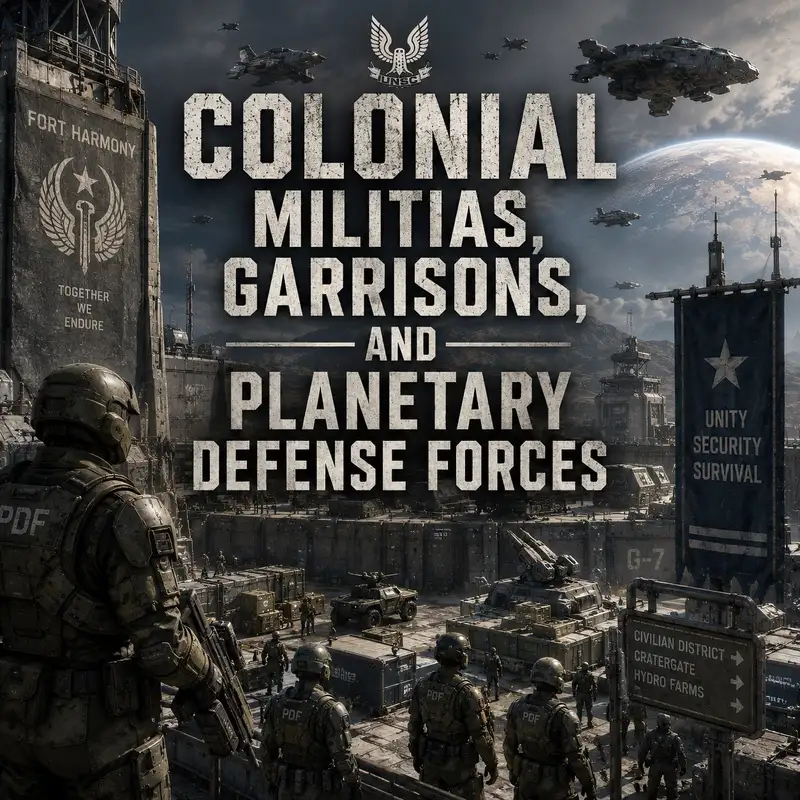
Colonial Militias, Garrisons, and Planetary Defense Forces
The Parliament of Harvest spent years arguing over whether its farmers and freight workers should be trained as soldiers. The official proposal described disaster response and internal security. The unofficial concern was the Insurrection. By the time every member finally agreed, Staff Sergeants Avery Johnson and Nolan Byrne had only a few months to turn civilians into a militia. Then the first Covenant ships arrived, and the force created for a human political crisis became the first organized human unit to fight an alien empire.
The militia could not save Harvest. It did something more realistic and, for the people trapped there, more immediate. Its members guarded refugees, escorted civilians toward transport, protected critical infrastructure, and volunteered for the attack that reopened the orbital route used by escaping cargo ships. They entered as part-time defenders and left carrying the first lessons of a conflict no central command had prepared them to fight.
Human planetary defense was never provided by one organization. It was layered among colonial militias, permanent garrisons, locally governed defense forces, regular United Nations Space Command branches, colonial authorities, police services, private security, and civilians who took up weapons after those systems began to fail. The categories overlapped in practice, but they were not interchangeable. Understanding the difference explains why some colonies could resist for years, why others collapsed within days, and why local defenders often distrusted the very government whose reinforcements they needed.
The Colonial Militia was a Unified Earth Government-backed auxiliary force trained and overseen by the United Nations Space Command. Its units fell under Unified Ground Command and were intended to safeguard colony worlds when regular forces were absent or too small. Members were local citizens rather than full-time expeditionary troops. They could provide emergency services, security, scouting, and a reserve of armed personnel who already understood the colony they were defending. Some later entered regular military service, carrying local experience into the Army or Marine Corps.
A garrison was different. It was not a separate branch, but a permanent military presence assigned to a world, station, base, or strategic facility. A garrison might include Army units, Air Force squadrons, Marine security personnel, communications teams, engineers, medical staff, and maintenance organizations. Its personnel served full time, trained within the regular military system, and answered through United Nations Space Command command channels. A major garrison could operate tanks, aircraft, sensors, and prepared defensive positions.
A planetary defense force was different again. The term referred to a military governed directly by a local planetary government rather than by the Unified Earth Government. Such forces could range from modest guards to professional organizations with aircraft, special operations personnel, or their own space capability. Their equipment and doctrine reflected local industry, political priorities, and relations with Earth. A planetary force might cooperate closely with the United Nations Space Command, remain suspicious of it, or prepare to resist it.
The Colonial Military Authority added another historical layer. It had been created to police and defend the colonies, with naval and marine elements working across the frontier. Its Marines coordinated militia operations and protected critical sites such as power plants and space elevators. Corruption, divided loyalties, and the growth of the Insurrection weakened the institution, and much of its role was absorbed by the United Nations Space Command. Some trained Colonial Military Authority personnel joined separatist movements instead. The central government inherited equipment and responsibilities, but not necessarily the confidence of the populations those forces had served.
These overlapping systems existed because interstellar distance made complete central defense impossible. A fleet based at Reach or Earth could not remain above every agricultural world, mining colony, and relay station. Slipspace travel varied, communications could fail, and a warning might arrive after the enemy had already entered orbit. Local defense forces were the people already present when the first sensor went dark. Their value began before reinforcements were requested and often continued after headquarters admitted that no reinforcements were coming.
Recruitment therefore emphasized availability as much as skill. A colonial militia might draw farmers, freight handlers, mechanics, utility workers, hunters, former soldiers, and local emergency personnel. Training by experienced noncommissioned officers gave them common weapons procedures, basic tactics, communications discipline, and enough organization to operate in squads or platoons. It did not turn a civilian volunteer into a Marine in two weeks. It created someone more useful than an untrained crowd when a storm destroyed a settlement, armed rebels attacked a facility, or alien dropships appeared over the road.
Local knowledge was their greatest advantage. Militia members knew which bridges could carry armored vehicles, which tunnels connected industrial districts, where civilian shelters had been built, and which farm tracks bypassed a blocked highway. They knew the technicians who could restart the water plant and the families likely to ignore an evacuation order until someone they trusted arrived in person. A regular battalion could bring heavier weapons. A local militia could explain what those weapons were defending and how to reach it without driving into a ravine.
That local identity could also complicate command. Militia members might obey a governor before an off-world officer. Planetary defense troops could see the United Nations Space Command as an ally, an occupying power, or a temporary necessity. During the Insurrection, local units sometimes divided between loyalty to Earth and loyalty to the independence movement around them. Central planners valued local manpower while worrying about political reliability. Colonists noticed the contradiction. The same government that doubted their loyalty still expected them to hold the power station until regular troops arrived.
Equipment reflected the realities of frontier service. Local forces often used older weapons, civilian vehicles, inherited Colonial Military Authority stocks, and aircraft that could be maintained by colonial industry. The Kestrel light strike aircraft became valuable because it was inexpensive, transportable, reliable, and designed for local manufacture with few parts required from the Inner Colonies. More advanced aircraft could offer better performance while demanding constant off-world support. A militia defending its home had little use for a superior machine grounded by one unavailable component.
This preference was not romantic attachment to obsolete equipment. It was operational arithmetic. A locally repairable aircraft could fly again after a damaged rotor assembly was rebuilt in a colonial workshop. A proprietary system waiting for a shipment from Mars remained an impressive object beside the runway. Garrisons and militias needed weapons whose ammunition, parts, tools, and technical knowledge existed on the same planet. Every improvement that increased dependence on distant supply had to justify what would happen after the route was cut.
Heavy defensive capability normally remained with regular garrisons and fixed installations. Tanks, mass drivers, long-range sensors, aerospace interceptors, and orbital-defense systems required trained crews and deep maintenance. Militias could guard those systems, supply scouts, carry ammunition, or defend the approaches. They could not replace the technicians, power infrastructure, and command networks that kept them operating. Planetary defense worked when local and regular forces covered one another's weaknesses rather than when each pretended to be a smaller copy of the other.
The defense of a world was therefore a system rather than a single unit. Sensors had to detect the approach. Communications had to carry the warning. Air and orbital forces had to contest the enemy. Ground troops had to protect generators, mass drivers, airfields, spaceports, and evacuation routes. Police and emergency services had to manage civilians. Engineers had to preserve power and transportation. Militias filled the spaces between those institutions, especially where the permanent garrison was too small to protect every settlement and every critical node at once.
Before the Covenant War, much of this effort was directed inward. Militias guarded against sabotage, terrorism, unrest, and natural disasters. Garrisons supported counterinsurgency, protected government facilities, and enforced emergency authority. The same structure that could save civilians during an evacuation could also police them during a political crisis. That history shaped how colonists interpreted mobilization. A new checkpoint might mean protection from attack. It might mean that the central government expected resistance.
Harvest carried that ambiguity from the beginning. Its militia required unanimous approval from a parliament reluctant to militarize the colony. The public justification emphasized emergencies and internal order. The hidden mission focused on possible Insurrectionist activity. Johnson and Byrne accelerated training after attacks on freighters revealed an unknown alien threat, but the recruits were not immediately told everything their instructors knew. The force began under a familiar combination of local consent, central secrecy, and intelligence officers pursuing a problem larger than the official explanation.
When first contact collapsed into violence, those recruits had to learn faster than any training schedule allowed. They guarded the meeting with the alien delegation, helped move refugees toward Utgard, and entered smaller communities to escort residents out. Some faced Yanme'e and Jiralhanae before humanity had established useful doctrine for either. Their weapons and organization gave them a chance to act. They did not erase the technological gap, and they could not defend every civilian scattered across the colony.
Their most important mission was tied to evacuation. One group volunteered to attack the Tiara orbital platform so civilian cargo ships could depart safely. Another defended the data center used by the agricultural artificial intelligence Mack. The militia was split between protecting the physical route off the planet and preserving the information systems coordinating survival below. The operation succeeded at a cost the small force could not easily absorb. Harvest was lost, but the militia helped convert commercial infrastructure into an escape system.
That outcome defined what colonial militias could realistically achieve against the Covenant. They could delay an advance, preserve a route, defend a control center, and buy time for evacuation. They could not defeat the warships above them or prevent orbital destruction once the wider defense collapsed. Their success had to be measured through people moved, information denied, and minutes gained. Judging them only by whether the colony remained on the map would erase the reason local defense existed.
Concord showed what became possible when militia and regular forces operated inside a functioning planetary system. In late twenty-five fifty-one, Concordian militia fought alongside United Nations Space Command Army Rangers during a Covenant attack. Local forces held positions around mass driver stations while regular units moved between threatened sectors. Pilots sacrificed aircraft to draw Covenant strikecraft into concealed anti-aircraft fire. Ground defenders denied the enemy easy control of the sky.
The colony's mass drivers were then used as improvised artillery against the limited Covenant presence in orbit, while a United Nations Space Command naval strike group completed the destruction of the enemy ships. Concord did not survive because militia rifle fire somehow defeated a fleet. It survived because local defenders, Army Rangers, aerospace forces, surface weapons, and naval power acted against different parts of the same problem. The militia held long enough for the heavier layers of defense to matter.
Reach displayed the less orderly version. The fortress world held enormous regular garrisons, military headquarters, training bases, airfields, orbital guns, and naval facilities. It also contained local armed groups outside the formal defense structure. Some militia members remained in evacuated regions to defend homes and recover weapons they had hidden from the United Nations Space Command. They were not simply another Army unit in civilian clothing. Their relationship with central authority was more suspicious and, in some cases, openly criminal.
Those local fighters still opposed the Covenant because political hostility toward Earth did not make alien extermination attractive. They knew the terrain and had reasons to remain after official evacuation orders moved regular priorities elsewhere. Their presence demonstrates why the term militia cannot be treated as one political category. A militia could be government-backed, independent, criminal, separatist, or improvised. What united these forces was local recruitment and limited reach, not one ideology.
Reach's fall showed the boundary of their contribution. Local groups could scout, guide regular forces, defend isolated settlements, and strike small enemy elements. They could not restore the orbital-defense network, rebuild communications, or stop Covenant reinforcements. Once the strategic system around them collapsed, they became pockets of resistance inside a lost theater. Their decision to stay could protect neighbors or preserve supplies. It could also leave them beyond any realistic extraction plan.
Years later, settlers returning to Reach again organized militia forces because the ruined world still lacked the security of an ordinary colony. When the Banished occupied parts of the planet, Blue Team formed an uneasy alliance with local defenders around New Mohács. The militia was rooted in reclamation communities whose members had returned to glassed territory and rebuilt among military ruins. Their defense was inseparable from the claim that Reach was still a home rather than only a former base.
New Mombasa revealed another form of local mobilization. Civilians took up arms during the Covenant attack, and official broadcasts promoted militia victories to sustain morale. Some claims were exaggerated or invented. The propaganda did not mean every armed civilian was imaginary. Local fighters and police helped protect movement through a city whose transportation, communications, and authority were collapsing. Their military effectiveness was limited, but their presence gave civilians escorts, information, and the belief that the streets had not been completely abandoned.
Meridian showed the cost of using militia as a convenient substitute for regular capacity. After the Covenant invasion, local fighters operated with young survivors and Office of Naval Intelligence direction against enemy activity around a Forerunner artifact. Command missteps cost the militia more than half its fighting strength. The mission still produced action behind enemy lines, but it exposed a recurring institutional temptation. Local troops were available, familiar with the terrain, and politically easier to risk than another regular battalion.
A planetary defense force could be more professional and independent than a militia. Sedra's Colonial Guard maintained order across a remote world, fielded trained personnel, and operated under its own colonial government. Its troops used a mixture of modern and older equipment and remained wary of the United Nations Space Command. When a biological attack struck Sedra City, the guard cooperated with an Office of Naval Intelligence team because the threat required capabilities neither side possessed alone. Cooperation did not erase the distrust that shaped it.
Venezia demonstrated the political independence local armed forces could acquire after separation from Earth. The colony's militia kept order in New Tyne while answering to power brokers aligned with the Keepers of the One Freedom, a Covenant remnant group that later pledged itself to the Banished. The force protected a functioning city populated by humans and former Covenant species, but it did not serve the Unified Earth Government. A colonial militia could preserve local order while supporting a political system hostile to the United Nations Space Command.
Permanent garrisons remained essential because local forces needed a professional core. Garrisons maintained plans, sensors, heavy weapons, training ranges, depots, medical facilities, and communications links. They gave militias instructors and a headquarters able to connect local reporting to regional command. They also provided a visible guarantee that the central government considered the colony worth defending. The size and quality of that guarantee varied considerably between a wealthy Inner Colony and a frontier settlement with one aging base.
Garrison life was less flexible than the militia image suggested. Fixed bases depended on power, fuel, ammunition, spare parts, and predictable access to transport. Their positions were known, their infrastructure expensive, and their personnel often responsible for more territory than they could physically cover. Militia allowed a garrison commander to protect several communities without dispersing every regular unit. The arrangement worked until local communications failed, political trust collapsed, or the militia discovered that its assigned support had been diverted elsewhere.
Once orbit was lost, every layer of planetary defense began operating under a shrinking set of choices. Garrisons lost resupply and aerospace support. Militias lost access to heavy weapons and medical evacuation. Planetary governments lost contact with the wider human network. Local forces could still protect shelters, destroy sensitive information, ambush occupying troops, and move civilians through terrain the invader did not understand. They could keep the colony resisting. They could not restore its connection to human industry by force of will.
This was why local defense remained useful even on worlds the Navy could not hold. Covenant forces still needed ground troops to seize artifacts, inspect infrastructure, control transport nodes, and hunt survivors. Militia could make those tasks slower and more expensive. A garrison could preserve command long enough to organize evacuation or denial operations. A planetary force could disperse into resistance rather than surrender its entire structure at one base. Losing orbit changed the objective from defeating the invasion to preserving whatever the invasion had not yet reached.
The postwar era increased the importance of these forces. The Unified Earth Government emerged with fewer ships, damaged colonies, renewed separatism, and threats ranging from Covenant remnants to the Created and Banished. Local governments could no longer assume that a central fleet would appear. Some expanded planetary forces. Others relied on corporate security, militias, or alliances outside Earth. Spartan Operations even drew experienced recruits from select planetary defense forces, acknowledging that professional military skill existed beyond the regular branches.
That growth carried political risk. A force raised to defend one colony might answer more strongly to local leaders than to the Unified Earth Government. It could become the foundation of independence, a tool of a corporate administration, or the armed wing of a faction hostile to Earth. Central officials could view this as fragmentation. Colonists could view it as the only rational response to decades in which distant authorities repeatedly failed to arrive before the attack.
Colonial militias, garrisons, and planetary defense forces were therefore not lesser versions of the United Nations Space Command. They were different solutions to the problem of defending scattered worlds. Garrisons supplied professional continuity and heavy capability. Colonial militias supplied local manpower, knowledge, and emergency depth under central oversight. Planetary defense forces supplied locally governed military power, sometimes as partners and sometimes as rivals. Their effectiveness depended on how well those systems connected before the shooting began.
The defenders of Harvest did not stop the first Covenant attack, and no honest assessment should pretend otherwise. They turned farms, freight lines, data centers, and cargo platforms into parts of an evacuation under fire. That was the measure of local defense when the fleet was absent and the enemy controlled the larger battle. A militia could not hold humanity's interstellar frontier together. It could keep one road open, one control room operating, and one transport moving long enough for part of that frontier to survive.