Combat Medicine, Casualties, Morale, and Unit Cohesion
A Jiralhanae chieftain drove the blade of a gravity hammer through Kojo Agu’s chest at the New Mombasa Police Department headquarters. The Orbital Drop Shock Trooper known as Romeo survived the immediate strike, but one lung was punctured and his condition deteriorated as Alpha-Nine searched for a way out of the city. Edward Buck applied biofoam through the damaged armor and kept the squad moving toward extraction. Romeo survived because somebody treated the wound, protected him, and preserved the route to further care.
That sequence is the practical center of combat medicine. Battlefield care is not a promise that every wounded soldier will recover. It is a race to keep a casualty alive long enough to reach the next level of treatment without sacrificing the entire unit. Halo’s wars place that race inside collapsing ships, glassing campaigns, failed evacuations, biological outbreaks, and occupations where the nearest hospital may be in orbit, destroyed, or controlled by the enemy. Medicine preserves people. It also preserves military organizations.
Casualty is a broader category than death. A force loses combat power through personnel killed, wounded, missing, captured, psychologically injured, contaminated, or separated from their units. The official total can mislead even when accurate. A Marine with a treatable wound may return. A pilot with damaged vision may never fly again. A ship reported missing may contain survivors nobody can reach. During the Human-Covenant War, whole garrisons disappeared with colonies, leaving casualty clerks to distinguish loss from uncertainty using records that had burned with headquarters.
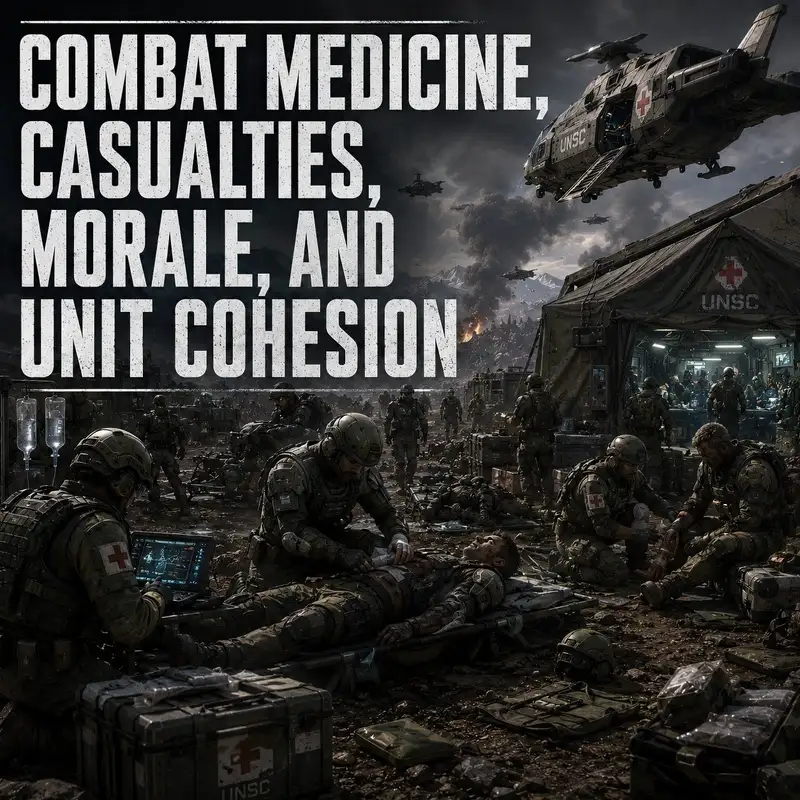
The survival chain begins with self-aid and buddy aid. A wounded person or nearby teammate controls bleeding, protects the airway, seals damaged armor, and gets out of immediate fire when possible. A medic or corpsman then stabilizes the casualty, identifies injuries that cannot wait, and decides who must move first. Collection points gather the wounded. Pelicans, ground vehicles, or shipboard teams carry them to surgery. Rehabilitation and replacement come later. Every link depends on security, communications, transport, and time.
Marine units normally relied on United Nations Space Command Navy hospital corpsmen attached to fight beside them. Army formations used medics, and special-operations teams often carried personnel with advanced trauma training. These people were not protected observers. They moved through the same fire, wore combat armor, and carried weapons because a dead medic treats nobody. Their equipment included biofoam, analgesics, dressings, monitoring tools, and supplies for controlling catastrophic injury until a surgeon or medical facility could take over.
Biofoam became the most recognizable part of that kit because it solved several immediate problems at once. The material expanded into a wound, helped control bleeding, sealed damaged tissue, reduced contamination, and provided pain relief. It was stabilization, not regeneration in the sense suggested by a health display. Biofoam could keep a casualty from bleeding out during movement. It could not rebuild an organ, remove shattered armor fragments, reverse brain injury, or replace the surgery and recovery that followed.
Some Mjolnir systems could administer biofoam automatically after detecting injury, giving Spartans a faster first response than most conventional troops. The armor also monitored vital signs, protected against environmental exposure, and transmitted medical information when the network remained available. None of this made a wounded Spartan self-sufficient. Damaged armor could trap fragments, restrict movement, or lose pressure. A Spartan still needed extraction, technical support, and medical personnel able to treat injuries inside a complex powered system.
Romeo’s treatment worked because Alpha-Nine still possessed several parts of the chain. Buck could reach him. The squad could suppress the enemy. Biofoam was available. The troopers could carry Romeo, reunite with Veronica Dare, and reach an extraction route. His injury reduced the squad’s firepower and changed how fast it could move, but it did not dissolve the unit. Medical care preserved one soldier and prevented the casualty from becoming the event around which every remaining decision collapsed.
That balance is difficult under fire. Stopping immediately may expose the wounded, the medic, and the security element to the weapon that caused the injury. Moving too quickly can worsen bleeding, spinal damage, or internal trauma. The team leader must decide whether to treat in place, drag the casualty behind cover, continue toward the objective, or break contact. The medic advises on survival. The commander remains responsible for the mission and the people who may become casualties while the first one is being saved.
Casualty evacuation is an air and logistics operation as much as a medical one. A Pelican requires a usable landing zone, fuel, a crew, current navigation, and protection from Banshees, anti-air guns, and orbital fire. A ground vehicle needs a road that has not become a crater or refugee column. When air superiority is lost, wounded personnel accumulate near the front. The medical system may possess excellent surgeons and no safe way to deliver patients to them.
Aboard a warship, the wounded enter another contested system. Med bays need power, atmosphere, sterile supplies, pharmaceuticals, and personnel. Damage-control teams may be sealing compartments while medical teams are opening routes toward surgery. Escape craft and Pelicans may be carrying evacuees rather than ammunition. A captain may have to choose between remaining near the surface to recover casualties and withdrawing before Covenant weapons destroy the ship. The medical decision is inseparable from survival of the platform providing care.
Installation Zero Four removed that platform almost immediately. The Pillar of Autumn was abandoned and later crashed, scattering personnel across the ring in lifeboats and dropships. Survivors established Alpha Base and recovered matériel from the wreck because they lacked a normal supply and medical chain. Every injured Marine required care from a shrinking pool of medics and supplies. A casualty who would have survived aboard an intact fleet might die because the surgical equipment, blood support, aircraft, or specialist needed for treatment had landed somewhere else.
The Flood turned casualty care into a containment problem. A wounded person was no longer only a patient. Exposure could make that person a source of infection, intelligence, and additional combat forms. Medics had to distinguish ordinary trauma from a biological threat they barely understood, while commanders decided whether quarantine was possible. Recovering bodies, evacuating the injured, and opening sealed compartments could spread the outbreak. Compassion without containment could destroy the force the medical system was trying to preserve.
Reach overwhelmed medical capacity through scale. Ground units fought around generators, airfields, cities, bunkers, and evacuation routes while Covenant control expanded above them. Hospitals and aid stations could be damaged, isolated, or forced to move. Pelicans needed for casualty evacuation were also carrying ammunition, specialists, and civilians. The wounded did not stop arriving because a shipyard was burning or a landing corridor had closed. Triage became the decision about who could survive with the resources remaining, not who deserved to survive.
The loss of Reach also removed infrastructure needed after immediate treatment. Rehabilitation centers, training establishments, hospitals, shipboard medical support, and specialist communities were part of the military system concentrated on the planet. Saving a wounded technician or pilot mattered only if there was somewhere to continue treatment and a unit to receive that person later. A fortress world can lose future combat power through destroyed hospitals and training pipelines even when some patients escape the bombardment.
Replacement is where casualty figures become force structure. A unit can receive new personnel and remain weaker because the replacements do not yet know the team’s routines, leaders, terrain, or private signals. A rifleman may be trained in months. An experienced corpsman, pilot, reactor technician, intelligence analyst, or noncommissioned officer takes longer. Spartan casualties were especially difficult to replace because augmentation, armor, training, and experience could not be reproduced on the timetable of a collapsing campaign.
The death of a squad leader removes more than one weapon. It removes knowledge of the commander’s intent, the route, the personalities in the team, and the moment when a frightened Marine needs a direct order rather than another map symbol. The loss of a medic changes how aggressively the unit can operate. The loss of the radio operator may isolate it. Personnel accounting treats these as individual casualties. The unit experiences them as missing functions improvised by people already carrying their own responsibilities.
Morale is often confused with confidence or enthusiasm. In military terms, it is a force’s willingness to continue acting toward its mission despite fear, loss, and uncertainty. A unit can be exhausted, angry, and grieving while retaining high morale. It can sound aggressive while losing the belief that orders have purpose, leaders are competent, or support will arrive. Halo’s troops rarely needed to believe they were winning the war. They needed to believe the next task was possible and their sacrifice would not be wasted through neglect.
Combat medicine directly influences that belief. Soldiers fight differently when they trust that a wounded teammate will be recovered, treated, and remembered. They fight differently when evacuation aircraft fail to appear, casualties remain beside the route, or commanders spend people without explaining the purpose. A functioning medical chain tells the force that survival remains part of the plan. Its collapse tells every person that a treatable wound may become a death sentence. That knowledge changes risk tolerance long before ammunition runs out.
Food, sleep, communication, and relief shape morale for the same reason. A Marine who has not slept, eaten, or heard from higher command is not displaying poor character by becoming less effective. The body and the organization are reaching their limits. Rumors fill the space left by absent information. A credible casualty report may be painful and stabilizing. An obviously false victory announcement can be worse than silence when the people receiving it stand beside evidence that the official situation is imaginary.
Leadership converts loss into meaning or resentment. A commander who shares danger, explains priorities, and preserves the unit when an objective becomes useless can maintain cohesion through defeat. A commander who conceals avoidable mistakes or abandons casualties may keep formal authority while losing trust. Miranda Keyes’s evacuation of Crow’s Nest preserved personnel when the bunker could no longer serve its purpose. Holding the corridors for symbolism would have added casualties without improving the defense of Earth.
Unit cohesion is the trust that lets personnel act before every order is explained. It is built through training, shared hardship, competent leadership, and the expectation that others will perform their roles. Halo’s fireteams and Spartan teams depend on this because communications often fail and battles separate units from higher command. Cohesion does not require affection or agreement. It means a Marine covers the movement, the medic enters the danger, and the wounded person believes the team will not leave without making a deliberate decision.
Noble Team entered the final defense of Reach with cohesion already shaped by replacement. Thom A two ninety-three had been killed during an earlier operation, and Noble Six joined to fill the vacant place. The team received little integration time before Winter Contingency began. Six had to learn Carter’s command style, Kat’s planning, Jorge’s experience, Emile’s aggression, and Jun’s reconnaissance role while the Covenant revealed a hidden invasion. Replacement restored the roster. Operations had to create trust.
The team then lost members faster than cohesion could be rebuilt. Jorge died destroying the Long Night of Solace. Kat was killed during the withdrawal from New Alexandria. Carter sacrificed himself to open the route toward the Pillar of Autumn. Emile died defending the ship’s launch position, and Noble Six remained behind to keep the route open. Each loss removed a specialty, a relationship, and part of the team’s shared memory. Noble Team continued because its members understood the larger mission, not because casualties left its structure unchanged.
Blue Team learned the same lesson at the beginning of the Covenant War. Samuel Zero Three Four remained aboard the Covenant ship Unrelenting after his armor was breached and escape through vacuum became impossible. His action ensured the demolition succeeded. The mission proved Covenant ships could be boarded and destroyed. It also removed one of Blue Team’s original members during its first encounter with the alien enemy. Tactical success and grief entered Spartan service together, and neither could be separated from the team that survived him.
The Office of Naval Intelligence later listed many fallen Spartans as missing rather than publicly killed. The policy protected operational information and supported their image as enduring symbols. It also concealed real deaths behind administrative language. Propaganda can strengthen morale outside the unit by offering a population a figure that appears impossible to defeat. Inside the unit, people still know which voice has disappeared from the channel. Institutional myth does not perform the work of mourning or replacement.
Orbital Drop Shock Trooper culture offered another form of cohesion. Units such as Alpha-Nine relied on shared risk, professional identity, and experienced noncommissioned officers. The squad argued, competed, and carried personal grievances. It still reorganized after the New Mombasa drop scattered its members because they understood how one another operated. Romeo’s injury tested that cohesion. The squad adapted its movement and mission around a wounded specialist without becoming only a casualty escort. That is mature cohesion under pressure.
Covenant forces faced similar problems inside very different institutions. Sangheili formations drew cohesion from military service, keep loyalty, religious belief, and confidence in commanders. Unggoy units could fight effectively when trained, supported, and led, despite imperial practices that treated their lives cheaply. Jiralhanae packs relied on pack hierarchy, personal authority, and rewards. Species stereotypes obscure the real issue. Morale depended on whether troops trusted the chain of command and believed the empire’s purpose justified what it demanded.
The Great Schism destroyed that trust faster than human firepower could have done. Sangheili units learned that the Hierarchs were replacing and purging them. Jiralhanae forces were ordered to attack former allies. Fleets, security detachments, and ground formations that had shared communications and doctrine became enemies within the same installations. Medical support, logistics, and evacuation fractured along political loyalties. The Covenant still possessed advanced weapons. Its unit cohesion had been converted into civil war.
The Banished built morale around a different promise. Atriox rejected the Covenant’s sacrificial theology and offered power, spoils, status, and survival to those who proved useful. That could produce strong loyalty to commanders and clans after victories. It could also rely on fear, coercion, and access to resources. Shortages at isolated outposts, rivalry among leaders, or the death of a respected war chief could expose the limits. A force held together by success must keep producing enough success to distribute.
The ambush of the Infinity at Zeta Halo created a medical and morale disaster in minutes. The ship carried med bays, surgeons, supplies, aircraft, command staff, and the network linking them. Survivors reached the ring in lifeboats and damaged transports, often without unit leaders or medical personnel. A wound that would have been routine aboard the flagship became dangerous in the open. The loss of the ship multiplied every later casualty because the force had lost the system that would have returned people to duty.
The wreck of the Mortal Reverie became valuable because it restored part of that system. Survivors used it as a rally point, shelter, depot, command post, and place where the wounded could receive organized care. It gave isolated Marines and Spartans evidence that the United Nations Space Command still existed as more than scattered individuals. When the Banished captured the site, they took more than terrain. They removed the institution around which medical support, information, and cohesion had begun to rebuild.
Combat Medic Lucas Browning represented the vulnerability of specialists in that campaign. The Banished captured him and forced him to assist with the release of the Harbinger before subjecting him to months of imprisonment and abuse. His medical training made him valuable beyond his rifle. Capturing a medic denied care to human survivors and gave the enemy a technically trained prisoner. Medical personnel in Halo are not outside the war. Their skills make them targets.
The Rubicon Protocol gave scattered survivors a framework when normal command could no longer reach them. Deny the enemy, preserve useful intelligence, resist when possible, and prevent capture of critical assets. Such guidance could not replace medicine, ammunition, or leadership, but it gave separate groups a shared purpose. Morale survives isolation more readily when people know what their actions are meant to accomplish. Cohesion can extend beyond face-to-face teams when a common protocol creates confidence that unseen survivors are working toward the same end.
Civilian casualties complicate every one of these systems. Hospitals, shelters, and evacuation routes serve populations as well as troops, while aircraft and medical supplies remain finite. Commanders may have to choose whether a Pelican carries wounded Marines, injured civilians, medical specialists, or ammunition needed to prevent more casualties. There is no morally clean allocation once capacity is inadequate. Treating civilians as outside the military problem guarantees that roads, hospitals, and public trust will fail in ways the operational plan did not count.
Survival continues after the battlefield. Burns, nerve damage, lost limbs, brain injuries, and prolonged exposure require rehabilitation and often prosthetics or reassignment. Psychological trauma can damage sleep, judgment, memory, and relationships without appearing on an armor diagnostic. Lucy B zero ninety-one survived Operation Torpedo after almost all of Beta Company was killed, but trauma left her unable to speak for years. Her survival was real. So was the injury that continued long after the mission ended.
An army can absorb casualties while it retains the ability to treat the wounded, replace lost functions, integrate newcomers, and convince survivors that the mission remains worth the cost. It begins to fail when casualties become permanent gaps, medics and transports disappear, leaders cannot explain why positions are still being held, and personnel expect abandonment more than recovery. The unit may still fire, move, and report combat effective while the trust required for another operation is already gone.
Romeo returned to Alpha-Nine because Buck’s biofoam application was only the first action in a larger chain of protection, movement, and care. That chain preserved a person, a marksman, and the squad’s belief that being wounded did not mean being discarded. Combat medicine, casualty replacement, morale, and cohesion are not separate subjects. They are the system by which a military proves that its people remain more valuable than the time required to save them. When that proof disappears, the army begins losing before its final weapon falls silent.