Combined Arms: Warthogs, Scorpions, Artillery, and Air Support
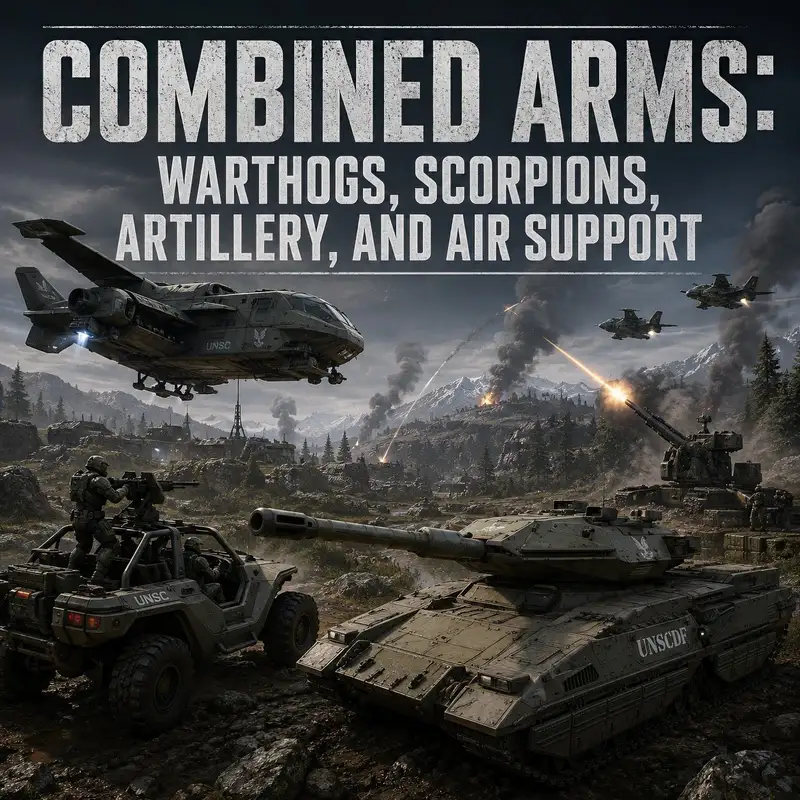
At Szurdok Ridge on Reach, the first human vehicles into the valley were not the heaviest ones. Warthogs and Mongooses formed the advance wave, carrying personnel and reconnaissance ahead of the armored body. Scorpion tanks followed with the weight to challenge Wraiths and fortified targets. Falcons and Pelicans moved above the ground force, while Longswords and frigates waited for anti-air defenses to be broken. The attack looked like a collection of famous machines. It was actually one weapon system made from many different parts.
That distinction is the foundation of combined-arms warfare. A Warthog provides speed but little protection. A Scorpion brings armor and direct fire but cannot see through every ridge or defend itself from every direction. Artillery can strike beyond line of sight but needs observers, communications, and security. Aircraft can move faster than the ground battle, yet they remain vulnerable to fighters, missiles, plasma batteries, weather, and the loss of a landing site. Combined arms works by making one element cover the limitations of another.
The United Nations Space Command did not fight planetary campaigns through one branch or one preferred vehicle. Navy ships delivered forces and controlled orbital access. Marines provided expeditionary infantry. Army formations defended colonies and conducted sustained ground operations. Air Force and service aviation moved troops, contested the atmosphere, and attacked surface targets. Orbital-defense personnel, engineers, intelligence units, artificial intelligences, and Spartans connected these forces to larger objectives. The service boundaries shown on organization charts became considerably less neat once the Covenant began burning the chart’s home planet.
The Warthog was the most visible link because it could perform so many ordinary jobs. The M twelve family served as a joint light tactical vehicle, reconnaissance platform, weapons carrier, ambulance, transport, and utility truck. A chaingun Warthog suppressed infantry and light vehicles. A Gauss-armed version gave a fast team an anti-armor weapon. Rocket variants added stand-off fire. Its value came less from one turret than from a common chassis units already knew how to drive, repair, fuel, and load onto a dropship.
Speed allowed Warthog crews to scout routes, screen flanks, escort convoys, and move infantry before the enemy adjusted. A driver, gunner, and passenger formed a compact team, but the vehicle worked best when linked to others. One Warthog could observe a Covenant column. Another could carry a missile team toward an ambush. A Gauss vehicle could attack from a different angle while infantry prevented the enemy from closing. The Warthog’s mobility turned terrain into an advantage, provided the driver understood that speed was not armor.
Its weaknesses were equally important. The crew was exposed. Concentrated plasma fire, mines, heavy weapons, and rough terrain could destroy the vehicle or separate it from support. The turret required a gunner who could be killed while the chassis remained functional. A Warthog moving far ahead of the squad’s radios or the tank platoon’s protection became a fast way to deliver three Marines into an unsupported fight. Combined arms asked the crew to use mobility so the enemy never received the clean shot a tank might have absorbed.
The Scorpion solved a different problem. The M eight zero eight main battle tank brought a heavy cannon, machine-gun protection, durable armor, and cross-country mobility to the direct-fire battle. It could destroy Covenant vehicles, breach fortified positions, and provide infantry with moving cover. Its independent track assemblies helped it negotiate debris and broken terrain, while a relatively compact crew reduced the personnel exposed inside each vehicle. Pelicans could transport Scorpions beneath their tail booms, allowing commanders to place heavy armor where surface roads did not yet connect.
A Scorpion was not a self-contained victory. Its size and firepower made it easy to detect. Banshees, Wraiths, fuel-rod weapons, mines, infantry attack teams, and heavy Covenant platforms could all kill it. Urban streets restricted movement and offered close approaches to the hull. Broken bridges and soft ground could turn mobility into an engineering request. Infantry screened the tank, Warthogs extended its observation, aircraft watched the approaches, and recovery crews kept damaged vehicles from becoming permanent roadblocks. The Scorpion was formidable. Maintenance schedules and destroyed bridges remained stubborn exceptions.
The tank’s main gun was direct fire. It was designed to engage targets the crew or supporting network could locate with enough precision to shoot. Artillery attacked the battlefield differently. It reached over terrain, struck assembly areas and defensive positions, disrupted movement, and forced the enemy to disperse. That effect mattered against Covenant forces whose technology often made a fair line-of-sight exchange a poor human career choice. Artillery allowed a commander to apply violence before infantry crossed the final exposed ground.
Human artillery did not consist of one universal vehicle. The Spirit of Fire fielded the S P forty-two Cobra, a hybrid self-propelled gun and tank destroyer that could lock down for heavier fire. The M one forty-five D Rhino was an unusual platform armed with a plasma cannon derived from Covenant technology, but it remained scarce. In the postwar era, the M four hundred Kodiak provided long-range fire from a wheeled chassis, deploying stabilizing braces before firing. Each represented the same trade: greater reach in exchange for reduced mobility and dependence on other units.
An artillery crew normally fought targets it could not see. Someone else had to find them. Scouts, infantry observers, drones, aircraft, sensors, or an artificial intelligence supplied coordinates and corrections. Communications had to survive long enough to move that information from observer to fire-control system. Friendly units had to report their own positions. The ammunition had to arrive, the weapon had to deploy on suitable ground, and the crew needed protection while firing. Artillery is sometimes called the king of battle. Kings still require staff, roads, guards, and a reliable supply of shells.
The fires also had to serve a maneuver plan. Bombarding a Covenant position without a follow-on action might destroy equipment and persuade survivors to move, but it did not seize the route. Artillery could suppress anti-air batteries while aircraft approached, isolate a strongpoint while armor attacked, or break up reinforcements moving toward infantry. Poor coordination produced craters where the commander wanted roads, smoke where pilots needed visibility, and friendly casualties where the map had promised an empty grid square. Advanced fire control reduced those risks. It did not abolish responsibility.
Air support operated in several layers. Pelicans were tactical aerospace lifters able to move troops, vehicles, supplies, and casualties between ships and the surface. They carried Warthogs, Scorpions, and resupply canisters beneath their frames, making them part of the ground force’s logistics as well as its aviation. Falcons gave Army units a smaller short-range transport and gun platform. Hornets conducted reconnaissance, close support, limited insertion, and attacks against isolated targets. Longswords and other strike craft reached farther, contested the air and near-orbital environment, and delivered heavier attacks.
These aircraft performed different missions because lift, protection, range, and firepower compete. A Pelican carrying a tank is not maneuvering like a dedicated attack craft. A Falcon can move a squad quickly through atmosphere but cannot replace a ship-to-surface logistics network. A Hornet can suppress a ground position and protect troops, but its frame limits what it carries and how long it remains. A Longsword can strike large targets and enemy aircraft, yet it needs targeting, fuel, munitions, and somewhere to recover. Calling all of them air support is accurate, but not especially helpful.
Air power also depended on suppression of enemy air defenses. Covenant anti-air guns, missile systems, Banshees, Seraphs, and warships could close an approach faster than a pilot could improvise another one. Ground forces therefore attacked batteries, marked emitters, and secured landing zones. Artillery and naval fires could suppress known sites. Fighters screened transport aircraft. Electronic warfare disrupted sensors and communications. The objective was rarely to make the entire sky safe. It was to make one corridor safe enough, for long enough, to move the force that mattered.
Command and control made these separate actions occur in the correct order. A battalion commander needed reports from scouts, tank leaders, infantry companies, pilots, artillery crews, and higher headquarters. Fire-support personnel had to clear targets. Aircraft needed current friendly positions. Navy officers above the planet needed to know whether an orbital strike would destroy the objective or the troops approaching it. Artificial intelligences could fuse sensor tracks and calculate solutions rapidly, but they still depended on accurate reports and lawful authority. A perfect firing solution aimed at an obsolete objective remained perfectly obsolete.
The combined-arms network was therefore fragile. Destroy a communications relay and artillery could lose its observers. Drive away the Pelicans and a tank force could lose fuel, ammunition, repairs, and evacuation. Gain air superiority and exposed Warthog columns became vulnerable. Destroy a bridge and the Scorpions might be unable to follow the infantry they were meant to support. Break orbital control and the entire expeditionary force could lose its heaviest logistics base. The vehicles remained present. Their military value began separating into smaller pieces.
Logistics decided how long the system remained combined. Warthogs needed fuel, tires, suspension parts, weapons maintenance, and ammunition. Scorpions needed heavy transport, recovery equipment, cannon rounds, track components, and trained crews. Artillery consumed specialized ammunition at rates that demanded a deliberate supply plan. Aircraft required munitions, maintenance personnel, spare parts, and protected operating sites. Medical evacuation competed for the same aircraft carrying reinforcements. A commander could mass combat power for one attack and discover that the force had used tomorrow’s supplies to win today’s ridge.
The Spirit of Fire demonstrated the value of carrying a balanced expeditionary force. Originally built as a colony ship and later converted for military support, it could deploy Marines, Warthogs, Scorpions, aircraft, engineers, and specialized vehicles during the campaigns of twenty-five thirty-one. On Arcadia, those forces fought while civilians were being evacuated and while the Covenant pursued Forerunner sites. The ground battle required mobility through populated areas, protection for evacuation routes, armor against Covenant vehicles, and aircraft to connect dispersed positions. No single platform could satisfy all of those demands.
The Spirit of Fire’s campaigns also show why the historical force cannot be read directly from simplified tactical displays. Vehicles did not appear merely because a commander requested them beside a completed base. They had to be carried, assembled, maintained, crewed, supplied, and delivered. The ship could bring a large ground package because its hull, hangars, workshops, stores, and personnel supported that purpose. Once isolated from human space, every loss reduced a finite inventory, even when the command display made replacement look reassuringly orderly.
Reach provided the clearest large-scale example. At Szurdok Ridge, the United Nations Space Command Army launched a major counterattack against a Covenant beachhead. Warthogs, Mongooses, and Scorpions formed the ground element. Falcons and Pelicans supported the advance. Longswords struck heavy targets. Frigates moved close enough to apply naval fire once Covenant anti-air defenses were disabled. Noble Team attacked critical points inside the larger formation rather than replacing it.
The sequence mattered. Reconnaissance identified the Covenant positions. Mobile ground forces carried the assault toward anti-air weapons and shield systems. Infantry and Spartans attacked components that heavy weapons could not simply erase from a distance. Once the defensive envelope weakened, aircraft and frigates approached. Armor and air power engaged the Covenant’s vehicles while the smaller assault elements reached the spires controlling the local concealment network. Every arm opened the path for the next one.
The attack achieved its immediate purpose and revealed its strategic limitation. After one spire was disabled, the frigate Grafton destroyed it from above. The concealed supercarrier Long Night of Solace then appeared and destroyed Grafton. The human force had coordinated ground maneuver, air support, and naval fire successfully against the known defense. The result exposed an enemy platform too powerful for the plan that had uncovered it. Combined arms can solve a tactical system. It cannot compensate for intelligence that has not yet found the main fleet.
New Mombasa demanded a different combination. The city’s roads, tunnels, bridges, buildings, civilians, and damaged infrastructure restricted heavy vehicles and aircraft. Warthogs moved Marines quickly along highways and through open sectors. Scorpions provided the firepower needed against Wraiths, fortified positions, and Scarabs, but required routes wide and strong enough to carry them. Pelicans inserted forces and delivered equipment wherever Covenant air defenses permitted. Infantry cleared close terrain that tanks could not safely search.
Urban combat made the protection relationship especially clear. Tanks needed infantry to watch upper floors, alleys, and approaches too close for the main gun. Infantry needed tanks to break enemy strongpoints and survive armored counterattack. Warthogs could move between threatened sectors but were vulnerable when streets channeled them into predictable paths. Aircraft could see across the city and shift forces rapidly, yet buildings and anti-air weapons limited their access. Combined arms in a city was not every weapon firing at once. It was each element creating space for another to work.
The advance toward Voi in November of twenty-five fifty-two showed the same logic at campaign scale. Marine and armored forces fought along the Tsavo Highway and into the Covenant-held town. Their ground objective included eliminating anti-air defenses and temporary positions so aircraft and naval forces could approach the Forerunner Dreadnought above the portal. Warthogs provided movement and mobile weapons. Scorpions supplied direct fire. Hornets and Pelicans supported the ground force once the air corridor improved. Longswords and frigates then attacked the larger target.
The strike failed to destroy the Dreadnought, but the ground operation was not meaningless. It cleared routes, reduced local defenses, and allowed human forces to concentrate near the portal. That distinction is essential. Combined arms does not guarantee that the final weapon can defeat the target. It guarantees that the chosen weapon receives a reasonable opportunity. When the target is a Forerunner vessel operating beyond the limits of human firepower, excellent coordination can still deliver an unsuccessful attack with remarkable precision.
At the Ark, combined arms became coalition warfare. Human Marines, armor, aircraft, and the forces carried by Forward Unto Dawn operated alongside Sangheili troops, vehicles, dropships, and ships from the Fleet of Retribution. The allies shared immediate enemies but not identical doctrine, communications habits, or political goals. Ground forces attacked barrier towers and Covenant positions while aircraft contested the approaches and heavy vehicles fought Scarabs. The operation worked because each force contributed capabilities the other could use without requiring complete institutional trust.
Coalition warfare also multiplied deconfliction problems. Human aircraft and Sangheili dropships needed recognition procedures. Ground units had to understand whose fires were crossing the objective. Commanders had to coordinate evacuation and pursuit across organizations that had been enemies only weeks earlier. A shared target simplified the map. It did not simplify history. Combined arms at the Ark was effective because practical cooperation outran political reconciliation for exactly as long as the campaign required.
Zeta Halo shows the inverse condition. When the Banished ambushed and disabled the Infinity, the survivors did not merely lose one large ship. They lost the center that connected airlift, armor, supplies, intelligence, medical care, command, maintenance, and orbital support. Warthogs and other vehicles could still fight. Marines could still form defensive groups. Spartans could still conduct raids. What disappeared was the ability to combine those actions consistently across the campaign.
The Banished exploited that fragmentation with their own combined-arms system. Patrols and scouts found isolated humans. Choppers, Ghosts, Wraiths, and heavier vehicles controlled routes. Aircraft moved troops and attacked exposed positions. Artillery and fortified outposts extended local reach. Salvage and fabrication turned captured matériel into sustainment. Their advantage was not that every Banished vehicle was superior. It was that the organization could connect reconnaissance, movement, firepower, and supply while human survivors were still trying to find one another.
Spartans fit inside combined arms as exceptional maneuver and assault elements. They could destroy an anti-air battery, seize a bridge, mark a target, breach a command post, or hold a point until armor arrived. Their armor and training allowed them to act where ordinary infantry would require a larger force. They still needed intelligence, transport, ammunition, maintenance, and an objective tied to the campaign. A Spartan could open the corridor. Warthogs moved through it, Scorpions widened it, aircraft sustained it, and conventional troops held what had been gained.
The playable battlefield compresses this system around one Spartan because that is where the immediate experience is strongest. A vehicle may appear ready, a Pelican may arrive at the required moment, and artillery crews may remain beyond the map. Historical analysis should restore what the game removes: maintenance sections, fuel convoys, air controllers, recovery vehicles, ammunition points, traffic plans, and headquarters managing several fights. Their absence from view is not evidence that the army solved logistics by placing useful equipment beside scenic roads.
Combined arms was one of humanity’s most reliable methods for narrowing the Covenant’s technological advantage. A Warthog could not defeat an empire, but it could put an observer where artillery became effective. A Scorpion could not control the sky, but it could destroy the battery preventing aircraft from entering it. A Falcon or Pelican could not hold ground, but it could place infantry and ammunition where the line was failing. A frigate could not safely approach until forces below removed the weapons covering the route. Each arm made another one more dangerous.
The method also revealed the limits of human industry. A balanced force required several vehicle families, trained crews, specialized munitions, compatible communications, dropships, repair facilities, and enough shipping to carry all of it between worlds. Colonies cut off from that network fought with whatever had already arrived. Fleets retreating from a system could not take every tank, aircraft, and artillery piece with them. Combined arms produces tactical flexibility by demanding an enormous logistical foundation. Humanity’s problem was rarely understanding the principle. It was preserving the foundation while the Covenant destroyed the worlds that supported it.
At Szurdok Ridge, the Warthogs did not matter because they were iconic, the Scorpions because their cannons were large, or the Longswords because they arrived from the sky. They mattered because scouts found the route, vehicles carried the assault, tanks defeated resistance, infantry broke the anti-air network, aircraft struck exposed targets, and a frigate exploited the opening. Then the hidden supercarrier destroyed the frigate and reminded every surviving commander that coordination cannot fire at an enemy intelligence has not revealed. Combined arms wins by connecting strengths. It fails when the battlefield is connected more completely than the force understands.