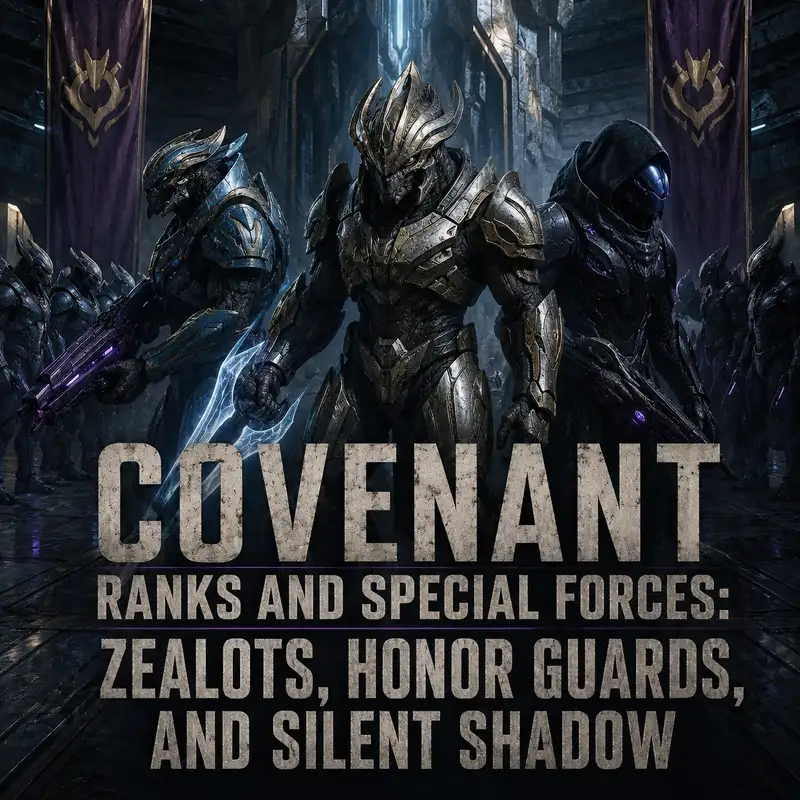
Covenant Ranks and Special Forces: Zealots, Honor Guards, and Silent Shadow
The order reached the Sangheili Honor Guards after the Prophet of Regret was already dead. They were to leave their posts, surrender the protection of the Hierarchs, and watch Jiralhanae warriors take the position their species had held since the Covenant’s founding. The official explanation was failure. The guards had not saved Regret from the human Spartan who killed him on Installation Zero Five. The real decision was political. The High Prophet of Truth had prepared the replacement in advance, and a change in security personnel became the opening movement of an imperial purge.
That moment explains why Covenant rank cannot be understood as a simple ladder. A human army can usually place a lieutenant beneath a captain and a captain beneath a major. Covenant authority depended on species, ministry, religious office, command appointment, warrior order, and personal patronage at the same time. Armor color offered clues, but never the entire answer. A Zealot, an Honor Guardsman, and a member of the Silent Shadow might all be elite Sangheili. They served different institutions, answered different needs, and could receive orders from different centers of power.
Most conventional Covenant fleets fell under the Ministry of Resolution. Fleets carried occupational forces, legions, lances, vehicle crews, naval personnel, and the large numbers of subordinate troops required to seize worlds and maintain an interstellar war. Sangheili dominated command, while other species were assigned roles shaped by the caste system. This was not one integrated joint force in the human sense. It was a military coalition organized around imperial hierarchy, with parallel chains of authority that could cooperate effectively until politics gave them reasons not to.
Human intelligence officers simplified what they saw. Sangheili were classified as Minors, Majors, Ultras, Generals, Rangers, Special Operations personnel, Zealots, and other recognizable battlefield types. Those labels were useful under fire. They were less reliable as a complete description of Sangheili institutions. A warrior’s armor might indicate status, specialist equipment, chapter membership, or local tradition. The same color did not always mean the same authority in every fleet. The Covenant’s personnel system was less a ladder than several ladders leaning against different ministries, with the Prophets deciding which wall mattered.
Species caste sat beneath every badge. An Unggoy could become an experienced veteran, receive improved armor, or enter Special Operations with a promoted Sangheili commander, yet strategic command remained reserved for species above it. Kig-Yar marksmen and Yanme’e protectors gained specialist status without equal political authority. Mgalekgolo were respected for combat power but did not enter the same promotion system. Jiralhanae advancement accelerated when the Prophets decided they could counterbalance Sangheili influence. Covenant rank therefore described several unequal careers rather than one merit system. Performance mattered, but the species assigned at birth still determined how high performance was permitted to rise.
Command titles added another layer. A shipmaster commanded a vessel. A fleetmaster coordinated a fleet. A field master directed ground forces. A Supreme Commander could hold authority over a major formation. These titles described responsibility, but did not always replace the warrior’s underlying rank or order. A Sangheili could be a Zealot and a shipmaster, or a Special Operations officer who later became a fleetmaster. Human translations often made the arrangement appear cleaner than it was. The Covenant itself had little incentive to make authority transparent to outsiders, or even to every subordinate inside the empire.
Rank also measured religious and political trust. Promotion brought improved armor, stronger energy shielding, better weapons, and larger commands, but it could also bring access to sacred sites and proximity to San’Shyuum officials. A technically capable warrior who lacked the correct patron or religious reputation might remain below a less capable rival. A favored officer could receive resources through one ministry that another commander could not obtain. This encouraged competition, initiative, and loyalty to immediate superiors. It also ensured that military coordination was never entirely separated from court politics.
The Zealots stood partly outside the conventional structure. Zealot was a high military rank within a distinct religious warrior order, not merely a human nickname for a Sangheili wearing gold armor. Their traditions predated the Covenant. Chapters preserved different codes of honor, obligations, and debt-packs, then adapted those traditions to imperial religion. Some chapters traced their identity to Sangheili institutions older than the Writ of Union. The Prophets did not create that warrior culture. They redirected it toward the search for Forerunner relics and the defense of Covenant doctrine.
Unlike most fleet forces, Zealots answered to the Ministry of Fervent Intercession. Their principal duty was not ordinary occupation. Small teams were attached to important campaigns to identify reliquaries, study ancient sites, recover artifacts, and protect discoveries from damage or theft. This placed them wherever religion and military operations overlapped. A conventional commander might want a city bombarded. A Zealot team might forbid the strike because a Luminary indicated sacred material below it. Superior technology did not remove friction from the chain of command. It occasionally made the argument theological.
Zealots also held major command responsibilities. They could serve as shipmasters or Supreme Commanders, while the rank of Field Marshal belonged specifically to the Zealot order. A Field Marshal could direct full-scale ground operations, command several legions, and report to the fleet’s highest commander. The title did not place its holder safely behind the line. Field Marshals were expected to appear near decisive objectives, sometimes leading small strike teams when relic recovery or the elimination of a critical target demanded personal involvement.
Their equipment reflected both status and mission. Zealots received advanced combat harnesses, powerful shielding, specialized insertion systems, and access to weapons unavailable to ordinary ranks. The exact configuration varied by chapter and fleet. Their greatest advantage was not one armor pattern. It was the combination of experience, authority, technical support, and permission to act independently around sacred objectives. A Zealot team could redirect local forces because the recovery of Forerunner technology carried religious importance greater than the survival of an individual commander.
The Devoted Sentries on Reach showed how this worked in practice. Supreme Commander Rho ‘Barutamee hand-picked a Zealot force for the Fleet of Valiant Prudence and assigned it to recover Forerunner artifacts. Field Marshal Orsu Lar ‘Ahtalee directed its ground operations. The fleet entered Reach covertly, using concealment and advance teams while its personnel searched for relics. The first Covenant forces discovered by Noble Team were therefore not a conventional invasion army announcing the full weight of the empire. They were religious military specialists protecting an archaeological operation with planetary consequences.
Orsu’s pursuit of Noble Team across Reach combined command, vengeance, and mission security. His warriors appeared around communications sites, military facilities, urban fighting, and the ship-breaking yards at Asźod. Orsu killed Kat-B320, and forces under his command later helped stop Emile-A239 from protecting the Pillar of Autumn’s launch. He was finally killed by Spartan-B312. The engagement history shows why Field Marshal was more than decorative status. Orsu could direct formations at campaign scale and still intervene personally at the point where one human ship threatened the Covenant’s objectives.
The Devoted Sentries were effective, but their sacred mission narrowed their priorities. Their fleet found Reach because it followed Forerunner evidence. It sought artifacts while the wider war demanded the destruction of humanity’s military center. The distinction mattered after the Pillar of Autumn escaped and reached Installation Zero Four. The Zealots had treated Forerunner discovery as the highest objective because Covenant doctrine required it. Their success in finding sacred technology helped place human forces on the ring that exposed the religion’s central lie.
Zealot orders survived the Covenant because their identity was older and more flexible than one government. Some warriors abandoned the Great Journey after the Great Schism. Others continued to worship the Forerunners while rejecting the Prophets. Postwar factions reused Zealot titles for combat leaders and formed new chapters such as the Silent Blade. The armor and language remained recognizable, but the political meaning changed. A postwar Zealot might defend a warlord, lead a relic expedition, or pursue religious restoration without answering to High Charity.
Honor Guards served a different purpose. The Covenant established them near the beginning of the union between the San’Shyuum and Sangheili. Their assignment was the protection of the Hierarchs, the High Council, major ministers, and the institutions that claimed to speak for the gods. This made the Guard both a security force and a constitutional symbol. Sangheili warriors protected San’Shyuum leaders because the founding bargain said military strength and religious authority would sustain one another.
Selection brought exceptional prestige. Honor Guardsmen were chosen from highly skilled warriors and placed close to the empire’s most important political figures. Their red and gold armor made that privilege visible. Ceremonial energy staves reinforced the image, though guards carried practical weapons when combat was expected. They could deploy plasma rifles, carbines, energy swords, vehicles, and the same lethal training that had earned them selection. The ornamentation was not a substitute for capability. It was capability converted into political theater.
The most senior Sangheili within the Guard formed the Lights of Sanghelios. These warriors protected individual San’Shyuum, secured important ministry towers, and supervised ordinary Honor Guardsmen. Their position offered access to officials and locations closed to most of the military. That access created influence, but it also confined them to protective duties. Some respected Sangheili declined Honor Guard service because it promised ceremony rather than the front-line combat through which warrior reputations were usually built. Turning down the position could be interpreted as religious disobedience, which made the career discussion unusually direct.
Protective service demanded a different discipline from battlefield command. The Guard had to secure chambers, landing zones, council sessions, processions, temples, and transport routes. It needed intelligence on threats before those threats reached weapon range. A skilled swordsman could stop an attacker in a corridor. He could not personally screen every distant firing position, inspect every servant, or command every ship defending the principal. The Covenant celebrated visible martial prowess, but executive protection succeeds most often through planning that nobody notices.
The record contains several failures that demonstrate the limitation. A San’Shyuum official on Heian was killed by a long-range human attack before his guards could close with the infiltrators. Regret reached Installation Zero Five with surviving Honor Guards, yet human forces crossed the lake, penetrated the temple complex, and killed him. The guards fought. They could not compensate for Regret’s strategic isolation, the arrival of the human frigate In Amber Clad, and a command structure that had brought the Hierarch into a vulnerable position.
Truth used Regret’s death as proof that Sangheili protection had failed. He and the Prophet of Mercy ordered the old Guard to stand down and transferred the duty to the Jiralhanae. The High Council had not approved the change. Sangheili councilors protested, and some sought protection from other Sangheili troops because they did not trust the new guards. The appointment was presented as a security reform. It functioned as a declaration that the founding military species no longer held the confidence of the state.
That change helped begin the Great Schism because Honor Guard status represented more than employment. Removing the Sangheili from the post announced that their ancestral duty, political standing, and access to the Hierarchs could be transferred to their rivals by decree. Jiralhanae guards then supported the isolation and killing of Sangheili leaders. The armor still indicated elite protection. The person wearing it now indicated which species the Prophets intended to preserve. A security badge had become a targeting indicator.
The Silent Shadow occupied a third category. It was not another name for every Covenant Special Operations unit. The broader Special Operations branch conducted infiltration, advance reconnaissance, guerrilla action, shipboard assault, and high-value attacks. Its teams could work with conventional formations or remain isolated under classified orders from a Hierarch. Sangheili officers dominated command, though subordinate personnel from other species could accompany them. The Silent Shadow was a smaller order inside that system, built around assassination and extraction.
Several squads formed the Silent Shadow, usually under leaders carrying the title First Blade. Its members were chosen for swordsmanship, stealth, close combat, and the ability to reach targets protected by ordinary military security. Their missions included human leaders, Spartans, disobedient Covenant commanders, and anyone whose removal served the Hierarchs. The order’s rules captured its political purpose. Members concealed their faces even from senior officers because one day they might be ordered to kill those same officers. The Covenant had institutionalized plausible deniability and provided it with active camouflage.
The Silent Shadow’s roots also reached into pre-Covenant Sangheili history. The order preserved old martial and religious traditions, then placed them in the service of the empire. Under the Prophets, assassination became a sacred act when directed against the correct target. This gave the Hierarchs a force capable of enforcing obedience without mobilizing a fleet or staging a public trial. It also gave Silent Shadow personnel a professional identity not entirely dependent on the government employing them.
Early in the Human-Covenant War, First Blade Tel ‘Szatulai and other Silent Shadow operatives were attached to the Fleet of Inexorable Obedience. They scouted human defenses and later helped the Bloodstars hunt Spartan Twos. On Zhoist, Silent Shadow warriors confronted Blue Team during the attack on the Ring of Mighty Abundance. Their purpose was precise. They were not there to hold territory or manage thousands of troops. They were there to remove the small human force capable of destroying a strategic construction complex.
The same organization hunted Covenant officers who became inconvenient. When fleetmaster Nizat ‘Kvarosee fell from favor in twenty-five twenty-six, Silent Shadow forces pursued him to Netherop, destroyed his remaining ability to escape, and helped bring him under High Charity’s judgment. The mission demonstrates the order’s internal-security function. A commander could survive human action and still face a specialist unit sent by his own government. Covenant officers understood that promotion brought authority, visibility, and a more capable class of potential executioner.
Later in the war, Silent Shadow operatives prepared an ambush for Spartan Three Headhunters on Rangiren. The Spartans believed they were attacking a Covenant excavation base. The assassins allowed the infiltration to proceed, then struck after the demolition charges had been placed and the attackers had relaxed. Roland-B210 was killed. Jonah-B283 detonated the charges around himself rather than surrender. The explosion killed most of the Silent Shadow team. Jega ‘Rdomnai survived, carrying the order’s methods into the postwar era.
Their equipment supported that form of war. Silent Shadow armor combined energy shielding, active camouflage, adaptive visual properties, and full-faced helmets designed to conceal identity. Blood-red energy swords became a symbol of fear rather than public honor. Experimental systems improved infiltration, but did not make the wearer invisible to every sensor or immune to concentrated fire. Small teams still depended on intelligence, timing, secure transport, and extraction. When surprise failed, elite assassins could become heavily equipped personnel standing inside someone else’s demolition plan.
The Great Schism broke the institution’s political direction without erasing its skills. Resa ‘Azavayl led one squad in a campaign to kill Jiralhanae after the betrayal of the Sangheili. When the unit confronted Atriox, several members decided the Banished leader offered a more useful future than revenge under their existing commander. They killed Resa and joined Atriox. Jega ‘Rdomnai and Inslaan ‘Gadogai later served Banished interests in different roles. The transition showed how easily elite capability could survive the death of the ideology that had justified it.
Zealots, Honor Guards, and the Silent Shadow were therefore not points on one ascending scale. Zealots joined religious authority to battlefield command and relic recovery. Honor Guards joined martial prestige to political protection. The Silent Shadow joined special operations to assassination and internal control. A Sangheili’s title, armor, and assignment had to be read together. Calling all three elite was correct. Treating them as interchangeable was not.
For human intelligence, that distinction could change a mission plan. Zealots near a site suggested Forerunner material or a target with religious importance. Honor Guards indicated the presence of a political principal, council facility, or protected ministry asset. Silent Shadow activity suggested a planned decapitation strike, extraction, or punishment operation. Identifying the unit did more than estimate how difficult the firefight would be. It helped reveal what the Covenant valued and what it intended to do next.
The system produced formidable specialists. Parallel institutions preserved old Sangheili traditions, rewarded unusual skill, and gave commanders forces designed for precise problems. The same system fragmented authority. Ministries guarded information. Warrior orders developed separate loyalties. Political patrons promoted favored personnel. Species hierarchy limited cooperation. A conventional fleet commander, a Zealot chapter, an Honor Guard captain, and a Silent Shadow First Blade might all serve the Covenant while understanding service through different obligations.
Truth exploited those divisions because the Covenant’s ranks were also maps of trust. He elevated Jiralhanae commanders, removed Sangheili guards, isolated councilors, and turned security appointments into the machinery of a coup. Zealots divided over faith and species. Special Operations forces followed local commanders. Silent Shadow squads selected new enemies or new patrons. The empire did not lack elite troops during its collapse. It lacked an authority those troops still agreed was legitimate.
The Covenant’s most dangerous warriors carried the symbols of the institutions that employed them. Gold marked sacred purpose. Red and orange marked proximity to political power. Deep crimson and a hidden face marked violence the state did not intend to explain. Those distinctions made the military more capable while the empire remained stable. When the Prophets broke the founding bargain, the same distinctions organized the civil war. The changing of the Guard did not merely replace one protective unit with another. It revealed that Covenant rank had always answered a political question before a military one: who was trusted to stand closest to power, and who would be killed when that trust ended.