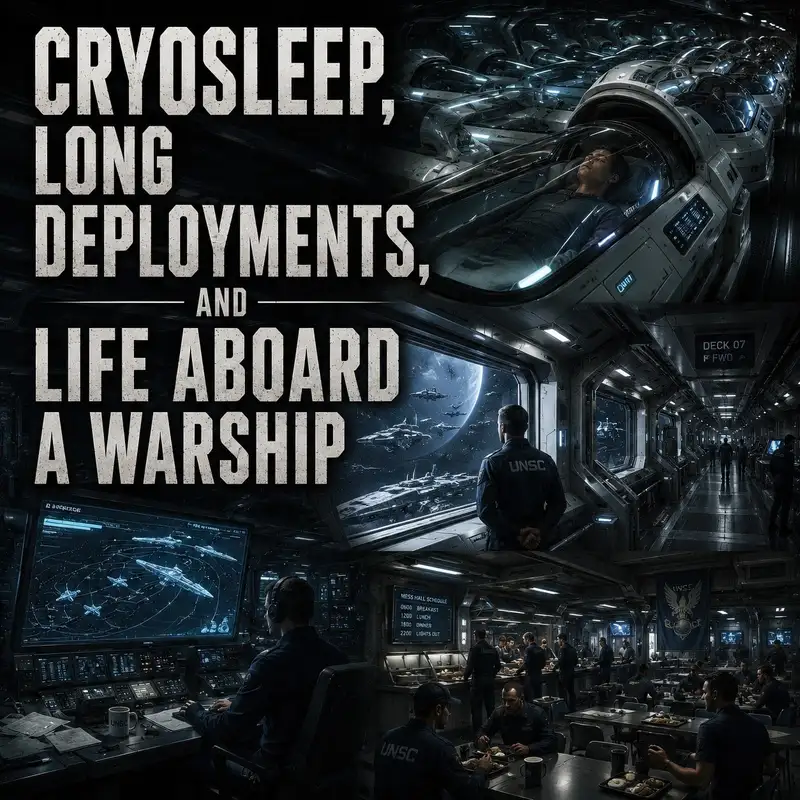
Cryosleep, Long Deployments, and Life Aboard a Warship
The crew of the Spirit of Fire went to sleep in twenty-five thirty-one believing that the Covenant War was still young, Harvest had only recently been reclaimed, and a long journey home might still be possible. They awakened at the Ark in twenty-five fifty-nine. Twenty-eight years had passed. The Covenant War was over, the empire had collapsed, and the people and institutions they had known outside the ship had changed or disappeared without them. Cryosleep had preserved the crew. It had not preserved the world they expected to return to.
That contrast defines cryogenic travel in human military service. Cryosleep made long interstellar voyages practical, reduced the supplies consumed by passengers, preserved injured personnel, and allowed stranded crews to survive waits measured in years. It did not make distance disappear. It transferred part of the cost into machinery, medical risk, power demand, maintenance, and time experienced unevenly by the people aboard. A sailor could cross several systems without aging much during the journey, then awaken to discover that the strategic map, the chain of command, and the meaning of home had all changed.
Human slipspace drives transformed civilization, but early and wartime drives were not precise gates between fixed points. Transit duration varied. Ships departing together could emerge separately. Older drives could require weeks for journeys newer vessels completed faster, and unfamiliar routes carried additional uncertainty. A warship therefore had to be a weapon, a transport, and a closed habitat capable of surviving far longer than its tactical mission suggested. Cryogenic stasis was one of the systems that made that endurance possible.
A cryotube lowered a person into a medically controlled state in which biological activity and aging were greatly reduced. The occupant required far less food, water, oxygen, living space, and daily medical support than an awake passenger. On a large troop movement, those savings multiplied across hundreds or thousands of people. A transport could carry combat personnel through a long voyage without feeding them three meals a day, finding bunks for every shift, or asking an infantry battalion to remain patient in confined spaces for several weeks. The last advantage was not formally listed in most technical manuals, but ship captains appreciated it.
Cryosleep also allowed military planners to preserve trained personnel through the dead time of transit. A Marine, pilot, Spartan, or specialist who had no role in operating the ship could be awakened shortly before arrival rather than spending the journey losing conditioning, consuming stores, and accumulating fatigue. The personnel needed to navigate, maintain, and protect the vessel remained available through watch rotations. Everyone else became cargo with medical requirements and a service record.
That arrangement was never as simple as placing the crew in freezers and asking an artificial intelligence to wake them near the objective. Cryogenic systems monitored temperature, circulation, neurological activity, and the pharmaceuticals used to keep the occupant stable. Medical personnel inspected the chambers and prepared the sleepers. Technicians maintained the equipment that sustained them. The ship still needed power, cooling, sensors, navigation, and an awake command element. A failure in a cargo hold might destroy supplies. A failure in a cryo bay could kill personnel who had no ability to respond.
Normal revival took time. Medical staff brought the occupant back gradually, assessed circulation and cognition, treated side effects, and confirmed that the person could safely return to duty. Emergency or flash thawing could accelerate the process when a ship arrived under attack, but speed came with disorientation, pain, and reduced effectiveness. Augmented Spartans tolerated rapid recovery better than ordinary personnel, yet even they required orientation and equipment checks. A commander could wake a battalion quickly. That did not mean the battalion became combat ready at the same instant.
This created a vulnerable period before arrival. The ship’s navigation team needed the best possible estimate of emergence time. Cryo technicians and medical personnel needed enough warning to begin revival. Armorers had to issue weapons, pilots had to reach aircraft, and troops had to move from cryo bays toward assembly areas without blocking damage-control routes. If the ship emerged early, late, or directly into combat, every minute of waking became part of the battle.
The Pillar of Autumn demonstrated the danger at Installation Zero Four. The cruiser emerged from slipspace into a hostile system and was engaged almost immediately by Covenant forces. Personnel who had been asleep during the transit had to be revived, briefed, armed, and moved while the ship fought for survival. The cryo bay that had conserved lives during the voyage became one more compartment exposed to boarding, fire, decompression, and evacuation orders. Cryosleep had delivered the force to the battlefield. It could not guarantee that the force would be awake before the battlefield reached the ship.
Cryotube capacity was therefore a logistical measurement, not a convenience. A vessel carrying more people than its chambers could support had to provide additional food, water, sanitation, medical care, atmosphere processing, and sleeping space for the awake passengers. In one postwar evacuation, an older courier’s slow slipspace drive meant the journey could take weeks, while the ship lacked cryogenic chambers for even half the personnel assigned to it. The solution was not to ignore the shortage. Crews loaded more rations, medical kits, and supplies because every missing cryotube converted a sleeping passenger into a continuing life-support requirement.
This was especially important during colony evacuations. A civilian transport might have room for bodies but not enough stasis chambers, provisions, or environmental capacity to keep everyone alive through the intended route. The difference between physical space and sustainable capacity could decide who boarded. A governor looking at an open cargo deck might see room for more evacuees. The ship’s engineer saw heat load, carbon dioxide, water consumption, sanitation, and the unpleasant possibility that the destination would not be ready when the transport arrived.
Cryosleep could also serve as medical preservation. Severely wounded personnel could be stabilized and placed in stasis until advanced treatment became available. Linda Zero Five Eight survived catastrophic injuries during the fall of Reach because she was placed in cryogenic suspension and carried away aboard the Pillar of Autumn. The chamber preserved a patient whom ordinary shipboard care could not restore immediately. It did not heal her by itself. Survival still depended on the chamber being ejected before the Autumn went down, recovered after the ring’s destruction, and eventually delivered to medical personnel capable of treating her.
The Master Chief’s years aboard the severed aft section of the Forward Unto Dawn showed a different emergency use. With no active crew, no dependable rescue schedule, and limited resources, he entered cryosleep while Cortana continued monitoring the drifting wreck. He awakened as the remains of the ship approached Requiem years later. The chamber turned an otherwise unsurvivable wait into suspended time. It also left the sleeper completely dependent on one damaged vessel and one increasingly unstable artificial intelligence to recognize when waking had become necessary.
Most warship life occurred outside cryo, and it was less dramatic than the awakening scenes suggest. Ships operated continuously. The bridge, engineering spaces, communications stations, tactical systems, hangars, medical facilities, and life-support sections required watch teams around the clock. Sailors worked while others ate or slept. Marines trained, maintained weapons, guarded sensitive spaces, and waited for deployment. Pilots reviewed routes and aircraft status. Intelligence personnel processed reports whose age might exceed the patience of the commander receiving them.
Artificial gravity made movement through many human warships familiar, but not necessarily comfortable. Its pull could feel different from a homeworld or station, and battle damage could disrupt it. Air was filtered and recycled until every compartment shared the same metallic, mechanical character. Machinery produced vibration and noise even during quiet transit. Lighting followed schedules rather than sunrise. A ship could travel through darkness while maintaining an artificial day for thousands of people who knew that the nearest real sky might be several systems away.
Privacy depended on rank, ship size, and mission. Senior officers might have individual cabins, though command spaces ensured they were never entirely off duty. Enlisted sailors and embarked troops used shared berthing, compact bunks, and rotating schedules. A berth could belong to more than one person on different watches. Personal possessions had to fit around equipment designed for survival and combat. Naval architects could provide additional comfort only by taking volume from machinery, ammunition, stores, armor, vehicles, or another department equally certain that its requirement was essential.
Meals provided one of the few predictable breaks in that routine. Mess spaces gave crews a place to eat, exchange information, complain about maintenance, and briefly encounter people outside their own section. Fresh food depended on storage and the length of the deployment. Packaged meals, preserved ingredients, and recycled water became normal as voyages continued. Good chow could improve morale out of proportion to its strategic significance. Bad chow could produce a level of unity among the crew that command had not intended but generally deserved.
Water and atmosphere were not background systems. They were the conditions under which every other system remained useful. Recycling reduced resupply needs, but filters, pumps, scrubbers, pipes, and storage tanks required maintenance. A leak in an empty compartment could become a shipwide loss if it reached a critical line. Fire threatened oxygen as well as structure. A damaged atmosphere processor could impose limits on how many personnel remained awake. Cryogenic storage reduced that burden, but only while the chambers and their support systems continued functioning.
Waste heat presented another constant problem. Reactors, drives, weapons, computers, and living bodies all produced it. A warship had to move that heat through internal systems and eventually release it without damaging the vessel or revealing more of its signature than the tactical situation allowed. Crew comfort was part of the calculation, but machinery usually received priority because machinery did not accept motivational speeches when its operating temperature was exceeded.
Maintenance occupied more of a deployment than combat. Technicians inspected engines, cryogenic systems, weapons, armor seals, aircraft, communications equipment, and life support. Crews repaired small failures before they became emergencies and documented parts that would need replacement at the next yard. In wartime, the next yard might already be destroyed, overloaded, or several systems away. A ship could remain officially operational while accumulating a private inventory of systems being held together through cannibalized parts and professional optimism.
Damage-control training unified the crew because combat could turn any specialty into a survival task. Sailors drilled for decompression, fire, flooding from internal systems, electrical failure, reactor emergencies, and hull penetration. Marines could defend corridors against boarders, but they also needed to understand sealed bulkheads and emergency breathing equipment. A weapons officer whose battery was disabled might become part of a repair party. Rank remained important. The pressure door closing behind a damaged compartment was less interested in anyone’s career plan.
Long deployments placed a different burden on command. Captains had to manage readiness without exhausting the personnel required for the next crisis. Watch schedules, training, maintenance, inspections, intelligence briefings, and disciplinary problems all competed for time. Keeping everyone awake because combat might occur eventually guaranteed that an exhausted crew would meet it. Freezing everyone who was not immediately needed conserved resources but reduced the force available for boarding defense or sudden emergencies. The correct balance changed with the mission and the quality of the warning.
The ship’s artificial intelligence could ease that burden by monitoring systems, scheduling maintenance, coordinating navigation, and identifying changes that human watch teams might miss. Smart artificial intelligences could manage several departments at once and preserve a coherent picture during crisis. They still relied on sensors, power, access, and human authority. They also had their own service limits. Serina remained behind while much of the Spirit of Fire’s crew slept, sustaining the ship and preparing for an uncertain future. She ended her own operation years before the crew awakened, as rampancy approached.
That detail changes the apparent simplicity of the Spirit of Fire’s survival. The crew entered cryo, but the ship did not simply wait untouched for twenty-eight years. Automated systems, an artificial intelligence, and the vessel’s remaining machinery preserved them. Serina’s work extended beyond the period her human shipmates consciously experienced. By the time they awoke, the person who had watched over their sleep was gone. Cryosleep had allowed thousands to outlast the voyage by assigning the passage of time to systems and minds that could not all make the same journey.
The awakened crew faced a form of temporal displacement more severe than ordinary deployment. The Covenant War had ended. New alliances and enemies existed. Equipment once considered current was obsolete or difficult to support. Families had aged, moved, or died. Colonies had been destroyed. The United Nations Space Command that issued their orders in twenty-five thirty-one was not the institution operating in twenty-five fifty-nine. The personnel remained trained, disciplined, and physically capable. Their context required rebuilding.
Even normal cryogenic travel created smaller versions of that separation. A service member might spend months or years of a career in stasis across repeated deployments while relatives experienced those periods continuously. Messages waited at the destination, arrived out of order, or described events already overtaken by war. A sailor could awaken to a promotion list, a death notice, and orders to defend a colony that had been attacked while the ship was still in transit. Cryosleep preserved the body. It made no promise about continuity of life.
This affected unit identity. Shipboard crews became communities because they shared a timeline outsiders did not. The people who maintained the same reactor, stood the same watches, and woke from the same transit understood which incidents had become jokes and which names no one mentioned during meals. Embarked Marines and soldiers developed their own culture, often regarding the sailors as both transport and home. Interservice rivalry survived because familiarity creates affection more slowly than it creates detailed complaints.
Discipline mattered during long inactive periods because boredom could damage readiness as surely as fatigue. Training schedules, physical conditioning, inspections, education, and maintenance gave structure to days without combat. Too much routine could become mechanical. Too little produced declining standards and personnel searching for entertainment in systems the engineering department preferred they not touch. A capable command team used routine to preserve purpose without pretending that another inspection of an already clean compartment was a strategic achievement.
Medical departments managed more than battle casualties. They treated illness, repetitive strain, sleep disruption, accidents, stress, and the side effects of cryogenic travel. They monitored whether personnel could safely reenter stasis and whether repeated freezing and thawing had produced complications. Mental health mattered because a ship could combine confinement, danger, delayed communication, grief, and uncertain return. The culture of the service did not always make it easy to report those problems before they affected performance.
War magnified every ordinary difficulty. A voyage that began with full stores might end after unplanned detours, rescue operations, or battles that consumed ammunition and medical supplies. Refugees could fill compartments designed for troops. Damaged ships could transfer survivors to vessels already near capacity. The cryo bays might contain wounded personnel, passengers, specialists, or individuals whose security clearance made their survival a command priority. Life-support calculations became moral decisions wearing the language of engineering.
No amount of cryosleep replaced replenishment. A sleeping crew consumed less, but the ship still needed reactor support, spare parts, coolant, missiles, magnetic accelerator projectiles, medical stocks, and repair capacity. Cryo could preserve a pilot through a year of drifting. It could not manufacture a replacement fighter. It could keep Marines alive until arrival. It could not provide the dropships required to place them on the surface. Suspended personnel were preserved capability, not usable power, until the ship could wake, equip, and deploy them.
The Covenant understood enough of human shipboard vulnerability to make boarding attacks strategically useful. A successful boarding party could reach the bridge, reactor controls, artificial intelligence core, navigation database, or cryo compartments before every defender mobilized. The Cole Protocol made information denial as important as survival. A captain might have to purge records, destroy an artificial intelligence, or abandon sleeping personnel rather than allow the enemy to recover routes leading to another colony. Cryogenic stasis could protect a person from time. It could not protect that person from the decisions made outside the chamber.
Some postwar designs improved automation, medical systems, armor support, and living facilities, but the underlying problem remained visible. Slow drives still made supply planning essential. Limited cryotube capacity still determined how many people could endure a voyage without consuming full stores. Artificial gravity still felt artificial to someone raised beneath a planet’s sky. Recycled air remained recycled air, no matter how advanced the ship carrying it. Technology made long deployments possible. It did not make them ordinary to the people living through them.
Cryosleep, long deployments, and life aboard a warship formed one connected system. The cryotube reduced consumption and biological aging. The ship sustained the machinery and the people who remained awake. Watch rotations kept command, navigation, maintenance, and defense functioning. Logistics determined how long the arrangement could continue. Culture and discipline held the crew together when orders, communications, and home became distant abstractions.
The Spirit of Fire’s crew awoke with nearly three decades removed from their bodies and added to everyone else’s lives. Their ship still carried weapons, vehicles, training, and a functioning chain of command. It also carried obsolete assumptions, old grief, and no simple route home. Cryosleep had accomplished exactly what it was designed to do. It delivered the same people into a different age. Life aboard a human warship was built around that contradiction: distance could be survived, time could be suspended, and neither could be defeated.