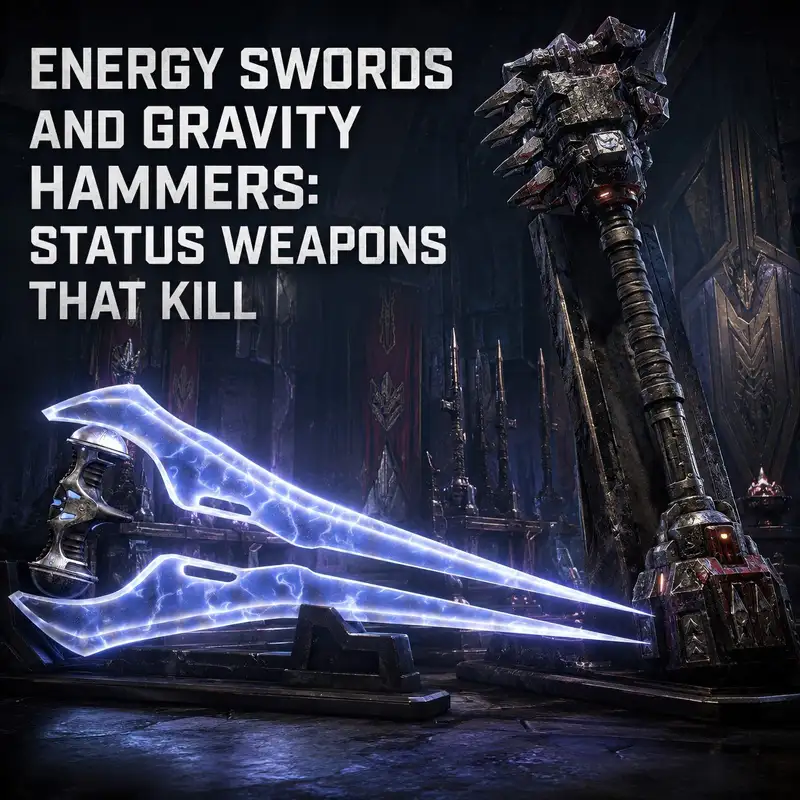
Energy Swords and Gravity Hammers: Status Weapons That Kill
At the control room of Installation Zero Five, the argument over who would command the Covenant’s future had already become a melee. Tartarus stood before the firing controls with the Fist of Rukt, an ancestral Jiralhanae war hammer transformed by Covenant gravity technology. The Arbiter approached with Sangheili councilors, zealots, and special operations warriors carrying energy swords. Their weapons were not incidental. The hammer marked Tartarus as Chieftain of the Jiralhanae and enforcer of the Prophet of Truth. The swords marked the martial standing of the warriors opposing him. What followed was a fight over the Halo Array, but it was also a contest between two rival systems of authority, each represented by a weapon that could kill at arm’s length.
That is the contradiction at the center of both designs. The Covenant possessed plasma rifles, particle beams, guided munitions, armored vehicles, and warships capable of burning cities from orbit. Its warriors still carried swords and hammers. These were not nostalgic ornaments dragged into a modern battlefield. Sangheili and Jiralhanae technology turned traditional weapon forms into practical instruments against armor, energy shields, vehicles, and tightly packed infantry. Their cultural meaning then made them more useful, and more dangerous, than their physical effects alone would suggest.
The energy sword emerged from a Sangheili weapons tradition older than the Covenant. Ancient curveblades and twin-scythes established forms that survived as the technology changed. During early Sangheili interstellar expansion, the arms masters of Qikost produced burnblades, weapons that remained in limited use even after more advanced designs appeared. As Sangheili artisans incorporated technology learned from Forerunner relics and later Covenant industry, the solid blade gave way to the modern fireblade. The outline remained recognizably Sangheili. The material inside that outline became contained plasma.
When activated, an energy sword projects two blades of superheated plasma from a grooved hilt. Magnetic fields hold the plasma in a stable contour rather than allowing it to disperse into the surrounding air. The hilt contains both the energy supply and the field-generating machinery. That compact assembly is one of the weapon’s greatest technical achievements. It turns a handle small enough to carry at the hip into a cutting surface able to burn through armor, structural material, and flesh. Stored power is finite, and a depleted sword must be recharged or replaced. Advanced technology still arrives with a battery problem.
The blade does not cut in the ordinary mechanical sense. Contact transfers immense heat, boiling and destroying material along the weapon’s path. Against a person, the result can include catastrophic tissue damage, flash-vaporized fluids, and wounds sealed at the surface while deeper organs have been ruined. The cauterization sometimes makes the injury look cleaner than it is. It is not clean. Against armor, the blade can exploit seams or simply apply enough heat to defeat material that would resist ordinary edged weapons. Against another energy sword, the containment fields can meet without both blades immediately passing through one another.
That lethality does not make the sword a sensible choice in every fight. Its effective range is measured in the distance the wielder can cross before being shot. Sangheili sword users therefore rely on speed, energy shields, active camouflage, surprise, confined terrain, or supporting fire. Boarding actions, shipboard passages, urban interiors, and defensive chokepoints reduce the advantage of a rifle. Open ground restores it quickly. A sword carrier seen crossing a clear field has provided the enemy with a high-priority target and a very straightforward firing solution.
The Sangheili accepted that risk because swordsmanship was tied to identity and rank. In civilian tradition, access to energy-sword training was associated with aristocratic status. The Covenant military was less rigid. A warrior did not always need noble birth, but lower-ranked Sangheili were generally denied the weapon, while zealots, ultras, generals, honor guards, stealth specialists, and special operations officers commonly carried it. Exceptions existed, because military institutions occasionally discover that a useful warrior does not fit the social diagram. The general rule remained visible. Drawing a sword announced that its bearer had been trusted with more than an ordinary weapon.
That trust included training. Sangheili sword combat was not a matter of igniting the blade and charging toward the nearest target. Warriors practiced footwork, timing, feints, shield management, and attacks suited to the horizontal hilt. Blademasters gained renown through sustained study and victory. The dual-sword discipline known as pzish’zawk demanded an even greater level of control. A master did not merely carry two lethal devices. He had to keep both plasma fields, his own limbs, and nearby allies from becoming participants in an instructional accident.
Personal swords reflected that investment. Mass-produced models could be comparatively plain, while ceremonial or master-crafted weapons carried ornate hilts, proverbs, maker’s marks, and the history of earlier owners. Blade contours and colors identified patterns, affiliations, or specialist roles. Some designs included a fail-safe that destroyed or permanently disabled the weapon when dropped, denying it to an enemy. The mechanism protected technology, but it also protected meaning. A fireblade was not supposed to become common battlefield salvage in the hands of anyone quick enough to pick it up.
Carrying the weapon also shaped how others read the warrior. An openly displayed sword could signal readiness, prestige, or a claim to martial authority. Surrendering it could mean submission. Refusing to surrender it could become a political statement. After the Covenant’s collapse, Sangheili protecting the Arbiter rejected demands from Created armigers to discard their personal blades because the weapons were inseparable from their duty to defend him. The armiger saw a prohibited weapon. The Sangheili saw a relationship of service and honor that no outside security instruction had the authority to dissolve.
The Covenant used that cultural weight. Energy swords appeared with honor guards around the Hierarchs, with zealots pursuing relics, and with special operations forces whose missions depended on stealth and decisive violence. The weapon made elite status visible across species lines. An Unggoy or Kig-Yar did not need to understand every Sangheili custom to recognize that the sword carrier was probably important, dangerous, or both. That visibility helped command and intimidation. It also helped enemy snipers decide whom to shoot first.
The sword’s meaning was never uniformly honorable. Bloodblades, whose red plasma marked assassins and special operatives such as the Silent Shadow, were symbols of fear rather than public virtue. Jega ’Rdomnai carried Ghostpierce, a personalized blade incorporated into his prosthetic arm, turning injury, technical modification, and reputation into one weapon system. Such swords showed how easily the language of honor could coexist with clandestine killing. A society may call one blade noble and another terrifying. The person on the receiving end experiences a less philosophical distinction.
The Great Schism transformed the energy sword without making it culturally neutral. Sangheili who turned against the Prophets carried the same weapons they had used in service to the Covenant. The blade now defended warriors the empire had ordered Jiralhanae forces to purge. Thel ’Vadam’s personal sword, Prophets’ Bane, made the reversal explicit in its name. The technology had not changed sides by itself. Its owner had changed the political story attached to it.
Postwar factions inherited the patterns, forges, and surviving blades. The Swords of Sanghelios used energy swords as part of a reformed military identity. Covenant remnants used them to claim continuity with the old empire. The Banished permitted extensive customization and treated the weapon’s worth more pragmatically, yet personal status remained. Okro ’Vagaduun acquired his Duelist Energy Sword only after killing his former master, Toha ’Sumai, as proof that loyalty to Atriox outweighed his earlier bonds. The blade was a reward, a severance ritual, and a warning about what Banished advancement required.
The gravity hammer came from an equally old tradition and expressed a different political culture. Before Covenant gravity drives were fitted to the weapon, Jiralhanae leaders carried enormous war hammers as clan objects, execution tools, and proof of authority. The form suited a species with the strength to use a weapon that would be impractical for most humans and awkward even for many armored troops. More important, the hammer made command visible. The individual carrying it did not need a rank insignia translated into several languages. He looked like the leader because he carried the object associated with leadership.
The most important of these objects was the Fist of Rukt. Its head incorporated rare and resilient material recovered in the early history of Doisac. Chieftain Rukt used it during the Great Immolation, the destructive conflict through which the Jiralhanae nearly ruined their own civilization. The hammer survived, was repaired and reforged, and passed through the ruling clan from one chieftain to another. It became a holy object as well as a weapon. Each bearer inherited the authority of the previous bearer and the burden of proving he deserved it.
By the opening of the Human-Covenant War, Maccabeus carried the Fist as chieftain of his clan. His nephew Tartarus came to believe that Maccabeus had become unfit to command. During the fighting at Harvest, Tartarus challenged him, killed him, and claimed both the hammer and leadership. The succession was not recorded through a committee vote or a carefully managed transfer ceremony. The weapon moved to the survivor. In that political system, the Fist did not merely symbolize authority after the duel. Possession of it helped establish who had won the right to command.
The Prophet of Truth later turned that Jiralhanae tradition into an imperial tool. After elevating Tartarus, Truth had the Fist of Rukt fitted with Covenant gravitic technology. The modification created the template for standardized gravity hammers. Other chieftains commissioned their own variants, often incorporating material from ancestral weapons when possible. Covenant industry had not erased clan history. It had attached a power core to it, increased its battlefield effect, and made the resulting symbol useful to the Hierarch who was building a rival military leadership beneath the Sangheili.
A gravity hammer typically combines a long haft, a massive head, a reverse blade, a gravitic drive, and repurposed impellers. When the head strikes, the system creates a localized kinetic pulse that can throw personnel, displace heavy objects, and damage targets beyond the exact point of contact. Some designs can pull an object toward the wielder or drive it away. The physical swing still matters. The Jiralhanae operator supplies strength, momentum, and aim. The gravitic system then makes the consequences larger than the hammer’s mass alone should permit.
This gives the weapon a tactical role closer to a breaching tool and shock weapon than a conventional club. A chieftain can break a defensive line, scatter a group, overturn equipment, or create space in a crowded engagement. The reverse blade remains available when a focused strike is preferable. A hammer can threaten light vehicles and armored personnel, while the pulse can affect opponents who avoided direct contact. The weapon is especially dangerous in passages, courtyards, and landing zones where several targets occupy the same confined space.
The same pulse creates risk. Friendly troops can be thrown aside with the enemy. Loose equipment becomes debris. A strike inside a ship can damage systems the boarding party hoped to capture. The wielder must close through rifle, plasma, and explosive fire before the hammer can dominate the engagement. His size, armor, and weapon make concealment difficult. When Sergeant Avery Johnson first reported a giant hammer on a Jiralhanae leader, he had also identified the logic of the weapon. The hammer told human troops whom the formation followed.
Covenant chieftains used that visibility to control their packs and subordinate species. The hammer could enforce an order in the most literal possible way. Tartarus used the Fist of Rukt against rivals who challenged his position and against those the Prophets placed under his authority. The weapon combined ceremonial legitimacy with immediate coercion. A chieftain did not have to choose between carrying a badge of office and carrying an execution device. Covenant engineering had helpfully placed both functions on the same haft.
In the final months of twenty-five fifty-two, the Sacred Promissory began producing gravity hammers in much greater numbers. The timing matters. The Prophet of Truth was preparing Jiralhanae forces to replace and then purge the Sangheili. Producing their weapons was part of producing their political authority. New hammers equipped chieftains who would command assault packs, enforce the new hierarchy, and kill former allies. An industrial order inside High Charity translated a secret political decision into equipment appearing in frontline hands.
During the battles on Earth and the Ark, Jiralhanae chieftains carried gravity hammers at the front of shock assaults. The weapon suited aggressive movement through human defenses and gave troops a visible point around which to rally. It also concentrated risk. Killing the hammer bearer could remove both a major close-combat threat and an important command figure. The same object that amplified authority made decapitation easier. Status weapons are excellent for morale until the person carrying one falls where everyone can see.
The Fist of Rukt demonstrated the full range of the technology at Installation Zero Five. Tartarus used its gravitic systems to seize the monitor known as Three Forty-Three Guilty Spark, pull Commander Miranda Keyes toward him, and hurl the Arbiter into the depths below. In the control room, its area effect allowed Tartarus to hold off multiple Sangheili warriors at close range. Yet the hammer could not resolve the larger political collapse around him. Sergeant Johnson’s fire and the Arbiter’s attack eventually killed Tartarus. The symbol of Jiralhanae ascendancy fell with the chieftain who had carried it.
The Banished inherited nearly every major gravity-hammer template after the Covenant dissolved. Their war forges reproduced old models, modified them, and created dozens of variants. Hammers became more common among warlords, jump-capable assault troops, and other high-value fighters than they had been under the Covenant’s stricter hierarchy. That broader issue did not remove status. Banished commanders still used personalized weapons to advertise glory, workshop connections, pack identity, and access to rare improvements. In an organization built around earned power, a superior hammer was both equipment and résumé.
Atriox carried Chainbreaker, a gravity mace built from Jiralhanae weapon traditions and modified into a personal command weapon. It helped him defeat Spartan Two Red Team on the Ark and later overpower the Master Chief aboard the Infinity. Escharum carried the Diminisher of Hope, a custom gravity hammer incorporating additional cutting capability and tuned to its owner’s aggressive style. These were not standard products selected from a depot shelf. They were extensions of command personalities, designed to make a leader’s presence physically undeniable.
Other Banished variants adjusted gravitic cores, swing characteristics, power capacity, and secondary effects. En’Geddon’s Rushdown Hammer reflected a fighting-pit culture in which executions and challenges established standing. The Mutilator later integrated gravity-hammer technology into a double-barreled close-assault weapon, showing that the mechanism could be separated from the full ceremonial form. Even then, Banished artisans surrounded new designs with invocations, pack loyalty, and promises of glory. Engineering changed quickly. The political language attached to it remained durable.
The energy sword and gravity hammer produced different kinds of close combat. The sword concentrated lethal heat into a precise line. It favored speed, timing, stealth, and individual technique. The hammer spread force through an area. It favored physical power, shock, disruption, and command presence. A sword duel could establish personal mastery. A hammer blow could scatter an entire group and make the wielder appear larger than the formation around him. Both weapons turned a kill into a public statement about the person delivering it.
Neither system made ranged weapons obsolete. Sangheili sword users required shields, concealment, and supporting fire to reach the target. Jiralhanae hammer users required armor, aggression, and troops able to occupy the enemy while the chieftain closed. Human forces learned to create distance, focus fire on the visible leader, use explosives, and avoid bunching inside a hammer’s effective area. Spartans could wield captured swords and hammers with unusual success, but doing so did not grant Sangheili honor or Jiralhanae command. They acquired the physical capability, not the social office.
The supply burden also survived the romance of the duel. Energy swords required charged power units, functioning field generators, specialized forges, and artisans able to maintain patterns built for Sangheili users. Gravity hammers required gravitic cores, impellers, power, structural materials, calibration, and workshops capable of repairing damage from repeated impacts. Captured weapons could be used until depleted or broken. Sustained issue required the industrial and cultural systems behind them. Humanity could pick up the symbol. It could not manufacture the history attached to it.
These weapons endured because status and lethality reinforced one another. The energy sword was prestigious because mastering it demanded skill and courage, and because it could kill through armor at intimate range. The gravity hammer marked leadership because few could carry it effectively, fewer could command the technology and workshop support behind it, and everyone nearby understood what happened when it struck. Ceremony did not reduce combat value. Combat value gave the ceremony credibility.
At Installation Zero Five, the Arbiter’s allies brought swords and Tartarus brought the Fist of Rukt because both sides were fighting as members of political cultures that expected authority to be visible. The swords did not save the Covenant. The hammer did not preserve Truth’s new order. They did something more revealing. They showed that even an interstellar empire with advanced ranged weapons still relied on leaders who could stand close enough to kill personally. In the Covenant and the powers that followed it, command was carried in the hand, powered by a battery or gravitic core, and proven when someone else did not rise from the floor.