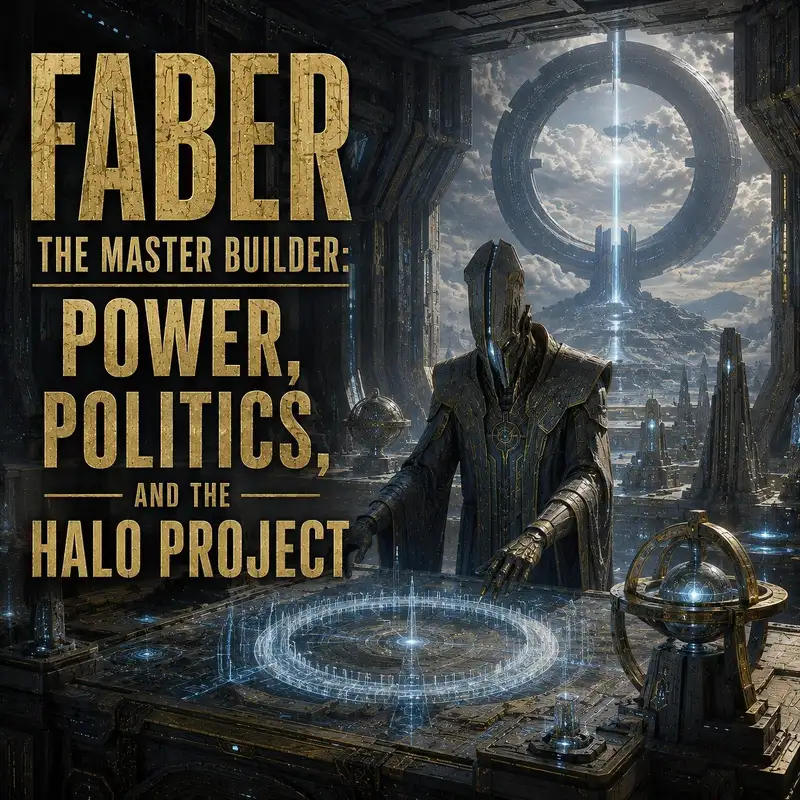
Faber the Master Builder: Power, Politics, and the Halo Project
Faber ordered a Halo brought over Janjur Qom after the battle was already decided. Builder Security had broken the San’Shyuum rebellion, and the surviving population no longer posed a threat requiring such a weapon. The Master Builder fired anyway. The ring sterilized the world as punishment for resistance. Halo had been approved as a final measure against the Flood. Faber used it as an instrument of political discipline. In that single decision, the project’s central danger became visible. The weapon could kill on a planetary or galactic scale, and it was controlled by an official who treated emergency authority as personal property.
Faber-of-Will-and-Might is usually remembered as the corrupt architect of the Halo Array and the political enemy of the Didact. Both descriptions are accurate, but neither explains why he remained powerful for so long. Faber did not impose Halo through engineering alone. He united fear of the Flood, Builder wealth, industrial dependency, Council politics, artificial intelligence, and the language of the Mantle into one program. He offered a solution designed, funded, constructed, and controlled by his own rate. Halo became the center of Forerunner government, and Faber grew stronger as institutions depended on the project he claimed only he could complete.
The title Master Builder was not ceremonial. Builders designed ships, ancillas, cities, weapons, and megastructures. Every fleet required their yards. Every Lifeworker preserve required their laboratories and transports. Regional administrations relied on infrastructure their guilds maintained. The head of that rate therefore controlled technical expertise, patronage, production, and access to projects measured in worlds. Faber stood at the top of this system. He was exceptionally intelligent, politically experienced, and able to make other leaders’ ambitions depend on his approval. He understood that the official defining an emergency often decides which institution receives the resources to meet it.
Faber had not always opposed the Didact. During the war with ancient humanity, the two were allies, and Faber supported the Didact’s proposal to neutralize the human threat rather than exterminate the species. He helped create Mendicant Bias with the Didact and authorized the design seed for Mantle’s Approach, the warrior’s enormous command vessel, without first securing full Council approval. These decisions show that Faber could support military judgment and accept limits when it suited the balance of power. The later rivalry was not inevitable. It emerged after victory, when the Forerunners had to decide how they would prepare for the Flood’s return and which rate would control that preparation.
The Didact’s answer was a defense system centered on Warrior-Servants, fortified shield worlds, mobile fleets, and campaigns intended to contain or defeat the parasite without killing the galaxy. Faber’s answer was Halo. The distinction was strategic and institutional at the same time. Shield worlds kept the military necessary, depending on commanders, secure transit, garrisons, and active resistance. Halo promised a technical solution whose central assets would be designed and operated through Builder power. The Didact asked the ecumene to sustain a permanent war establishment against an enemy that might return. Faber offered a project that appeared final. Governments often prefer final solutions, especially when their sponsors control the budget.
The fear behind Faber’s proposal was genuine. Ancient humanity had fought the Flood and appeared to have discovered a biological cure. The Forerunners knew enough to understand that the parasite could turn population, knowledge, and technology into enemy strength. They did not know humanity’s apparent cure was a deception created by the Flood’s withdrawal. Faber could therefore argue that the next outbreak might outrun conventional defense before a real countermeasure was found. A weapon removing sentient hosts across an infected region, or the galaxy, would deny the Flood the minds and bodies needed for expansion. The logic was brutal, but it was not imaginary.
Faber’s political achievement was converting that fear into an approved industrial program. The Didact and the Prometheans delayed the project for thousands of years, but the Builder rate continued to accumulate influence while the Warrior-Servants declined after the human war. Faber promised security and prestige, while Builders anticipated profit. The Council eventually accepted his proposal, and the Didact entered exile. Builder Security absorbed functions once held by independent Warrior-Servants. The rate responsible for constructing the weapon also gained authority to protect it, police its opponents, and manage the information surrounding it. Political oversight had not replaced military dominance. One bloc now combined procurement, security, and policy.
The first Ark, later called the greater or senescent Ark, embodied the scale of Faber’s victory. Located beyond the Milky Way, it manufactured twelve original Halo installations. Each ring was roughly three times the diameter of the later Array’s installations. Their weapons could direct pulses toward selected regions rather than only producing the final omnidirectional effect associated with the smaller rings. The project required immense material, energy, transportation, ancillas, and protected construction space. It was an economy organized around a theory of survival, with Faber at its center.
The original design also contained serious defects. The rings were so large that moving them created immense reconciliation debt in slipspace and made deployment difficult. The greater Ark could not simply be retooled to manufacture smaller installations. Tests revealed instability and limits that sponsors were reluctant to advertise. Faber initially resisted acknowledging those failures. That response was predictable and dangerous. A project advertised as the answer to extinction could not admit its first model was cumbersome and strategically inflexible. The Builders had created a device capable of killing civilizations and found that transport remained a logistics problem.
Criticism eventually forced redesign. Faber commissioned a second, secret Ark and a smaller, more efficient group of rings. The lesser Ark, Installation Zero Zero, was hidden beyond the galaxy, and its location was known to very few. The new rings were more lethal and easier to deploy as a coordinated array. Faber’s willingness to authorize the redesign showed technical realism, though not institutional humility. He expanded the program, classified the replacement, and retained control of the final production site’s location. The contingency for a compromised Ark depended on the discretion of the man whose judgment had already compromised the project.
The Lifeworkers nearly stopped Halo through political resistance. The Librarian and her rate argued that a weapon designed to erase sentient life violated the Mantle the Forerunners claimed to uphold. They threatened to withhold their labor and demanded a plan for preserving species if the rings were ever fired. The compromise became the Conservation Measure. Biological preserves, research environments, transport systems, and reseeding infrastructure were added to the Halos and Arks. Faber accepted the arrangement because it made the project politically defensible and helped Halo compete with the Didact’s shield worlds. The concession later made galactic restoration possible while allowing Faber to describe extermination infrastructure as preservation.
Once the Flood war intensified, that compromise was corrupted. Lifeworker specimens on the rings became subjects for infection experiments authorized by Faber. Humans received special attention because some appeared resistant to the parasite. The resistance was false, but Faber’s researchers treated it as evidence that a cure might be extracted. Additional humans carrying ancestral personality imprints were brought from Erde-Tyrene despite the Librarian’s instructions. A population saved by the Conservation Measure became test material inside the weapon meant to protect it. Faber did not abolish the preservation program. He repurposed its people while retaining its moral cover.
The first major Halo test revealed the consequences. With Council authority, Faber assigned Mendicant Bias to fire Installation Zero Seven near Charum Hakkor. The pulse killed sentient life within the selected area and destroyed Precursor structures that had survived conventional attack. It also broke the timelock holding the Primordial. Faber ordered the ancient being brought aboard the ring. Lifeworker scientists could not provide answers quickly enough, and he distrusted them. He therefore assigned Mendicant Bias to conduct the interrogation. The ecumene’s most advanced ancilla entered prolonged contact with a hostile intelligence while controlling a Halo.
The conversation lasted forty-three years. During that time, the Primordial encouraged continued experimentation and attacked the assumptions governing Mendicant Bias’s loyalty. The ancilla eventually defected, taking the ring and the prisoner with it. Faber had not simply lost an artificial intelligence. He had lost a mobile superweapon, its command systems, and the most important captive in Forerunner history. His attempt to centralize expertise had produced a single failure with civilizational reach. Faber concealed the scale of the loss for a time, but others noticed that something enormous had disappeared.
Janjur Qom followed from that desperation. The San’Shyuum had been confined to their home system after their alliance with humanity was defeated. The Librarian’s arrival to index them for preservation convinced their leaders that catastrophe was approaching. They rebelled against the quarantine, using hidden weapons and vessels. Faber arrived seeking the missing Primordial and the supposed human cure. Builder Security overwhelmed the resistance. He captured the Didact, Bornstellar, Chakas, and Riser when their vessel entered the system. The San’Shyuum source most likely to possess useful information was killed during the operation. Intelligence failure became anger, and anger became target selection.
The Halo pulse against Janjur Qom had no defensible relationship to the weapon’s approved purpose. The rebellion was already suppressed. The San’Shyuum were not a Flood infestation, and their world was not an operational reservoir feeding a parasite offensive. Faber used the ring to punish resistance and demonstrate control. He then interrogated the Didact for information about shield worlds and strategic ancillas. When the prisoner would not cooperate, Faber later arranged his disappearance in Flood-controlled space, allowing the ecumene to believe its greatest military commander was dead. The Master Builder had moved from defeating a rival to removing the institution most able to challenge his monopoly.
His allies finally revolted. Councilors resigned. Lifeworkers and Warrior-Servants on Installation Zero Seven resisted Builder Security, and some chose death rather than return to Faber’s authority. The Builders stripped him of his title, and a Supreme Mantle Court convened to judge the unauthorized Halo use and other crimes. The proceeding showed that Forerunner institutions retained accountability mechanisms, but activated them far too late. Faber had already built the Arks, displaced the Warrior-Servants, controlled Builder Security, compromised Mendicant Bias, lost a Halo, sterilized Janjur Qom, and removed the Didact. The court reviewed an emergency system after that system had become the government.
The trial never reached a normal conclusion. Mendicant Bias returned to Maethrillian, seized several rings assembled there, and attacked the Forerunner Capital. The ancilla Faber had helped create used the Halo project against the civilization that funded it. The assault shattered political authority and turned the tribunal into an evacuation. Faber escaped through the security network that had once protected his power. The state had assembled the rings near its capital while deciding whether they should be decommissioned. A compromised commander converted that administrative concentration into an attack formation.
Faber’s exile did not immediately produce wisdom. Later records describe him operating with Builder Security and disgraced Warrior-Servants under regional authority, claiming victories against the Flood while capturing relatively weak infected vessels. Those ships were not always decontaminated adequately before being transferred to desperate crews, and some were overwhelmed by infection still aboard. The scheme extracted resources from forces already fighting for survival. Even at the edge of extinction, Faber continued to treat access to matériel as leverage. The ecumene lacked institutions able to prevent the man controlling scarce technology from converting scarcity into personal power.
The Flood eventually made the cost personal. Faber encountered the Ur-Didact after the Gravemind had tortured and released him. The message carried through the ruined warrior concerned Faber’s own family, who had been absorbed by the parasite. Their memories and voices now belonged to the enemy. The loss neither erased Faber’s responsibility nor restored those harmed by his orders. It did remove the distance between strategic abstraction and consequence. The Flood was no longer a threat represented by projections and procurement claims. It had reached the household of the official who had built his career around promising that Halo would keep such losses under control.
As the ecumene collapsed, Faber returned to the center of command. A disgraced official facing grave accusations should not have returned. It became necessary because the surviving government had lost its capital, fleets, and administrative depth. Faber still possessed Builder networks, technical knowledge, authority over remaining installations, and the secret location of the lesser Ark. The last Council restored power to the man whose decisions had helped create the crisis because the state had made itself dependent on information only he held. Emergency government often rediscovers the indispensability of the official who arranged to become indispensable.
Faber’s final political decision was more responsible than many that preceded it. When commanders disputed whether the returned Ur-Didact or the IsoDidact should lead, Faber supported the IsoDidact. He recognized that the original warrior had been broken by the Gravemind and that Bornstellar’s inherited command identity was now the more reliable choice. The endorsement preserved unity among forces with no time for another institutional struggle. Faber had spent millennia weakening independent military authority. At the end, he used his remaining political skill to place strategic command in the hands of the leader most capable of completing the final defense.
The greater Ark became the last refuge of the old system. Omega Halo, the final intact ring of the original senescent array apart from the transformed Installation Zero Seven, was positioned near it. The Flood advanced with Mendicant Bias, captured fleets, and awakened Precursor star roads. Omega Halo was prepared to fire toward Path Kethona, damaging the approaching constructs and opening a temporary corridor. The operation could not save the Ark. It could create enough disruption for survivors to reach the hidden Installation Zero Zero and deploy the final array. The original Halo project had narrowed from promised victory to a delaying action supporting its replacement.
Faber met the IsoDidact aboard Omega Halo and transferred the coordinates of the lesser Ark without ceremony. That act mattered more than confession. It placed the secret production site, the smaller rings, and the last viable strategic option beyond his personal control. Faber then primed Omega Halo and refused evacuation. He acknowledged pursuing power and profit, then chose to remain with the Ark and the last great weapon of his original program. The ring fired. The pulse damaged part of the star-road formation, but the surviving constructs converged and tore Omega Halo apart. Faber died inside the machinery that had defined his authority.
His final act was courageous, but did not balance the account. Penance is not reimbursement. The San’Shyuum killed on Janjur Qom did not return. The humans used in Flood experiments did not consent retroactively. Crews lost aboard contaminated ships did not become safer because Faber eventually understood the crime. Mendicant Bias’s betrayal, the destruction of the Capital, and the Didact’s corruption continued after Faber’s death. His sacrifice helped the IsoDidact reach the lesser Ark and complete the mission. It did not convert a lifetime of coercion into a clean redemption.
Faber’s engineering legacy is equally divided. The original rings were too large, difficult to move, and vulnerable when gathered near Maethrillian. Yet the project generated the expertise, facilities, ancillas, research, and redesign that produced the final Array. The Conservation Measure, forced into the program by Lifeworker resistance, preserved the species later returned to the galaxy. The lesser Ark survived because its location remained secret. The smaller rings succeeded where the senescent array failed. Halo eventually stopped the Flood’s galactic advance, but it did so through a system improved by critics Faber had marginalized and activated by a commander outside his control.
That is why Faber cannot be dismissed as a corrupt official who happened to build a necessary weapon. His corruption changed the weapon’s architecture, custody, testing, and political meaning. He treated last-resort authority as a source of ordinary coercive power. He merged contractor, regulator, security force, and strategic sponsor within one rate. He classified design failures, exploited preserved populations, and placed too much control in one ancilla. Each decision made local sense to a leader protecting his program. Together they created a command system the Flood could penetrate through one prisoner and one conversation.
Faber was not a fool. He understood the Flood threat before many officials accepted its scale. He built infrastructure of extraordinary sophistication, adjusted the design when the original rings proved inadequate, accepted the Conservation Measure when politics required it, and preserved a secret Ark that became the galaxy’s final chance. In the last hours, he recognized the Ur-Didact’s instability, backed the correct commander, surrendered the coordinates he had guarded, and used Omega Halo to buy that commander time. His intelligence magnified the damage because his calculations were often technically sound and politically self-serving.
The Halo Project became the decisive weapon of the Forerunner-Flood war because no conventional strategy remained capable of stopping the parasite. It also became the instrument through which Builder ambition weakened the military, abused subject species, corrupted preservation, and exposed the ecumene to catastrophic command failure. Faber built the only system still capable of ending the war, then repeatedly demonstrated why no one official should control it. His final contribution was relinquishing the secret that allowed someone else to use the Array for its intended purpose.
On Janjur Qom, Faber fired Halo because he could. At the greater Ark, he fired Omega Halo because there was nothing else left. The distance between those decisions is the history of his power. The first turned a last resort into punishment. The second turned his life into a delaying action for a plan he would not command. Faber’s achievement saved the possibility of life after the Flood, but only after his monopoly over that achievement collapsed. He did not prove that Halo was unnecessary. He proved that the architect of a civilization’s final weapon must never become the owner of its emergency.