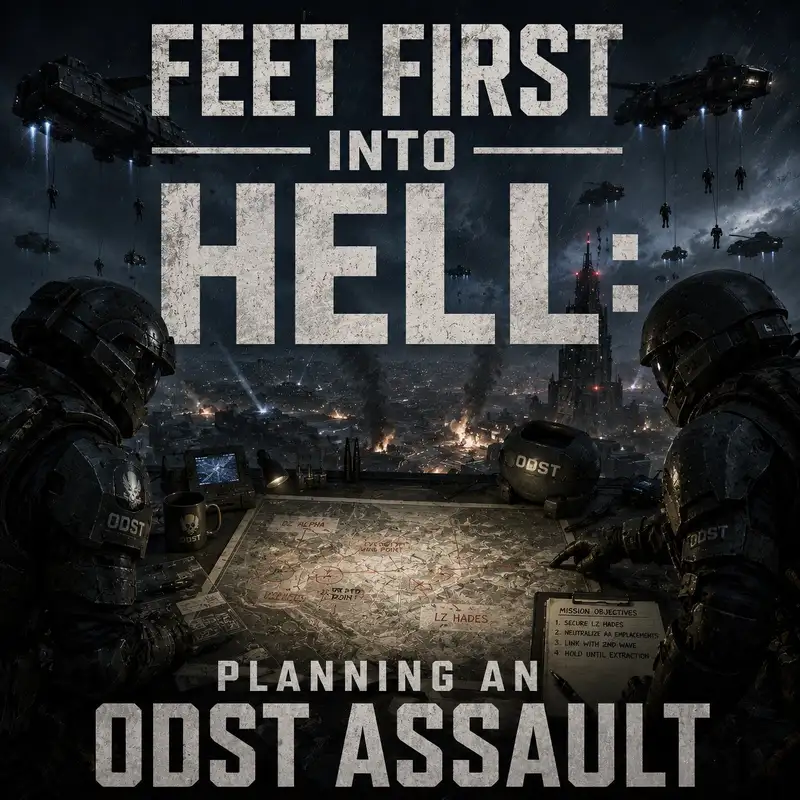
Feet First Into Hell: Planning an ODST Assault
The descent clock was already running when Captain Veronica Dare changed Alpha-Nine’s mission. The Orbital Drop Shock Troopers had launched above New Mombasa expecting to board the Covenant carrier hanging over the city. Dare redirected the squad toward a classified intelligence objective below. Seconds later, the carrier entered slipspace inside the atmosphere. The resulting shock and electromagnetic disruption threw the drop apart, damaged pods, and scattered the team across an occupied city. The troopers survived the fall. The assault plan did not.
That difference explains what must be planned before anyone goes feet first into hostile airspace. An Orbital Drop Shock Trooper assault is not a dramatic method of arriving at a firefight. It is an attempt to place a small, highly trained force at a decisive location faster than the defender can respond. The pods provide speed and surprise. They do not provide a complete operation. Intelligence, orbital access, communications, fire support, resupply, medical evacuation, and extraction must already exist around the drop, or be rebuilt by the people who survive it.
Orbital Drop Shock Troopers are an elite, all-volunteer force within the United Nations Space Command Marine Corps. Their institutional ancestry reaches back to the Drop Jet Jumpers of the twenty-second century, military units trained to descend from space and seize critical positions before heavier forces arrived. By the Insurrection, they were used for counterterrorism, raids, boarding operations, and assaults against defended colonial objectives. The Covenant War expanded those missions across worlds where the enemy possessed better weapons, stronger aircraft, and control of orbit more often than human planners preferred to admit.
The military value of an ODST unit comes from vertical access. Conventional troops normally approach through a port, landing zone, road network, or secured air corridor. A drop-pod force can cross the atmosphere directly and land beyond a defensive line, beside an isolated installation, or near terrain that aircraft cannot safely hold over. The method compresses time. It can place infantry near the objective before the enemy moves reserves. It can also place infantry beyond friendly artillery, armor, and medical support with admirable efficiency.
The first planning question is therefore not where the pods will land. It is what the assault must accomplish before the enemy reorganizes. ODSTs may seize an orbital-defense control center, destroy anti-air weapons, recover intelligence, capture a command figure, open a landing zone, reinforce a collapsing position, or conduct a raid followed by immediate withdrawal. Each mission produces a different force package. A demolition target requires engineers and explosives. A prisoner recovery requires security, medical support, and transport. A long defense requires supplies that one-person pods cannot carry.
Intelligence preparation begins with the target, but it cannot stop there. Planners need current imagery, terrain models, atmospheric data, enemy unit locations, air-defense coverage, communications frequencies, likely reserve routes, civilian concentrations, and the location of friendly forces. They must know whether the objective is on the surface, beneath it, or moving. A building selected from yesterday’s orbital image may be empty today. A landing area marked as clear may contain Covenant armor, construction equipment, or the remains of the reconnaissance team that made the original report.
The age of the intelligence matters because slipspace and battlefield communications make certainty perishable. A ship may arrive with an excellent plan built around a fleet that has already moved. A city may lose its sensor network during the approach. The enemy may deploy jammers or alter anti-air positions after detecting the parent vessel. Commanders should identify which assumptions are essential and which can fail without collapsing the mission. If the entire assault depends on one target remaining stationary for another ten minutes, the plan has acquired a deadline whether headquarters labels it one or not.
Orbital conditions come next. Drop pods must be launched from a ship or station that can reach the correct position and remain there long enough to deploy them. Friendly forces may need to suppress enemy ships, fighters, orbital weapons, and surface batteries. The launching vessel does not have to control the entire system, but it needs a corridor through which the pods can descend. If the parent ship is destroyed, forced away, or compelled to maneuver during launch, pod spacing, timing, communications, and extraction arrangements can all change before the first trooper reaches atmosphere.
The parent vessel is also the assault’s first logistics base. It holds the troops, pods, mission equipment, reserves, aircraft, medical facilities, intelligence staff, and command network. The operations team must load pods in the correct sequence and place specialists where their loss will not eliminate the mission. Heavy equipment may require separate cargo pods or follow-on aircraft. A force that lands with rifles but without breaching charges, communications relays, or medical supplies has not been equipped for speed. It has simply been equipped incompletely at high altitude.
Landing-zone selection combines geometry with purpose. The closest point to the objective is not always the best. Open ground may reduce collision risk and simplify regrouping, but it exposes pods to direct fire. Urban streets provide cover and immediate access while increasing the chance of striking buildings, power lines, transit structures, or civilians. Forests conceal the force but separate teams and obstruct navigation. Mountain terrain can shield the descent from some sensors while turning one damaged guidance system into a very brief mountaineering career.
The single-occupant exoatmospheric insertion vehicle is designed to keep one trooper alive through that path. Its systems protect against reentry heat, provide limited steering, slow the final descent with braking mechanisms, and absorb enough of the landing shock for the occupant to exit and fight. Later accounts show drag chutes, retro thrusters, directional controls, and onboard status displays assisting the descent. These systems reduce risk. They do not remove it. A failed chute, damaged thruster, collision, or bad landing can eliminate a soldier before the ground battle begins.
Enemy air defense must be mapped as a layered system. Capital ships and orbital platforms threaten the launching vessel. Fighters and interceptors can attack the drop stream. Surface weapons cover likely approach corridors and landing areas. Small arms may be ineffective against pods at speed but dangerous during final descent or immediately after impact. The assault plan can use electronic warfare, decoys, orbital fire, fighter sweeps, sabotage, or simultaneous attacks to create a temporary opening. Temporary is sufficient if the force crosses before the defender closes it.
Timing is more important than raw speed. The pods may need to arrive seconds after a surface battery is destroyed, before enemy reserves leave their barracks, or just as conventional forces begin a diversion. Launch too early and the ODSTs land beneath active weapons. Launch too late and the defender has recovered from suppression. Fires must be coordinated so that magnetic accelerator rounds, missiles, or aircraft do not strike the same ground the troopers are entering. The phrase danger close becomes particularly literal when the infantry is arriving from above.
Force organization should reflect what happens after impact. Squads need leaders, automatic weapons, precision fire, communications, demolitions, and medical capability distributed across the formation. Placing every specialist in one cluster makes coordination easy until that cluster lands several kilometers away or is destroyed. Distributing capability creates redundancy but may leave each team weaker. The commander must decide which functions are essential in the first five minutes, which can wait for regrouping, and which require a separate reserve.
Command relationships must be just as clear. The Marine commander may control the assault force while a Navy captain controls the launch platform and orbital fires. An Army headquarters may own the ground campaign. The Office of Naval Intelligence may hold the information that defines the real objective. Aircraft, artillery, Spartans, and local defenders may answer to separate chains of command. The operation needs one understood priority and a succession plan. Classification can protect the mission, but it can also produce supporting units that know precisely when to launch and very little about why.
Rehearsal exposes those seams before gravity does. Troopers practice loading, pod egress, emergency procedures, navigation, rally points, communications failures, casualty movement, and alternate objectives. Ship crews rehearse launch sequencing and damaged-pod handling. Intelligence staffs update terrain and target packages. Pilots practice the extraction route. The best rehearsal includes the conditions most likely to break the plan, not only the clean version used for senior briefings. A force that has rehearsed losing communications can continue. A force surprised by silence usually pauses exactly where speed mattered most.
The drop pattern balances concentration against survivability. Pods launched too close risk collision and may create a single target for defensive fire. Pods spread too widely lose mutual support and force the unit to spend its first hour finding itself. Leaders may place teams into several clusters around rally points, sequence command and support pods behind the first wave, or assign alternate landing areas if the primary zone becomes untenable. The pattern should assume some pods will miss. A plan requiring perfect landings is an administrative tribute to optimism.
Communications begin before launch and must survive several transitions. The trooper moves from the ship’s network into an individual pod, through atmospheric interference, and onto a ground battlenet that may not yet exist. Relays, command pods, aircraft, satellites, and artificial intelligences can help maintain the picture. On Installation Zero Four, the military artificial intelligence Wellsley supported Orbital Drop Shock Troopers through a command-pod system and mobile relay. That arrangement was valuable because dispersed infantry needed current information after the parent ship had crashed and the original campaign structure had disappeared.
Every unit also needs a lost-communications plan. The plan should specify rally points, time windows, recognition signals, mission priorities, and conditions for aborting or continuing. Troopers cannot wait indefinitely for headquarters while the enemy searches the landing area. Nor should every isolated team charge toward the objective and accidentally attack friendly elements from opposite directions. Mission command matters here. The force needs enough understanding of the commander’s intent to act without continuous supervision, but enough discipline to avoid converting initiative into several unrelated private wars.
Impact begins the most vulnerable phase. The pod has stopped, but the trooper may be disoriented, injured, buried in debris, or surrounded. The hatch can open toward a wall, water, wreckage, or enemy fire. The first actions are to escape the pod, check equipment, establish local security, locate teammates, and move away from a position the enemy can observe. A landing zone is not secure because the first pod stopped moving. It is secure when the force can prevent the enemy from destroying or isolating the people still arriving.
Regrouping must be fast because dispersion is built into the method. Navigation systems and shared waypoints help, but landmarks may be obscured and urban infrastructure may be damaged. Leaders need secondary rally points and a policy for bypassing missing personnel. Search too long and the objective is lost. Move too quickly and surviving troopers are abandoned in enemy territory. The correct answer depends on mission urgency, the enemy’s response, and whether the scattered personnel carry critical equipment. Planning turns that moral problem into a decision made before the commander is exhausted and under fire.
Urban drops create additional hazards. Buildings mask sensors, channel movement, and divide squads vertically as well as horizontally. Transit tunnels and service corridors may offer concealed routes while also holding civilians, enemy patrols, or automated security systems. Rooftops can serve as landing or extraction points, but aircraft approaching them are exposed. Local networks may provide maps and traffic control if they remain functioning. New Mombasa’s Superintendent helped make the city legible to isolated personnel, although the network itself had become part of the intelligence objective.
Specialists make the assault useful beyond the first firefight. Demolition personnel breach structures and destroy systems. Communications experts establish the network. Medics stabilize casualties until evacuation is possible. Snipers observe routes and suppress high-value threats. Engineers assess machinery, power, and access points. Intelligence personnel exploit records or identify the correct prisoner. Veronica Dare’s presence with Alpha-Nine reflected that last requirement. The mission did not merely need soldiers who could reach the city. It needed someone who understood what information had to leave it.
Medical planning is especially unforgiving. Drop injuries occur before enemy contact, and a pod force has limited ability to carry casualties. Each team needs immediate trauma care, but serious injuries still require a collection point and transport. Evacuation aircraft may be unable to enter until anti-air defenses are destroyed. The assault commander must decide whether wounded personnel move with the force, remain concealed with a medic, or trigger an extraction that may reveal the unit. The pod gets the trooper down. It is not designed to bring anyone back.
Resupply determines whether the ODSTs remain raiders or become a holding force. A short mission may rely on carried ammunition and captured material. A longer operation needs cargo pods, Pelicans, ground vehicles, or a link with conventional units. Batteries, medical supplies, food, water, demolition charges, and communications equipment matter alongside ammunition. If the force is expected to defend a landing zone for follow-on troops, planners must provide heavier weapons and engineers quickly. Elite light infantry can seize ground. Keeping it usually becomes a larger organization’s responsibility.
Extraction should be planned before launch, with primary and alternate sites, time windows, authentication, and conditions for abandonment. The aircraft need a route, fuel, escorts, and updated information about enemy air defenses. A shipboard recovery may require the parent vessel to remain within reach. A ground linkup may depend on conventional forces breaking through. The mission may also change from withdrawal to reinforcement, as happened repeatedly during the Covenant War. An extraction plan is not a promise. It is a set of resources and decisions that must survive the same enemy as the assault.
Alpha-Nine’s drop over New Mombasa shows what happens when several planning assumptions fail together. The squad launched from the heavy cruiser Say My Name as part of Operation Bumrush, a rapid attempt to board the Covenant assault carrier Solemn Penance and force it down. Captain Dare had requisitioned Alpha-Nine for a classified intelligence mission tied to the city’s data systems and redirected the squad during the final approach. That left little time to distribute the purpose, revise rally plans, or prepare every trooper for what the new objective required.
Regret’s carrier then entered slipspace within the city. The event disrupted the descent, scattered the pods, and transformed a coordinated assault into a survival and recovery operation. Alpha-Nine lost immediate command cohesion. Individuals awoke or landed in different parts of New Mombasa, separated by Covenant forces and a citywide infrastructure crisis. The squad’s original timetable no longer existed. So did much of the supporting plan. What remained was training, local initiative, incomplete communications, and the knowledge that other members of the unit were probably still alive.
The troopers rebuilt the operation from fragments. Edward Buck searched for Dare and reconnected with other members of the squad. Separate teams fought through the city, used available vehicles and weapons, and adapted to Covenant forces whose own command structure was changing after the carrier’s departure. The surviving unit eventually reached Dare’s intelligence objective beneath the city, recovered a Huragok carrying critical data, and escorted it toward extraction. This was not the assault as briefed. It was a new mission assembled from the useful pieces of the old one.
Their success should not romanticize the failure. Alpha-Nine survived because its members were experienced, adaptable, and able to exploit the Superintendent’s guidance and the disorder inside the Covenant occupation. They also benefited from chance. A different pod impact, a faster enemy search, or the loss of one specialist could have ended the mission. The operation proves why ODSTs are selected and trained as they are. It does not prove that changing objectives during descent is a sound way to test that training.
The emergency deployment from the Pillar of Autumn at Installation Zero Four offers another lesson. Orbital Drop Shock Troopers and other survivors descended while the cruiser was under attack and preparing to crash. Fireteam Raven fought boarders, deployed by drop pod, and joined the effort to establish and support Alpha Base. Major Antonio Silva, Lieutenant Melissa McKay, and the artificial intelligence Wellsley helped turn scattered survivors into an organized ground force. The pods delivered troops. Command, salvage, communications, and captured supplies made those troops sustainable.
That campaign also showed why ODSTs do not replace conventional forces. They secured positions, raided the crashed cruiser for matériel, fought Covenant units, and supported wider operations. They still depended on Marines, naval personnel, pilots, technicians, medical staff, artificial intelligence, and whatever vehicles or ammunition could be recovered. Their effectiveness came from operating at the sharp end of a combined force. When the larger system collapsed or made a disastrous decision, elite infantry could not make the consequences disappear.
Postwar operations preserved the same logic. ODSTs remained an active Marine Corps capability in twenty-five sixty, with units assigned to ships, stations, and colonies. They deployed alongside Spartans during Operation Wolfe on Reach, prevented the Banished from obtaining a dangerous Forerunner fighter during Operation Spearbreaker, and cleared anti-air weapons during the Battle of Boundary to open extraction airspace. The technology and enemies changed. The planning problem did not. Someone still had to identify the decisive point, create a corridor, land the force, and recover it afterward.
Planning an ODST assault is the work of turning a violent descent into an operational advantage. The commander defines an objective that light infantry can actually achieve, obtains current intelligence, secures a launch corridor, distributes essential skills, rehearses failure, plans regrouping, and protects the path from landing to extraction. The troopers accept the remaining risk because speed may be the only advantage available. Their courage begins where the plan ends, but it should not be required to repair every decision made before the pod doors closed.
Over New Mombasa, Alpha-Nine entered the atmosphere as one squad and reached the ground as isolated survivors. They still completed a mission of strategic value, but only after abandoning the shape of the assault that had carried them there. That is the meaning behind the Helljumper reputation. The drop is not bravery replacing preparation. It is preparation compressed into seconds, entrusted to people who know that the target may move, the ship may leave, and the first order on the ground may be to build the operation again from whatever landed with them.