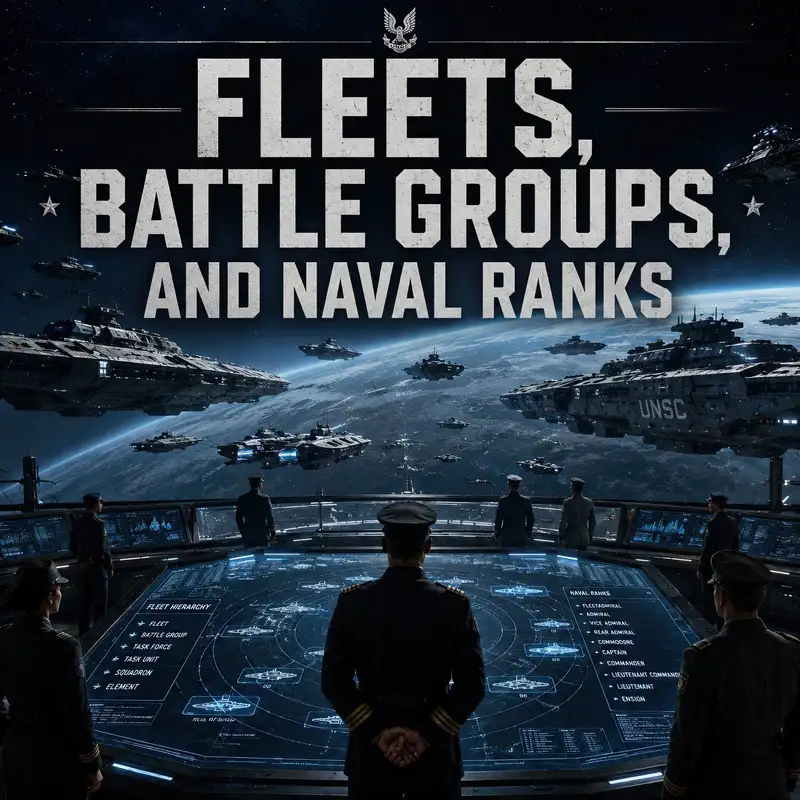
Fleets, Battle Groups, and Naval Ranks
Commander Jacob Keyes had four Covenant warships in front of him and one human destroyer beneath his feet. As commanding officer of the Iroquois, everyone on the bridge called him captain, even though captain was not yet his rank. He was a commander. At Sigma Octanus Four, that distinction did not change who had to decide when to accelerate, where to place the ship, and how long to remain inside the enemy’s firing envelope. Keyes used an audacious maneuver later known as the Keyes Loop to break a stronger formation. The battle made his reputation. It also illustrates the first rule of United Nations Space Command naval organization. Rank tells you where an officer stands. Command tells you what that officer is responsible for when the shooting begins.
A fleet is not simply a large number of ships on the same display. A battle group is not a smaller fleet with a more fashionable name. A naval rank is not a measurement of personal combat ability. These are parts of a command system designed to turn separate hulls, crews, sensors, weapons, and supply chains into coordinated military power. The system had to function across star systems where orders arrived late, ships emerged from slipspace separately, and a formation could lose its flagship before headquarters even knew the battle had started. The Navy’s hierarchy therefore combined central direction with delegated authority. It tried to preserve unity without pretending that an admiral on Reach could maneuver a frigate several systems away in real time.
At the top of the operational structure, Fleet Command directed the movement and tasking of naval squadrons and allocated warfighting assets where senior leaders believed they would have the greatest effect. High Command established wider military priorities. Fleet Command translated those priorities into deployments. Sector and regional commands adapted them to local conditions. Fleet commanders managed broad theaters or defensive regions. Battle group commanders handled mission-tailored formations. Ship captains fought their individual vessels. This sounds orderly because organizational charts are generally drawn before the enemy starts deleting parts of them. In practice, authority moved through communications networks, courier traffic, artificial-intelligence systems, and officers expected to act when the next level of command could no longer be reached.
The fleet was the Navy’s largest normal operational and administrative formation. Human fleets were generally divided between defensive fleets and expeditionary fleets. Defensive fleets were usually associated with a star system or major region. The Home Fleet protected Earth and the Solar System. The Epsilon Eridani Fleet defended Reach and the surrounding system. Expeditionary fleets were more often numbered and intended for offensive or deep-space operations. The distinction described purpose rather than a fixed ship count. A fleet could include many battle groups, stations, support elements, and ships dispersed across an enormous area. Most of those vessels did not patrol in one grand formation. A fleet was a command relationship and a theater responsibility long before it became a line of ships facing the enemy.
Defensive fleets grew from the practical needs of colonial control. Before the Covenant War, some were regarded as little more than heavily armed revenue police. They patrolled trade routes, supported inspections, deterred raiders, and provided the central government with a visible presence in distant systems. Their ships could be older, their crews familiar with local routes, and their doctrine shaped by patrol rather than fleet combat. That made them easy to underestimate. When the Covenant began destroying colonies, defensive fleets supplied trained crews, functioning hulls, sensor networks, and local command staffs that could respond before reinforcements arrived. An outdated warship already in the threatened system was usually more useful than a modern cruiser still several slipspace transitions away.
Expeditionary fleets were organized for a different problem. They were intended to carry naval power beyond established defensive zones and sustain operations in deep space. Heavy carriers and large command ships could provide fighters, Marines, communications, maintenance capacity, medical support, and staff facilities for prolonged campaigns. These formations were expensive because mobility does not remove the need for infrastructure. It merely forces the fleet to carry more of that infrastructure with it. The early Covenant War devastated many expeditionary forces. By the final years, the distinction between expeditionary and defensive fleets had become less meaningful. Almost every surviving formation was defending something, and every offensive deployment risked leaving Earth or another remaining colony with fewer ships than the next attack required.
Battle groups were the Navy’s practical fighting formations. They were assembled as needed for a mission and could vary from only a few ships to a substantial carrier group. A small battle group might escort a convoy, investigate a contact, raid an insurgent base, or reinforce a threatened colony. A larger group might center on a carrier or command cruiser and include escorts, reconnaissance vessels, troop transports, and support ships. The composition was supposed to follow the mission. A force built for commerce protection needed endurance, sensors, and enough escorts to cover widely separated freighters. A force built to attack a Covenant concentration needed massed fire, electronic intelligence, and enough surviving ships to fire again after the first exchange.
This flexibility explains why battle group names and sizes can appear inconsistent. They were not standardized boxes containing an identical number of frigates, destroyers, and cruisers. They were temporary combinations of available capabilities. Most were assigned a number or code name, but the name did not reveal their strength. A three-ship group might be the only force available in a sector. A carrier group might contain enough aircraft and Marines to support a planetary operation. By the final year of the Covenant War, every battle group was expected to benefit from prowler support. Prowlers collected electronic intelligence, scouted ahead, laid mines, inserted personnel, and gave commanders information that heavy warships could not obtain by pointing larger guns at the problem.
Task forces added another layer of flexibility. The terms task force and battle group could overlap, because both described forces assembled for a purpose rather than permanent collections of hulls. In twenty-five twenty-six, Vice Admiral Preston Cole detached Task Force Yama from Battle Group X-Ray. Yama consisted of prowler squadrons assigned to harass and disrupt Covenant supply activity while the larger force pursued its own campaign. Other task forces could be built as destroyer wolf packs, carrier-centered strike elements, or specialized reconnaissance groupings. The labels mattered less than the command relationship. Every ship had to know who controlled the mission, what objective justified the risk, and where it was expected to go when the original plan stopped resembling reality.
Squadrons were smaller organizational groupings, but their meaning changed as the war consumed the fleet. Earlier squadrons could function as tactical units. By the later Covenant War, many had become primarily administrative and honorific groupings used for records, tradition, and assignment. Artificial-intelligence administrators arranged dwindling ships into attack, battle, carrier, monitor, and support squadrons while Fleet Command moved those hulls into whatever operational combinations were still possible. Some fleets existed only on paper after their sectors, ships, and headquarters had been destroyed. The Navy sometimes assigned a new vessel to one of these dead fleets through bureaucratic error. Crews considered that an ill omen, which was a reasonable response to discovering that their first official destination no longer existed.
Once a battle group formed, its commander normally established a flagship. The flagship was not necessarily the largest vessel, though size helped when an admiral required communications spaces, planning rooms, additional sensors, and a staff large enough to turn several ships into one formation. Command-oriented vessels such as the Valiant-class super-heavy cruiser were modified with flag bridges for that purpose. The admiral’s staff tracked intelligence, logistics, navigation, damage reports, and the commander’s intent across the force. The flagship captain still commanded the ship itself. The admiral commanded the formation from the ship. Those responsibilities could occupy the same bridge complex without becoming the same job.
That separation prevented one officer from trying to fight a cruiser and an entire battle group at the same time. The captain controlled the ship’s maneuver, internal readiness, damage control, weapons employment, and crew. The embarked flag officer issued operational orders to the group, assigned objectives, coordinated timing, and decided how the formation would accept or avoid risk. If the flagship was damaged, the captain might have to maneuver for survival while the admiral wanted to preserve communications with the rest of the force. Both concerns were valid. A fleet without a command network could fragment. A command network attached to a destroyed ship was also of limited value. Naval command required officers to understand which problem they owned.
The word captain creates much of the confusion. Captain is a commissioned rank, but it is also the customary title of a ship’s commanding officer. Commander Keyes was therefore the captain of the Iroquois before he held the rank of captain. A lieutenant or commander placed in lawful command of a smaller vessel could also be addressed as captain aboard that ship. The reverse was equally important. An officer holding the rank of captain might serve on a staff and command no vessel at all. Rank established seniority and eligibility. A billet established duty. Operational orders established who controlled a specific mission. The Navy depended on all three, especially when casualties forced officers into responsibilities earlier than peacetime career plans intended.
The enlisted structure ran from crewmen through petty officers to chief petty officers, senior chiefs, and master chief petty officers. These sailors operated and maintained the ship’s reactors, weapons, sensors, drives, communications, atmosphere, hangars, and damage-control systems. Petty officers supervised compartments and work divisions. Chiefs carried technical knowledge that could not be replaced by promoting an ensign and issuing a maintenance manual. Master chief petty officer was the highest enlisted naval rank, not a title invented for John One One Seven. An admiral could order a damaged ship back into battle. Senior enlisted leaders often knew whether it could return without losing propulsion, atmosphere, or the only technicians capable of repairing the next failure. Rank gave officers authority. Professional trust gave their orders a chance of working.
Warrant officers and chief warrant officers occupied a specialized place between the enlisted and commissioned systems. They were resident technical experts, command advisers, and in some cases captains of utility vessels. Their value came from depth rather than breadth. A line officer might rotate among navigation, operations, weapons, and command assignments. A warrant officer could spend a career mastering a technical field whose failure would immobilize a ship or blind a station. Halo’s wars are filled with advanced machinery, but advanced machinery increases the need for expertise. A slipspace drive remains miraculous only until its maintenance schedule is missed. Then it becomes a very expensive reason the convoy is not leaving.
The commissioned ladder began with ensigns and lieutenant junior grades, followed by lieutenants and lieutenant commanders. Ensigns learned the fleet through initial postings. Junior lieutenants could lead staff sections. Lieutenants commanded work divisions and could captain support vessels. Lieutenant commanders often served as department heads or executive officers, especially aboard smaller warships. These assignments trained officers to connect technical performance with command decisions. A weapons officer learned that ammunition was finite. An engineering officer learned that battle damage did not respect the operations schedule. An executive officer learned that a crew could meet an impossible requirement once, perhaps twice, and would eventually begin producing failures faster than official readiness reports could rename them.
Commanders and captains were the Navy’s principal ship-command ranks. A commander might captain a smaller warship or serve on a senior staff. A captain typically commanded a line warship, major installation, or other high-responsibility organization. Yet wartime practice produced exceptions. Commanders led battle groups. Captains directed fleets or expeditionary strike groups when their billet and orders gave them that authority. The Navy could not wait for every formation to be led by the rank normally associated with it. Experience, available personnel, political confidence, and simple survival shaped appointments. The system remained hierarchical, but it was not mechanical. A more senior rank did not automatically make an officer the best person to command every kind of operation.
Above captain came the flag officers. A rear admiral typically commanded a battle group. A vice admiral could command a sector fleet or major academy. Admirals served in High Command and other senior posts. Fleet admiral was the highest naval rank and could carry responsibility for an entire fleet or the broadest military leadership. Preston Cole’s authority as a vice admiral rested not only on stars and insignia, but on his assignment, staff, flagship, and the ships placed under his control. Terrence Hood’s power came from being a fleet admiral and from holding offices that linked him to the Home Fleet, Naval Command, and High Command. Rank opened the door. Position determined what was on the other side.
Authority within a formation was divided into different kinds of control. Fleet Command allocated ships and defined broad missions. A fleet commander set theater priorities. A battle group commander coordinated the operation. A ship captain retained responsibility for the vessel and crew. Department heads controlled their systems. Senior enlisted personnel made those systems function. An officer from another branch could command embarked troops without controlling the ship that carried them. A Marine commander answered to naval authority while aboard a warship, but still retained professional authority over the Marines. This arrangement could create friction, particularly when a ground commander wanted immediate support and the captain knew that remaining in orbit would expose the only available transport to destruction.
Slipspace made delegated authority unavoidable. Ships departing together did not always arrive together. Transit times varied. Communications between systems could not provide constant direction. A battle group commander might receive an order based on intelligence that had already become obsolete. A captain might emerge from slipspace to find the rendezvous empty, the colony under attack, or the flagship missing. Naval officers were therefore expected to understand commander’s intent rather than merely repeat the last transmission. The objective might remain valid after the plan failed. A convoy still needed protection even if one escort arrived late. A colony still needed evacuation even if the fleet commander had not yet learned that its orbital defenses were gone.
Against the Covenant, formation design became a method of concentrating human firepower without allowing ships to interfere with one another. Magnetic accelerator cannon required firing lanes. Missile and nuclear salvos needed precise timing and deconfliction. Fighters and dropships had to cross space covered by point-defense weapons. Prowlers needed freedom to scout without being mistaken for hostile contacts. Damaged vessels required routes out of the line while fresh ships moved forward. The battle group commander managed that larger pattern. Individual captains still had to evade plasma, protect vulnerable sections, and decide whether a firing solution justified remaining exposed. Artificial intelligence improved calculation, but it could not replace ammunition already spent or restore a flagship whose communications had failed.
Attrition steadily distorted the organization. Ships were transferred between fleets, combined into temporary groups, detached for convoy duty, or retained in repair yards that no longer had the parts to finish the work. Officers were promoted, reassigned, killed, or forced into acting command. A formation’s official strength could include vessels too damaged to fight, ships still in transit, and hulls whose crews had been stripped to reinforce another unit. The name on the order remained stable while combat power changed underneath it. By the final year of the war, the difference between a fleet, a battle group, and a surviving cluster of ships sometimes depended less on doctrine than on whether anyone could still contact a headquarters willing to update the paperwork.
Postwar formations became more capable and, in some cases, more concentrated. The Infinity could function as flagship, carrier, mobile base, and command center for an expeditionary force. Captains such as Andrew Del Rio and Thomas Lasky exercised authority far beyond the traditional image of one officer commanding one ship because their billet included the forces embarked with and assigned to that vessel. The arrangement improved unity of command. It also placed extraordinary personnel, intelligence, and technical capacity aboard one hull. A formation built around a powerful flagship can act quickly while the flagship survives. When it is isolated, disabled, or driven from the battle, the same concentration turns into a long list of capabilities the remaining escorts cannot replace.
The Created uprising and the Banished ambush at Zeta Halo exposed that vulnerability. Central command networks were disrupted. Flag officers were isolated. The Infinity and its escorts were scattered or destroyed. Surviving captains, lieutenants, chiefs, Spartans, Marines, and sailors had to rebuild local command from whatever personnel and communications remained. Rank still mattered because it established lawful precedence and experience. It did not create a fleet where no functioning ships could assemble. A lieutenant with a working transmitter could influence more of the battle than an admiral whose location was unknown. A chief who restored power to a wrecked communications array could reconnect units that had possessed orders but no way to coordinate them.
Fleets, battle groups, and naval ranks were therefore not ceremonial layers placed on top of Halo’s space battles. Fleets connected strategy to regions and theaters. Battle groups turned available ships into forces built for specific missions. Task forces and squadrons provided additional ways to organize specialized capabilities. Ranks established seniority, professional development, and the normal scale of responsibility. Billets and orders converted that rank into actual command. The system was strongest when communications, logistics, intelligence, and trust allowed every level to reinforce the next. It was weakest when a formal chain of command remained on paper after the ships, relays, and people supporting it had been lost.
The United Nations Space Command Navy did not fight as one enormous armada directed by one admiral. It fought through captains commanding ships, rear admirals assembling battle groups, vice admirals managing sectors, chiefs keeping damaged systems alive, and crews following intent when orders could no longer reach them. Its formations were flexible because interstellar war demanded flexibility. Its ranks were rigid enough to preserve authority, yet adaptable enough to survive casualties and distance. That balance held as long as people could still communicate and ships could still move. When those conditions failed, the title of the formation mattered less than the oldest naval question of all: who still had a functioning vessel, a clear objective, and the authority to give the next order.