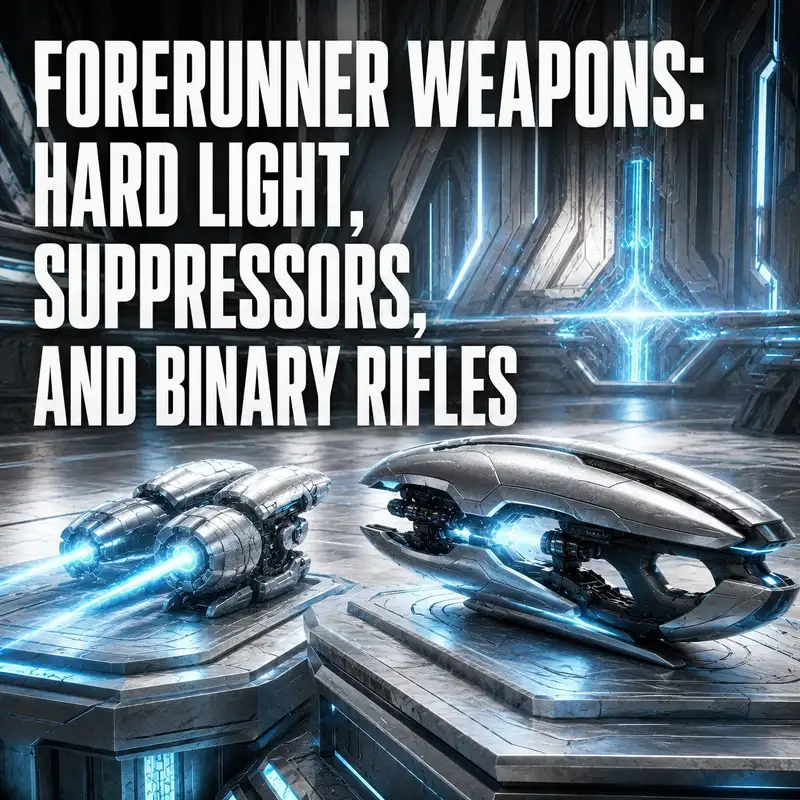
Forerunner Weapons: Hard Light, Suppressors, and Binary Rifles
When the United Nations Space Command Infinity was pulled into Requiem in twenty-five fifty-seven, its crew believed it had entered an ancient structure. The structure answered by deploying an army. Promethean constructs appeared through portals, their bodies forming from suspended components and hard light. Their weapons assembled in the same manner. A rifle that had not existed a moment earlier locked itself into a Knight’s hands, acquired a target, and began firing ammunition humanity could neither manufacture nor properly name.
That encounter revealed the central difficulty in studying Forerunner weapons. Human observers could classify the object, measure its effects, and sometimes turn it against its former owner. None of those actions meant they understood the system that had produced it. The Suppressor and Binary Rifle were not isolated marvels. They were portable elements of a civilization able to build structures from light, encode machines inside design seeds, and manufacture soldiers and weapons through automated assemblers.
Hard light was the foundation of much of that capability. Human specialists described it as a boson-photon field, an engineered state in which coherent energy and particles behaved like solid matter. The simplest explanation is light made capable of carrying weight, although the actual technology was considerably less simple. Forerunner bridges could support vehicles and then disappear when their projectors shut down. Interfaces could form in empty air. Walls, internal compartments, shields, and decorative surfaces could be created or rearranged without conventional construction.
A weapon made from the same technological family did not need to imitate a human firearm. It could accelerate hardened photonic matter, channel ionized particles, shape a blade, or project a destructive field. Components could remain separated until energy brought them into alignment. A sight did not have to be attached by a metal bracket if a field could hold it exactly where the weapon required. To a Marine, the rifle appeared to assemble itself. To a Forerunner armory, it was probably doing what a rifle was expected to do.
That elegance can create a false impression that Forerunner weapons needed no logistics. Hard light depended on power, projection, control, and a stable field. The weapons consumed light mass, ionized particles, or other prepared energy and material. Their components could be damaged. Their power cells could be depleted. Their targeting systems could lose the network that informed them. A bridge made of light was impressive until the projector failed. A rifle held together by fields was still a rifle whose fields had to remain active.
Forerunner industry addressed those requirements at a scale later civilizations could barely reconstruct. Assembler vats used encoded designs to produce weapons, machines, and other systems. Design seeds could contain the instructions needed to assemble anything from combat skins to starships, provided the user possessed the correct machinery, materials, authority, and knowledge. A surviving weapon therefore represented only the last object in a much larger chain. Humanity could recover the rifle. It had not recovered the civilization that made the rifle routine.
The Z one thirty Suppressor was the automatic weapon within that arsenal. Its human classification called it a directed-energy automatic weapon, although its name did not refer to reducing sound. It suppressed by filling the space in front of it with rapid hard-light fire. The distinction was useful, especially for anyone expecting a quiet weapon and receiving several dozen luminous projectiles instead. Forerunner terminology and human field labels did not always approach the same object from the same direction.
The Suppressor used a coil-set architecture to accelerate bolts of hard light in rapid succession. It was older than the final war with the Flood and had already served during earlier Forerunner conflicts, including the war against ancient humanity. When the Flood crisis became the central military problem of the ecumene, the weapon gained new importance. Its rate of fire and effectiveness against organic matter made it useful to Warrior-Servants and automated combat units fighting infection at close range.
Retaking a Flood-controlled ship helps explain the design. Passageways limit sight lines. Bulkheads and machinery divide the interior into short engagement spaces. Infection forms and combat forms can emerge from several directions before a marksman has time to select each target individually. A high-rate weapon firing destructive hard-light bolts gives the assault element a way to saturate those approaches. The Suppressor was not elegant because it fired slowly and perfectly. It was elegant because Forerunner engineering made volume of fire possible without returning to chemically propelled ammunition.
The anti-Flood role also explains why terminal effect mattered differently. A conventional wound might stop an ordinary soldier while leaving a body the Flood could still use. Forerunner weapons increasingly emphasized burning, disintegration, and the destruction of usable biological material. The Suppressor’s individual bolts were not equal to the Binary Rifle’s catastrophic shot, but repeated impacts could tear through unshielded organic targets and deny the parasite intact bodies. Against the Flood, killing the combat form and reducing what remained were connected tasks.
Close-range saturation created limitations. Hard-light bolts still required time to reach the target. Accuracy declined when the user tried to extend the weapon beyond the range for which it was intended. Energy shielding could absorb the first impacts, forcing the shooter to maintain fire while the target moved or returned fire. The Suppressor was dangerous in a corridor and less convincing across a broad valley. Forerunner sophistication had produced a specialized automatic weapon, not a device exempt from the relationship among range, target motion, and shot placement.
Its ready supply was also finite. Human personnel encountering the weapon on Requiem could see its ammunition or energy state decline and had to replace the relevant light-mass unit before continuing. The reload looked alien because the weapon opened, separated, and reformed around the new component. The underlying military fact remained familiar. A soldier firing continuously would empty the weapon. An isolated unit without compatible replacements would eventually possess an advanced club, although the Promethean attached to it often had a hard-light blade available for that stage of the discussion.
Promethean constructs reduced some of the Suppressor’s training burden. A Knight or Crawler did not need a human-style range qualification, and its targeting behavior could be linked to the wider command network. Watchers could provide protection, repair, and tactical support. Teleportation allowed units to reposition or appear inside a threatened sector. The weapon was therefore part of a combat system in which the shooter, sensor, repair asset, and command architecture could cooperate at machine speed.
That integration was powerful and brittle. A networked construct performed best while the network remained coherent, the command authority remained valid, and local support units continued functioning. Destroying a Watcher, isolating a Knight, or disrupting access to a portal reduced the combined system even if the rifle itself still worked. The Forerunners had not eliminated combined arms. They had compressed several combined-arms functions into machines whose relationship was less visible to human observers.
Variants showed how the Suppressor adapted to different crises. The Song of Peace improved rate of fire and control during the chaotic final years of the ecumene, when some operations connected to the Librarian’s Conservation Measure required military intervention. The name was characteristically Forerunner. A weapon could be called a song of peace while being issued to force compliance with a preservation program. Advanced civilizations remain fully capable of naming coercion politely.
Another variant, Razor’s Edge, used volatile metastable hard-light shards that could combine explosively after several hits. Its development reflected desperation as the Flood war approached extinction. Forerunner engineers were experimenting with less stable forms of a technology they already understood extremely well. The result resembled the cumulative effect of blamite without depending on crystal from Suban. It also demonstrated that technical mastery did not prevent emergency programs from trading safety and standardization for immediate lethality.
The Z seven fifty Binary Rifle occupied the opposite end of the infantry engagement. Human analysts classified it as a special-application sniper rifle. It was built to strike exceptionally dangerous Flood targets at extreme range before they could close with friendly forces or disappear behind the mass of an outbreak. Where the Suppressor produced many chances to hit, the Binary Rifle concentrated almost everything into one firing solution.
Its name reflected a paired architecture. Twin core-mounted particle accelerators launched ionized beams carrying jacketed antimatter particles. The effect combined extraordinary accuracy with destructive energy sufficient to disintegrate most infantry targets. This was not simply a more powerful human sniper cartridge. It was a portable energy-channel weapon designed by a civilization that regarded manipulation of matter and antimatter as an infantry engineering problem.
During the Forerunner-Flood war, Binary Rifles were used against emerging Key Minds, large pure forms, and other targets whose continued existence could change the local battle. That target set matters. The weapon was not created merely to remove an exposed soldier. It was created to interrupt the Flood’s development, eliminate rare warforms, and attack coordination before the parasite could bring more biomass and intelligence into the fight.
A successful shot therefore produced an effect larger than the casualty. Destroying an emerging coordinating intelligence could delay the organization of nearby Flood forms. Removing a specialized warform could keep an evacuation route open or preserve a containment position. The Binary Rifle converted tactical precision into operational time. Against an enemy whose strength grew with every host and memory absorbed, time was among the few resources the Forerunners could not manufacture.
The rifle’s power came with severe constraints. Its ready capacity was extremely small. Follow-up fire was slow compared with ordinary infantry weapons. Replenishing the system took time, and the shooter could not afford to waste a discharge on a target that another weapon could handle. The Binary Rifle demanded intelligence, identification, and priority. It was a poor answer to a crowd and an excellent answer to one target whose survival would make the crowd much worse.
The weapon also announced its attention. A visible orange aiming beam could reveal that a target was being tracked and could lead observers back toward the firing position. Against the Flood, intimidation was irrelevant, but warning remained tactically important. Against humans, Sangheili, or Spartans, a detected beam allowed movement, concealment, suppression, or an attack on the marksman. Forerunner designers accepted that compromise because extreme power and accuracy were more important than perfect concealment for the weapon’s original mission.
That visible beam reminds us not to treat Forerunner technology as magic. The rifle required a line of fire. The target could move behind sufficient cover. The operator could miss. A shield could complicate the effect depending on its condition and strength. The weapon’s optics and accelerators could be damaged. A Binary Rifle in the hands of an isolated soldier remained terrifying, but it did not see through every wall, carry unlimited discharges, or decide which target mattered without external information.
Knight Lancers, Crawler Snipes, and later Armiger marksmen carried Binary Rifles because their sensors and machine control could exploit the system. They could remain motionless, observe for long periods, and fire as part of an automated defense. Their bodies were also replaceable in ways an organic sniper was not. The rifle and construct had been matched around the same assumption: the user was one component in a networked weapons architecture, not an independent hunter carrying all necessary intelligence inside one helmet.
Requiem placed that architecture into a political context its designers had never intended. The Prometheans guarding the shield world had spent one hundred thousand years conducting automated patrols and returning to their crèches. When the Ur-Didact awakened, those systems received active direction again. Weapons designed during civilizational wars against ancient humanity and the Flood were turned on the crew of the Infinity, a military force that had arrived without understanding the installation or the authority controlling it.
Jul ’Mdama’s Covenant sought those same weapons as sacred inheritance and practical military advantage. Some Sangheili learned to operate captured examples. Spartan Fours did the same during the Requiem campaigns. A human or Sangheili could acquire the weapon, recognize its controls, and use its effects in combat. That was a significant tactical gain. It was not proof that either faction could produce the rifle, replenish every component, or integrate it across an army.
The LightRifle illustrates the missing middle between the Suppressor and Binary Rifle. It accelerated hard-light particles for controlled mid-range and long-range fire, giving Warrior-Servant marksmen a general precision weapon. Its existence prevents a common analytical mistake. The Forerunner arsenal was not divided between inaccurate automatic fire and overwhelming sniper shots. It contained families of systems designed for distinct ranges, targets, and tactical conditions, just as later armies did.
Other weapons extended the same logic into close assault and heavy attack. Scattershots used redirected energy in confined spaces. Incineration Cannons attacked large Flood forms and matériel with explosive particle streams. Hard-light blades allowed constructs to continue fighting after a ranged engagement collapsed into melee. These examples matter only because they show where the Suppressor and Binary Rifle fit. One was the automatic workhorse. The other was a specialist used when a single target justified disproportionate force.
Human forces tried to turn battlefield access into institutional knowledge. The Office of Naval Intelligence created Z classifications, recovered components, recorded firing behavior, and placed examples or modeled versions into the Infinity’s War Games environment. Researchers could compare field footage with damaged artifacts. Spartans could learn how to operate weapons they might encounter again. This was responsible exploitation of captured equipment, although the phrase responsible exploitation has historically done a great deal of work in classified programs.
The problem was reproduction. A Binary Rifle was not just a receiver, barrel, and power cell. Its accelerators depended on materials, tolerances, field control, and manufacturing processes human industry did not possess at the same level. A Suppressor’s self-assembling chassis depended on more than a convenient animation. It reflected design seeds, assembler systems, and energy fields integrated from the beginning. Copying the outside would not reproduce the weapon any more than copying the shape of a starship would reproduce its slipspace drive.
Postwar research did accelerate. Requiem, Gamma Halo, Genesis, and the Created uprising forced human specialists to move from archaeological study toward emergency exploitation. Office of Naval Intelligence projects examined design seeds and adaptive armor behavior. Some Forerunner concepts informed experimental human systems. Progress was real, but it remained uneven. Humanity could operate recovered technology, integrate selected principles, and sometimes build prototypes. It could not casually reopen the Ferrarius Assembler Vats and order a million rifles before the next budget review.
Operational use also created a security problem. A captured weapon might retain unknown access rules, telemetry, or dependencies. A construct might accept one user and reject another. An apparently inert system could respond when a Forerunner command network returned. Human units had spent decades learning that Covenant equipment might be booby-trapped, tracked, or impossible to recharge. Forerunner weapons added the possibility that the armory itself was part of an ancient machine still following orders.
The Binary Rifle’s later service history makes that danger clear. After the Didact’s defeat, Promethean forces passed through changing command relationships, first supporting Jul ’Mdama’s Covenant and later the Created. The same rifle could serve different political masters because its immediate loyalty came through the system controlling the construct that carried it. Weapon ownership was therefore less important than command of the network, assemblers, and ancillas behind the weapon.
Humans did sometimes turn the system back against its origin. Linda zero-five-eight carried a Binary Rifle during Blue Team’s pursuit of the Didact at Installation Zero Three. The image is strategically revealing. One of humanity’s finest marksmen could exploit a recovered Forerunner weapon against the Forerunner commander whose forces had fielded it. The shot demonstrated adaptability and skill. It did not create a human Binary Rifle program or remove the need for conventional sniper weapons that human industry could actually sustain.
Forerunner weapons were devastating because they were designed inside a civilization where matter, energy, information, and manufacturing were deeply integrated. Hard light could be a bridge, a control surface, a shield, part of a building, or ammunition. The Suppressor transformed that versatility into close-range automatic fire. The Binary Rifle concentrated it into extreme-range destruction against the most dangerous forms of the Flood.
Their weakness was not poor engineering. It was dependence on the larger order that engineering assumed. They required power, design libraries, assembler capacity, command networks, specialized users, and a strategic system capable of choosing the correct target. When that order collapsed, the weapons survived as fragments. A Knight could still fire. A human could still pull the trigger. A remnant commander could still claim the armory. None of them automatically recovered the civilization that had connected every weapon to a functioning whole.
The Forerunners possessed rifles capable of disintegrating an enemy and automatic weapons designed to deny the Flood usable flesh. They still lost the war. The failure was not at the muzzle. It was in politics, delayed recognition, divided command, failed strategy, and the inability to produce a conventional solution before the parasite consumed the civilization supporting the weapons. The arsenal could destroy almost any target placed before it. It could not repair the decisions that had allowed the target to become a galactic threat.
That is the final meaning of hard light on the battlefield. It looks permanent while power sustains it, then vanishes when the system behind it fails. The Suppressor and Binary Rifle followed the same pattern. Their effects outlived the ecumene, but their strategic coherence did not. Later soldiers inherited the trigger, the beam, and the disintegrated target. What they did not inherit was the industrial and political order that once made those weapons ordinary.