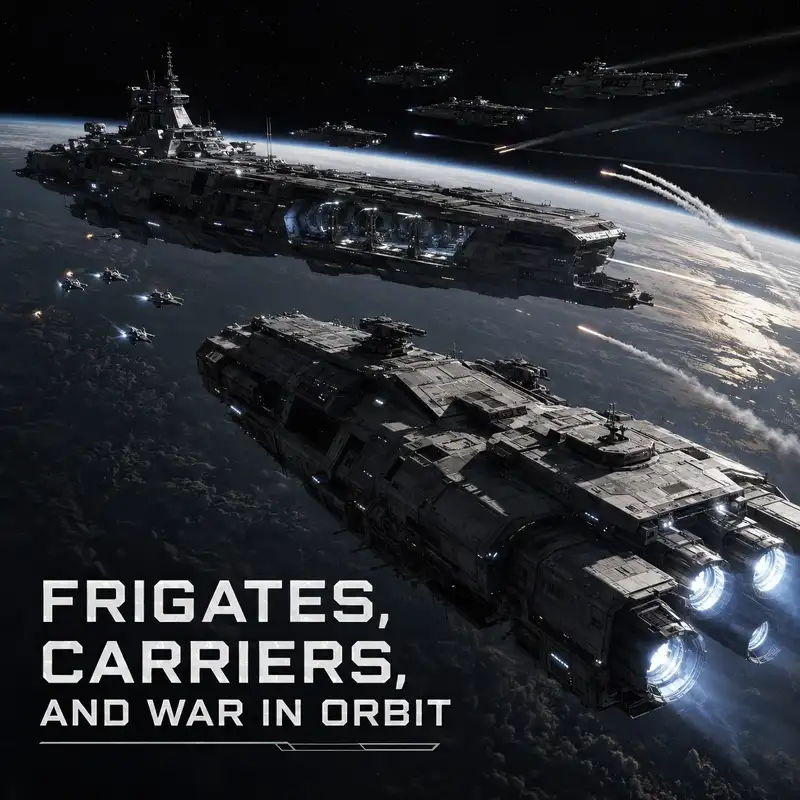
Frigates, Carriers, and War in Orbit
The first Covenant ships reached Reach’s orbital-defense line under fire from weapons powerful enough to tear through a capital ship. The platforms had the range, acceleration, and firing authority to make a direct approach ruinously expensive. They also depended on fusion generators buried on the planet below. Once Covenant ground forces began attacking those generators, the battle in orbit became inseparable from infantry fighting on the surface. Reach’s largest guns could dominate space only while soldiers, engineers, cables, and power plants remained alive beneath them.
That relationship explains war in orbit across the Halo universe. Frigates, carriers, cruisers, fighters, and defense platforms were not isolated collections of weapons. They were parts of a system connecting shipyards to fleets, fleets to planets, and orbital control to every convoy, landing, and evacuation below. The central question was never simply which ship carried the largest gun. It was which force could detect the enemy, survive the first exchange, keep its formation together, and still support the political objective after the firing stopped.
For the United Nations Space Command, Fleet Command directed the movement and tasking of naval squadrons across human space. That authority sounded centralized until slipspace made distance inconvenient again. Transit times varied. Ships departing together could arrive separately. Intelligence might describe a colony that had already fallen or an enemy fleet that had already moved. Commanders therefore needed plans detailed enough to coordinate several ships and flexible enough to survive the moment one of them emerged in the wrong position.
Detection often decided whether a fleet received that chance. Sensors had to identify contacts, separate warships from civilian traffic, estimate shield strength, and develop firing solutions across enormous distances. Stealth vessels and reconnaissance craft tried to provide information without revealing the main force. Smart artificial intelligences processed sensor data and coordinated weapons faster than a human staff could manage. They did not create perfect knowledge. A hidden ship remained hidden until something found it, and an accurate calculation based on incomplete data was still incomplete.
Frigates were the workhorses of the human fleet because they could be built and assigned in greater numbers than capital ships. The name covered several designs and roles. Stalwart-class light frigates emphasized escort and defensive work. Charon-class light frigates were suited to carrying troops and supporting planetary operations. Paris-class heavy frigates sacrificed some transport capacity for greater combat power. The exact fit varied by vessel and era, but the strategic logic remained consistent. A frigate was large enough to fight, travel between systems, and deploy personnel, yet common enough to place beside convoys, colonies, and larger warships.
That versatility made frigates visible wherever the wider war created too many requirements for too few ships. They escorted transports, screened carriers, hunted raiders, carried Marines, launched drop pods, supported evacuations, and provided orbital fire when the tactical situation allowed it. A captain might begin a patrol expecting customs enforcement and end it fighting a Covenant cruiser. The vessel did not become better armored because the mission had changed. It remained useful because its crew could redirect sensors, missiles, embarked craft, and one forward gun toward a new problem.
The magnetic accelerator cannon formed the center of most human warship doctrine. It used powerful magnetic fields to launch a dense projectile at extreme velocity. On many ships, the weapon ran along the hull, which meant the captain had to orient the vessel toward the target rather than simply rotate a turret. Capacitors required time and power to charge. The projectile still needed an accurate firing solution. A miss could not be recalled, and a hit against an intact Covenant shield might spend a precious round without damaging the hull beneath it.
Human commanders therefore combined weapons rather than trusting one dramatic shot. Magnetic accelerator fire could weaken or collapse shields. Archer missiles followed against exposed hull sections, engines, weapons, or hangars. Nuclear warheads were used when the opportunity justified the limited stock and the danger to nearby forces. Point-defense guns attempted to stop enemy missiles, strike craft, and boarding vehicles. Timing mattered. A missile arriving before the shield failed could be wasted. One arriving too late might find that the target had already fired back.
Artificial intelligence made those sequences possible at combat speed. A shipboard intelligence could track several targets, predict movement, prioritize point defense, and coordinate salvos with neighboring ships. It could also help with navigation, damage control, communications, and electronic warfare while the bridge crew concentrated on command decisions. The intelligence remained dependent on sensors, power, and access. If antennas were destroyed, data links jammed, or compartments isolated, the ship’s fastest mind could become exceptionally well informed about systems it could no longer reach.
Carriers solved a different problem. Their primary value was not simply that they carried fighters. They carried a mobile air and ground campaign. An Epoch-class heavy carrier could form the center of a battle group, sustain flight operations, transport Marines, and place dropships and strike craft over a planet. Punic-class supercarriers had originally been conceived as space-control vessels able to support long colonial expeditionary and interdiction campaigns. When the Covenant War began, the same capacity became a way to move an entire military package toward a threatened world.
A carrier’s hangars linked orbit to the surface. Longsword strike craft could conduct reconnaissance, interception, and attacks against ships or ground targets. Pelicans moved troops, vehicles, ammunition, and casualties. Boarding craft placed personnel inside stations or enemy vessels. Maintenance crews repaired aircraft while ordnance teams prepared the next sortie. The carrier supplied command spaces, medical facilities, communications, fuel, and stores. Its air wing was not an accessory. It was the means by which the fleet influenced everything beyond the range or political acceptability of a capital-ship weapon.
That made carriers extraordinarily valuable and expensive to lose. The destruction of a carrier removed more than one hull from an order of battle. It could eliminate experienced pilots, flight controllers, Marines, command staffs, spare aircraft, ammunition, and the maintenance specialists needed to keep the surviving squadrons operating. A carrier might survive a direct exchange only to become ineffective after its hangars were damaged or its fuel, power, and ordnance handling systems failed. The ship could remain afloat while the campaign it was meant to support quietly disappeared.
Human carriers were not invulnerable battleships. They needed escorts to screen them, reconnaissance to keep threats at distance, and maneuver space to launch and recover aircraft. Their size made concealment difficult. Their importance made them priority targets. A carrier commander had to balance offensive action with preservation of the hangars, launch systems, embarked force, and command network. Committing the ship too cautiously wasted its purpose. Committing it too aggressively risked losing the part of the fleet least easily replaced.
Covenant carriers operated on a larger political and military scale. A C A S-class assault carrier could serve as fleet flagship, troop transport, aerospace base, siege platform, and instrument of occupation. A C S O-class supercarrier could support major invasions and coordinate forces across an entire planetary campaign. These vessels carried fighters, dropships, ground armies, command facilities, and weapons capable of devastating targets in orbit or on the surface. They were not simply carriers in the human naval sense. They were mobile centers of imperial power.
Even these ships required support. Covenant carriers operating far from High Charity or major outposts depended on escorts, supply vessels, technical specialists, and a functioning chain of authority. Their energy shields and plasma weapons gave them a major advantage over human ships, but they still consumed power, munitions, food, atmosphere, and maintenance effort. Huragok and other specialists could preserve systems ordinary crews did not fully understand. Losing a carrier meant losing rare personnel and infrastructure as well as a symbol of religious authority.
Covenant energy shields changed every engagement. Human fire first had to overload the field before it could reach the nanolaminate hull. Plasma torpedoes could track targets and burn through human armor. Energy projectors could cut ships apart or attack the surface below. Pulse lasers threatened missiles and smaller craft. More accurate slipspace systems allowed Covenant commanders to arrive with better cohesion and maneuver in ways human officers found difficult to predict. Technological superiority did not guarantee perfect command, but it gave Covenant mistakes a larger margin for survival.
Human fleets narrowed that margin through concentration. Several ships could coordinate magnetic accelerator rounds against one target, then follow with missiles and nuclear weapons before the shield recovered. Frigates maneuvered as groups to complicate enemy targeting and create more firing opportunities. Carriers and cruisers supplied command, sensors, and heavier weapons. Damaged ships sometimes remained in formation because their presence forced the enemy to account for another possible salvo. A vessel described as combat effective might have possessed one working cannon and a damage-control officer with an unusually persuasive relationship with the truth.
Formation discipline was essential because human ships rarely survived isolated exchanges with major Covenant vessels. Screening ships intercepted missiles, fighters, and smaller attackers before they reached the carrier or command ship. Fast vessels scouted ahead or attacked exposed flanks. Heavier ships absorbed attention long enough for frigates to fire. Once the formation broke, individual captains faced superior sensors, shields, and weapons without mutual support. The battle could then become a sequence of separate losses rather than one coordinated defense.
Fighters remained useful because capital ships could not watch every approach or pursue every target. Longswords and other strike craft extended sensors beyond the main formation, intercepted bombers, carried missiles or nuclear weapons, and attacked vulnerable systems from directions a ship’s main gun could not cover. Covenant Seraphs performed similar roles, while Banshees and dropships carried the fight through atmosphere and toward the surface. Strike craft were not miniature capital ships. Their value came from distribution, speed, and the ability to force a larger vessel to divide its defenses.
Boarding actions also remained rational despite the power of naval weapons. A commander might need intelligence, prisoners, navigation data, a functioning ship, or control of a station that could not be obtained by destroying it. Boarding craft and dropships exploited damaged hangars or shield failures. Marines and special operators fought through compartments whose atmosphere, gravity, and power could fail without warning. A successful boarding action could produce technology or information worth more than the target’s destruction. It could also place an entire assault force inside a vessel whose captain had decided to overload the reactor.
Every exchange created a second battle inside the ships involved. Damage-control teams sealed compartments, fought fires, restored power, moved casualties, and kept weapons supplied. Armor could absorb a strike while transmitting enough force to rupture internal systems. Plasma could melt through several decks and ignite secondary explosions. A bridge might remain intact while engineering lost control of the drive. The official report could list the ship as damaged. The crew experienced darkness, decompression, smoke, and the realization that the nearest shipyard might already be under attack.
Repair capacity governed the campaign after the tactical engagement ended. Frigates needed armor plates, reactor components, capacitors, missiles, trained crews, and dockyard time. Carriers required even more specialized labor and replacement aircraft. Reach, Mars, Tribute, and other industrial centers mattered because fleets could not regenerate themselves in deep space. Mobile repair stations and tenders extended endurance, but they could not reproduce every major component. A victory that filled the surviving ships with damage could leave the fleet weaker than the enemy formation it had just destroyed.
This industrial imbalance haunted humanity throughout the Covenant War. The Covenant possessed a larger military economy, more advanced propulsion, and fleets drawn from an empire spanning many species and worlds. Humanity could replace some frigates and missiles. It could not quickly replace veteran crews, carrier aviation groups, shipyard capacity, or colonies producing specialized materials. Each lost Punic-class supercarrier removed an irreplaceable concentration of personnel and equipment. The battle might be recorded as a holding action. The industrial base recorded it as permanent subtraction.
Orbital-defense platforms offered a way to strengthen a planet without placing every weapon inside a maneuvering ship. Their magnetic accelerator cannons could engage Covenant capital vessels at ranges and power levels smaller human warships could not match. Networks of platforms, fleet units, sensors, and surface generators created layered defenses around systems such as Reach and Earth. They also created fixed dependencies. The platform needed power, ammunition, communications, and protection against boarding. The generator below needed ground forces. The whole network needed enough fleet presence to prevent the enemy from attacking each layer separately.
Reach demonstrated both sides of the design. Its orbital platforms inflicted serious damage and made direct assault costly. Covenant forces inserted ground troops against the generators, forcing Spartans, Army units, Marines, and local defenders to fight for the power supply of weapons operating far above them. The supercarrier Long Night of Solace was destroyed through Operation UPPER CUT, an improvised plan using a slipspace drive as a bomb. The operation removed one enormous threat. A larger Covenant force arrived soon afterward, proving that a brilliant local solution could not replace theater-level warning and fleet depth.
Earth’s defenses presented another problem. Orbital platforms and naval forces protected the home system, but the Prophet of Regret’s force reached the planet while pursuing a Forerunner objective it had not expected to find beneath New Mombasa. An assault carrier entered atmosphere, deployed troops, and turned a naval penetration into a ground campaign. The carrier’s movement showed why orbital war could not be reduced to ships exchanging fire at long range. The vessel had crossed the defensive layer because what it wanted was located below it.
Control of orbit shaped every surface operation without automatically deciding it. A friendly fleet could deliver reinforcements, move supplies, provide reconnaissance, and evacuate casualties or civilians. An enemy fleet could isolate spaceports, destroy communications, land forces where resistance was weak, and threaten bombardment. Ground troops still mattered because generators, portals, cities, archives, and populations existed on the surface. A fleet could make organized resistance difficult. It could not search every tunnel, identify every local ally, or create political legitimacy from altitude.
Civilian shipping complicated the same battles. Evacuation transports, cargo vessels, and medical ships shared orbital space with warships and became priorities for escort. A frigate screening a convoy was not free to join the main fleet without abandoning the people it had been assigned to protect. A carrier committing fighters to defend transports had fewer aircraft available for offensive strikes. Commanders sometimes had to choose between damaging the enemy and preserving the population whose survival gave the campaign meaning.
Glassing represented the most destructive use of orbital superiority, but it still required ships, time, energy, and control of the battlespace. Covenant vessels used energy projectors and other systems to devastate human worlds after major resistance had been broken. The process varied by fleet, objective, and terrain. It could destroy cities, agriculture, industry, and ecological systems without erasing every survivor or every underground position. The strategic result was usually the elimination of the colony as a functioning member of human space, even when people remained alive beneath the ruins.
The postwar fleet attempted to reduce the old technological gap. Newer Strident-class frigates incorporated stronger weapons and, where available, energy shielding. Mulsanne-class frigates replaced the traditional magnetic accelerator cannon with a brightlance reflex laser, giving smaller ships a human-built directed-energy option. The Infinity-class supercarrier combined command, research, troop deployment, embarked frigates, advanced sensors, and Forerunner-derived systems in one mobile base. These developments made the fleet more capable. They also concentrated even more strategic value inside a limited number of ships.
The ambush at Zeta Halo exposed that concentration. The Infinity had spent more than a year evading the Created, losing personnel and scavenging supplies while preparing for an assault on Cortana. Banished dreadnoughts struck at close range, rammed the flagship, and launched boarding forces before its command could restore a coherent defense. Captain Lasky ordered evacuation. The most advanced human warship in service was not defeated because its weapons had stopped being powerful. It was defeated because surprise, readiness, position, and enemy planning prevented those weapons from solving the immediate problem.
The Covenant’s collapse created similar vulnerabilities among its successors. An assault carrier in Sangheili, Jiralhanae, remnant, or mercenary hands could anchor a regional power. It still needed trained crews, fuel, maintenance, escorts, and political loyalty. The Banished solved part of that problem through salvage, extraction, workshops, and contracts with shipmasters. Other factions possessed impressive hulls whose support systems were steadily becoming less reliable. Inheritance created power, but not the imperial economy that had once made that power routine.
Frigates and carriers therefore represented different kinds of naval strength. Frigates provided presence, numbers, escort, rapid attack, and a bridge between fleet and ground force. Carriers provided command, endurance, aviation, troop lift, and the ability to sustain a campaign away from established bases. Orbital platforms provided concentrated defensive fire. None could replace the others. A carrier without frigates was exposed. Frigates without command and logistics became scattered patrol ships. Platforms without ground protection became guns waiting for the lights to fail.
War in orbit decided whether armies arrived, whether civilians escaped, whether colonies remained connected, and whether a government could still move power between stars. It was not decided by the largest hull alone. It was decided by detection, formation, fire control, artificial intelligence, embarked forces, damage control, and the shipyards waiting behind the fleet. The final irony was that the most important naval victory was often invisible. It was the convoy that reached the planet, the damaged frigate that returned to a repair dock, or the carrier that preserved enough aircraft and personnel to fight again before the enemy arrived somewhere else.