Human Warship Design: Built Around the MAC
On December twelfth, twenty-five fifty-nine, the United Nations Space Command Infinity entered the Zeta Halo system and ran into a Banished ambush. Its super-heavy magnetic accelerator cannons answered almost immediately. One tungsten projectile tore through a Banished dreadnought and left a hole large enough for escaping lifeboats to pass through. The shot worked. The flagship was still being boarded, rammed, and driven out of the battle. That contrast explains human warship design better than any specification table. The magnetic accelerator cannon could destroy almost anything placed correctly in front of it. The difficult part was arranging the battle so the enemy remained there long enough to be hit.
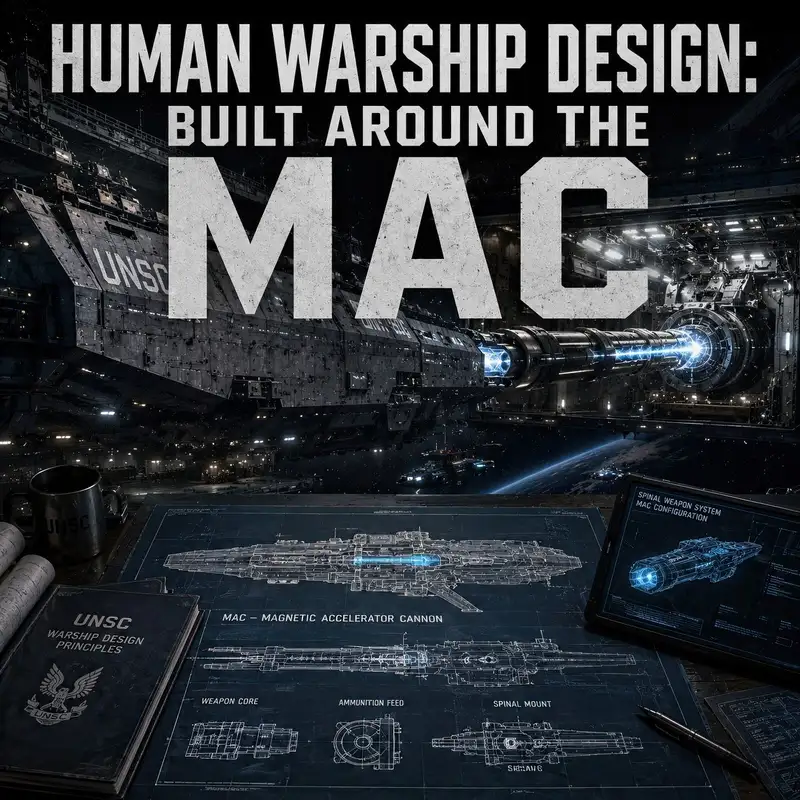
A magnetic accelerator cannon, usually shortened to MAC, is a large electromagnetic mass driver. Instead of chemical propellant, it uses powerful magnetic fields to accelerate a dense projectile to extreme velocity. The projectile does not need an explosive warhead. Its energy comes from mass and speed. When a capital-ship round strikes armor, a station, or an unshielded hull, the impact can tear through structure, scatter superheated debris, destroy internal systems, and continue beyond the first compartment. It is a simple idea carried to a scale that turns the rest of the ship into supporting machinery.
That point is easy to miss because Halo’s human warships are covered with other weapons. Frigates carry missile pods, point-defense guns, naval coilguns, and systems for fighters or dropships. Destroyers and cruisers add more launchers, heavier secondary batteries, and larger magazines. Carriers may deploy entire aerospace groups. Yet on most traditional United Nations Space Command capital ships, the MAC remains the principal direct-fire weapon. The ship is not merely a vessel that happens to carry one. Its hull, power plant, internal volume, maneuvering doctrine, and tactical employment are shaped around delivering that shot.
Human naval architects adopted this approach because it matched what their civilization could build reliably. Before the Covenant War, humanity did not possess mature shipboard energy weapons or widespread energy shielding. It did possess advanced fusion power, superconducting technology, precision guidance, artificial intelligence, and an enormous industrial base capable of producing dense projectiles, capacitors, armor plate, and long electromagnetic accelerators. The MAC converted those strengths into naval firepower. It did not require humanity to master alien plasma physics. It required engineers to make a very large coilgun survive repeated use aboard a moving spacecraft, which was difficult enough.
The result was the long, angular design language associated with human warships. The main accelerator was normally aligned along the ship’s longitudinal axis. Its coils, power connections, loading system, and structural supports occupied a path through much of the hull. The bow became the weapon’s muzzle. The engines at the stern provided the thrust needed to place that muzzle on the target. Between them sat magazines, reactors, crew spaces, hangars, sensors, and armor arranged around a central fact: the ship had to point its body where it intended to place its most important round.
That geometry made the vessel part of the fire-control system. A turreted gun can rotate independently of its platform. A spinal MAC has a much narrower field of fire, so major corrections require the ship to maneuver. The captain, navigation team, thrusters, and artificial intelligence therefore help lay the gun. A firing solution is not only a calculation of range and relative motion. It is a decision about where the ship must be, what direction it must face, how much velocity it should carry, and which threats can fire back while it aligns.
The arrangement imposed structural demands. Accelerating a massive projectile produces an equal reaction through the weapon and its mountings. The frame must distribute those loads while keeping the accelerator aligned. Armor around the bow must protect the weapon without making maintenance impossible. Bulkheads must limit damage while preserving a loading path from magazine to breech. A vessel can retain engines, atmosphere, and communications after battle damage yet lose its decisive weapon because coils, capacitors, sensors, or alignment have been compromised.
Power was the second great constraint. A MAC shot required energy to be generated, stored, and released through the accelerator. That tied the weapon directly to the ship’s reactor and electrical network. Charging the gun competed with propulsion, defensive systems, sensors, communications, and every other demand on the vessel’s power plant. The exact balance varied by class and era, but the operational principle did not. A captain could not treat maximum acceleration, full combat systems, and repeated heavy-gun fire as independent choices. The ship’s engineering department had to make the command decision physically possible.
Capacitors made the shot available on tactical timescales, but they did not create unlimited fire. After discharge, the system required another projectile, another charge cycle, and continued cooling. Damage could lengthen the interval or prevent another shot. This is why the first volley mattered, especially against the Covenant. A human ship might receive only one clean opportunity before plasma fire arrived. A captain who fired too early could waste the round against an unfavorable angle. One who waited too long might preserve a perfect shot for a ship that no longer possessed a bow.
Ammunition was simpler than a guided missile, but simplicity did not mean weightlessness. MAC projectiles had to be manufactured to strict tolerances, transported, loaded, and moved safely through the ship. The gun needed the correct ammunition for its model and loading system. A fleet beyond established depots might have reactor fuel and food yet still lack enough heavy projectiles for another engagement. Naval logistics occasionally produces this sort of achievement: a functioning warship that has successfully transported its empty weapons to the battle area.
Missiles remained essential because they solved problems the MAC could not. Archer pods and other naval missile systems could attack from multiple bearings, complicate enemy defenses, carry nuclear warheads, and exploit damage created by a kinetic strike. They could be launched without pointing the entire hull directly at the target. They could also be intercepted, deceived, or exhausted. During the Covenant War, human commanders often combined synchronized MAC fire with missile salvos. The kinetic rounds struck shields or hulls. Missiles followed into weakened defenses, while nuclear weapons offered additional ways to overload shields or damage clustered ships.
Point-defense guns protected the vessel from incoming missiles, fighters, and boarding craft. Naval coilguns and autocannons covered arcs the main weapon could not. Fighters extended sensors, intercepted hostile aerospace forces, and attacked targets poorly suited to a spinal cannon. Marines defended the ship and conducted boarding operations. These systems allowed the vessel to survive long enough to use its MAC. A warship designed only to fire one perfect shot would be impressive on a proving range and considerably less impressive during the approach to one.
Not every human naval vessel carried a MAC. Some corvettes, patrol craft, support ships, and missile-focused designs served other missions. The Scholte-class missile corvette, for example, relied on cannon and missile batteries. That exception shows that human designers were not following a religious rule. They omitted the weapon when patrol, cost, endurance, or internal volume mattered more. The MAC dominated capital design because it answered the capital-combat problem, not because every hull improved when a large accelerator was forced through its center.
Other small ships reveal the compromises required to carry heavy electromagnetic armament. The Lancer-class fast-attack corvette mounted a MAC and several rapid-fire naval coilguns in a long, fast hull. It became useful against Covenant forces because it could harass larger ships and attack smaller vessels before they closed to plasma range. Its ammunition capacity and endurance were limited. Lancer squadrons could expend their rods early, withdraw behind the main formation, and seek replenishment. The design delivered impressive firepower for its size, then presented the fleet with the less glamorous question of where the next load of ammunition was located.
Frigates represented the most familiar expression of MAC-centered design. They were flexible escorts, patrol ships, troop carriers, and orbital-support platforms, but their main cannon gave them a weapon capable of threatening targets much larger than themselves. A frigate captain could contribute to a fleet volley, support a planetary campaign, or attack a hostile ship that would dominate the frigate in almost every other measure. The trade was survivability. A smaller human hull had less armor, fewer redundant systems, and less capacity to absorb plasma damage. Its main gun gave it a dangerous first move. It did not guarantee a second.
Destroyers and cruisers expanded the same concept. Larger reactors supported heavier weapons and more demanding combat systems. Greater internal volume allowed larger magazines, more missiles, better command facilities, thicker armor, and improved endurance. The Able-class heavy destroyer, used by both the Colonial Military Authority and the United Nations Space Command, carried one primary MAC with substantial missile and defensive armament. It was designed as a compromise between frigate and cruiser roles. That description is not an insult. Naval procurement is largely the art of deciding which compromises can be explained to commanders before the enemy explains them more forcefully.
Cruisers could remain in action longer and serve as command platforms, but they were still shaped by the same firing geometry. Their greater size did not turn the MAC into a turret. The ship still needed a favorable axis, accurate tracking, and time to charge. A cruiser could carry more protection around the weapon and more secondary systems for the periods between shots. It could coordinate smaller ships and absorb damage that would destroy a frigate. Against shielded Covenant capital ships, even that might not be enough. Larger human hulls increased the force available. They did not cancel the technological imbalance.
Many carriers also carried magnetic accelerator armament because aerospace capacity did not remove the need to fight capital ships. A carrier could launch fighters, dropships, and boarding forces while remaining part of the battle line. This produced vessels that were air bases, troop transports, maintenance centers, command posts, and gun platforms at once. The advantage was concentrated capability. The disadvantage was that enemy fire could remove all of those functions by destroying one large hull.
Orbital-defense platforms represented the same logic without the compromises of independent travel. A platform did not need a slipspace drive or the endurance of a warship, so it could devote more mass and power to the weapon. Reach’s defense network used extraordinarily powerful MAC platforms supported by generators on the planet below. The guns could destroy major Covenant vessels, but the system created a clear dependency. The Covenant did not need to duel every platform indefinitely if ground forces could disable the generators feeding them.
That dependency tied naval design to combined-arms defense. Soldiers on Reach protected power facilities that kept orbital guns firing. Ships defended the platforms that anchored fleet firepower. Fighters protected approaches, while communications linked ground commanders, orbital crews, and headquarters. A MAC impact may look like a purely naval event. The ability to produce it could depend on engineers, infantry, technicians, and supply personnel who never saw the target.
The Covenant War turned MAC doctrine from an effective human system into a survival strategy against superior technology. Covenant energy shields could absorb attacks that would have destroyed unshielded ships. Human commanders therefore concentrated fire. Multiple ships aligned on one target and timed their rounds to arrive together or in rapid sequence. The first impacts strained or collapsed shields. Follow-on rounds and missiles attacked the exposed hull. This demanded precise coordination. It also created predictable human behavior. A Covenant commander who saw several ships turning their bows toward one vessel had reason to suspect that the next few seconds would be professionally unpleasant.
Artificial intelligence improved the odds by calculating intercepts, managing power, coordinating salvos, tracking shield behavior, and updating solutions faster than biological crews could. It could account for relative velocity, projectile travel, enemy maneuver, and the timing of several ships firing as one. It could not remove uncertainty. Sensors could be jammed or damaged. Enemy commanders could change course. Ships could fail to charge on schedule. Slipspace arrivals could divide a formation before the battle began. An artificial intelligence might produce the best possible solution from the available data. The available data retained its traditional habit of being incomplete.
The fixed firing axis also influenced formation. Human ships needed clear lanes for their main guns and enough separation to maneuver without crossing one another’s solutions. Escorts screened vulnerable vessels, prowlers searched for enemy positions, and commanders tried to create opportunities for massed fire. A fleet turning to align its MACs could expose its flanks. A damaged ship falling out of formation might block fire or collide with another vessel. Naval battle was therefore a contest over geometry as much as destructive power. The side controlling position controlled which ships could fire and which had to maneuver.
Covenant plasma weapons punished delay. Guided plasma torpedoes and energy projectors could threaten human ships before those ships completed repeated firing cycles. Human armor could absorb some punishment, but it lacked the renewable protection of energy shields. Damage accumulated through compartments, power systems, sensors, and crew. A human vessel that survived the first strike often became less capable of delivering the second. This produced many engagements in which the MAC performed exactly as designed and the ship carrying it still died. Weapon effectiveness and platform survivability are related. They are not the same measurement.
The gun also shaped command behavior. Captains had to decide whether to preserve distance for another firing cycle, close the range to improve the probability of a hit, or use the ship itself to protect another vessel. Fleet commanders had to choose whether to mass fire on one target or divide it across several threats. Concentration could achieve a kill while allowing other enemy ships to fire unopposed. Dispersion could damage several vessels without destroying any. The MAC rewarded discipline because its greatest effect came from coordinated volleys. War rarely supplied the quiet, orderly conditions in which coordination is easiest.
A successful kinetic strike could create problems beyond the target. Debris continued along dangerous trajectories. A round missing in orbit did not politely disappear. Fire near civilian traffic, stations, moons, or a planet required attention to what lay beyond the aiming point. Orbital support against surface targets could be devastating, but it was not a cost-free substitute for ground forces. The weapon had to be aimed through an atmosphere and toward a world someone might intend to govern, evacuate, or rebuild. The ability to strike a location from orbit did not answer whether doing so would accomplish the political objective.
Maintenance was as decisive as marksmanship. Coils, conduits, capacitor banks, loading machinery, sensors, and structural mountings required inspection and repair. A shipyard could realign components that a crew could only stabilize in the field. Bow damage might leave a vessel able to travel but unable to use its main weapon safely. Fleets without secure yards accumulated mission kills even when hulls survived. A ship listed as operational could mean it still moved under its own power. Whether the weapons officer agreed was a separate administrative matter.
The MAC’s industrial logic remained one of its greatest strengths. Dense projectiles and electromagnetic accelerators were demanding, but humanity could manufacture them in quantity across a mature industrial network. Different classes could carry weapons scaled to their size and mission. Training, fire-control doctrine, ammunition production, and maintenance knowledge could be distributed across the fleet. The system was not dependent on a rare alien artifact or one irreplaceable operator. During a war that destroyed shipyards and colonies, that reproducibility mattered. A weapon slightly less miraculous but available on many hulls can shape a war more reliably than a prototype no surviving factory can duplicate.
Postwar technology changed the surrounding ship without immediately replacing the principle. The Infinity combined advanced human engineering, selected Forerunner-derived systems, energy shielding, vast embarked forces, and multiple super-heavy magnetic accelerator cannons. Its guns could tear through heavy enemy vessels with extraordinary effect. Postwar frigates and cruisers also benefited from improved reactors, sensors, materials, and limited access to shielding. The MAC remained useful because better defenses and power systems made the firing platform more likely to survive and shoot again. Technological progress strengthened the old weapon rather than making kinetic impact obsolete.
There were alternatives. The Mulsanne-class frigate replaced the traditional MAC with a brightlance reflex laser, a directed-energy weapon suited to different tactical conditions. Rapid-fire naval coilguns on other designs offered higher rates of fire against smaller or more maneuverable targets. Missiles remained flexible. Captured and reverse-engineered technologies opened new possibilities. These developments did not prove that the MAC had been a primitive mistake. They showed that a fleet facing Covenant remnants, the Banished, Forerunner machines, and other threats could no longer assume one principal weapon solved every engagement.
The ambush at Zeta Halo exposed the final limitation of MAC-centered design. The Infinity’s guns were powerful enough to punch through Banished dreadnoughts. They were not powerful enough to undo surprise, compromised positioning, boarding attacks, ramming vessels, confused traffic, and a command plan collapsing at close range. The flagship could destroy targets in front of its accelerators while enemies attacked from multiple bearings and closed against the hull. Once the battle became a melee, the weapon that had shaped the ship could no longer shape the entire fight.
Human warships were built around the magnetic accelerator cannon because it converted humanity’s strongest industrial capabilities into a weapon that could threaten technologically superior enemies. It gave frigates the ability to wound capital ships, allowed fleets to concentrate fire across enormous distances, and turned orbital platforms into strategic defenses. It also required alignment, power, ammunition, maintenance, coordination, and time. The MAC was never a guarantee of victory. It was the best answer human shipbuilders could produce to the problem of placing destructive force across space.
That answer left a visible mark on every elongated hull and armored bow. A United Nations Space Command warship was a reactor, magazine, sensor platform, maneuvering system, and crew organized around one demanding act: point the ship, charge the weapon, solve the intercept, and fire before the enemy changed the conditions. At Zeta Halo, one round opened a passage through a Banished dreadnought while the Infinity itself was being lost around it. The cannon had done exactly what it was designed to do. The battle required more.