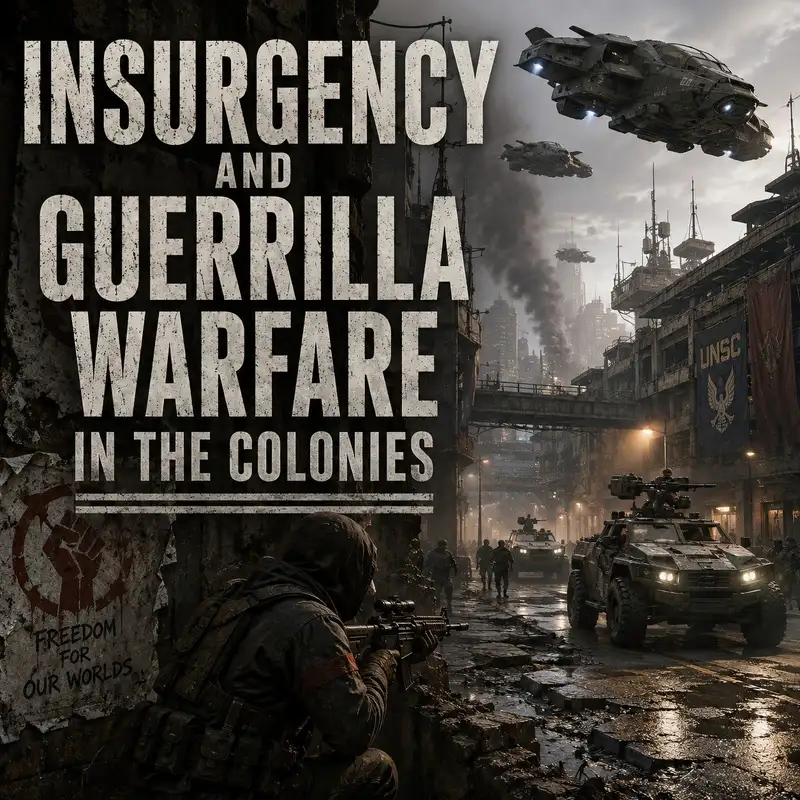
Insurgency and Guerrilla Warfare in the Colonies
The order concerning Far Isle in twenty-four ninety-two ended with a nuclear strike on a human colony. The surviving record does not explain every step that led there, who approved the final escalation, or how many people escaped. It establishes enough. Conventional suppression had failed, the Unified Earth Government treated the revolt as a threat that had to be contained, and the United Nations Space Command used a weapon normally associated with strategic war against people it still claimed as citizens. The rebellion ended. The political damage did not.
That is why insurgency in the colonies cannot be explained as a contest between better soldiers and worse ones. The government possessed fleets, intelligence services, special forces, and the industrial power of Earth and the Inner Colonies. Insurgent organizations possessed far less. They survived because they were dispersed across enormous distances, embedded in local disputes, able to replace leaders, and sustained by grievances that could not be destroyed with one base. Guerrilla warfare was their military method. Colonial alienation was the environment that made the method possible.
Human expansion had created a political system larger than its ability to feel local. The Colonial Administration Authority managed settlement, employment, infrastructure, and commerce on behalf of the Unified Earth Government. The Colonial Military Authority handled much of the frontier’s security. Those institutions connected distant worlds to Earth, but distance weakened representation and trust. Slipspace shortened travel without making it immediate or predictable. Messages arrived late. Officials rotated through communities they did not understand. Colonists often saw resources moving inward and orders moving outward.
The Outer Colonies were not one political bloc. Some worlds depended heavily on Earth. Some possessed strong local governments and little interest in secession. Others wanted greater autonomy without armed conflict. Separatists disagreed about whether independence should come through elections, strikes, noncooperation, sabotage, or war. The label Insurrection eventually covered peaceful organizers, local militias, smugglers, mutineers, terrorists, former government troops, and opportunists who found rebellion profitable. Treating all of them as one enemy simplified briefings and complicated every attempt to end the conflict.
The Callisto Incident in twenty-four ninety-four showed how quickly a security action could become a political symbol. A United Nations Space Command corvette stopped a merchant vessel in the Twenty-Six Draconis system while authorities searched for contraband linked to slipspace-drive production. The boarding ended in gunfire and deaths. The corvette Callisto was later seized, and the naval response culminated in a costly engagement involving several warships. What began as enforcement against smuggling became evidence, depending on the observer, of either a widening rebellion or an occupying military treating frontier commerce as hostile.
Far Isle and Callisto did not create every grievance, but they gave later violence a history. Government officials could point to hijacking, black-market strategic material, and attacks on naval personnel. Separatists could point to searches, central control, and nuclear punishment. Each side selected the part of the record that justified its next action. That is a familiar feature of insurgency. The past becomes ammunition, and facts that ought to encourage restraint are reorganized into reasons why restraint has already failed.
Guerrilla forces avoid the kind of battle a stronger military wants. They attack patrols, depots, officials, communications, shipping, and isolated installations. They use mines, hidden explosives, assassinations, kidnappings, piracy, and brief concentrations of force. Afterward they disperse among terrain, settlements, or commercial traffic. The purpose is not always to hold ground. It is to make administration costly, expose the government’s limits, acquire supplies, and provoke a response that can be presented as proof that local people are being ruled by outsiders.
Interstellar geography enlarged that opportunity. An asteroid belt could hide a station that no practical patrol could inspect rock by rock. A freighter could be a merchant one week and a courier the next. Small vessels could move through routes too unimportant for constant naval coverage. Slipspace delays meant a distant commander might receive a warning after the raiders had already moved. The same distance that frustrated government control also frustrated insurgent coordination, which encouraged cells to operate independently and made the movement harder to decapitate.
Robert Watts became one of the most capable rebel leaders because he understood both sides of that problem. He had served as a respected Marine officer before defecting and joining the separatist struggle. In the Eridanus system, forces associated with him used equipment supplied by sympathizers and defectors within the colonial military establishment. Bombings, political killings, kidnappings, attacks on shipping, and captured vessels supported an effort to seize Eridanus Two and build a base for a wider campaign.
The government retook Eridanus Two in twenty-four ninety-six, but victory on the planet did not destroy the network. Rebel forces withdrew into the system’s asteroid belt and eventually operated from the hidden settlement known as Eridanus Secundus. Search forces either found nothing or risked ambush in a region too large to examine efficiently. Watts could raid commerce, recover supplies, and preserve a political center beyond ordinary colonial oversight. The fortress was not powerful because its guns matched a fleet. It was powerful because the fleet could not confidently find the correct asteroid.
Such sanctuaries still had logistical limits. People inside Eridanus Secundus needed atmosphere, water, food, power, medicine, spare parts, and access to trade. Warships and captured freighters needed fuel, ammunition, trained crews, and repair. The rebels survived through smuggling, piracy, sympathetic contacts, and commercial networks that could conceal military support inside ordinary traffic. Every supply run created a chance for intelligence collection. Every blockade risked punishing civilians and neutral traders more severely than the leadership it was meant to isolate.
The intelligence war therefore mattered more than the number of ships on either side. Government services sought informants, intercepted communications, financial patterns, stolen matériel, and defectors who could identify hidden cells. Insurgents cultivated sympathizers inside colonial agencies, military units, ports, and shipping firms. They also benefited from the government’s uncertainty. A commander who could not distinguish a cooperative colony from an insurgent sanctuary might impose restrictions on both, creating new resentment while the actual cell moved elsewhere.
The Colonial Military Authority became part of that crisis. Its personnel were recruited and stationed closer to colonial society than many Earth-directed forces, and some sympathized with local demands. Others remained loyal and fought the rebellion. Evidence that insurgents had penetrated or received support from elements of the organization damaged trust across the entire institution. Resources and authority shifted toward the United Nations Space Command. Centralization improved control from Earth’s perspective. To colonists already suspicious of Earth, it also looked like another removal of local power.
Operation Trebuchet, beginning in twenty-five thirteen, was the government’s broad military answer. It was not one battle or one invasion. It was a long counterinsurgency campaign spread across multiple systems, involving naval patrols, Marine units, special warfare teams, raids, blockades, intelligence collection, and attacks on rebel infrastructure. The campaign could clear a base, retake a city, or destroy a flotilla. Holding the result required reliable local government and security after the task force departed, which was the portion no magnetic accelerator cannon could provide.
Counterinsurgency placed ordinary troops in politically dangerous situations. A patrol had to search civilian traffic because weapons and couriers used civilian traffic. A Marine unit had to protect itself against concealed bombs while avoiding actions that treated every resident as a bomber. Checkpoints slowed insurgents and the economy together. Raids depended on intelligence that could be old, manipulated, or supplied by local rivals. The force could follow procedure and still create anger, especially when the procedure assumed that security took priority over dignity, commerce, and political consent.
Avery Johnson and Nolan Byrne experienced that problem on Tribute in twenty-five twenty-four. Their teams were sent against an insurgent bomb-making operation. The mission deteriorated into a hostage crisis and an explosion at a civilian restaurant. Dozens of civilians died along with Marines and rebels. The tactical record contained targets, casualties, and decisions made in seconds. The political result was harder to contain. Survivors did not experience the event as a clean division between counterterrorists and terrorists. They experienced armed organizations turning an ordinary public place into a battlefield.
Insurgent violence could be far more deliberate. In twenty-five eleven, the Freedom and Liberation Party detonated a commercial nuclear device inside the Haven arcology on Mamore. The attack killed two million people and injured more than eight million. The organization demanded the withdrawal of the Colonial Military Authority from the Eridanus sector. Whatever grievance it claimed to represent, the weapon targeted a population on a scale that made political language secondary. It was terrorism designed to force policy through mass civilian death.
Far Isle and Haven define the moral boundaries of the conflict more clearly than any slogan. Colonial inequality, weak representation, and central coercion were real. They did not justify annihilating civilians in an arcology. Bombings, kidnappings, and assassination campaigns were real. They did not make nuclear destruction of a colony an acceptable substitute for political control. The history becomes inaccurate when one side’s crimes are used to erase the other side’s grievances, or when legitimate grievances are used to sanitize crimes committed in their name.
Violence also created a cycle useful to the most uncompromising actors. A terror attack strengthened officials who argued that negotiation rewarded murder. A sweeping security response strengthened insurgents who argued that Earth understood only force. Moderate colonial leaders could be discredited as collaborators. Local officials who cooperated with the military became targets. Military personnel who questioned policy appeared weak or disloyal. Each escalation reduced the political space in which autonomy, security, and accountability might have been negotiated.
Strategic models reinforced the government’s fear. The Carver Findings and later Office of Naval Intelligence projections warned that spreading unrest could become a catastrophic war between the Inner and Outer Colonies. Whether every assumption in those models was sound mattered less than the conclusion adopted by senior officials. They believed conventional counterinsurgency was too costly, too visible, and too slow. Leadership networks had to be removed before separate rebellions could combine into a civil war that the interstellar economy might not survive.
That reasoning shaped the Orion project and later the Spartan Two program. The Spartans were not originally built to fight alien armies. They were designed as a clandestine counterinsurgency force capable of infiltrating rebel sanctuaries, capturing or killing leaders, destroying strategic targets, and leaving before a larger battle developed. The program’s military logic was direct. Its methods included the abduction of children, flash-clone replacements, lethal augmentation, indoctrination, and secrecy from the public whose future supposedly justified it.
Operation Talon in September of twenty-five twenty-five demonstrated the tactical concept. Blue Team entered Eridanus Secundus, identified Robert Watts, captured him alive, and extracted him for interrogation. A conventional assault against the entire asteroid settlement would have required ships, troops, and extensive casualties. A small force removed the senior leader with speed and surprise. As a special operation, it succeeded. As a political solution, it did not. Other figures assumed authority, and the broader conflict remained larger than the man taken from one room.
Decapitation works best against an organization that cannot replace the head. Insurgent movements built from separate cells, local grievances, personal networks, and multiple leaders are less cooperative. The capture of Watts damaged coordination and intelligence, but it did not make the colonies trust Earth or cause every armed faction to disband. A new leader could inherit the symbols without inheriting the exact command system. A local cell could continue attacking even if it received no orders at all. Tactical precision reduced collateral damage. It did not manufacture legitimacy.
The Covenant’s arrival changed the priority of the war without resolving its politics. Operation Trebuchet was suspended as human forces confronted extermination. Some insurgents fought the Covenant, cooperated with government units, or protected communities that no larger force could reach. Others remained suspicious of the United Nations Space Command, withheld intelligence, continued piracy, or tried to use the chaos to preserve independence. The new enemy made human survival a common interest. It did not make every colonial memory of Far Isle, Eridanus, Mamore, or military occupation disappear.
The war also blurred the line between insurgent sanctuary and refugee survival. Displaced populations created hidden settlements, black markets, and local defense forces beyond normal government control. Places such as the Rubble combined refugees, smugglers, separatist politics, improvised industry, and the constant danger of discovery. An independent community might trade with criminals because recognized supply systems no longer existed. A rebel ship might defend civilians from the Covenant and still remain hostile to Earth. War did not simplify allegiance. It made survival dependent on arrangements no prewar law had anticipated.
The Covenant destroyed many Outer Colonies that had been central to the Insurrection. That reduced some rebel networks through genocide rather than reconciliation. At the same time, emergency rule transferred extraordinary authority to the military, damaged civilian institutions, and concentrated decision-making even further. Colonists who survived often owed their rescue to United Nations Space Command personnel. They could honor that sacrifice and still distrust the government that had ruled them before the invasion. Gratitude and political consent are related less often than official ceremonies suggest.
When the Covenant War ended, the conditions for renewed insurgency were already present. The Unified Earth Government was exhausted. Many colonies had been destroyed, isolated, or left to reconstruct with limited help. Veterans returned to communities that remembered both alien attack and human repression. Alien weapons entered black markets. Independent worlds and criminal ports offered sanctuary. The military remained powerful but overextended, while the political institutions expected to restore ordinary authority were rebuilding at a much slower pace.
The United Rebel Front reappeared in postwar violence, including fighting on Draco Three and the crisis on Talitsa. The latter drew Spartan personnel into another conflict with human rebels and ended with Michael Crespo, known as Mickey, defecting from the United Nations Space Command. His choice did not represent every veteran or every colonial cause. It demonstrated that the government’s own personnel could emerge from the Covenant War convinced that they were again being ordered to fight humans without addressing why the conflict had returned.
The New Colonial Alliance pursued an even more ambitious model. Founded by former Admiral Mattius Drake, it recruited military defectors, acquired human and alien vessels, and penetrated organizations expected to be secure. Its operations threatened the Infinity and endangered diplomatic efforts involving human and Sangheili leaders. Rogue Spartans gave the movement capabilities an earlier insurgent cell could scarcely have imagined. They also gave the government a new reason to treat political dissent as a potential strategic threat, which was not especially helpful to dissenters who had no intention of stealing a warship.
By twenty-five fifty-nine, Ilsa Zane had killed Drake and pledged the New Colonial Alliance to the Banished. The alliance offered ships, weapons, manpower, and a larger enemy’s protection. It also changed what the movement represented. A colonial insurgency claiming liberation from Earth had become part of a conquest organization led by nonhuman warlords and sustained through raiding, coercion, and spoils. By twenty-five sixty, New Colonial Alliance personnel were fighting under Banished authority against a Spartan training academy. Rebellion had survived. Its political content had mutated.
That mutation is one of guerrilla warfare’s recurring dangers. A dispersed movement can survive defeat because it adapts, recruits, and accepts outside support. The same flexibility can transfer control to smugglers, extremists, defectors, or foreign patrons whose objectives differ from those of the population. Weapons acquired to defend autonomy can become instruments of private power. A sanctuary can become a criminal market. An alliance that keeps a cell alive can make the cell dependent on a stronger sponsor.
The government faced a parallel danger. Military effectiveness could become a substitute for political strategy. Ships could blockade a system, Spartans could seize a leader, and intelligence services could penetrate a network. None of those actions answered how much autonomy a colony should possess, how resources should be distributed, or who had authority to investigate abuses. Counterinsurgency can suppress violence while leaving the dispute intact. When emergency measures become permanent, the state may defeat one organization and preserve the argument used by the next one.
A durable response required distinctions that warfare encouraged commanders to ignore. Peaceful separatists were not terrorists. Local militias were not automatically part of the United Rebel Front. Smugglers might be motivated by profit rather than independence. A colony requesting autonomy could still want protection from pirates and alien attack. Security forces needed intelligence precise enough to isolate violent cells without treating whole populations as enemy support. Political authorities needed concessions, representation, reconstruction, and accountability credible enough that cooperation did not look like surrender.
The Insurrection endured because it was never only an order of battle. It was a struggle over distance, representation, resources, security, and who possessed the right to command communities scattered across human space. Guerrilla warfare allowed smaller groups to exploit those disputes and survive stronger fleets. Terrorism discredited causes it claimed to advance. State repression converted military control into political resentment. The Covenant interrupted the conflict with a war of extinction, but interruption was not settlement.
Far Isle ended beneath a nuclear strike. Watts was carried out of Eridanus Secundus by Spartans. Haven became a mass grave. Decades later, new rebels flew alien ships and served the Banished. Each event looked like a decisive answer to someone at the time. None resolved the relationship between Earth and the colonies. The insurgency survived because leaders and bases could be replaced while the political distance remained. The most difficult terrain was never the asteroid belt or the city street. It was the space between being governed and believing that government was legitimate.