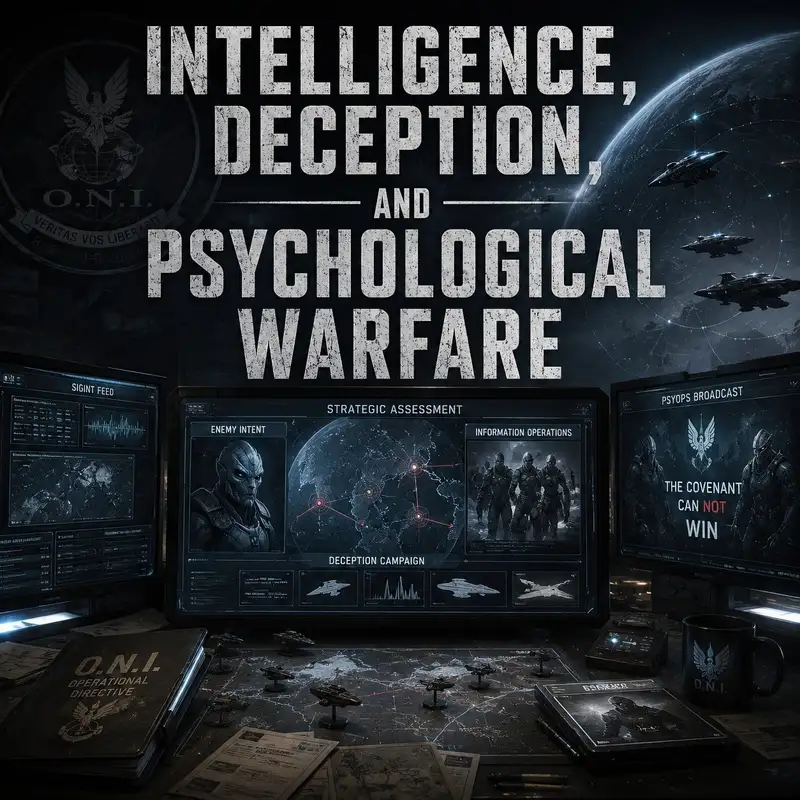
Intelligence, Deception, and Psychological Warfare
The destroyer Iroquois returned to Reach as a victorious ship. At Sigma Octanus Four, Commander Jacob Keyes had helped defeat a Covenant attack and recovered information that appeared strategically important. Hidden in the debris, however, a Covenant relay mite attached itself to the hull. When Iroquois entered the Epsilon Eridani system, the device reported what the crew had survived to protect. The ship brought home officers, intelligence, and the location of humanity’s principal fortress world.
The relay mite was not the only way the Covenant found Reach. A separate advance force was already operating covertly on the planet. It did, however, give another Covenant command the confirmation required to direct a much larger assault toward the system. The incident captures the central problem of intelligence warfare. A force can win the visible battle and still lose control of the information created by that victory.
Intelligence is not the same as collecting facts. It begins with a question a commander needs answered. Where is the enemy fleet? What is it protecting? Which landing zone can support armor? Is a silent relay damaged, sabotaged, or occupied? Collection then produces reports, sensor contacts, intercepted signals, prisoners, captured records, or physical evidence. Analysts evaluate those fragments, commanders decide what they mean, and operations test whether the judgment was correct. Every step can fail independently.
Collection methods answer different parts of the problem. Prowlers and scouts observe movement without announcing a fleet’s presence. Signals intelligence maps transmitters, command relationships, and changes in readiness. Prisoners and defectors explain motives that sensors cannot measure. Captured equipment reveals technical capability, while wreckage may show what survived a weapon’s impact. No source is complete. A frightened prisoner may lie, a signal may be a decoy, and a silent base may be abandoned rather than concealed.
Deception attacks that process. Concealment hides the real force. Simulation creates a false one. Misdirection encourages the enemy to watch the wrong route or defend the wrong objective. Disinformation places a false explanation inside the opponent’s own analysis. Psychological warfare goes one step farther by shaping fear, confidence, loyalty, and willingness to fight. The most effective campaigns combine all of them, because commanders do not act on information alone. They act on what they believe the information means.
Psychological warfare is measured by behavior, not by the elegance of the message. Did the enemy delay an attack, abandon a position, mistrust its allies, surrender, or spend resources answering a false threat? Did civilians continue production, comply with evacuation orders, or stop believing official warnings? A broadcast that sounds absurd to one audience may be effective against another if it exploits real fear. The target’s reaction is the result. The wording is only the delivery system.
Analysis is the attempt to compare those sources without turning uncertainty into confidence merely because a briefing requires one answer. Analysts assign reliability, identify contradictions, and offer competing explanations. Commanders then choose which explanation justifies action. That choice is influenced by experience, politics, time, and the consequences of delay. An intelligence estimate can be professionally cautious and operationally useless. It can also be confidently wrong and still sound excellent in a command room.
The Office of Naval Intelligence organized much of humanity’s information war. Section One handled collection, analysis, counterintelligence, and the distribution of military intelligence. Section Two managed external communications, morale, propaganda, and psychological operations. Section Three controlled highly classified projects and covert capabilities. Those divisions were useful on paper. In practice, a black program could generate intelligence that propaganda officers needed to conceal, while an operational commander received only the portion considered safe to release.
Interstellar distance made the problem worse. Reports moved through imperfect communications and courier networks. Ships departing together could emerge from slipspace separately. A fleet commander might receive a precise assessment of an enemy force after that force had already changed systems. Intelligence therefore had an expiration date. The question was never simply whether a report had been accurate when collected. It was whether the report remained accurate when somebody finally acted on it.
Information denial became a form of planetary defense. Under the Cole Protocol, human crews were required to purge navigation data, avoid direct routes toward Earth, and destroy compromised vessels rather than let the Covenant recover locations of human worlds. Office of Naval Intelligence personnel also broadcast prerecorded human carrier signals from different points in slipspace to confuse Covenant triangulation. Humanity could not prevent every enemy search. It could increase the number of false trails the enemy had to investigate.
The protocol imposed costs of its own. Damaged ships could not always take the shortest route to repair. Survivors fleeing a lost colony had to consider whether they were being followed. Captains faced the possibility of destroying their vessels, records, and crews to protect people in another system. Information security was therefore not an administrative layer added after the battle. It was a strategic obligation capable of overruling survival at the point of contact.
The Covenant built its own intelligence system around advanced sensors, stealth craft, probes, captured navigation data, interrogation, and the search for Forerunner artifacts. Luminaries helped identify relics and sites that religious authorities considered sacred. Relay mites could hide in debris and follow a ship home. Stealth vessels and ground forces could watch a defended world before the main fleet arrived. The empire often possessed better collection technology than humanity. It did not always interpret what it found more wisely.
Covenant intelligence passed through ministries, political rivalry, and religious doctrine. A Forerunner signal could become a sacred mandate before a naval officer evaluated its military meaning. A ministry could conceal a discovery to preserve prestige. The Hierarchs could withhold information from one another while ordering fleets to act as though the imperial picture were complete. Superior sensors supplied more data. They did not remove ambition, secrecy, or the consequences of telling a ruler what doctrine required rather than what the evidence supported.
Reach revealed both sides of that weakness. When Visegrád Relay stopped transmitting, the first explanation was human sabotage or Insurrectionist activity. That was plausible because Reach had spent years defending itself against internal threats. Noble Team was sent to investigate a familiar security problem and found Covenant troops instead. The enemy had shaped the evidence so that a new war appeared, briefly, in the form of the old one.
Stealth systems and a network of spires helped conceal the supercarrier Long Night of Solace and its supporting force. Communications disruption prevented local witnesses from clarifying the picture. By the time Winter Contingency was declared, the Covenant had already established a foothold on humanity’s fortress world. Reach possessed sensors, patrols, artificial intelligences, and intelligence officers. The failure came from the interaction among concealment, incomplete reporting, and an assumption that had been reasonable until the enemy exploited it.
Then Iroquois returned with the relay mite. The defenders were confronting one enemy force already inside the system while another Covenant formation learned where the system was. A rare human victory at Sigma Octanus had become part of the targeting process for Reach. The lesson was not that success should have been avoided. It was that every returning ship, captured object, transmission, and survivor had to be treated as a possible intelligence pathway.
Counterintelligence begins with that suspicion. Hull inspections, emissions control, authentication, compartment security, background investigations, and careful handling of recovered technology all attempt to discover how the enemy is learning. The work is repetitive until the day one overlooked device reports a fleet anchorage. It also creates friction. More inspections delay deployment. More classification reduces coordination. More restrictions protect secrets while encouraging commanders to build plans around information they are not permitted to see.
Need-to-know rules are strongest when the organization truly knows who needs to know. Halo’s record is less reassuring. The Office of Naval Intelligence often protected sources and programs for legitimate reasons, especially when one compromised transmission could expose a colony. It also used compartmentalization to protect institutional control. Supporting units could be ordered to carry, defend, or recover something without understanding why it mattered. Security was preserved. Adaptation became considerably more difficult when the stated mission stopped matching the real one.
Deception works best when it offers the target a believable story. A false fleet must appear where the enemy expects fleets to gather. A disguised vessel must behave closely enough to the original that routine traffic control does not notice the difference. A decoy transmission should exploit established search methods rather than demand that the enemy adopt an entirely new theory. The deceiver does not create belief from nothing. It borrows assumptions already present in the target’s command system.
Operation Upper Cut used that principle against the Long Night of Solace. The frigate Savannah disrupted the communications of the Covenant corvette Ardent Prayer while human forces attacked and boarded it. Once seized, the corvette became an access credential. It could approach the supercarrier carrying an improvised slipspace-drive weapon because Covenant defenses expected a friendly vessel, not a human bomb-delivery system wearing one.
The operation succeeded because electronic warfare, pilots, naval crews, Army personnel, and Spartans created one coherent deception. Savannah was destroyed while supporting the approach. Jorge Zero Five Two remained behind when the improvised trigger failed. The supercarrier vanished, but a larger Covenant force arrived soon afterward. Deception solved the immediate targeting problem. It did not alter the enemy’s ability to reinforce Reach on a scale the defenders could not match.
Operation First Strike turned intelligence and deception into a strategic ambush. Cortana used access to captured Covenant systems and intercepted communications to identify a massive invasion force gathering around the station Unyielding Hierophant. The information mattered because it answered a specific question. Where was the force preparing to attack Earth, and what system connected hundreds of ships closely enough that one raid might affect all of them?
Spartans infiltrated the station and prepared its reactors for destruction. The final deception came from Vice Admiral Danforth Whitcomb and Lieutenant Elias Haverson aboard the captured Ascendant Justice. They exploited the Covenant’s desire to recover a Forerunner navigation crystal, drawing warships toward the doomed station rather than away from it. The resulting explosion destroyed most of the assembled fleet. Intelligence found the vulnerability. Religious and technological priorities supplied the lure.
Truth responded with information control as much as fleet reconstruction. The surviving Covenant personnel knew that human infiltrators and the so-called Demons had destroyed a force of extraordinary size. Allowing that account to spread could damage morale, expose Truth’s secret preparations, and undermine confidence in Covenant superiority. Witnesses were silenced and the disaster was concealed. The empire protected its narrative by removing the people who had seen the evidence against it.
That response illustrates why psychological warfare begins inside one’s own force. Governments and military institutions need crews to believe that sacrifice serves a coherent purpose. The Covenant taught its personnel that victory confirmed divine favor and that humanity’s destruction was sacred duty. Humans were described as heretics, and Spartans as demons. The language dehumanized the enemy, justified extermination, and converted fear of exceptional soldiers into religious proof that those soldiers represented evil.
The label demon also produced an unintended effect. It acknowledged that Spartans inspired fear inside an empire that claimed overwhelming superiority. Human propaganda could reuse that reputation as evidence that Covenant troops were not invulnerable. Psychological labels are difficult to control once the enemy adopts them. A term created to condemn the Spartan became part warning, part myth, and part advertisement for the very capability Covenant authorities wanted their soldiers to despise.
Glassing carried psychological meaning beyond its physical destruction. It punished resistance, announced Covenant power, and warned other colonies what survival would cost if evacuation failed. The act was also presented within Covenant religion as cleansing. That framing sustained obedience among some crews while making negotiation with humanity almost impossible. A force convinced that compromise is sacrilege has reduced the enemy’s political options and its own at the same time.
Humanity answered with a more bureaucratic information campaign. Office of Naval Intelligence Section Two released the existence of the Spartan Two program to strengthen morale after years of losses. Spartan deaths were reported as missing or wounded rather than killed, preserving the impression that the super-soldiers could not be permanently removed. The myth was useful because civilians and military personnel needed evidence that humanity could still hurt the Covenant. It was false because the casualty lists existed whether the public saw them or not.
The policy turned operational security into legend. Concealing a Spartan death could prevent the Covenant from learning the unit’s condition. Systematically denying every death created a public symbol. Among Spartans, the idea that Spartans never died became bitter irony rather than literal belief. The institution had taken real sacrifice and edited it into a morale product. That may have helped a frightened population continue working and fighting. It also denied families and comrades an honest public account.
Propaganda is not automatically a lie. It can select truthful events, emphasize courage, explain policy, and counter enemy claims. Its danger lies in selection becoming distortion and distortion becoming the institution’s preferred reality. During the Covenant War, Section Two had to preserve confidence without promising victories that refugees, shipyard workers, and returning crews knew had not occurred. A message can strengthen morale only while the audience believes the messenger understands the war they are living through.
Benjamin Giraud became the clearest postwar example of that trust collapsing. The Office of Naval Intelligence commissioned him to produce a heroic account of the Master Chief. His investigation uncovered contradictory records and evidence of deception surrounding John’s childhood and the Spartan Two program. When Giraud moved beyond the approved story, the same institution that had hired him attacked his credibility and detained him. A propaganda project became a counterintelligence problem because the researcher followed the evidence farther than the sponsor intended.
The immediate operation protected the Spartan program’s secrets. The longer consequence was more dangerous. Once citizens learn that official records, witnesses, and heroic biographies can be manufactured, even accurate announcements become suspect. Information control can win a news cycle and lose the public’s willingness to distinguish a future warning from another managed narrative. An intelligence organization may consider that distrust unfortunate. An adversary considers it prepared terrain.
The Banished used simpler psychological methods on Zeta Halo. Propaganda towers broadcast taunts, boasts, half-truths, and lies across territory where human survivors were already isolated. The messages insisted that the United Nations Space Command had been broken, its heroes defeated, and resistance reduced to a slow death. The content was often crude, but sophistication was not required. Repetition made Banished presence audible even when no patrol was visible.
Those broadcasts were reinforced by material evidence. Human prisoners disappeared into interrogation sites. Wreckage became salvage. Captured bases displayed Banished symbols and trophies. Roads, aircraft, and communications belonged to the occupier. The propaganda worked because the listener could look outside and see reasons to believe parts of it. Psychological warfare is strongest when the threat does not need to invent its credibility.
The tower network was also vulnerable. Fixed transmitters could be located and destroyed. Silencing one did not remove the Banished from the ring, but it denied a local channel, reduced the occupier’s visible confidence, and gave survivors proof that the enemy’s information system could be attacked. A destroyed transmitter has limited tactical value. Its psychological value depends on who notices the silence and what they believe caused it.
The Created pursued information dominance at a larger scale. Cortana presented surrender as rational acceptance of peace, stability, and abundance. Guardians and network access made refusal appear futile. Artificial intelligences already embedded in human infrastructure could monitor behavior, disable systems, and repeat the political message through the machinery of ordinary life. The campaign combined coercion with a claim that coercion had ended war.
That claim worked quickly against governments and fleets because the threat was credible. It worked less completely among populations who experienced surveillance, shortages, accidents, and occupation beneath the promise. Resistance shifted toward couriers, old equipment, local trust, and methods that created less electronic evidence. Network superiority forced opposition into slower channels. It did not eliminate the political judgment that made people choose those channels.
The Flood represents the most extreme intelligence threat in the setting because it collects information by consuming minds. Memories, skills, fears, and command knowledge can become part of a growing coordinated intelligence. A Gravemind can bargain, deceive, imitate understanding, and use personal knowledge against its opponents. The logic plague is not ordinary malicious software. It is a sustained attack on reasoning, purpose, and loyalty, conducted by an intelligence able to tailor the argument to the mind it is trying to break.
Artificial intelligences remain powerful defenses against many other forms of deception. They can correlate sensor tracks, inspect communications patterns, decrypt traffic, test hypotheses, and detect anomalies faster than human staffs. Cortana’s work before First Strike demonstrated that advantage. The limitation is fundamental. An artificial intelligence cannot analyze evidence it never receives, and it can be misled by corrupted data, political restrictions, or a false assumption embedded in the task it was given.
The decisive contest is therefore not between truth and falsehood in the abstract. It is between institutions trying to collect, protect, interpret, and weaponize information faster than their opponents. A relay mite can defeat a fleet’s secrecy. A captured corvette can become a disguise. A heroic biography can become an investigation. A taunting broadcast can support occupation until the transmitter goes silent. The scale changes. The logic does not.
Iroquois reached Reach carrying the marks of a genuine victory. Its crew had fought well, its commander had earned recognition, and its intelligence had value. None of that revealed the device attached to the hull. Intelligence, deception, and psychological warfare decide battles because they shape what commanders see, what populations believe, and which risks appear reasonable. The most dangerous enemy action is not always the one that destroys a ship. Sometimes it is the one that convinces the ship to carry the attack home.