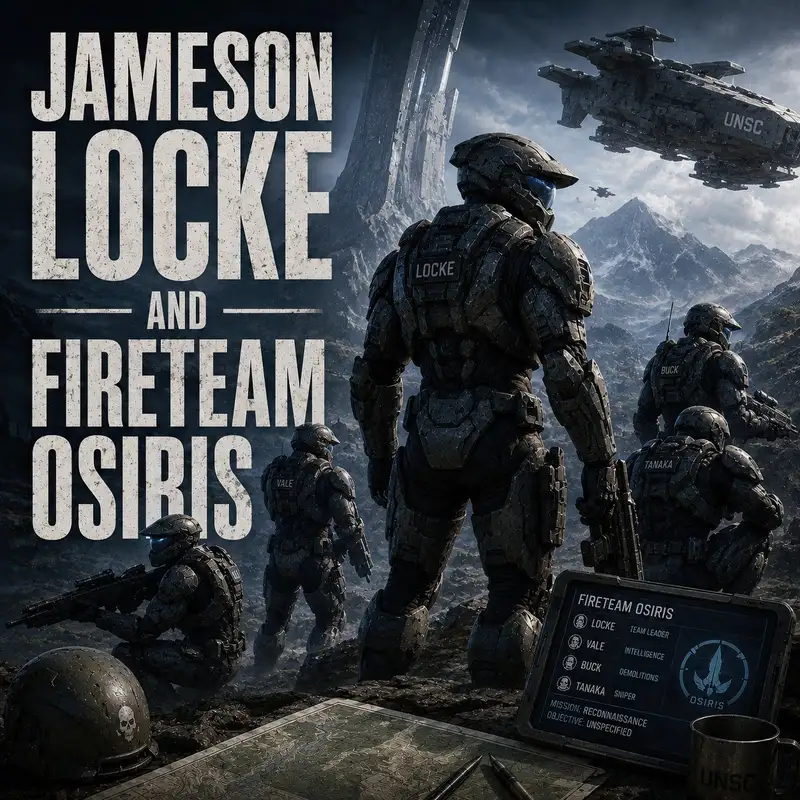
Jameson Locke and Fireteam Osiris
At Apogee Station on Meridian, Jameson Locke reached John One One Seven moments before a Forerunner Guardian departed. His orders were to detain Blue Team and return them to the United Nations Space Command Infinity. Locke presented the order. John refused it. The confrontation became physical, and the Master Chief used Locke’s own armor-restraint device against him before following Cortana into the Guardian. The mission had failed in the most visible way possible.
That failure is usually treated as a contest between two Spartans. It was more important as a command problem. Locke had lawful orders, incomplete intelligence, and a target whose judgment carried extraordinary credibility. John possessed information he could not fully explain and personal motives he could not separate from the mission. Fireteam Osiris had been sent to recover a missing unit. It instead found itself enforcing institutional authority during a crisis the institution did not yet understand.
Why was Jameson Locke chosen for that task, and what made Fireteam Osiris more than a squad assembled to chase the Master Chief? The answer begins before Locke became a Spartan. He was an intelligence operator trained to find people, recover sensitive material, and make decisions where normal military support could not reach. Osiris combined that background with the experience of an Orbital Drop Shock Trooper, the knowledge of a Sangheili cultural specialist, and the practical skill of an engineer who had survived a glassed world.
Locke was born on Jericho Seven in twenty-five twenty-nine. Six years later, Covenant forces invaded the colony. He was evacuated only minutes before the world was glassed and grew up in state care among other children who had lost families, communities, and any confidence that distant institutions could protect them. Many survivors entered military service seeking revenge. Locke initially reached the opposite conclusion. He blamed the government for failing Jericho Seven and became a freelance tracker and assassin.
The Office of Naval Intelligence recognized that a skilled, distrustful outsider could be useful if trained, directed, and given access to better resources. Locke accepted recruitment and entered Section Three as an acquisitions specialist. The title sounded like procurement. The work included recovering objects from hostile control, locating high-value individuals, and killing people whose continued activity was judged strategically dangerous. Intelligence services occasionally prefer vocabulary that allows an assassination file to sit comfortably beside a supply request.
By the end of the Human-Covenant War, Locke had become a lieutenant commander and one of the organization’s most capable field operatives. In September of twenty-five fifty-two, he prepared a target assessment of Sangheili Supreme Commander Thel ‘Vadamee. Locke traced the commander’s campaigns, including attacks that had destroyed human colonies and contributed to the fall of Reach. He recommended termination and offered to conduct the mission himself.
The assessment was reasonable within the information available at the time. Thel commanded the Fleet of Particular Justice and had inflicted losses humanity could not afford. Killing him might disrupt Covenant operations. The plan became obsolete when Covenant politics transformed the target. Thel was disgraced, made Arbiter, betrayed by the Prophets, and eventually became one of humanity’s most important allies. Locke’s file had correctly identified a decisive individual while misjudging how that individual’s future political value might exceed the value of his death.
That distinction followed Locke into every later mission. An intelligence operator reduces complexity by defining a target, objective, and acceptable risk. A commander must know when those definitions no longer describe the situation. Locke’s record showed that he could make that adjustment, but not that he would always make it early enough.
In twenty-five fifty-six, a Covenant-derived biological attack struck the human colony of Sedra. The weapon used material mined from a surviving fragment of Installation Zero Four, the Halo ring destroyed years earlier. Locke led the Office of Naval Intelligence response and joined a Sedran Colonial Guard force commanded by Colonel Randall Aiken, a former Spartan Two known earlier as Randall Zero Three Seven. The operation had to locate the source, stop further extraction, and destroy the dangerous material.
The mission to the Alpha Halo shard placed intelligence personnel and colonial soldiers in an environment where active technology attracted hostile Lekgolo organisms. Their transport was lost, oxygen became scarce, and members of Locke’s own team turned on the others to improve their chances of survival. Locke did not preserve command by insisting his agency outranked everyone present. He allowed Aiken to lead the combined force and kept trying to move survivors toward the objective and extraction.
Aiken remained behind to detonate the nuclear weapon that destroyed the deposits. Locke and Private Talitha Macer escaped. The operation demonstrated several qualities that later defined his Spartan command. He could cooperate with personnel who disliked the Office of Naval Intelligence, accept another officer’s tactical authority, and continue after compartmentalization collapsed into open distrust. He also learned that elite status did not prevent trained people from becoming dangerous when supply, fear, and isolation reduced the mission to individual survival.
Locke entered the Spartan Four program later that year. The fourth generation did not repeat the childhood abduction and indoctrination used to create the Spartan Twos. It selected adult volunteers with established military or intelligence careers and added augmentation, Mjolnir armor, and Spartan training to experience already earned. Locke did not become a soldier after augmentation. He became a more capable version of an operator whose habits had formed before the program.
His post-augmentation missions ranged across the unstable postwar frontier. He conducted denial operations against Insurrectionists, surveillance of Kig-Yar salvage activity, security for xenoarchaeological surveys, and strikes against Jiralhanae-controlled industrial assets. These tasks demanded more than physical power. They required intelligence collection, target discrimination, technical understanding, and the ability to function where political authority was disputed and reinforcements were uncertain.
By October of twenty-five fifty-eight, Locke led Fireteam Osiris. The team was created for complex assignments from the United Nations Space Command Security Council and High Command. It was not a family formed through childhood training like Blue Team. It was a deliberately assembled group of adult specialists whose differences were the reason for the formation.
Edward Buck brought decades of combat experience, including service as an Orbital Drop Shock Trooper and command of Alpha-Nine. He understood urban operations, improvised extraction, and the behavior of conventional troops around Spartans. Buck also possessed enough experience to question an order without turning every disagreement into a contest for command. His skepticism gave Locke a senior subordinate who could identify when the official mission and the practical situation were beginning to separate.
Olympia Vale brought language, cultural knowledge, and diplomatic awareness. She was fluent in Sangheili and had studied the species beyond its weapons and military ranks. That expertise mattered because the post-Covenant galaxy could not be navigated through target recognition alone. Keeps, clans, religious beliefs, personal honor, and civil-war loyalties shaped whether a Sangheili force would cooperate, delay, or attack. Vale allowed Osiris to interpret a society rather than merely engage its soldiers.
Holly Tanaka brought engineering and electronics expertise shaped by survival on Minab after the colony was glassed. She had lived through the long environmental collapse that followed orbital destruction and understood machinery as something that kept communities alive, not as an abstract technical specialty. Tanaka could read damaged infrastructure, operate in industrial environments, and recognize what settlers risked when a military mission moved through systems they depended upon.
Locke supplied intelligence tradecraft, target acquisition, command discipline, and familiarity with politically sensitive missions. Osiris therefore covered several weaknesses common to small elite units. It had a veteran who understood conventional combat, a specialist who could operate across an alien cultural boundary, an engineer who could work through damaged systems, and a leader accustomed to incomplete information. Mjolnir made them faster and harder to kill. Their backgrounds made that power useful.
Their first major recorded operation as a team was the recovery of Catherine Halsey on Kamchatka. Halsey had contacted Infinity with information concerning attacks by Forerunner constructs. Jul ‘Mdama’s Covenant held her while its own troops fought Promethean forces that had turned against them. Osiris inserted into a battle already in progress, moved through both factions, reached Halsey, and killed Jul before extracting her.
The death of Jul ‘Mdama was a successful decapitation strike, but not a complete political solution. His Covenant had already been weakened by internal rivalry, dependence on Forerunner power it could not control, and the Swords of Sanghelios campaign against it. Killing the leader accelerated collapse. It did not make every follower disappear or settle the Sangheili civil war. Osiris removed a commander and recovered the scientist who understood the larger threat. Both effects mattered more than the image of Locke standing over one defeated enemy.
Halsey’s intelligence soon pointed toward Cortana and the Guardians awakening beneath several colonies. At the same time, Blue Team left its assigned mission to follow a signal John believed came from Cortana. Infinity ordered Osiris to bring them back. Buck understood immediately that the assignment carried political and institutional danger. The Master Chief was not simply another absent soldier. He was a senior Spartan, a wartime symbol, and an operator whose unauthorized decisions had repeatedly prevented catastrophe.
Locke did not treat John as a traitor or assume the order required lethal force. He treated Blue Team as personnel to be recovered and contained until command understood the situation. That restraint was professionally sound. The weakness lay in the intelligence picture. Osiris knew Blue Team had disobeyed orders. It did not know enough about Cortana’s survival, the Domain, or the Guardians to judge whether John’s pursuit was reckless, necessary, or both.
Meridian made the uncertainty worse. The colony was being resettled by workers whose government and corporate leadership distrusted the United Nations Space Command. Its governor, Sloan, was a smart artificial intelligence entering rampancy and already moving toward Cortana’s political cause. Osiris could not simply declare authority and expect cooperation. The team defended settlers against Promethean attacks, negotiated access to roads and industrial areas, and used local testimony to trace Blue Team toward Apogee Station.
The work showed why Osiris had been assembled. Tanaka understood the colony’s machinery and the experience of people rebuilding beneath a damaged sky. Vale gathered information from civilians without treating them as obstacles. Buck recognized the operational strain. Locke held the team to the recovery mission while accepting local tasks needed to earn movement and information. The Spartans depended on workers, vehicles, and infrastructure belonging to a population with no reason to welcome another classified military crisis.
At the Guardian, the recovery plan narrowed into a personal confrontation. Locke reached John before the rest of Osiris could establish full control of the position. He ordered the Spartan Two to stand down and attempted to use an armor-restraint device. John refused, defeated him, and escaped. The fight settled no strategic question. It proved only that Locke could not compel compliance in that moment and that Blue Team valued its own assessment above the chain of command.
The more important failure came afterward. The Guardian activated, damaged Meridian, and carried Blue Team away. Sloan openly joined Cortana. Osiris had neither detained the Spartans nor prevented the Forerunner construct from leaving. Yet the team survived the colony’s collapse and returned with a clearer picture of the threat. Mission failure produced intelligence that made the next mission possible.
Following the Guardian required cooperation with the Swords of Sanghelios. Osiris traveled to Sanghelios while the Arbiter’s forces prepared to break Jul ‘Mdama’s last major stronghold at Sunaion. Vale advised Locke to disclose his Office of Naval Intelligence background rather than allow the Arbiter to discover it later. The recommendation was more than diplomatic etiquette. Thel had once been the target of Locke’s assassination proposal. Concealing that history inside an alliance built on limited trust could have destroyed the mission before it began.
The Arbiter had every reason to distrust him. Locke represented the intelligence service that had considered killing Thel before later benefiting from his alliance. Locke, in turn, stood before a former Covenant commander responsible for the destruction of human worlds. Neither man needed to pretend the past had disappeared. They needed to decide whether the current objective justified cooperation. Vale’s cultural judgment and Locke’s willingness to reveal the truth allowed the mission to proceed.
Osiris operated as one element inside a Sangheili campaign, not as the force that liberated the planet by itself. The team recovered a Forerunner Constructor needed to activate the Guardian near Sunaion, destroyed a Covenant Kraken threatening the operation, and attacked anti-air defenses while the Arbiter’s troops and fleet fought the larger battle. Sangheili forces supplied local intelligence, aircraft, ground formations, and political legitimacy. The Spartans created openings that the Swords could exploit.
The operation also changed Locke’s relationship with his old target. The file written in twenty-five fifty-two had reduced Thel to a military problem. On Sanghelios, Locke saw him as an allied political leader balancing civil war, traditionalist opposition, and cooperation with former enemies. The intelligence assessment had not been false. It had been incomplete because it treated a person’s current role as the limit of his possible future.
Palmer delivered Osiris to the rising Guardian, and the team rode it through slipspace to Genesis. There they met the monitor Exuberant Witness and learned the scale of Cortana’s plan. She intended to use the Guardians and allied artificial intelligences to impose peace through overwhelming coercion. Blue Team had not joined her, but Cortana had imprisoned them inside a Cryptum after John rejected her authority.
Locke changed the mission. Fireteam Osiris had arrived after pursuing Blue Team under an order to detain them. It now fought to rescue them. This was not disobedience for personal loyalty. The evidence had changed the objective. Cortana, not John, was the immediate threat. Exuberant Witness provided access and local knowledge. Osiris fought through Promethean defenses, restored the monitor’s control over key systems, and freed Blue Team before Cortana could take them away.
That reversal is the most important event in Locke’s command history. He did not need John to apologize before acting. He did not defend the original order after it became irrelevant. He recognized that institutional authority exists to serve the mission, not to preserve an officer’s pride after the facts change. The man trained to turn people into targets helped recover the person he had failed to capture.
Osiris and Blue Team returned to Sanghelios as the Created uprising spread. Infinity recovered both teams, Palmer, and Halsey, then began moving through the galaxy to avoid Guardian detection. The crisis dispersed the formation that had made Osiris effective. Buck left to rebuild Alpha-Nine. Vale increasingly served in diplomatic and independent operational roles involving the Sangheili. Tanaka’s later assignments remain less fully documented. Its most familiar roster did not remain permanently fixed.
That impermanence was not necessarily failure. Spartan Four fireteams were built from adults whose experience could be reassigned according to the mission. Osiris lacked Blue Team’s lifelong family structure, but it possessed modular expertise. The same feature that made the team adaptable also made it easier for higher command to separate. A capability assembled from rare specialists can be dissolved by four individually reasonable reassignment orders.
Locke remained aboard Infinity during the Created conflict and continued sensitive operations. Halsey considered him a possible alternative to John for deploying the Weapon against Cortana at Zeta Halo, evidence that command still trusted his judgment and capability after Meridian. Shortly before Infinity’s attack, Captain Lasky reported that Locke was already conducting the next stages of Operation Breaker Trip. The surviving record has not yet revealed that operation’s complete purpose.
Months later on Zeta Halo, the Banished warrior Hyperius carried Locke’s Hunter-class helmet and part of his armor as trophies. Banished propaganda used the display to claim another Spartan defeat. The armor is real evidence. It is not a confirmed casualty report. Locke may have been killed, wounded, captured, or separated from damaged equipment. Core records do not yet establish which explanation is correct.
The uncertainty fits a career spent between official files and incomplete field reports. Locke was often defined by the institution assigning the mission. To the Office of Naval Intelligence, he was an acquisitions specialist. To Spartan Operations, he was a fireteam leader. To the Arbiter, he was an assassin who arrived asking for cooperation. To John, he was the officer attempting to enforce an order at the worst possible moment. Each description was accurate and insufficient.
Fireteam Osiris represented the Spartan Four model at its strongest. Its members entered augmentation with adult identities, technical specialties, political experiences, and memories of conventional service. They could work with settlers, intelligence officers, alien allies, and ordinary troops because they had not spent their entire lives inside a sealed Spartan culture. Their armor expanded capability. It did not create the judgment, language skill, engineering knowledge, or combat experience that made the team effective.
The same model carried risks. Adults brought independent loyalties and institutional histories into the program. Locke’s Office of Naval Intelligence background complicated diplomacy. Buck’s experience made him question command. Vale’s knowledge sometimes placed her interpretation ahead of a simple military reading. Tanaka’s colonial survival made civilian consequences difficult to dismiss. Those tensions were not defects. They were part of the information available to the commander, provided the commander was willing to listen.
Osiris could not replace the forces that supported it. Infinity supplied transport, intelligence, communications, armor maintenance, and command authority. Palmer delivered the team to objectives. Halsey interpreted Forerunner systems. Meridian’s settlers provided routes and local information. The Swords of Sanghelios supplied the army, fleet, aircraft, and political control needed to defeat Jul’s remaining Covenant. Exuberant Witness opened Genesis in ways no human operator could reproduce. Four Spartans reached decisive points because a larger network made those points reachable.
Jameson Locke’s record is therefore not the story of a replacement for the Master Chief or a rival who failed to defeat him. It is the story of an intelligence operative learning that command requires more than identifying the correct target. Fireteam Osiris failed to arrest Blue Team, helped expose the Created threat, supported the liberation of Sanghelios, and then rescued the people it had been ordered to detain. The team’s value appeared most clearly when it abandoned the shape of the original mission without abandoning its purpose.
The helmet on Hyperius’s armor was intended to turn Locke into a symbol of Banished victory. It may yet prove to be evidence of his death, or only evidence that armor can be lost before the soldier’s fate is known. Either way, the trophy captures the danger of reducing Jameson Locke to one image. He was never merely the Spartan who hunted the Chief. He was the commander who learned, under pressure, when the hunt had ended and the rescue had begun.