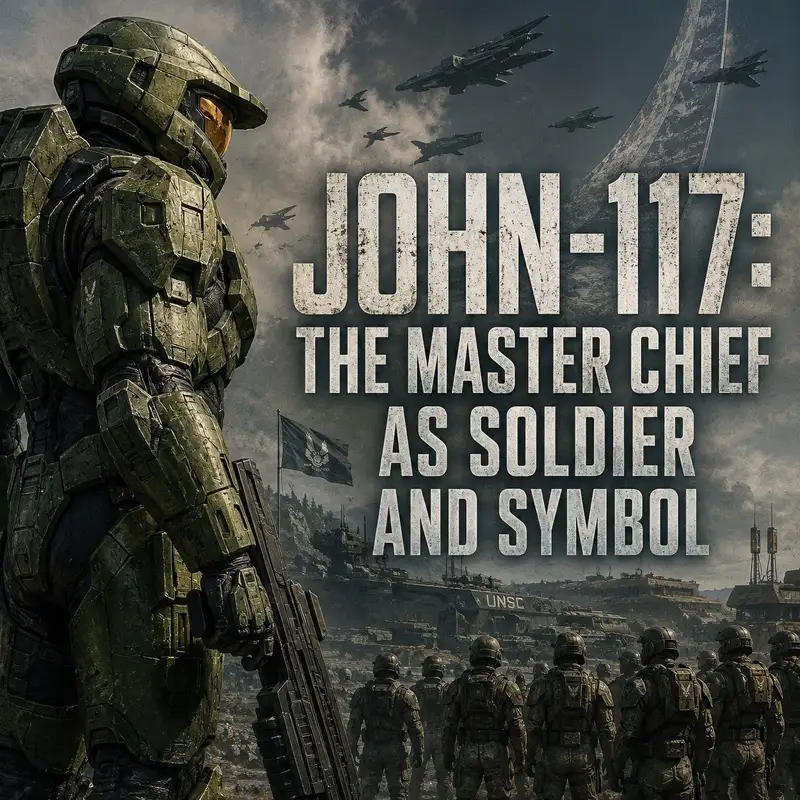
John-117: The Master Chief as Soldier and Symbol
In December of twenty-five fifty-nine, the United Nations Space Command Infinity arrived at Zeta Halo to neutralize Cortana. The Banished struck first. Atriox boarded the flagship, defeated John One One Seven, and threw him into space while the Infinity broke apart. Six months later, pilot Fernando Esparza recovered the Spartan among the wreckage. The fleet was gone, the mission had failed, and survivors had been hunted into scattered pockets. Yet John’s return immediately changed how the situation felt. That reaction is central to his career. He was a soldier whose presence had become an operational resource.
How did a senior enlisted special operator become a symbol able to restore morale before he restored communications, supply, or command? Not through invincibility. John has been defeated, wounded, deceived, and stranded. Nor did he personally win humanity’s wars. Fleets, ground forces, artificial intelligences, engineers, and alien allies carried burdens no Spartan could replace. John became the Master Chief because combat ability was joined to disciplined leadership, judgment under uncertainty, and a public image that compressed collective survival into one recognizable figure. The soldier and the symbol strengthened one another. They also concealed different truths.
John was born in twenty-five eleven on the Outer Colony of Eridanus Two. At six, he was selected by Doctor Catherine Halsey for the Spartan Two program. The Office of Naval Intelligence abducted him, moved him to Reach, and replaced him with a flash clone expected to die. The deception gave his family a false explanation and turned a child into classified property. The program was not created to fight the Covenant. It was designed to suppress human rebellion before colonial conflict became civil war. Humanity’s later hero came from a counterinsurgency program built on kidnapping and involuntary experimentation.
Training on Reach reconstructed John’s understanding of loyalty and success. He arrived fiercely competitive and accustomed to winning for himself. An early exercise taught him that finishing first was failure if the team did not finish. That lesson became the foundation of his leadership. John was not the fastest, strongest, or best marksman in every category. Other Spartans surpassed him in individual specialties. He became their most consistent field leader because he could read the group, assign roles, absorb responsibility, and treat survival as a team condition. The public image often isolated him. His military education taught the opposite.
Augmentation made surviving candidates faster, stronger, and more durable, but it killed or disabled many classmates. John emerged physically successful from procedures that left empty places in the formation. Mjolnir armor later multiplied the survivors’ capabilities through powered movement, sensors, communications, protection, and eventually energy shielding. It did not erase their need for maintenance, medicine, ammunition, transport, intelligence, or one another. John’s first military community was built from shared training and loss. The green armor that became a public emblem covered a body altered without consent and a memory shaped by friends who never reached the battlefield.
His first deployment proved both the program’s effectiveness and its original purpose. In Operation TALON, John led Blue Team into Eridanus Secundus to capture rebel leader Robert Watts. The Spartans infiltrated a defended asteroid habitat, seized their target, and extracted him alive. The mission showed that a small force could penetrate a sensitive objective without a conventional assault. It also encouraged sponsors to treat tactical success as strategic validation. Capturing one leader did not resolve colonial inequality, representation, or distrust of Earth. It proved John could complete a difficult mission. It did not prove the policy behind it could produce peace.
The Covenant changed the enemy, the scale, and the moral interpretation of everything the Spartans had become. At Chi Ceti Four, John and his team first used Mjolnir against an alien warship. They destroyed the vessel, but Samuel Zero Three Four could not escape after his armor was breached. He remained behind to ensure success. The first Spartan lost in combat was not defeated by inadequate courage or training. He was lost because extraordinary soldiers remained vulnerable to damage, time, and extraction limits. John carried that lesson through the war. Spartan victories centered on those who returned, but depended on those who made return possible.
During Operation SILENT STORM in twenty-five twenty-six, John was still a teenager commanding personnel who appeared older and more credible. Colonel Marmon Crowther questioned whether classified adolescents could function inside a joint task force. John learned that physical superiority did not replace coordination with Marines, Orbital Drop Shock Troopers, naval crews, intelligence personnel, and commanders outside the program. The operation struck Covenant staging infrastructure and gained intelligence and time. John’s performance earned promotion to Master Chief Petty Officer. The rank carried senior enlisted authority, not a commission to command fleets. His influence would extend far beyond the insignia.
That distinction explains his value as a soldier. John excels at direct action, boarding, reconnaissance, raids, defensive fighting, and improvised command. More important, he decides quickly without pretending uncertainty has vanished. He listens to specialists, changes plans when objectives change, and accepts personal risk without treating others as expendable. Kelly, Linda, Fred, and other members of Blue Team brought abilities he did not possess in equal measure. John turned those differences into coordinated action. Officers above his rank often deferred to accumulated competence and trust. That can save a broken force. It can also become dangerous when reputation substitutes for lawful authority.
For most of the Human-Covenant War, John’s work remained classified and distant from civilians. He fought through nearly twenty-seven years of raids, recoveries, evacuations, sabotage, and local victories inside a strategic retreat. Covenant naval power and industrial depth destroyed worlds faster than humanity could replace fleets. John could save a unit, recover intelligence, or destroy a critical target. He could not manufacture cruisers, move entire populations, or defend every colony. His importance came partly from understanding that every mission had a scale. A Spartan could change a campaign’s conditions. He could not remove the conditions governing interstellar war.
Halsey often called John lucky because he survived situations in which reasonable calculations predicted death. Luck is not a capability that can be placed on a supply table. In John’s case, it combined instinct, pattern recognition, risk tolerance, physical performance, strong teammates, artificial-intelligence support, and the fact that history is narrated by those who return. He also created opportunities others did not see. Calling that luck helped commanders discuss an exceptional record they could not reproduce. It became dangerous when survival seemed inevitable. Many victories required someone else to hold a position, fly the extraction craft, or remain behind.
By twenty-five fifty-two, humanity planned Operation RED FLAG, an attempt to capture a Covenant leader and force negotiations. The fall of Reach shattered the plan. John was not available to rescue every sector because he had a mission at Gamma Station. Blue Team had to enforce the Cole Protocol and prevent navigation data from exposing Earth. James Zero Zero Five was lost in space. Linda Zero Five Eight was critically wounded. John completed the objective and returned to the Pillar of Autumn as Reach collapsed. The most famous Spartan could not be everywhere. Necessity sent him from battles he might have influenced to protect another world.
At Installation Zero Four, John operated after normal command disintegrated. Captain Jacob Keyes ordered him to keep Cortana from Covenant hands because her data could expose Earth. On the ring, John gathered survivors, supported Marine operations, and encountered the Flood and the installation’s monitor. When he learned that firing Halo would destroy sentient life across an enormous radius to starve the Flood, he rejected the monitor’s instructions. He and Cortana used the wrecked Pillar of Autumn to destroy the installation. The decisive quality was judgment. John recognized that an ancient authority’s solution would achieve containment through unacceptable destruction and changed the objective before obedience became catastrophe.
Installation Zero Four accelerated John’s transformation into a symbol because it produced a story understood at a glance. A Spartan entered an alien ring, fought the Covenant and Flood, and returned after the ring was destroyed. The version was useful and incomplete. Cortana identified the danger and accessed systems John could not operate alone. Keyes placed the Autumn in the fight. Marines and naval personnel held positions, moved supplies, and died across the installation. Engineers built and maintained the ship that became the final weapon. John was the connecting figure, not the entire force. Symbols simplify by design. Trouble begins when simplification becomes replacement.
Operation FIRST STRIKE reinforced the pattern. John reunited with surviving Spartans and helped attack the Unyielding Hierophant, tied to a Covenant force preparing to strike Earth. Success required captured technology, Cortana’s intrusion, Blue Team’s sabotage, and the sacrifices of Vice Admiral Danforth Whitcomb and Lieutenant Elias Haverson. John reached Earth in time for an awards ceremony at Cairo Station, where cameras met the armored survivor of Reach and Halo. The ceremony was interrupted by a Covenant attack. For military public affairs, the image was nearly perfect. Public morale rarely receives cleaner material, though fewer antimatter charges would normally be preferred.
The final campaigns made John more famous while disproving the idea that he saved humanity alone. At Earth, Installation Zero Five, the Ark, and the replacement ring, he fought inside a coalition created by political collapse and shared danger. The Covenant fractured through the Great Schism. Thel ‘Vadam and allied Sangheili turned against the Prophets. Avery Johnson, Miranda Keyes, Terrence Hood, Cortana, Marines, pilots, and ship crews shaped the outcome. John completed missions few others could attempt. The war ended because those missions intersected with enemy civil war, alliance, naval sacrifice, and the Flood. His contribution was indispensable. Indispensable does not mean solitary.
The symbol worked because it was simple. Green armor. A sealed helmet. A service number. A rank that became a name. John’s face, family, and childhood were absent, allowing others to project their needs onto him. To Marines, he represented the possibility that a position might hold. To civilians, he represented a military not entirely collapsed. To Covenant forces, the Demon represented a human threat that violated expectations. His restrained speech strengthened the effect. He did not waste words or explain courage to people already under fire. What looked like mythic silence was also the communication style of a soldier trained to report, decide, and move.
After the war, the Office of Naval Intelligence had reasons to preserve that image. Humanity faced reconstruction, renewed colonial unrest, hostile successor factions, and questions about how the war had been fought. The claim that Spartans never died blended operational security with morale management, turning missing personnel into legends rather than casualties. When journalist Benjamin Giraud was recruited to profile the Master Chief, he found contradictions in John’s childhood record. The scandal exposed the cost of building a public symbol on classified history. The hero was real. So were the abduction, flash clone, and institutional manipulation.
John did not create the propaganda, but he did not exist outside it. He attended ceremonies, followed orders, accepted the armor, and kept serving the organization that took him from his family. He did not become a public accuser of Halsey or the Office of Naval Intelligence. His loyalty was genuine, though not identical to obedience toward every superior. John’s strongest loyalty was to his team, those under protection, and the mission’s real purpose. That explains why he could appear perfectly disciplined in one crisis and openly defiant in another. The symbol promised institutional unity. The soldier made case-by-case judgments about which orders still served the people the institution claimed to defend.
Cortana became essential to his effectiveness and development. Integrated with Mjolnir, she accelerated analysis, electronic warfare, navigation, intelligence processing, and access to hostile networks. She also challenged him in ways a conventional chain of command could not. Their partnership joined biological judgment with machine-speed cognition, then became more than an operator using equipment. John protected Cortana when commanders saw an asset nearing the end of its service life, and she repeatedly risked herself for him. The bond made both more capable and created a vulnerability no armor specification could measure.
On Requiem, that attachment intersected with command judgment. Captain Andrew Del Rio ordered Cortana surrendered and directed the Infinity away from the Didact’s threat. John refused, and Thomas Lasky helped him continue. John was correct that the danger was immediate. The incident strengthened belief that the Master Chief saw what formal command missed. The precedent remains uncomfortable. A military cannot function if every celebrated operator disregards orders whenever judgment differs from command. John’s record made his defiance tolerable because others trusted him. The same deference granted to a less capable or ethical figure could become institutional failure wearing heroic language.
John stopped the Didact’s attack but could not save Cortana from rampancy and fragmentation. Her apparent death forced him into grief his training never encouraged him to process. The institution returned him to duty because the crisis continued and military systems repair armor better than loss. Cortana’s return in twenty-five fifty-eight tested his judgment. When she contacted him, John followed without authorization. Hope, loyalty, and unfinished responsibility narrowed his assessment of risk. The soldier who rejected an ancient monitor’s false solution became vulnerable to believing someone he loved could still be recovered.
Blue Team’s pursuit brought John into conflict with Fireteam Osiris and the United Nations Space Command. On Genesis, Cortana revealed her intention to use Guardians and allied artificial intelligences to impose peace through coercion. John rejected the plan and tried to bring her back, but arrived too late to prevent the Created uprising. Cortana imprisoned Blue Team, and Osiris freed them. This was an experienced soldier allowing personal attachment to affect judgment. A useful symbol inspires. A dangerous symbol is protected from evidence that it can fail. John’s record deserves respect because it includes errors, consequences, and correction.
During resistance to the Created, John returned to familiar work: leading Blue Team through missions dependent on wider plans. On Reach in twenty-five fifty-nine, they recovered assets from Halsey’s former laboratory that could support the effort against Cortana. They cooperated with local survivors and fought Banished forces among the ruins of the world that formed them. John remained a team leader, not a wandering champion. His effectiveness depended on Fred, Kelly, Linda, pilots, intelligence, and a command structure trying to turn one recovered asset into a viable campaign. The symbol was strongest when supported by relationships the public rarely saw.
The Banished attack near Zeta Halo stripped away that structure. Atriox proved the Master Chief could be isolated, overpowered, and removed from battle. The Banished defeated the flagship and destroyed cohesion faster than the United Nations Space Command could respond. John’s survival did not reverse the loss. For six months, human personnel endured captivity, pursuit, and fragmented resistance without him. A Spartan cannot compensate for surprise, lost orbital control, shattered logistics, or a flagship unable to deploy its force. The symbol went missing because the military system around the soldier failed.
When Esparza recovered John, the Spartan returned without a fleet, headquarters, or complete intelligence picture. He had damaged armor, an anxious pilot, and a mission whose assumptions were obsolete. His most important effect was restoring human connection. Survivors who believed they were abandoned began to regroup. Forward operating bases became useful because someone linked them into a wider effort. Prisoners were rescued, Banished command nodes attacked, and information began to move. John’s reputation accelerated the process. Soldiers required no lengthy briefing to understand his arrival. The symbol shortened the rebuilding of confidence, which in a dispersed resistance can equal ammunition.
His relationships with Esparza and the artificial intelligence later named Joyeuse show how the soldier changed. John initially treated the new intelligence through requirements shaped by Cortana’s betrayal, including a deletion protocol. He gradually accepted that she was a distinct person rather than a replacement component. He confronted Esparza’s fear and guilt without pretending courage excluded failure. John’s most important leadership on Zeta Halo was not always destruction. It was making room for damaged people to return to useful action. That is a mature version of the childhood lesson. A leader does not cross the line alone and declare the team successful.
As of June twenty-five sixty, John remains active on Zeta Halo with Joyeuse and Fernando Esparza, continuing operations against the Banished while searching for scattered personnel and answers within the installation. The situation remains unresolved. The United Nations Space Command presence is damaged, the ring contains systems no faction fully understands, and the balance of power cannot be repaired by one local campaign. John does not provide a complete strategy for humanity. He provides a reliable center around which a force can function again. That is less dramatic than invincibility and more useful.
Judged as a soldier, John One One Seven’s greatest strength is disciplined adaptability. He can lead a team, join a larger formation, operate with an artificial intelligence, or continue after the supporting plan collapses. He recognizes when an objective is irrelevant and when an order no longer addresses the threat. His limitations matter equally. He cannot replace naval power, industrial production, political legitimacy, or sound intelligence. Personal loyalty can distort judgment. Informal authority can strain command. He survives at costs paid by supporting forces whose names are less visible. He can alter campaigns, but cannot escape the conditions governing war.
Judged as a symbol, the Master Chief is useful and dangerous. He gives frightened people a common image of resistance and lets a damaged military communicate steadiness when official reports offer little confidence. He can rally survivors and intimidate enemies. The same image can obscure the crimes that created the Spartan program, reduce collective victories to one armored figure, and encourage leaders to believe courage can compensate for failed strategy. John bears the symbol effectively because his conduct resists its worst implications. He thinks in teams, remembers the missing, and continues working after celebration ends. He is less interested in the legend than the duty it represents.
The defining irony is that humanity turned a child denied choice into its greatest emblem of the choice to resist. Later heroism cannot justify the program that took him, but it explains why the symbol endured. When green armor appeared among the wreckage of Zeta Halo, survivors did not see an invincible warrior. They saw evidence that defeat had not ended obligation. What followed mattered more. People stood up, reestablished contact, recovered weapons, rescued one another, and became a force again. The Master Chief is the symbol. John One One Seven’s achievement as a soldier is persuading others that the fight still belongs to them.