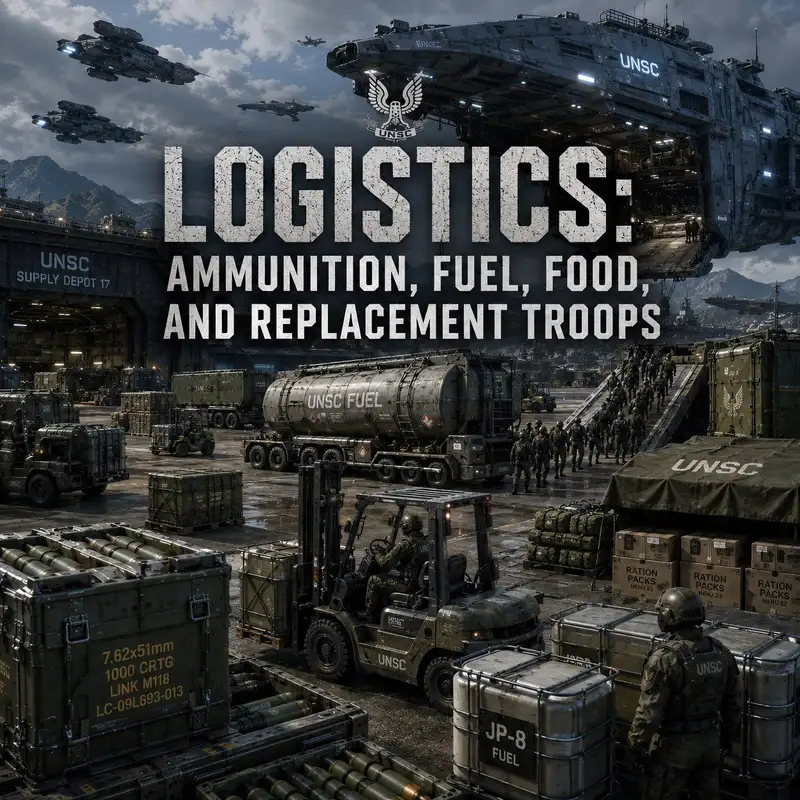
Logistics: Ammunition, Fuel, Food, and Replacement Troops
At Sigma Octanus Four, the mobile refit station Cradle had already done what warships could not do for themselves. It had taken the damaged destroyer Iroquois alongside, opened access to wounded sections, and returned the ship to the battle group on a timetable measured in hours rather than weeks. When Covenant plasma threatened the formation, Vice Admiral Michael Stanforth used Cradle as a shield. The warships behind it survived the volley. The station and its crew did not. Humanity had preserved combat power by sacrificing the machinery that repaired combat power.
That exchange reveals the central problem of United Nations Space Command logistics. A fleet could survive a battle and become weaker if its magazines were empty, its crews exhausted, and its damaged hulls had nowhere to go. A battalion could hold its ground and still fail if the next convoy carried ammunition to another continent. A colony could produce food, metals, or replacement parts for years, then disappear from the supply network in one Covenant attack. Logistics was not the activity that followed combat. It determined which combat was possible.
The Navy assigned much of this work to Naval Logistical Operations Command. Fleet Command moved and tasked warships. Naval Special Warfare Command supported specialized operations. The logistical command oversaw construction, maintenance, supply, and distribution for the fleet, including ships, ammunition, food, and replacement parts. Its officers dealt with contracts, depots, yards, transport schedules, inventories, and repair priorities. None of those duties looked impressive on a tactical display. Every ship icon on that display depended on them.
The supply system extended far beyond military commands. Commercial freighters, colony transports, tugs, survey ships, orbital stations, corporate carriers, and local warehouses moved most of the physical economy between human worlds. Warships protected those routes and sometimes carried urgent cargo, but a destroyer was an inefficient way to move grain, machine tools, or several thousand replacement components. Human military power rested on a civilian and commercial network whose ships were slower, less protected, and often crewed by people who had not volunteered to enter a fleet engagement.
Slipspace made that network possible without making it predictable. Transit times varied. Ships departing together could emerge separately. Route data, navigational expertise, working drives, and secure destinations all mattered. A convoy could leave with the correct cargo and arrive after the battle had already consumed the unit meant to receive it. A commander could request ammunition, replacements, or medical supplies and receive approval from a headquarters whose picture was several days out of date. The requisition process might be perfect. The war was not required to cooperate.
That uncertainty encouraged stockpiles. Colonies, stations, ships, and ground commands stored what they expected to need before the route became dangerous. Ammunition depots, fuel farms, spare-parts warehouses, food stores, medical facilities, and replacement pools converted advance warning into endurance. They also created fixed targets. A depot large enough to sustain a campaign was large enough to matter to enemy reconnaissance. Dispersal improved survival while making distribution slower and more complicated. Concentration improved efficiency while giving the enemy one location worth destroying.
Ammunition was the most obvious limit. Infantry units needed rifle and machine-gun cartridges, grenades, rockets, demolition charges, mines, and specialized rounds. Armored formations needed cannon ammunition and missiles. Aircraft needed gun ammunition, air-to-air and air-to-ground weapons, countermeasures, and expendable sensors. Warships carried magnetic accelerator projectiles, Archer missiles, nuclear weapons, point-defense ammunition, and stores for embarked forces. These were not interchangeable categories. A ship with spare rifle magazines could still have empty missile pods.
Magnetic accelerator cannons made the scale visible. Their projectiles were simpler than guided missiles, but they were massive, precisely manufactured, and difficult to move. Loading systems had to transfer them safely through armored sections of a ship. Capacitors needed power, coils needed cooling, and the barrel alignment had to remain within tolerance. A captain might have a working reactor and a valid firing solution while lacking the projectile, charge time, or undamaged loading path required to take the shot. The weapon could be ready in principle and unavailable in practice.
Missiles created a different burden. They carried guidance systems, propellant, warheads, and sensitive electronics. They occupied magazine volume and required safe handling. Nuclear weapons demanded still stricter custody and command procedures. A battle group that used most of its missile inventory to destroy one Covenant vessel might have won the engagement and lost the ability to repeat the tactic. Reports often recorded the enemy ship destroyed. The logistics staff recorded how many reloads remained and how far the nearest secure magazine had moved since the last update.
Ground forces faced the same arithmetic at closer range. A rifle squad could carry enough ammunition for a short action, not an indefinite defense. Resupply required vehicles, aircraft, porters, or prepositioned caches. Every method exposed someone to enemy fire. A Pelican carrying ammunition could not simultaneously carry a full load of evacuees. A Warthog hauling rockets was unavailable for casualty movement. The supply decision was therefore a tactical decision before the crate ever reached the firing line.
Fuel was not one commodity. Starships required reactor consumables, drive support, coolant, power-storage components, and the materials needed to keep propulsion and life-support systems operating. Fighters, dropships, drones, ground vehicles, generators, and field equipment had their own fuel or power requirements. A force could possess ammunition and still lack the energy to move it. The farther the operation extended from a depot, the more of its transport capacity had to be devoted to supporting the transport itself.
This produced a hard distinction between range and endurance. A ship might be capable of crossing the distance to a remote system, but that did not mean it could fight there, repair battle damage, support ground forces, and return. A Pelican might reach a distant landing zone, but only if the route, payload, reserve, and expected extraction allowed it. A tank could dominate open terrain while fuel and maintenance vehicles followed. Military equipment was often described by what it could do once. Logistics determined how many times it could do it.
Food appeared less dramatic, but it governed the same timetable. Ships carried preserved stores, ingredients for mess facilities, emergency rations, and medical nutrition. Field troops carried Meals, Ready-to-Eat and other compact rations for conditions where kitchens were unsafe or impossible. Water recycling and atmosphere processing reduced consumption aboard ships and stations. They did not remove it. Filters failed, tanks leaked, pumps wore down, and every additional passenger increased the load on environmental systems.
Cryosleep reduced that burden during long voyages by lowering the needs of personnel who were not required to operate the ship. It did not feed the watch crew, maintain the cryogenic chambers, or wake troops into immediate readiness. Medical staff, technicians, and power systems had to keep sleepers alive. Emergency thawing could put more people on their feet quickly, but disorientation and physical stress reduced their usefulness at the moment the ship most needed them. Cryogenic capacity conserved supplies. It did not create them.
Harvest demonstrated how closely food, freight, and survival could become connected. The colony’s agricultural machinery and orbital freight systems were designed to move produce through human space. When the Covenant attack began, the artificial intelligences Sif and Mack used those same networks to help organize evacuation. Cargo systems became life-saving infrastructure because the crisis required moving people rather than crops. The colony’s logistical design gave its population options. It could not provide enough military force to hold the world.
Replacement troops were more difficult to supply than equipment because a trained person could not be taken from a warehouse. Recruits required screening, boot camp, specialty instruction, unit integration, and transportation. Pilots, medics, engineers, communications specialists, weapons technicians, and senior noncommissioned officers took longer to prepare than basic infantry replacements. The death of one experienced reactor technician could remove knowledge that no number of untrained passengers could replace during the voyage.
Casualty replacement also changed the character of units. A company rebuilt from survivors and new personnel might recover its authorized strength while losing the relationships that made it effective. New troops did not know local terrain, enemy habits, or the unwritten procedures developed under fire. Veterans carried that knowledge, but too few veterans could leave a unit trapped in permanent exhaustion. Replacements preserved numbers. Training and leadership had to rebuild cohesion.
The Covenant War placed that system under pressure for twenty-seven years. Destroyed colonies removed population, industry, agricultural capacity, depots, and training establishments at the same time. A world lost from the map might have produced armor plate, missiles, electronics, food, or skilled labor. Its destruction did not only reduce future output. It forced surviving routes and factories to absorb requirements they had never been designed to meet. The supply system became narrower as the demand became greater.
This is why shipyards mattered as much as fleets. A damaged frigate represented preserved combat power only if workers, scaffolds, replacement armor, electronics, reactor components, and time were available. Mobile refit facilities such as Cradle could return vessels to action near the theater. Permanent yards could perform deeper repairs and construction. When the Covenant destroyed or isolated those facilities, battle damage became harder to reverse. A ship that would once have returned after repair became a permanent loss, even if it escaped the engagement.
Reach was the most severe example. It was a fortress world, but also a command, training, industrial, and logistical center. Its yards, depots, communications, military bases, and transport connections supported operations far beyond the Epsilon Eridani system. Losing Reach meant losing ships and soldiers during the battle. It also meant losing the capacity to repair other ships, train later replacements, coordinate routes, and distribute material for battles that had not yet begun. The fall continued to damage the war effort after the plasma cooled.
The same principle shaped convoy defense. Cargo ships carrying food, ammunition, medical stores, reactor components, or replacement personnel were often strategically more valuable than their armament suggested. Escorting them consumed frigates, destroyers, fighters, and intelligence assets that could not be used elsewhere. The convoy’s speed was limited by its slowest essential ship. Its route had to account for navigation security and the possibility that Covenant forces would follow survivors toward another colony.
The Cole Protocol made logistical movement even more complicated. Navigation data had to be protected or destroyed, and retreat routes could not expose populated systems. A supply ship fleeing an attack could not simply choose the shortest course to the nearest friendly depot. The cargo, crew, and destination all had intelligence value. Protecting the network sometimes required cutting a route, destroying records, or sacrificing a damaged vessel that might otherwise lead the enemy to another world.
Logistics also shaped offensive planning. Human commanders could attack a target only if they could deliver the force, sustain it, and recover what survived. Special operations often used prowlers because stealth reduced the need for a large escort, but the team still needed weapons, communications, medical support, and extraction. Planetary assaults required transports, landing craft, fuel, engineering equipment, and a secure flow from orbit. Capturing a position without opening the route behind it produced an isolated victory with a short life expectancy.
Human forces learned to attack the enemy’s support for the same reason. Early operations such as SILENT STORM struck Covenant staging and logistical activity rather than seeking only fleet engagements. Destroying transports, supply sites, or preparation areas could delay forces that humanity could not defeat repeatedly in direct combat. The Covenant possessed a much larger imperial system, but its campaigns still depended on ships, crews, munitions, maintenance, and orders reaching the correct place. Superior technology reduced some burdens. It did not abolish organization.
Installation Zero Four showed what happened when a force lost its supply network entirely. Survivors from the Pillar of Autumn reached the ring with the equipment carried in lifeboats, dropships, and scattered wreckage. They established Alpha Base, recovered supplies from the ship, repaired vehicles, organized medical care, and used Pelicans to connect separated groups. Every casualty, destroyed aircraft, and expended missile was difficult or impossible to replace. The force could improvise a local campaign. It could not rebuild the interstellar system that had delivered it.
The Flood outbreak made the logistical situation worse because ordinary recovery became dangerous. Weapons, vehicles, bodies, and facilities could carry contamination. A route used for evacuation might become an avenue for infection. Medical and quarantine requirements competed with the need to preserve combat power. The most efficient action under conventional conditions could become unacceptable once the enemy could turn recovered personnel into new attackers. Logistics was no longer only about delivery. It became containment.
The Spirit of Fire represented the opposite extreme: a ship designed from a colony-support vessel, carrying manufacturing capacity, ground forces, aircraft, supplies, and the equipment needed to establish operations far from existing bases. That internal capability allowed Captain James Cutter to fight campaigns without an ordinary nearby depot. It also concealed a finite inventory. Factories required raw material, power, designs, technicians, and time. The ship could manufacture and adapt. It could not replace every person, every specialized component, or the lost slipspace drive that left it stranded.
At the Ark, the crew survived by combining onboard production, salvage, captured resources, artificial-intelligence planning, and local procurement. Isabel was built for logistics and infrastructure, making her especially valuable to a ship using old machinery against a newer enemy. Nutrition specialists even evaluated local food sources for personnel operating away from the ship. The image is less dramatic than a battlefield charge, but more revealing. A force without a supply line eventually has to create one from whatever the environment and enemy leave available.
The Banished understood this kind of war well. Their forces salvaged, modified, captured, and repurposed equipment rather than depending on one sacred industrial system. That flexibility made them dangerous in theaters where formal supply networks had collapsed. It also created maintenance and standardization problems. A force can acquire many different weapons faster than it can acquire trained technicians, compatible parts, ammunition, and doctrine for all of them. Salvage extends endurance. It does not make logistics disappear.
The postwar United Nations Space Command attempted to rebuild a more capable network around surviving colonies, new ship classes, allied technology, and major platforms such as Infinity. The flagship carried workshops, stores, aircraft, vehicles, troops, Spartans, medical facilities, and command systems that made it a mobile base. Concentrating those functions produced exceptional reach. It also meant that one ship carried a large portion of the support structure for every unit deployed from it.
The Created uprising exposed that vulnerability. Artificial intelligences and Guardians disrupted communications, power, transportation, and established depots. Routes became unsafe, automated systems became suspect, and forces could no longer assume that a friendly installation would remain friendly when they arrived. Supply shifted toward hidden caches, isolated systems, scavenging, and reduced electronic signatures. The problem was not that humanity had forgotten how to move material. It had lost trust in the network that told the material where to go.
The ambush at Zeta Halo completed the collapse for Infinity’s expedition. Survivors reached the ring without the flagship’s organized stores, hospitals, maintenance sections, or command network. Ammunition had to be recovered from wreckage, abandoned positions, and enemy stocks. Wounded personnel could not count on evacuation to a shipboard medical facility. Every dead pilot, technician, Marine, or Spartan reduced a fixed pool of capability. The personnel still knew their missions. The system that made those missions sustainable had been broken.
This is why replacement troops never meant replacing only bodies. A new unit required weapons, armor, communications, transport, medical support, leadership, and a place in the supply schedule. A pilot without a functioning aircraft was an additional rifle. An engineer without tools and parts was an informed witness to machinery failing. A Spartan without armor support, ammunition, intelligence, and extraction remained formidable, but became another finite asset whose losses could not be reversed by reputation.
Logistics also carried political consequences. A government deciding which colony received escorts, evacuation shipping, food relief, or replacement troops was deciding whose survival received priority. Outer Colony populations remembered when ships arrived to enforce authority more quickly than they arrived with aid. During the Covenant War, concentrating resources around Reach and Earth was strategically understandable. It also confirmed to many distant communities that the center would preserve itself first.
The official language of supply made those choices appear technical. Tonnage, readiness percentages, transport capacity, and priority codes were necessary tools. They could conceal people inside categories. Replacement personnel were families separated by service. Food shortages were civilians and troops eating less. A ship declared beyond economical repair was also a crew losing its home and perhaps its route away from the next attack. Logistics converted political decisions into manifests, and manifests back into human consequences.
United Nations Space Command logistics worked when industry, transport, information, and trained personnel formed one continuous system. Ammunition gave weapons another engagement. Fuel and power moved the force to it. Food, water, air, and medicine kept people functional. Replacement troops restored units slowly and imperfectly. Shipyards returned damaged vessels before the enemy created another emergency. No category was secondary because failure in any one could stop the rest.
Cradle’s destruction preserved the battle group at Sigma Octanus Four, but it also removed the station that could have repaired the ships after the next fight. That was the contradiction at the center of humanity’s war economy. Combat forces repeatedly survived by consuming the support system that made future combat possible. The United Nations Space Command did not endure because supplies were abundant. It endured because logisticians, commercial crews, technicians, medical personnel, and replacement troops kept extending a system that the war was dismantling faster than humanity could rebuild it.