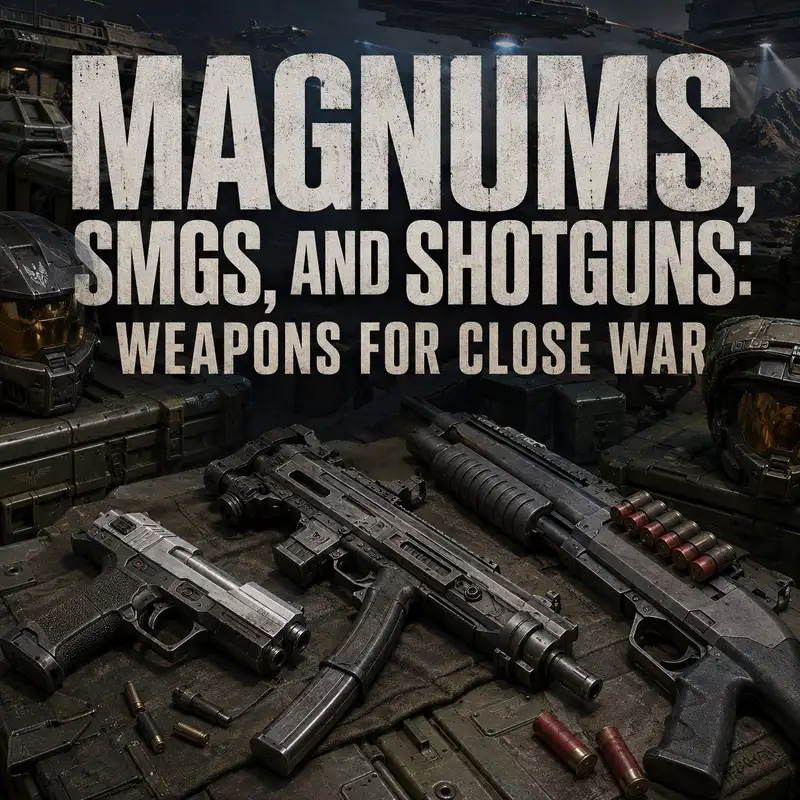
Magnums, SMGs, and Shotguns: Weapons for Close War
A boarding alarm changes the value of every weapon aboard a warship. The rifle that was ideal on a range becomes awkward at a pressure door. A long sight line disappears around a bend in the passageway. Crew members who normally work consoles reach for sidearms. Security personnel unfold compact submachine guns. Marines assigned to repel boarders bring forward shotguns because the next target may appear only a few steps away. At that distance, the problem is no longer how far a weapon can reach. The problem is how quickly it can be brought into action before the enemy reaches you.
Close war in the Halo universe takes place inside ships, orbital stations, bunkers, cities, tunnels, dropships, and Forerunner installations. It also begins whenever a formation loses the distance that normally protects it. A Sangheili boarding party crossing a hangar deck, a Jiralhanae pack forcing an entry point, or Flood forms emerging inside a defensive perimeter can compress a battle into seconds. Magnums, submachine guns, and shotguns survived in United Nations Space Command service because each answered a different part of that problem. The pistol was always available. The submachine gun placed automatic fire into a compact frame. The shotgun delivered overwhelming force across the shortest and most dangerous distances.
The M six family of magnums was the broadest of these answers. Misriah Armory built the series around recoil-operated, magazine-fed handguns that commonly fired large twelve point seven by forty millimeter ammunition. Individual models differed in size, capacity, sights, and intended user, but the family shared a basic philosophy. A sidearm should remain useful after a primary weapon becomes inaccessible, damaged, empty, or simply too large for the task. That sounds modest beside an assault rifle or battle rifle. It is not modest to the pilot climbing from a disabled aircraft, the officer separated from a command post, or the technician defending a compartment with no time to visit an armory.
A pistol is carried for the moment the plan has already failed. It rides in a holster while both hands operate equipment, move casualties, climb ladders, or manage another weapon. It can be drawn in a vehicle seat, behind a console, or while one arm is occupied. It can remain attached to the user when a rifle is set aside. These advantages explain why a handgun can be strategically unremarkable and personally decisive. The United Nations Space Command did not expect magnums to replace rifles. It expected them to keep personnel armed when rifles could no longer solve the immediate problem.
The M six D became the most famous expression of the family. It was a large personal-defense weapon firing twelve point seven millimeter ammunition from a twelve-round magazine and carrying a smart-linked magnified sight. Its scale and recoil suited augmented personnel particularly well, although the weapon was not useful only to Spartans. The important capability was the combination of substantial ammunition, controlled semiautomatic fire, and an optic that could communicate with compatible combat systems. A trained user could place deliberate shots rather than merely discharge a weapon in the enemy’s direction.
Its reputation requires caution. The M six D’s extraordinary performance in one playable campaign does not establish that every issue pistol could defeat rifles, machine guns, and alien heavy weapons on equal terms. A sidearm has a shorter practical reach, less stability, and a smaller ready ammunition supply than a shoulder-fired weapon. Even a powerful pistol round remains dependent on shot placement, target armor, and shield condition. The M six D was dangerous because it was accurate, powerful for its class, and present when needed. Treating it as a miniature sniper rifle confuses a memorable battlefield tool with the abstractions required to make a game function.
Other M six variants shifted the balance toward easier handling, faster presentation, or broader issue. The M six C, M six G, M six H, and later models did not form a perfectly orderly replacement chain in which one version disappeared when another entered service. Different branches, units, and operators retained different inventories. That was normal in a military spread across many worlds and forced to replace losses during a war of extinction. A pistol could remain in service because magazines, ammunition, holsters, armor interfaces, and trained users already existed. Procurement officers prefer a clean transition. Armories usually provide several generations and ask the supply sergeant to make the arrangement appear deliberate.
The M six C Socom showed how a sidearm could become a specialized close-war instrument. Issued particularly to Orbital Drop Shock Troopers and other special-operations personnel, it combined a suppressor, compensating features, and a smart-linked magnified optic. The configuration supported reconnaissance, infiltration, and operations in which the first shots needed to reveal as little as possible. Suppression did not make the pistol silent. Mechanical noise, impact, enemy sensors, and a collapsing body could still compromise the shooter. It reduced the signature and bought time, which is often the most valuable result stealth can provide.
That weapon also demonstrated the difference between close quarters and short range. An Orbital Drop Shock Trooper moving through New Mombasa might need a compact weapon inside a building, then use the same pistol to observe and engage across a street. Magnification helped identify targets and place shots, but it did not turn the user into a sniper or solve the problem of energy shields. Against shielded Jiralhanae, a suppressed pistol was still a pistol. Its best use came through surprise, precision against exposed targets, and cooperation with weapons capable of stripping protection more efficiently.
The postwar Mark Fifty Sidekick represented another choice. Emerson Tactical Systems produced a compact ten-millimeter pistol that emphasized rapid handling and close-to-medium-range use rather than the full M six formula of a heavy magnum with an integrated magnified optic. By the fighting around Zeta Halo, it served personnel from the United Nations Space Command Infinity and other surviving forces. Its name was unusually honest. The Sidekick was designed to accompany a primary weapon, not to win a campaign through enthusiasm and a quick trigger finger.
The M seven submachine gun filled the space between pistol and rifle. Misriah Armory designed it as a compact personal-defense weapon using five by twenty-three millimeter caseless ammunition. It carried a large magazine, a collapsible stock, and automatic fire in a package suited to vehicle crews, shipboard personnel, and special operators. The original requirement was not to give every infantryman a smaller assault rifle. It was to arm people who needed more firepower than a handgun but could not carry a full-size rifle without interfering with their primary duties.
That distinction mattered aboard armored vehicles and aircraft. A crew member might have to escape through a narrow hatch after losing the vehicle. A pilot might be forced down behind enemy lines. A naval technician might fight from behind machinery in a passageway never designed as an infantry position. In each case, the weapon had to remain compact until the emergency began. The M seven could be carried where a rifle became burdensome and then extended into a more stable firing configuration. It was an emergency weapon that proved useful often enough to become something more.
The Insurrection expanded that role. Paramilitary police, special forces, and government troops used the M seven in orbital habitats and crowded urban terrain where long weapons were difficult to maneuver. Insurrectionists valued the same qualities. A compact automatic weapon does not acquire a political allegiance at the factory. It can be concealed, carried through infrastructure, and used during raids by whichever side obtains it. The M seven’s spread through both government and rebel forces was a reminder that weapons designed for control can move into resistance, criminal markets, and local defense faster than policy can follow.
In close combat, the M seven offered volume. Automatic fire could force an opponent away from an opening, cover movement across a corridor, or place repeated hits on a shielded target. The large magazine gave the user more immediate ammunition than a pistol, while the compact body remained easier to maneuver than a rifle. The cost was range and control. Sustained fire caused the muzzle to climb, rapidly consumed ammunition, and reduced the number of useful hits. A submachine gun could produce a great deal of noise and very little tactical improvement if the user treated the trigger as a substitute for judgment.
Caseless ammunition reduced the need to extract and eject a metal case, and it supported the M seven’s compact design. It did not remove logistics. The rounds still had to be manufactured, protected from damage, packaged, transported through slipspace, and delivered to the correct unit. The unusual side-mounted magazine required its own production and handling. A force using M sevens alongside assault rifles, battle rifles, magnums, and shotguns gained tactical flexibility while increasing the number of ammunition types and magazines its supply system had to manage. Close war may last seconds. Preparing for it occupies warehouses.
The suppressed M seven S became closely associated with Orbital Drop Shock Troopers. It added a sound suppressor, reduced muzzle signature, and a smart-linked sight to a weapon already suited to confined terrain. The result supported reconnaissance patrols and urban movement where a team wanted automatic fire without immediately announcing its exact position. The suppressor could reduce signature. It could not make dozens of impacts, breaking glass, enemy return fire, and radio traffic disappear. The weapon helped a team control the beginning of an engagement. It did not guarantee control of the end.
Postwar forces introduced the M twenty personal-defense weapon as a replacement path for the M seven. It used a top-mounted magazine and high-velocity armor-piercing ammunition intended to improve performance against modern body armor and enemies shaped by the Covenant War. It was configurable for pilots, security forces, boarding parties, and Spartan operators. The M twenty preserved the central lesson of the M seven while changing the details. Crews and specialists still needed a compact automatic weapon. The new design placed greater emphasis on modularity, faster reloading, and compatibility with contemporary smart-link systems.
The shotgun answered a different problem. Where the submachine gun produced repeated hits, the shotgun placed a heavy cluster of projectiles into a target at very short range. The M ninety Close Assault Weapon System and related M forty-five line fired powerful eight-gauge magnum shells through pump-action mechanisms. These were not delicate sporting arms carried into space through nostalgia. They were purpose-built close-assault weapons used for boarding, urban combat, defensive positions, and any environment where the enemy might appear on the other side of a door.
The M ninety’s extended tubular magazine supported boarding actions by keeping multiple shells ready without a detachable box magazine. The pump action was mechanically straightforward and allowed the user to cycle another round with a deliberate movement. That simplicity had value in dirt, smoke, and damaged compartments. It also created limitations. Each shell had to be loaded into the fixed magazine, and replenishing an empty weapon took time. A shooter could top it off between contacts, but only if the fight allowed a hand to leave the weapon and only if loose shells remained accessible.
Eight-gauge ammunition delivered formidable close-range effect and equally formidable recoil. Spartans could manage that impulse with little difficulty. Ordinary Marines, Army personnel, and security forces had to train around it. Recoil slowed follow-up shots, punished poor stance, and became more difficult in awkward positions. A shotgun used from a ladder, behind a pressure door, or while wearing damaged armor was not the effortless instrument suggested by its reputation. The weapon rewarded preparation and physical control. It was not a substitute for either.
Shot spread created both advantage and danger. At close range, multiple projectiles increased the chance of striking a moving target and delivered extensive trauma. As distance increased, the pattern dispersed and fewer projectiles reached the intended point. That made the weapon less efficient and increased risk to anyone nearby. Inside a ship or crowded city, every pellet that missed the enemy continued into something else. The primary hull was rarely the most immediate concern. Pipes, controls, pressure seals, power systems, civilians, and friendly personnel provided more reachable consequences.
Against Covenant energy shields, a close shotgun blast could deliver enough simultaneous kinetic impact to overwhelm protection or badly weaken it. The result depended on range, model, ammunition, and the target. A shielded Sangheili remained dangerous after a poor hit, and closing far enough to use the shotgun placed the operator inside the enemy’s own preferred distance for strength, blades, and plasma fire. The shotgun therefore worked best when terrain, surprise, or team action forced the engagement on human terms. Carrying a powerful weapon did not make entering sword range a sound plan.
The Flood gave the shotgun another grim purpose. Combat forms could absorb injuries that would stop an ordinary soldier, while infection forms made close contact especially dangerous. A heavy close-range blast could destroy limbs, break a charge, or create space for withdrawal. The same short range meant the shooter was already near infectious material and potentially surrounded. Shotguns helped solve the immediate body in front of the muzzle. They did not solve contamination, hidden infection forms, or the possibility that ammunition would run out before the outbreak did.
The M forty-five and M ninety remained in overlapping service because military replacement is rarely complete. The Marine Corps was strongly associated with the M ninety, while Army formations used M forty-five variants, and postwar procurement moved toward later M forty-five models. Their practical roles were similar enough that units treated them as members of the same close-assault category. Differences in manufacturer, magazine arrangement, and branch preference mattered to supply and training. To the person covering a breach, the more urgent questions were whether the weapon functioned, whether the correct shells were available, and who was standing beyond the target.
The C Q S forty-eight Bulldog offered a different postwar compromise. Misriah Armory chambered it for twelve-gauge magnum shells and fed it from a detachable rotating magazine. The smaller shell reduced the single-shot authority associated with the older eight-gauge weapons, but the magazine could be replaced more quickly than a fixed tube could be reloaded from empty. That changed the rhythm of close combat. The user gained faster replenishment and a compact package, accepting that some targets might require more than one carefully placed shot. The design favored faster replenishment and repeated engagements over the maximum effect of one shell.
None of these weapons worked independently of doctrine. A pistol user needed to know when to transition from a primary weapon. A submachine-gun team needed burst control and overlapping sectors. A shotgun operator needed someone covering the reload and the angles beyond the breach. Communications mattered because close terrain fragmented units into rooms, decks, and passageways. Medical support mattered because wounds occurred at distances where both sides could hit quickly. Engineers mattered because doors, locks, atmosphere, and power systems shaped every route. The weapon was the visible part of a much larger procedure.
Target identification was especially difficult. Covenant forces were visually distinct from humans, but human counterinsurgency, civil disorder, postwar piracy, and mixed-species alliances produced more complicated environments. Suppressed weapons and fast room clearing increased the risk of acting before identification was complete. Smart links, helmet displays, and motion sensors could help. They could also be degraded, deceived, or denied by the structure around them. At close range, a wrong decision could not be recalled after a better sensor picture arrived.
Training therefore mattered more than raw specifications. Troops practiced keeping muzzles away from friendly personnel, controlling automatic fire, moving around corners, communicating during reloads, and changing weapons without losing awareness. They learned that a pistol should not be drawn merely because it looked faster, that a submachine gun should not be emptied merely because it could be, and that a shotgun pattern did not excuse poor aim. Spartans performed these actions with augmented speed and advanced armor support. The weapons remained important because conventional personnel could also use them effectively after disciplined training.
Close-war weapons carried another institutional history. The M seven expanded during counterinsurgency. The Bulldog’s earlier forms served colonial peacekeeping and riot-control organizations. Suppressed pistols and submachine guns supported units whose missions often depended on secrecy. These origins complicate the heroic image attached to the same weapons during the Covenant War. Systems later used to defend humanity from extermination had also been developed, distributed, and refined for coercive operations against human populations. Tactical usefulness does not erase the political conditions that created demand.
The Covenant War changed the targets without removing the original problems. Boarding actions still required compact weapons. Urban fighting still produced short sight lines. Vehicle crews still needed emergency arms. What changed was the protection and physical power of the enemy. Energy shields demanded repeated or concentrated hits. Jiralhanae could continue fighting through injuries that would stop many humans. Sangheili could cross a room with lethal speed. Flood forms made every failed engagement a biological risk. The United Nations Space Command responded by retaining several close-range systems rather than expecting one weapon to solve every threat.
That diversity created burdens. Twelve point seven millimeter pistol rounds, five millimeter caseless ammunition, later personal-defense cartridges, eight-gauge shells, twelve-gauge shells, magazines, suppressors, optics, and spare parts all competed for transport and storage. A boarding team could carry an excellent mixture of weapons and still fail if the wrong ammunition container reached the launch bay. The most advanced smart link remained unhelpful if its battery or interface failed. A shotgun with no shells became an unusually heavy club, although soldiers have historically found uses for those as well.
Magnums, submachine guns, and shotguns endured because close war contains several different problems disguised as one distance. The magnum kept a person armed when no larger weapon was practical. The submachine gun gave crews and assault teams compact automatic fire. The shotgun delivered immediate force when the enemy crossed the final few meters. Each gave up something in return: reach, stability, ammunition efficiency, reload speed, recoil control, or flexibility beyond its intended environment.
Their deepest significance appears when the battle narrows to a doorway. Strategic failures have already occurred by that point. The enemy reached the ship, entered the city, crossed the perimeter, or escaped containment. Fleet maneuver, orbital defense, and intelligence have compressed into a few armed people deciding who controls the next compartment. The sidearm leaves the holster. The stock extends. A shell is chambered. These weapons do not make close war desirable. They give human forces a final set of choices after distance, warning, and most of the original plan have disappeared.