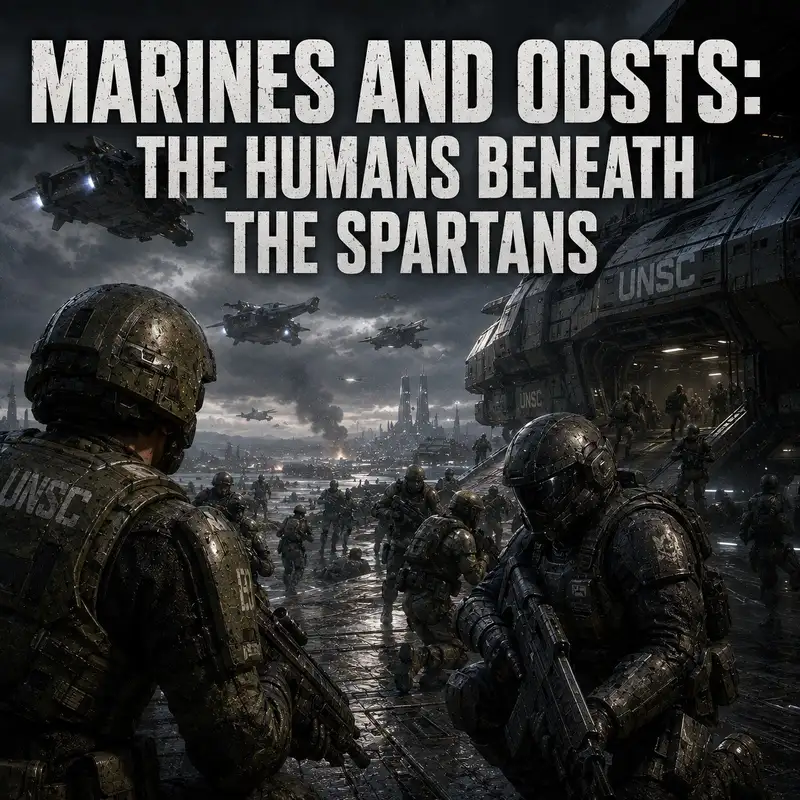
Marines and ODSTs: The Humans Beneath the Spartans
The drop was supposed to place Alpha-Nine beneath the Covenant assault carrier over New Mombasa. Most of the Orbital Drop Shock Troopers in their pods expected a violent descent, a hard landing, and an immediate fight toward the ship above them. Captain Veronica Dare carried a different classified objective. Then the carrier entered slipspace inside the city. The shock wave scattered the pods, severed communications, and turned a coordinated assault into several isolated survival problems. On the streets below, regular Marines were already trying to hold routes, protect civilians, and understand why the Covenant had chosen that one place on Earth.
The green armor receives most of the attention in Halo, but the war was fought by far more people who never wore it. Marines guarded ships, assaulted landing zones, defended colonies, crewed vehicles, and held positions after the fleet above them had been destroyed. Orbital Drop Shock Troopers went farther into the same danger, usually with less warning and no guarantee that the spacecraft which launched them would still exist when extraction became necessary. Spartans could change the outcome at a decisive point. Marines and ODSTs created the battlefield on which that point mattered.
The United Nations Space Command Marine Corps is an expeditionary service. Its purpose is to move with the Navy, reach distant worlds, and place combined-arms forces ashore before a slower planetary mobilization can occur. Marines conduct ground assaults, boarding actions, ship security, station defense, emergency law enforcement, and the protection of sensitive weapons and personnel. They are not the same as the Army, which carries more of the burden for sustained planetary defense and garrison duty. The distinction is not absolute during a crisis, but it explains why Marines appear wherever a Navy ship arrives with a problem that must be solved on the other side of an airlock.
The Corps was formed in twenty-one sixty-three during the Interplanetary War, when the United Nations combined naval and spaceborne expeditionary units from several national militaries. Its first extraterrestrial campaign on Mars established a pattern that endured for centuries. Warships would not merely fight other ships. They would carry troops capable of boarding stations, seizing surface objectives, and securing the infrastructure naval victory was meant to protect. The Corps became the human link between control of space and control of anything physically located below it.
The Orbital Drop Shock Trooper concept is even older. Early Drop Jet units appeared in the twenty-second century, and the modern organization developed with the Marine Corps. ODSTs became its all-volunteer rapid reaction and special operations force, trained for transorbital insertion, reconnaissance, direct action, personnel recovery, counterterrorism, and attacks behind enemy lines. The organization belongs to the Marine Corps, though candidates can arrive from special-operations backgrounds across the human services and member nations. An ODST is therefore a Marine special operator, not simply a regular infantryman issued darker armor and a more alarming transportation method.
Both organizations were shaped by the Insurrection before either fought the Covenant. Marines enforced blockades, raided separatist positions, guarded installations, and supported Operation TREBUCHET across the colonies. ODSTs attacked leadership targets, recovered stolen equipment, and conducted reconnaissance in politically sensitive areas. These missions built experience in dispersed operations and imperfect intelligence. They also tied the Corps to colonial repression, civilian casualties, and a conflict in which the word insurgent could describe a terrorist, an armed separatist, or a resident who happened to live near the wrong warehouse.
That history affected military culture. Marines learned to operate in settlements where the population might contain allies, informants, frightened civilians, and hostile cells at the same time. ODSTs developed pride in handling missions that conventional forces could not approach quietly or quickly. Their officers were expected to lead from the front, and the drop sequence itself placed commanders among the first pods into danger. Rank mattered. Competence mattered more. Administrative punishment was not a particularly persuasive threat to personnel who had already volunteered to enter atmosphere inside a single-occupant vehicle with only limited steering.
First contact at Harvest transformed the mission. Only a small Marine cadre was present, training the colonial militia when the Covenant arrived. Captain Ponder became the Corps’ first known casualty of the new war. The defenders had weapons designed for human enemies and doctrine built around insurgency. They now faced energy shields, plasma fire, gravity-controlled vehicles, and an enemy that did not seek political concessions. The same Marines who had been sent to preserve Earth’s authority over distant colonies became the first conventional troops asked to preserve the human species.
The ordinary Marine remained the foundation of ground combat because armies require mass. A Marine rifle squad could patrol, establish security, occupy a structure, escort refugees, and defend a landing zone. Vehicle crews brought Warthogs, armored vehicles, and heavier weapons into the fight. Combat engineers cleared obstacles and restored routes. Communications specialists connected the ground force with ships and aircraft. Corpsmen and medics kept wounded personnel alive long enough to reach treatment. None of those jobs looked like a Spartan operation, but a Spartan arriving without them eventually became one person with limited ammunition in hostile territory.
Marine equipment reflected that role. Standard body armor protected against fragments and small-arms threats, but it did not provide the strength amplification or routine energy shielding of Mjolnir. Human rifles, machine guns, rockets, and vehicle weapons could kill Covenant troops, particularly when used through disciplined fire and combined arms. They could not make the individual Marine equal to a shielded Sangheili in every close fight. Training, fields of fire, crew-served weapons, cover, and mutual support narrowed the difference. The Marine Corps fought the technological gap as an organization rather than asking each rifleman to become a super-soldier.
ODST selection concentrated experience into smaller units. Candidates had usually already succeeded in another demanding military specialty before volunteering. Additional screening tested physical endurance, judgment, squad tactics, live-fire discipline, and the ability to continue functioning in hostile environments. The process created a force whose members could arrive scattered, identify the mission, and reorganize without waiting for a complete headquarters. It also created a culture of severe pride. Being returned to a previous unit could feel worse than being wounded, which is an efficient way to produce determination and a less efficient way to encourage reasonable discussions about fatigue.
The single-occupant exoatmospheric insertion vehicle gave the ODST its defining capability. A ship could launch dozens or hundreds of pods during a fast pass, spreading the force across several landing zones and making it harder for one enemy missile to destroy an entire platoon. Expert systems guided much of the descent while the occupant made limited corrections. Braking systems reduced the final velocity. The pod carried weapons and supplies. If it worked correctly, one trained soldier reached the surface quickly with enough equipment to begin the mission.
The pod solved insertion with impressive directness. It did not solve extraction, casualty evacuation, resupply, or the problem of landing several kilometers from the rest of the team. Anti-aircraft defenses could destroy pods. Weather and damaged guidance could scatter them. A trooper might emerge injured, disoriented, and under fire. The launching ship also had to survive long enough to reach the release point. Orbital dropping was therefore not a dramatic substitute for planning. It was a method for accepting calculated risk when a dropship was too visible, too slow, or likely to lose everyone aboard at once.
ODST armor was designed around that environment. It provided better protection and environmental support than ordinary Marine equipment, included integrated communications and battlefield data systems, and could support short periods of activity in vacuum. The Visual Intelligence System, Reconnaissance suite could map terrain, identify equipment, and connect the wearer to available infrastructure and mission data. Variants supported communications, demolitions, heavy weapons, reconnaissance, and other specialties. The armor was still not Mjolnir. It did not routinely give its wearer energy shields, Spartan strength, or the ability to ignore plasma fire.
The first years of the Covenant War showed why both levels of force were required. At Alpha Corvi Two, Marine formations absorbed the main ground battle while Blue Team attacked the Covenant objective associated with a Forerunner artifact. The Spartans completed the high-value mission. The Marines paid heavily to keep the enemy’s attention divided and then withdrew when the wider position could not be held. The operation succeeded because conventional troops and special operators performed different tasks. Judging only the final objective would conceal most of the force that made it reachable.
Early counteroffensives also placed ODSTs beside the Spartan Twos. The Twenty-First Space Assault Battalion, known as the Black Daggers, specialized in boarding and combat outside normal planetary conditions. During Operation SILENT STORM, their experience gave the human task force a conventional special-operations structure capable of supporting attacks against Covenant logistics. The Spartans brought physical capability no ODST could duplicate. The Helljumpers brought veteran officers, assault troops, and experience coordinating actions larger than one team. Cooperation improved after both groups learned that resentment was not a particularly effective breaching charge.
On Arcadia, Marines and ODSTs defended population centers and evacuation routes while Red Team struck Covenant positions. The battle demonstrated what ground success could and could not accomplish. Troops kept civilians moving, prevented immediate occupation, and counterattacked where the enemy was vulnerable. None of that guaranteed the colony’s long-term survival once the Covenant controlled the larger campaign. A Marine could hold an intersection for an hour and save hundreds of people. The star chart might still mark the world as lost.
This was the conventional soldier’s war. Covenant ships could defeat human naval formations and then place overwhelming firepower above the surface. Marines fought under the knowledge that orbital support might disappear without warning. They had to preserve ammunition, maintain vehicles, move wounded personnel, and prepare withdrawal routes while enemy plasma steadily reduced the infrastructure behind them. Tactical competence mattered enormously. It could not manufacture another fleet. The Corps repeatedly won enough ground to evacuate survivors or complete a mission, then left because the strategic situation had made occupation impossible.
Reach compressed that experience into one catastrophic campaign. Marines defended headquarters, shipyards, evacuation sites, and the generators supporting orbital defense platforms. ODST units fought across the planet and suffered with the formations they reinforced. Spartans protected objectives that could influence the battle, but they could not be everywhere. When Covenant forces broke orbital defense and landed in strength, the conventional forces carried most of the direct contact. Reach did not fall because its soldiers lacked courage. It fell because courage was being supplied faster than ships, air support, and strategic options.
Earth brought the war to the home system and produced the ODST operation most often remembered. Alpha-Nine launched over New Mombasa with an intelligence mission hidden inside an assault plan. The Prophet of Regret’s carrier entered slipspace, disrupting the drop and scattering the team. The surviving troopers spent hours rebuilding contact through an occupied city while regular Marines and local forces fought around them. Their original plan was gone. Their value lay in continuing to operate after the plan had become irrelevant.
The team eventually recovered a Huragok known as Quick to Adjust, linked to the city’s Superintendent intelligence. The being carried information about Covenant activity and the Forerunner structure beneath the region. Escorting that asset out of New Mombasa produced more strategic value than destroying another platoon of Covenant infantry. This is what special operations are meant to do. The objective is not the largest possible firefight. It is the particular result that a larger force cannot obtain before the opportunity closes.
Installation Zero Four offered an even clearer view of conventional service. After the Pillar of Autumn was boarded and forced down, Marines and ODSTs landed across the ring in lifeboats and drop pods. Survivors established Alpha Base, recovered weapons and vehicles from the wreck, rescued scattered personnel, and fought Covenant attacks while John One One Seven pursued the ring’s control systems. Fireteam Raven and other ODSTs operated as part of that wider force. The Master Chief’s mission decided the fate of the installation. It depended on a battlefield sustained by people whose names rarely appeared in the final summary.
The Flood turned that campaign into a containment disaster. Marines accompanied Captain Keyes into the facility where the parasite was released. Other units defended Alpha Base and attempted to recover trapped personnel. Major Antonio Silva later planned to return to Earth aboard the captured Covenant cruiser Truth and Reconciliation, despite Flood contamination and the risk of exposing human space. First Lieutenant Melissa McKay recognized that the ship could not be allowed to leave. She destroyed the vessel and everyone aboard, including herself. The decisive act was not performed by a Spartan. It was a conventional officer refusing to let hope become a route for extinction.
Relations between ODSTs and Spartans had never been simple. In twenty-five twenty-five, four troopers aboard the Atlas were used without full understanding as part of a test of the newly augmented John One One Seven. Two were killed and two badly injured. The event became part of ODST institutional memory. Some Helljumpers saw Spartans as secretive products receiving equipment and attention while conventional special operators continued dying in greater numbers. Later combat softened the rivalry, but did not erase it.
The comparison was never especially useful. ODSTs were not failed Spartans, and Spartans were not replacement Marines. A Spartan could penetrate a position that would destroy a normal squad. An ODST unit could deploy in numbers, perform specialized reconnaissance, clear landing zones, and support an entire theater. Conventional Marines could then occupy terrain, protect logistics, crew vehicles, guard prisoners, escort civilians, and keep fighting after the high-value team departed. The three forces overlapped, but each solved a different problem.
The postwar Spartan Four program drew heavily from experienced volunteers, and veteran ODSTs were attractive candidates. Edward Buck and several members of Alpha-Nine eventually accepted augmentation. Others refused, retired, or resented the idea that becoming a Spartan represented promotion into a more important form of service. Their reluctance was not irrational. ODST identity had been built around achieving difficult results without biological enhancement. The new program offered greater capability, but also absorbed experienced leaders from the units that still had to perform every mission not assigned to Spartans.
ODSTs therefore remained a core fighting force after the Covenant War. They deployed with the Infinity during Operation WOLFE on Reach, supported the Spirit of Fire’s campaign against the Banished on the Ark, fought beside Spartans at Netherop and Boundary, and continued specialized operations in twenty-five sixty. Command Squad Sunray prevented the Banished from obtaining a Forerunner fighter that could have changed the balance around the Ark. The mission mattered because the Spirit of Fire lacked an easy way to replace ships or aircraft. One captured system could have become an operational crisis.
The modern Corps also continued improving equipment rather than conceding every advanced system to the Spartan branch. Semi-powered exoskeletons such as ORCUS were tested for Helljumper use in twenty-five fifty-nine. Better armor could increase endurance, mobility, and survivability. It could not remove the institutional reasons ODSTs existed. The United Nations Space Command still needed formations that could be trained in larger numbers than Spartans, deployed from ordinary ships, and trusted to complete missions without uniquely rare augmentations.
Zeta Halo proved the point after the Banished ambushed the Infinity. Marines, ODSTs, pilots, medics, technicians, and Spartans evacuated in whatever craft remained. Survivors reached the ring without a functioning theater command, secure logistics, or reliable orbital support. Some rallied at the wreck of the Mortal Reverie. Others formed isolated groups, hid in Forerunner structures, raided Banished supply lines, and tried to keep communications alive. The fighting became a guerrilla campaign conducted by the fragments of a force that had expected to arrive behind the most powerful human warship in service.
Spartans provided leadership and striking power, but conventional personnel kept the resistance humanly possible. A medic could preserve expertise that no replacement shuttle would deliver. A pilot could turn a captured aircraft into mobility for an entire group. Marines guarded shelters and moved supplies. ODSTs attacked Banished logistics, reconnoitered occupied territory, and created temporary freedom of movement. The Mortal Reverie was eventually overrun. The resistance survived because it had never depended on one base or one armored soldier.
This is the scale at which Marines and ODSTs matter. A Spartan can destroy the gun blocking a valley. Marines must move through the valley, secure the road, evacuate the wounded, and hold the ground against the counterattack. ODSTs may arrive first to identify the gun, sabotage its support network, or clear the landing zone. Navy crews must place every one of them in the system. Logistics must keep them supplied. Remove any layer, and the celebrated tactical action becomes an isolated event with no durable effect.
The humans beneath the Spartans were never secondary to the war. They were the force large enough to be present on every deck, in every convoy, and across every colony where the United Nations Space Command attempted to resist. Their armor was thinner, their names less protected by classification, and their casualties easier for official histories to compress into a number. They still boarded the ships, entered the drop pods, and held the routes that others needed.
Alpha-Nine’s scattered descent over New Mombasa did not produce the clean assault its planners expected. It produced isolated troopers, damaged communications, and a classified objective that only made sense after the original battle had changed. The Marines below continued fighting because civilians still needed a route out. That is why Spartans never made them obsolete. A super-soldier could reach the decisive point. Marines and ODSTs were the people who ensured there was still a force, a mission, and someone left to benefit when the decisive point was won.