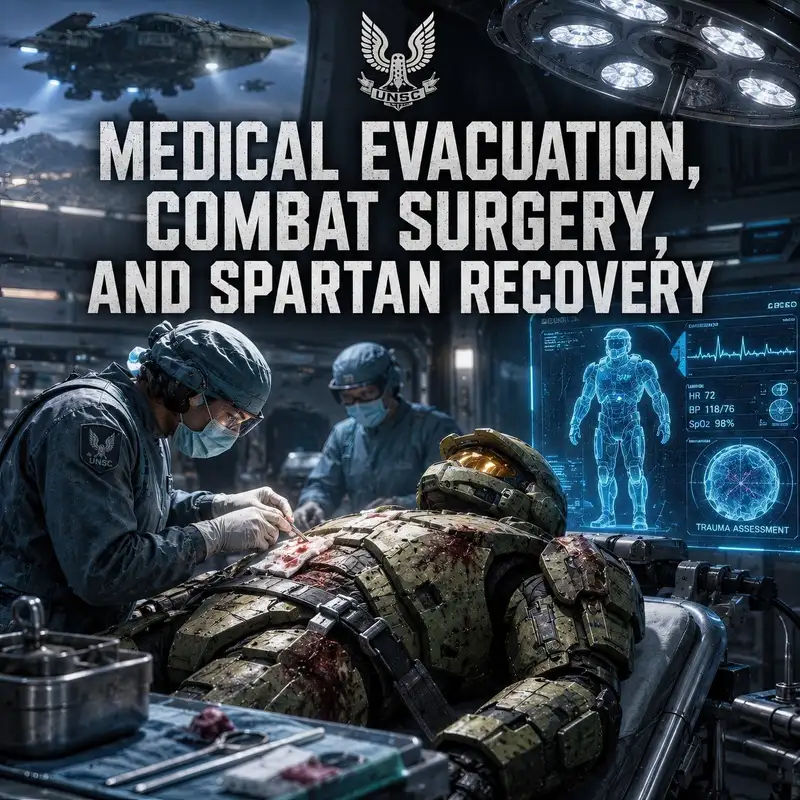
Medical Evacuation, Combat Surgery, and Spartan Recovery
Linda Zero Five Eight reached the Pillar of Autumn alive only in the narrowest administrative sense. Covenant fire had torn through her armor during the fighting around Gamma Station. John One One Seven carried her back to the cruiser, where medical personnel could find no heartbeat and no practical path to immediate recovery. He placed her in cryogenic suspension anyway. The decision preserved no guarantee. It preserved a possibility.
That possibility survived the destruction of Reach, the escape to Installation Zero Four, the loss of the Autumn, and the destruction of the ring itself. Linda's chamber was recovered only because other people protected it, moved it, and refused to treat clinical death as the final line in the report. Doctor Catherine Halsey later revived her through specialized surgery and replacement tissue. The famous part is that a Spartan returned from the dead. The military reality is that she returned because an entire chain of evacuation, refrigeration, transport, surgery, and command decisions remained intact long enough to reach her.
Medical care in the United Nations Space Command was built around buying time. A medic could not reverse every plasma burn or rebuild a shattered organ beside the road. A Pelican could not complete surgery while dodging anti-aircraft fire. A shipboard infirmary could not replace a hospital station after its supplies were exhausted. Each level tried to keep the casualty alive, stable, and movable until the next level could do more. The chain was only as strong as the aircraft, communications, power, sterile equipment, and people connecting it.
Halo battlefields produced injuries that tested every part of that chain. Human ballistic weapons caused penetrating trauma, fragmentation, and blunt-force damage. Covenant plasma burned through armor and transferred extreme heat into tissue beneath it. Needler impacts combined penetration with explosive fragmentation. Vehicle wrecks produced crushing injuries and amputations. Space combat added decompression, radiation exposure, toxic smoke, and casualties trapped behind sealed pressure doors. Flood outbreaks added a biological threat for which ordinary casualty collection could become a route of infection.
The first response usually came from the wounded person or the nearest squadmate. Combat armor carried individual medical supplies, and trained personnel understood that uncontrolled bleeding could kill before a corpsman arrived. The immediate priorities were simple because complexity wastes time under fire: stop major hemorrhage, protect the airway, seal breaches, reduce contamination, and move the casualty out of the weapon's direct reach. The tools were more advanced than those of earlier centuries. The body remained vulnerable to the same basic failures.
Biofoam became the most recognizable of those tools. It was a self-sealing medical compound designed to fill damaged space, control bleeding, reduce contamination, numb pain, and hold injured tissue in place. It could be sprayed or injected into a wound, including through access ports in sealed armor. That made it useful when removing the suit would expose the patient to vacuum, toxins, or enemy fire. Biofoam did not restore a destroyed organ or turn a fatal wound into a minor inconvenience. It created temporary internal pressure and stability so the casualty might survive transport.
Its value depended on judgment. Too little might fail to control the injury. Poor placement could complicate later treatment. Pain reduction could convince a wounded soldier to continue moving on damage that still required surgery. A casualty sealed with biofoam was not healed. The person had been converted from an immediate emergency into a slightly delayed one, which is a genuine medical achievement and a dangerous misunderstanding when a unit is desperate for every rifle.
Combat medics and Navy hospital corpsmen carried the skill that made those tools useful. Corpsmen served with Marine and Orbital Drop Shock Trooper units, while Army formations employed their own medical personnel. They carried biofoam canisters, trauma packs, diagnostic equipment, and tools for direct field intervention. They also carried weapons because the enemy rarely recognized the area around a casualty as neutral merely because someone had opened a medical case.
A corpsman had to work inside the tactical situation rather than beside it. Reaching one wounded Marine might expose the medic to the fire that caused the injury. Treating the casualty in place might block the squad's withdrawal. Moving too early could worsen spinal, vascular, or internal damage. Waiting for a perfectly secure site could leave the patient dead before the site became perfect. The medic's decision combined clinical knowledge with terrain, enemy position, transport availability, and the uncomfortable fact that another casualty might arrive before the first could be moved.
Triage became unavoidable whenever casualties exceeded immediate capacity. The wounded were assessed according to who needed intervention now, who could wait, who could move with assistance, and who was unlikely to survive with the resources available. That process was not a judgment of personal worth. It was an attempt to save the greatest number while time, supplies, and transport were limited. The distinction offered little comfort to the person asked to wait beside a friend receiving the last available unit of blood.
Casualty collection points gave medics a place to combine treatment and prepare evacuation. Their location had to be close enough for litter teams and vehicles to reach, but far enough from the fighting to avoid becoming another target. They needed cover, communications, marked approaches, and a route for aircraft or ground transport. Once established, they immediately became dependent on batteries, lighting, oxygen, sterile supplies, and security. A medical position could be improvised quickly. Keeping it functional was a logistical operation.
Medical evacuation usually depended on the same aircraft supporting the battle. Pelicans could move between surface positions, ships, and orbital facilities, carrying wounded personnel on the return leg after delivering troops or supplies. Their versatility made them indispensable. It also created competition. The Pelican assigned to casualties was unavailable for ammunition, reinforcements, or civilian evacuation. A commander could order the aircraft forward. The pilot still needed a usable landing zone, enough fuel, and a route not controlled by Banshees or anti-aircraft batteries.
Air superiority therefore had a medical consequence. When friendly aircraft controlled a corridor, severe casualties could reach surgery quickly. When Covenant fighters or ground defenses closed it, treatment stopped at the capability already present. A wounded soldier might be stable enough for an hour and still die because the aircraft arrived in the second. Medical technology could extend the evacuation window. It could not clear the sky.
The same problem appeared in orbit. A ship with functioning hangars, medical spaces, and life support could serve as a receiving facility for casualties from the surface. If the naval battle forced that ship to maneuver, withdraw, or seal damaged sections, the evacuation plan changed immediately. A hospital compartment without pressure, power, or surgical staff was only a room with unusually clean cabinets. Space control did not guarantee medical care, but losing space control could remove it with remarkable speed.
Combat surgery aboard ships and forward facilities focused first on survival. Surgical teams controlled bleeding, removed contamination and damaged tissue, relieved pressure, stabilized fractures, and preserved organs until more complete reconstruction became possible. Automated systems and advanced imaging improved speed and precision, but they did not remove the need for surgeons, anesthetic control, blood products, sterile fields, and postoperative monitoring. A machine could complete a procedure exactly as programmed. Someone still had to decide which procedure the casualty could survive.
Major hospitals handled what forward teams could not. The United Nations Space Command Hopeful became the best-known example, a massive mobile medical facility assembled from refit stations and later fitted for slipspace travel. It treated military casualties, supported civilian evacuations, and carried medical resources on a scale ordinary warships could not match. Front-line personnel came to regard it with near-mythic affection. This was partly gratitude and partly arithmetic. Reaching the Hopeful meant the casualty had already survived several stages intended to prevent that journey from ending early.
The Hopeful also demonstrated the vulnerability of medical concentration. It needed escorts because its value and limited combat capability made it a target worth protecting. Its operating rooms required power, supplies, specialists, and constant movement between threatened regions. Sending it toward one campaign meant accepting that another would receive less support. A mobile hospital could bring advanced care to the wounded. It could not be present over every colony whose defenders were producing them.
Civilian mass-casualty operations made those choices harder. A military medical system designed around service members might suddenly receive burned families, children injured during evacuation, industrial workers exposed to toxic debris, and patients whose chronic conditions had been destabilized by the collapse of local hospitals. The transports carrying military casualties might also be the only aircraft able to reach a shelter. Treating the population was a humanitarian obligation and a requirement for maintaining civil order. It also consumed the same finite medical stocks needed by the units protecting the evacuation.
Plasma trauma was especially difficult because the visible wound could conceal wider thermal damage. Armor might stop complete penetration while transferring heat into the body. Burns damaged tissue beyond the immediate point of impact and increased fluid loss, shock, infection risk, and respiratory problems. A patient who remained conscious could still deteriorate rapidly. Biofoam could seal bleeding. It could not reverse tissue already destroyed by heat.
Vacuum injuries required a different response. Sealed armor and emergency breathing systems provided protection only while the suit remained intact. A puncture had to be closed, atmosphere restored, and the casualty moved before pressure loss and oxygen deprivation caused irreversible damage. Removing armor to reach the wound might worsen the environmental danger. Medical access ports and suit telemetry allowed treatment without complete removal, which was less a convenience than a recognition that the operating room might currently be the inside of the armor.
Mjolnir pushed that concept further. The armor monitored the wearer's condition, displayed team biological data, supported pressure and temperature control, and incorporated medical systems capable of stabilizing some injuries. Later suits could deliver biofoam and share vital signs across a fireteam or command network. This gave commanders and medics warning that a Spartan had been injured even when the operator continued moving. It did not make the data perfect. Damage, interference, and sensor failure could turn a clean display into an uncertain guess.
The armor also made physical recovery difficult. A wounded Spartan in Mjolnir was larger, heavier, and more complicated to move than an ordinary casualty. Removing the suit required training and appropriate equipment, especially when armor damage had distorted joints or locked components. Litter teams needed enough strength or mechanical assistance. Aircraft required room and secure restraints. Armor technicians, engineers, and medical staff might all be needed before the patient could reach surgery. The person inside was biologically exceptional. The recovery operation remained stubbornly mechanical.
Spartan physiology changed treatment without eliminating injury. Augmented bones, muscles, organs, neural interfaces, and altered metabolic systems allowed Spartans to survive trauma that would kill ordinary personnel. Those same changes meant physicians needed access to classified medical records and specialists who understood the specific program. A treatment suitable for an unaugmented Marine might interact differently with a Spartan's implants, organ modifications, or medication requirements. The most valuable patient in the facility could also be the one least compatible with routine care.
The different Spartan generations added more variation. Spartan Twos had undergone dangerous childhood augmentation and decades of adaptation to their altered bodies. Spartan Threes received another augmentation regime designed for larger cohorts and different operational requirements. Spartan Fours entered as consenting adult veterans and received extensive gene therapies, artificial organs, cybernetic enhancement, and continuing medical support. The title Spartan identified a military capability. It did not identify one standardized patient.
Recovery began before deployment through baseline monitoring, physical conditioning, and detailed medical records. It continued after injury through surgery, rehabilitation, neural testing, armor recalibration, and assessment of whether the operator could safely return to duty. A Spartan who could stand was not necessarily ready for Mjolnir. A Spartan who could operate the armor was not necessarily ready for another combat deployment. The pressure to shorten that distinction increased whenever the next mission had already been classified as urgent.
Linda's survival remains the clearest example of what exceptional recovery actually required. After she was critically wounded at Reach, cryogenic suspension slowed biological deterioration and preserved her until advanced treatment became possible. Her chamber had to remain powered, protected, and identifiable through the loss of the Autumn and the fighting around Installation Zero Four. Recovery teams then had to bring her back into a medical system with the expertise to attempt revival.
Halsey's intervention went beyond ordinary field medicine. She used advanced surgical techniques and replacement biological material to repair damage that had already produced clinical death. The procedure succeeded because human medicine could grow compatible tissue and replace organs, because Halsey understood Spartan physiology, and because Linda's body had been preserved before irreversible decay completed what the weapon had begun. Describing the event as resurrection hides the more useful lesson. Every earlier decision had prevented one final failure.
Other Spartan recoveries followed the same principle at different scales. Wounded Spartans were removed from battle when transport existed, treated inside classified facilities, and returned only after medical and technical personnel restored both body and armor. Some survived augmentation washout and were later rehabilitated into useful service. Others never recovered enough for field duty but contributed through intelligence, research, administration, or training. The program's casualty categories concealed a wide range of bodies and futures behind a small number of official terms.
The secrecy surrounding Spartans complicated care. Medical records revealed augmentations, program history, and weaknesses the Office of Naval Intelligence did not want widely distributed. Access could be limited to cleared personnel and facilities. That protected information from enemy intelligence and public scrutiny. It could also delay treatment when the nearest capable surgeon lacked authorization or the casualty arrived without records. Classification is effective at preventing unauthorized access. It has never shown much ability to stop internal bleeding.
Postwar Spartan Operations improved institutional support by creating dedicated training, armor, and medical structures for larger numbers of augmented personnel. Specialized combat medic Mjolnir entered testing, and one response team at the Avery J. Johnson Academy was led by a Spartan carrying foldable stretchers in purpose-built armor. The image is important. Spartan capability had expanded from being only the casualty that everyone struggled to recover into a means of reaching and carrying other wounded personnel under conditions ordinary medics might not survive.
That did not remove conventional medical services. Corpsmen still treated Marines. Army medics still supported soldiers. Pilots still flew evacuation routes. Surgeons still worked inside ships and bases. Spartan medical specialists added capability at the most dangerous point in the chain. They did not replace the chain, and their armor still required maintenance, transport, and supplies.
Zeta Halo showed what happened when nearly every link broke at once. The Infinity's defeat scattered personnel across the ring without dependable aerospace control, hospital support, communications, or replacement stocks. Combat medic Lucas Browning treated survivors while moving with groups that could not count on evacuation. The wreck of the Mortal Reverie became a refuge because its remains offered shelter, salvage, and a place to organize care. The survivors possessed training and some advanced equipment. They lacked the secure route that would turn stabilization into recovery.
Under those conditions, every medical item became strategic. Biofoam, dressings, pain control, antibiotics, power cells, food, clean water, and transport had to be conserved. A wound that would have been survivable aboard Infinity became dangerous because no surgical team waited overhead. A casualty who could not walk slowed the entire group and required people to carry protection, ammunition, and the patient at the same time. The enemy did not need to defeat the medical system separately. It had already done so by destroying the network around it.
Medical logistics were therefore as important as medical knowledge. Blood products had to be stored and matched. Pharmaceuticals expired or required controlled conditions. Surgical tools needed sterilization. Imaging and automated systems required power. Cryogenic chambers required maintenance. Replacement organs required cloning facilities, sterile equipment, and specialists. The medical plan that ignored these demands was not a plan. It was a confident list of procedures no one would be able to perform.
Commanders influenced survival before anyone was wounded. They chose whether evacuation aircraft remained on alert, whether a hospital ship entered a threatened system, whether a rear guard held the landing zone, and whether scarce transport carried casualties or ammunition. They also decided when a position had become impossible to support. Medical personnel could advise how long patients would remain stable. They could not create a route through enemy air defenses by force of diagnosis.
The United Nations Space Command's medical system was advanced because it could seal trauma rapidly, monitor casualties through armor, replace damaged organs, preserve patients in cryogenic suspension, and conduct surgery far from Earth. It was limited because every capability depended on access. A biofoam canister needed a medic. A medic needed security. A casualty needed transport. The transport needed air or orbital control. The surgeon needed power, supplies, and time. Spartan recovery demanded all of those things, plus classified expertise and equipment capable of handling an augmented body inside powered armor.
Linda Zero Five Eight survived because the chain bent without breaking. A squadmate carried her. A cryogenic chamber preserved her. Crews moved that chamber through the destruction of a ship and a Halo installation. Recovery personnel found it. A surgeon understood what had been done to her body and possessed the technology to repair it. The extraordinary patient receives the attention. The quieter achievement was that enough ordinary people and systems remained in place to give extraordinary medicine a chance to work.