Meridian and the Collapse of the Outer Colonies
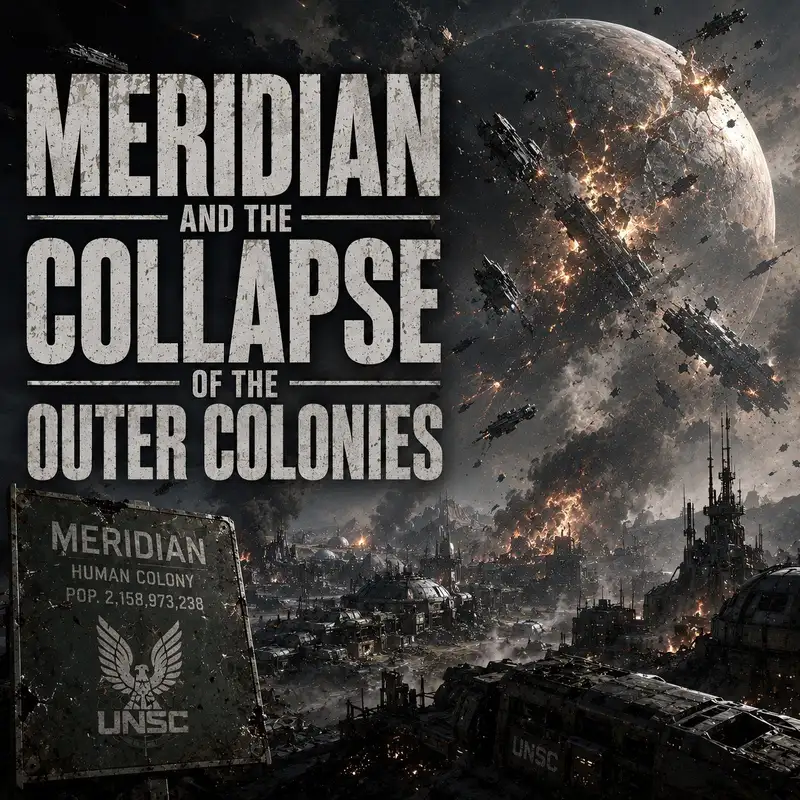
Captain Edmund Persie did not order the defense fleet away from Meridian because the battle had become unimportant. He ordered the withdrawal because the remaining ships could no longer prevent their destruction. The survivors of the naval force fell back toward the edge of the Hestia system, leaving the colony beneath an uncontested Covenant fleet. Within hours, plasma began cutting across the surface. Meridian had resisted for three years. Once control of orbit was gone, the end came with the speed of a firing solution.
That contrast explains why Meridian matters. It was not a weak frontier settlement surprised and destroyed before help could arrive. It was a prosperous Outer Colony with military industry, a large United Nations Space Command presence, an extensive orbital defense grid, and an Air Force garrison strong enough to delay the Covenant far longer than most worlds managed. Its fall showed that the collapse of the Outer Colonies was not simply the destruction of undefended planets. It was the systematic exhaustion of colonies that had defenses, factories, trained personnel, and every reason to believe they could hold.
Meridian was a small moon orbiting the gas giant Hestia Five, but its society was anything but small in ambition. Human colonization began in the early twenty-fifth century, when settlers established communities along green equatorial coastlands and later expanded across the supercontinent of Turones. Many early settlers came from France, and names such as Avignon, Annecy, Bretagne, and Brume-sur-Mer preserved that heritage. The world had fertile land, heavy rains, forests, and mineral wealth in the Mathon Mountain Range. Before the Covenant arrived, Meridian attracted settlers, manufacturers, students, and tourists.
Its development had never been politically simple. One faction wanted to preserve much of the moon's natural surface. Another favored mining, settlement, and rapid growth. The discovery of rich mineral deposits shifted the balance toward expansion, but arguments over control continued. Meridian later became an important theater in the Insurrection. The Sundered Legion gained support during the withdrawal of the Colonial Military Authority and fought the Unified Earth Government for influence over cities and regions. The colony had lived with armed politics long before it learned the name Covenant.
The central government eventually defeated the Sundered Legion after years of fighting, including the Siege of Aethia. The settlement that followed tied Meridian's prosperity even more closely to the military. Defense contracts became a major source of revenue. Chalybs Defense Solutions operated numerous facilities there and produced equipment for the United Nations Space Command, including the Scorpion main battle tank. Mining supported manufacturing. Manufacturing supported the fleet and ground forces. A colony once divided over development became one of the Outer Colonies' most important military economies.
That importance brought defenses. Meridian maintained a substantial United Nations Space Command presence, an impressive Air Force establishment, Office of Naval Intelligence facilities, and a broad orbital defense network. Its industries could sustain local forces and supply other theaters. Its population had experience with emergency authority, security operations, and the consequences of rebellion. On paper, Meridian possessed many of the features planners said an Outer Colony needed to survive. The problem was that survival depended on more than the strength listed in one system's readiness report.
By the late twenty-forties, the Outer Colonies had been collapsing for more than two decades. Harvest, Madrigal, Biko, Jericho Seven, and many other worlds had been attacked, glassed, abandoned, or reduced to scattered survivors. The destruction did not advance along one continuous front. Covenant fleets appeared through slipspace, struck a system, and moved on. Human commanders could not place a permanent fleet above every colony. Every force concentrated around one world left another route less protected, and every costly victory reduced the ships available for the next emergency.
Meridian survived long enough for that wider disaster to become almost abstract to people living there. Other colonies had fallen, but Meridian still exported equipment, operated factories, and maintained defenses. Its endurance encouraged the belief that it might remain beyond the Covenant's reach or prove too costly to destroy. That belief was understandable. It was also based on the dangerous assumption that previous survival predicted future security. The Covenant did not need Meridian to become weaker before attacking. It needed only to discover the system and assign enough force to isolate it.
The invasion began in twenty-five forty-eight with an attempt to blockade the moon and cut the supply lines connecting its industries to the rest of the war. The first major naval fighting lasted roughly a week near the other moons of Hestia. Meridian's defenders benefited from extensive preparation and from the fact that the initial Covenant fleet was smaller than the formations used in many other planetary assaults. Human warships, orbital defenses, and aerospace units prevented an immediate collapse. The Covenant eventually forced a route through and began landing troops, but it did not gain effortless control.
The blockade was as important as the landings. Meridian's value came from what it produced and moved outward. A factory that cannot receive materials, ship finished equipment, or replace specialized components remains physically intact while becoming strategically silent. Every convoy required escorts. Every damaged ship consumed repair capacity. Every missile fired at an approaching Covenant vessel had to come from a stockpile that might not be replenished. Meridian's military economy allowed it to fight longer. The blockade steadily converted that advantage into a collection of fixed assets waiting to run short.
Ground combat spread beneath an orbital contest that neither side had completely resolved. Human defenses continued to contain much of the Covenant force, while the Covenant established positions around selected objectives. Fighting in and near the atmosphere disturbed Meridian's weather and intensified its already heavy seasonal rains. Roads flooded, aircraft operated through difficult conditions, and both sides had to move troops through terrain that favored neither clean maneuver nor easy surveillance. The campaign became a prolonged combined-arms struggle rather than the brief sequence of orbital defeat and surface destruction seen elsewhere.
The Covenant's interest in Forerunner artifacts helped keep Meridian alive. Beneath Brume-sur-Mer lay an ancient device the invaders wanted intact. Their religious restrictions made immediate glassing unacceptable while recovery remained possible. That restraint was not mercy. It was target preservation. The same fleet willing to kill a population could delay planetary bombardment because a buried object mattered more than the people living above it. Meridian gained time because Covenant doctrine imposed limits on how its commanders could use their superior firepower.
The people of Brume-sur-Mer did not know they were living above the objective. Authorities had limited public information about the invasion to prevent panic, and some regions remained unaware that a planetary siege was underway. When a Covenant corvette anchored over the town and ground forces attacked, the residents were badly unprepared. A large portion of the population died in the opening assault. Many survivors reached an old bomb shelter, where they waited while the Covenant concentrated on excavation rather than immediate extermination.
Spartan Three Owen B zero nine six had been deployed as part of Meridian's defense and was injured after his aircraft went down. He joined four local teenagers, Evelyn Rousseau, Saskia Nazari, Victor Gallardo, and Dorian Nguyen. They were civilians with local knowledge, not a substitute Spartan team. Owen trained them enough to move, observe, and fight in an emergency. Together they disrupted Covenant operations, reached the shelter, and helped evacuate survivors aboard an old stealth vessel once used by the Sundered Legion.
That escape carried a particular Meridian irony. Equipment left by a separatist organization helped save civilians from the alien empire attacking the colony. The old political conflict had not vanished. Its infrastructure had acquired a new use. The people aboard did not need to agree on whether the Unified Earth Government had governed Meridian well. They needed a ship capable of crossing a contested battlespace.
The Office of Naval Intelligence then focused on the artifact beneath Brume-sur-Mer. Its Xeno-Materials Exploitation Group wanted to deny the device to the Covenant and determine whether it could help the human war effort. The four teenagers returned to Meridian with Owen and local militia personnel. They discovered that the siege had continued longer than they had been told and that some communities still did not understand its scale. Classification had protected operations while leaving different populations inside different versions of the same war.
The recovered artifact pointed toward another Forerunner structure near Annecy and functioned as a key to systems the Covenant had uncovered. Human personnel removed critical components to deny the enemy access. The decision was defensible and dangerous. The presence of recoverable Forerunner material had restrained Covenant bombardment. Taking that material away reduced the reason for restraint. This did not cause every later event by itself, and Meridian continued fighting for years. It did reveal the recurring problem of ancient technology. Possessing it could protect a location, endanger it, or do both in sequence.
Meridian's conventional defenders kept the campaign alive. Air Force units, local militia, naval crews, orbital personnel, and ground formations defended cities, industrial sites, and transportation routes. A prototype Mark Nine Mantis armored defense system distinguished itself during the Cherbourg Run by attacking a heavily protected Covenant anti-aircraft network. The incident later became part of the machine's service history. More importantly, it showed that Meridian was still producing and testing military technology while under pressure. The colony was not waiting passively to be destroyed.
Innovation could solve local problems. It could not solve the fleet equation. A new walker might break an anti-aircraft position. It could not stop an assault carrier from entering the system. A militia could protect a road or extraction point. It could not escort an interstellar convoy. Orbital guns could punish an approaching vessel if they received targeting data and survived long enough to fire. They could not replace destroyed crews, ammunition, reactors, or maintenance facilities. Meridian resisted because many systems worked together. It remained vulnerable because each system depended on the others.
The three-year campaign did not mean Covenant superiority had been exaggerated. It showed that superiority had conditions. The first attacking force was limited. Meridian's defenses were unusually strong. The Covenant wanted artifacts preserved. Human forces knew the terrain and drew on local industry. Those factors slowed the invasion and allowed the United Nations Space Command to contain or repel parts of the enemy force. None prevented the Covenant from returning after the defenders had spent years consuming their strength.
This was the wider pattern of the Outer Colonies. Human strategy depended on local resistance buying time for reinforcements. Covenant strategy exploited the fact that reinforcements were scarce, slow, and often committed elsewhere. Slipspace did not allow Fleet Command to move one reserve instantly between threatened systems. Ships departed together and could arrive separately. Information aged in transit. A fleet sent to save one colony might arrive after the evacuation had ended or after the Covenant had moved to another target. The Outer Colonies were not one defensive line. They were hundreds of isolated obligations.
Each lost colony made the remaining system harder to defend. Destroyed agricultural worlds reduced food supply. Lost mines reduced raw materials. Burned shipyards and factories reduced production and repair. Refugees required transport, shelter, and medical support. Surviving naval forces had to escort more traffic across longer and less secure routes. The collapse became self-reinforcing. The Covenant did not merely remove dots from a map. It dismantled the network that allowed distant human settlements to support one another.
Meridian appeared to reverse that pattern in twenty-five fifty-one. After years of fighting, United Nations Space Command and local forces drove back the initial Covenant presence, and the Unified Earth Government reasserted control. On a situation board, this was a major success. The decisive question was what remained available to defend the colony when the Covenant returned.
The return came quickly and with far greater power. At least three Covenant assault carriers participated in the final phase, including the Solemn Penance commanded by the High Prophet of Regret. An assault carrier was not merely a large gun platform. It could deploy troops, aircraft, vehicles, command systems, and the support needed for extended planetary operations. Multiple carriers indicated that Meridian was no longer facing a probing force. The Covenant had committed enough power to remove the colony and complete its search for Forerunner technology.
Captain Persie commanded the final naval resistance from the Sevenfold Gates. The surviving record does not provide a complete list of every ship under him, which is appropriate to the end of a three-year siege. Vessels had been destroyed, damaged, reassigned, or reduced to whatever functions remained possible. Persie fought until the fleet could no longer hold the orbital battlespace, then ordered the survivors toward the edge of the Hestia system.
That withdrawal ended the colony's last meaningful protection from strategic bombardment. Ground formations may still have held positions. Air Force personnel may still have possessed aircraft, ammunition, and functioning command posts. Civilians may still have been moving toward shelters or launch sites. None of those facts could stop assault carriers firing from orbit. Control of the ground had become irrelevant to the Covenant's immediate objective because it no longer needed to occupy Meridian. It needed to destroy human life, industry, and resistance while preserving only the ancient sites it still wanted to search.
Within approximately five hours of the naval retreat, the Covenant delivered the decisive glassing of Meridian. Plasma fire melted soil into lechatelierite, destroyed cities, ruined factories, and drove enough heat into the environment to evaporate the oceans. Later Meridian histories described the world as completely eradicated. That was the language of a society remembering catastrophe, not a precise environmental survey. The bombardment was rushed and incomplete. Much of the atmosphere remained. The original human colony was still gone.
That distinction matters because glassing was not one uniform process. Meridian was not transformed into a perfectly smooth sphere. Some regions remained physically recognizable. Caverns preserved limited life. The atmosphere survived, though glass particles made parts of it dangerous to breathe. The Covenant had achieved the destruction of Meridian as a functioning wartime society without spending the time required to sterilize every square kilometer. Military effectiveness did not require geological completeness.
The industrial loss reached far beyond Hestia. Chalybs Defense Solutions abandoned or lost facilities across the moon. Other companies eventually absorbed production of some equipment, but replacing a defense industry requires more than copying a contract. Machine tools, skilled workers, testing grounds, transport links, supplier relationships, and accumulated experience disappear together when a colony is burned. Meridian had spent decades becoming useful to the war economy. Plasma removed much of that capacity in hours.
The human cost was even less replaceable. Evacuees carried memories of towns that no longer existed, while families were divided among ships, shelters, military units, and worlds farther inside human space. People who had survived the Insurrection and three years of Covenant siege lost the political community they had argued over for generations. A colony is not preserved merely because some residents escape. The population may survive while its institutions, property, local culture, and ability to choose its own future are destroyed.
Meridian's fall marked the late stage of the Outer Colonies' collapse. Most of the frontier had already been devastated, but Meridian had remained a major economic and military holdout. Its defeat showed that no surviving Outer Colony could assume time alone would produce safety. The Covenant could return after a human victory, reinforce more rapidly than humanity could rebuild, and transform years of resistance into a brief terminal bombardment once orbital control changed hands.
The loss also reduced the strategic depth protecting the Inner Colonies. Outer worlds had provided resources, warning, bases, routes, and distance. As they disappeared, Covenant fleets operated closer to Reach, Earth, and the core industrial systems sustaining the war. Human commanders gained shorter defensive lines only by losing the territory, population, and production that had made those lines worth defending. A smaller perimeter is not an advantage when it is smaller because the enemy has destroyed everything outside it.
The Covenant's search beneath Meridian produced a final consequence no human defender could see from the battlefield. After the glassing, a special operations team recovered a Forerunner Luminary from an underground structure and delivered it to Regret. The device contained information about the Halo installations, the Ark, and a portal located on a world the Forerunners had called Erde-Tyrene. Regret ordered his fleet there without understanding that the destination was Earth.
Meridian therefore connected the destruction of the Outer Colonies to the invasion of humanity's homeworld. The colony was attacked because it supplied the human war effort and because Covenant instruments detected ancient technology beneath it. Its defense delayed the enemy for years. Its final loss gave a Hierarch the information that brought a Covenant fleet directly to Earth in twenty-five fifty-two. The outer defensive network did not merely collapse inward. One of its ruins pointed the enemy toward the center.
The postwar history of Meridian prevents the story from ending with complete erasure. Because the glassing was incomplete, Liang-Dortmund Corporation returned with former residents, contractors, and people willing to work in a hazardous reconstruction economy. They filtered the damaged air, mined through vitrified ground, and planned to restore portions of the surface over generations. The colony that emerged was politically independent from the Unified Earth Government and heavily shaped by corporate ownership.
That recovery carried another irony. Meridian's prewar prosperity had grown from mining, military contracts, and central-government support. Its postwar future grew from mining the glass left by the Covenant and from a corporation positioning itself to control the restored land. The world survived, but not as a simple continuation of the colony Captain Persie had tried to defend.
Meridian held for three years because it possessed strong defenses, local industry, experienced personnel, and an enemy temporarily constrained by force size and religious objectives. It fell because those advantages were local, while the collapse surrounding it was systemic. The United Nations Space Command could not replace losses, secure every convoy, and keep a superior enemy from returning in greater strength. The final image is Persie's ships withdrawing toward the edge of Hestia while plasma strikes the green world behind them. Beneath that fire were factories, shelters, old rebel routes, and a Luminary that would guide the war to Earth. Meridian was not where the Outer Colonies began to collapse. It was where one of their strongest survivors proved the collapse had become irreversible.