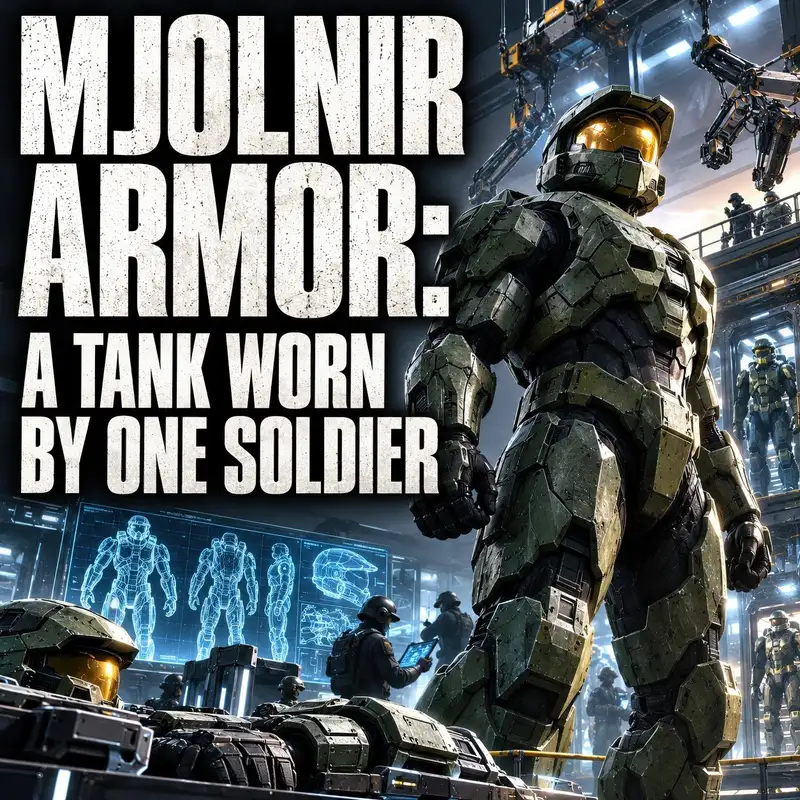
Mjolnir Armor: A Tank Worn by One Soldier
On November twenty-seventh, twenty-five twenty-five, technicians at the Damascus Materials Testing Facility prepared a suit that weighed roughly half a ton and could kill the wrong wearer. The Spartan Twos receiving it had only recently survived surgical augmentation. They were warned to move carefully because the armor did not merely follow motion. It anticipated and amplified it. A careless gesture could become a blow. A pain-induced spasm could become a lethal feedback loop. Before evaluation was complete, the Covenant crisis at Chi Ceti Four turned the new Mjolnir Mark Four from an experimental system into combat equipment.
Calling Mjolnir a tank worn by one soldier is useful because the armor combines protection, power, sensors, communications, mobility, life support, and computing around one operator. The comparison is also incomplete. A tank carries a crew, ammunition, fuel, maintenance tools, and a weapon built for a specific part of the battlefield. Mjolnir concentrates vehicle-like functions around an augmented human body, but cannot replace artillery, aircraft, armored formations, or supply. Its achievement was not making one person into an army. It was making one person capable of reaching objectives an army could not reach in time.
Human militaries had experimented with powered exoskeletons before Project Mjolnir. Those machines could lift heavy loads and carry substantial weapons, but power remained the decisive problem. Some depended on cables or broadcast energy from a nearby generator. That was acceptable for docks, industry, or a prepared defensive site. It was less useful to a soldier expected to cross broken terrain, board a spacecraft, or operate behind enemy lines. Catherine Halsey and the Office of Naval Intelligence’s Materials Group instead designed armor around an operator biologically altered to survive it.
The history of Mjolnir cannot be separated from the Spartan Two program. The armor was developed while its candidates were being trained and augmented. Its original mission was counterinsurgency, not alien warfare. The Unified Earth Government wanted small teams capable of penetrating separatist strongholds, capturing leadership, and ending crises before they expanded into interstellar civil war. Mjolnir would give those teams the protection and speed to act where a larger deployment would be politically visible, operationally slow, or impossible to conceal.
The first production model was designated Mark Four, despite being the first Mjolnir suit issued for combat. Its architecture was layered rather than one solid shell. External plating protected the torso, limbs, hands, and feet. Advanced titanium-based materials and coatings reduced the effect of heat and energy weapons. Beneath the plates sat a sealed bodysuit, mechanical linkages, power distribution, sensors, and the systems that moved with the Spartan. The result looked like heavy infantry armor. Functionally, it was an exoskeleton wrapped around a pressure suit and battlefield computer.
The most important layer was not the visible plating. Reactive liquid-crystal material converted electrical signals into mechanical response. Through the Spartan’s neural interface, the armor detected intended movement and strengthened it. A step became faster. A strike carried more force. A jump moved a mass that should have been difficult to lift from the floor. The system worked because Spartan augmentations reinforced bones, improved muscles, accelerated reflexes, and kept the operator ahead of the armor’s response. An unaugmented body could not safely control the feedback.
This is the difference between powered armor and ordinary protection. Conventional armor adds weight while absorbing damage. Mjolnir carried much of its own mass and amplified the person inside it. The wearer did not pull levers or operate pedals. Movement remained instinctive because the suit was integrated with the nervous system. That made it responsive and unforgiving. If its control system was damaged, or if an unsuitable wearer reacted in panic, the same amplification intended to protect the operator could produce catastrophic injury.
A hydrostatic gel layer helped manage the punishment. It distributed impact, regulated temperature, and could change density to support the wearer during acceleration or violent contact. Lockdown systems could stiffen the suit before a collision, reducing damage to joints and soft tissue. This allowed Spartans to survive falls, crashes, and maneuvers that would kill ordinary personnel. It did not make impact harmless. Gel could leak, become contaminated, or lose proper viscosity. A survivor might still have internal injuries and armor unable to protect against the next collision.
The compact fusion power plant made the concept practical. Earlier exoskeletons had been trapped by their energy requirements. Mjolnir carried the source needed for reactive circuits, computers, environmental controls, and later energy shields. That gave the Spartan exceptional endurance compared with battery-driven equipment. It also created a critical vulnerability. Damage to power distribution could disable mobility assistance, sensors, temperature control, and protection together. A suit with failing power was not simply armor with a dead display. It was a half-ton machine becoming harder to move while the battlefield remained interested in the wearer.
The helmet turned Mjolnir into an information system. Its heads-up display presented navigation, ammunition, communications, sensor contacts, friendly status, and targeting information without forcing the Spartan to look away. Motion detection and thermal or optical systems expanded awareness in darkness, smoke, vacuum, and hazardous atmospheres. The suit connected the wearer to command networks, vehicles, weapons, and other personnel. None of this made the Spartan omniscient. Sensors could be blocked, spoofed, overloaded, or deprived of power. A motion tracker showed movement within its limits. It did not explain intent or repair bad intelligence.
Environmental sealing allowed operation in vacuum, toxic atmospheres, contaminated facilities, and extreme temperatures. The armor carried oxygen and monitored the Spartan’s condition. Later versions added improved medical systems, including automated biofoam delivery. These capabilities extended the time available for rescue or mission completion. They did not create unlimited life support. Oxygen could run out. Seals could be breached. A medical system could stabilize bleeding without replacing surgery, blood, food, or recovery. Mjolnir was designed to keep a wounded Spartan functioning. The institution using it sometimes treated continued function as evidence that the wound no longer mattered.
Mark Four entered service without the full-body energy shields later associated with Mjolnir. Its physical armor could resist small-arms fire, fragments, pressure changes, and environmental hazards. Covenant plasma remained a severe threat. During the first boarding action above Chi Ceti Four, plasma breached Samuel Zero Three Four’s armor. The suit protected him long enough to complete the mission, but the breach prevented his return through open space. Samuel stayed aboard the Covenant vessel with a nuclear weapon while John One One Seven and Kelly Zero Eight Seven escaped. Mjolnir made the boarding possible. It did not make the consequences negotiable.
Mark Four remained the principal Mjolnir platform through most of the Human-Covenant War. Its long service did not mean it remained unchanged. Materials Group, field technicians, and specialized teams introduced new helmets, sensors, armor packages, and mission systems. Some Spartans needed equipment for vacuum operations. Others required improved communications, reconnaissance, demolitions, or command functions. Mjolnir became a family of compatible technologies rather than one frozen suit. Its outward shape varied because mission requirements varied, not because the quartermaster had discovered a sudden interest in personal expression.
The armor changed what a soldier could carry and how quickly it could be used. A Spartan could handle heavy weapons, control recoil, move equipment that normally required several people, and shift between infantry combat, vehicle operation, boarding, and reconnaissance. Magnetic attachment points secured weapons and gear. Interfaces connected the armor to vehicles and networks. The suit improved every weapon the Spartan carried because the wearer could aim, move, and recover faster. It still did not supply ammunition. A launcher without rockets remained an expensive object carried by an unusually strong person.
Weight created logistical consequences even when the armor supported itself. Floors, drop pods, aircraft, ladders, recovery equipment, and vehicle compartments had to tolerate the mass of suit and operator. Damaged Spartans could not always be moved by ordinary personnel. Putting the armor on or removing it safely required trained technicians and specialized equipment. Modern facilities used multi-axis Brokkr devices for that process. A deployment plan had to account for fitting, calibration, software, replacement seals, armor plates, diagnostics, and recovery. The suit had one wearer. Its maintenance crew was considerably larger.
Cost kept Mjolnir rare. Contemporary assessments compared one suit with a small starship. The exact price changed across decades, variants, and production methods, but the meaning remained consistent. Humanity could not issue Mjolnir to every Marine or Orbital Drop Shock Trooper. Most personnel lacked the augmentations required to use it safely, and every suit consumed advanced materials, secure facilities, specialist labor, and technical support. The United Nations Space Command chose concentration. It placed extraordinary capability around a small number of operators and accepted that most battlefields would still be fought by conventional forces.
The Mark Five changed the balance in late twenty-five fifty-one and twenty-five fifty-two by adding self-recharging energy shields derived from Covenant technology. The shield absorbed bullets, fragments, plasma, and other hazards before an attack reached the physical armor. Once the Spartan escaped sustained fire, the system could recharge. This offered something Mark Four had never provided: a recoverable margin for error. A Spartan could cross a threatened gap, survive the opening burst of an ambush, or remain exposed long enough to complete an action that would otherwise be fatal.
Shields did not make cover obsolete. Every impact drained the field. Sustained fire could collapse it, and a powerful attack could overwhelm shield and armor in the same engagement. Recharge required time without additional damage. The Spartan gained a renewable protective layer, not invulnerability. Good operators treated shield strength as another resource. They moved, broke contact, and reentered the fight after recovery. A careless commander could see the same capability and conclude that the Spartan no longer needed concealment, supporting fire, or a reasonable extraction plan.
The second defining Mark Five improvement was artificial-intelligence integration. A memory-processor superconductor layer and upgraded neural interface allowed a smart artificial intelligence to reside within the armor and communicate directly with the wearer. Cortana’s partnership with John demonstrated the value. She could process sensor data, penetrate networks, translate alien systems, monitor the suit, and provide analysis while John acted physically in the battlespace. The armor became a shared platform joining machine-speed computation with human judgment and mobility.
Not every Mjolnir suit carried a smart artificial intelligence, and artificial-intelligence support did not remove uncertainty. The intelligence required functioning sensors, networks, and hardware. It could be isolated, corrupted, or denied entry. The Spartan retained override authority and still had to decide whether a recommendation fit the mission. The partnership worked when each side supplied what the other lacked. It became dangerous when commanders treated technical access as proof that the system was understood or rapid analysis as lawful command authority.
Mark Five’s combat record demonstrated how damage accumulated. John’s armor survived the fall of Reach, fighting on Installation Zero Four, Flood exposure, repeated Covenant engagements, and operations conducted before proper overhaul. By the time he reached Earth, technicians found failing plating, damaged optics, degraded gel, and serious power problems. The suit had performed beyond a normal maintenance cycle. It was also nearing the point where another mission could turn hidden damage into fatal failure. Heroic endurance is impressive. It is not a substitute for depot maintenance.
Mark Six entered service in October of twenty-five fifty-two with better synchronization, improved shielding, faster shield recharge, and automated medical support. It refined rather than discarded the Mjolnir architecture. The armor responded more efficiently and recovered protection more quickly between contacts. These changes mattered because Spartan missions often included several violent engagements separated by little time. Improving recharge and medical stabilization was less dramatic than adding shields for the first time. It increased the chance that the operator would still be effective at the next objective.
Specialized variants continued to expand. Reconnaissance armor emphasized sensors and signature management. Explosive-ordnance configurations improved protection around dangerous devices. Close-quarters variants managed visibility, mobility, and impact in confined spaces. Air-assault and vacuum-oriented systems addressed different insertion environments. The platform allowed components to be selected for the mission, but compatibility remained an engineering question rather than a visual one. A helmet that could be physically attached was not automatically certified to communicate with every suit generation, sensor package, or life-support system.
The advanced Mark Seven showed the tension between technical excellence and fieldability. It introduced limited shield shaping and nanotechnological repair, but complexity and expense restricted production. A system can exceed every performance goal and still fail the military requirement if only a few copies can be built, maintained, and supplied. Mark Seven provided a testbed for later development. It did not replace the need for a platform able to support a growing postwar Spartan force across many theaters.
Generation Two Mjolnir answered that production problem after the Covenant War. Designers integrated more essential hardware into a streamlined techsuit, reduced complex components, opened production to military and private manufacturers, and made specialized configurations easier to field. The system was developed with Spartan Fours in mind, whose adult augmentations differed from those of Spartan Twos. Generation Two could compensate while supporting a larger organization. Performance over late Generation One was sometimes modest. The improvement in manufacturability, modularity, and availability was the strategic breakthrough.
Broader production created new difficulties. More manufacturers meant more supply relationships, software baselines, certification standards, and proprietary components. Modular armor could be tailored rapidly, but every module created another maintenance and integration burden. Networked systems improved coordination while creating more surfaces for hostile artificial intelligences to attack. The Created uprising transformed that concern into an emergency. Armor designed to connect a Spartan with the battlefield now had to operate where the network itself might belong to the enemy.
Generation Three emerged during that crisis by combining the heavy protection and performance of Generation One with the modular lessons of Generation Two. Blue Team field-tested new suits at Perihelion Station in September of twenty-five fifty-nine before returning to Reach. By twenty-five sixty, Generation Three had become standard for nearly all active Spartans, although upgraded older equipment remained where replacement was impossible. Mjolnir generations were standards and architectures, not a sequence in which every previous suit became useless when a new one appeared.
The Generation Three Mark Six worn by John One One Seven demonstrated extreme survival capability after the Banished attack on the Infinity. Atriox threw John into space, where the armor entered a survival state and kept him alive for roughly six months until Fernando Esparza recovered him. That event was not normal operational independence. The suit preserved one augmented human under exceptional conditions. It did not provide a mission, navigation, rescue, ammunition, or a fleet. The armor converted immediate death into a chance of recovery. A pilot still had to find him.
The Created conflict also encouraged armor for long deployments without secure support. Rakshasa configurations emphasized field maintenance, adaptability, scavenged components, and reduced dependence on centralized infrastructure. Specialized attachments helped mask thermal signatures or isolate hostile artificial intelligence. These systems acknowledged an uncomfortable fact. Mjolnir at peak performance required extensive monitoring and maintenance, closer to a high-performance aircraft than ordinary body armor. When depots and supply networks failed, the armor had to become easier to repair or the Spartan became a stranded weapons platform waiting for one unavailable component.
On the battlefield, Mjolnir gave a Spartan protection to cross exposed ground, strength to breach obstacles, speed to exploit a short opening, and sensors to understand several threats at once. It allowed one operator to move between infantry, reconnaissance, boarding, anti-armor, and command tasks with unusual speed. That concentration could produce strategic effect when the objective was a control room, ship reactor, captured intelligence asset, or the commander holding an enemy formation together. The armor was most valuable when the mission rewarded precision and initiative rather than numbers.
It remained vulnerable to weapons designed for vehicles or other heavily protected targets. Sustained plasma, anti-armor fire, energy swords, gravity weapons, catastrophic falls, radiation, system intrusion, and Flood infection could defeat suit or wearer. Joints, seals, optics, power routing, and communications remained failure points. Energy shields could collapse. Armor plates could crack. Medical systems could stabilize wounds without making them survivable forever. Mjolnir made a Spartan difficult to kill. It did not change the battlefield into a place where killing had become technically inconvenient.
The operator remained the most important component. Augmentation allowed the body to survive the armor, but training allowed the Spartan to use its speed without losing control. Judgment determined whether to spend shields crossing open ground, carry a heavier weapon, accept a damaged seal, or continue after extraction disappeared. The armor amplified bad decisions as efficiently as good ones. Mjolnir could make a trained Spartan faster than the opponent expected. It could not decide whether the objective still mattered after the strategic situation changed.
The system carried the politics of the programs that created it. Mark Four was built to turn abducted Spartan Two children into a clandestine counterinsurgency force. Later versions became symbols of human survival during the Covenant War. Generation Two and Generation Three equipped adult Spartan Four volunteers and survivors of earlier programs under a more visible military institution. The armor’s meaning changed from classified weapon to public icon, but the technical achievement never erased the decisions that placed particular people inside it.
Conventional forces remained essential because Mjolnir could seize an objective more easily than it could hold a theater. Marines secured landing zones and protected supply routes. Army units defended infrastructure. Orbital Drop Shock Troopers conducted reconnaissance and direct action in numbers Spartans could not match. Aircraft moved the armored operator. Navy ships carried the system between worlds. Technicians restored damaged suits, and medical personnel treated injuries the armor could only contain. A tank unsupported by infantry, maintenance, fuel, and intelligence becomes an isolated target. A Spartan faced the same rule in compact form.
Mjolnir was a tank worn by one soldier because it brought armor, power, mobility, sensors, communications, medical support, environmental protection, and computing into one integrated combat system. It was never only clothing, and never only protection. The suit allowed a Spartan to survive the approach, understand the problem, and apply force where one person could alter a campaign. Its limitation was the same as its strength. Everything depended on one operator, one suit, and a long chain of people and infrastructure that the battlefield usually kept outside the frame.