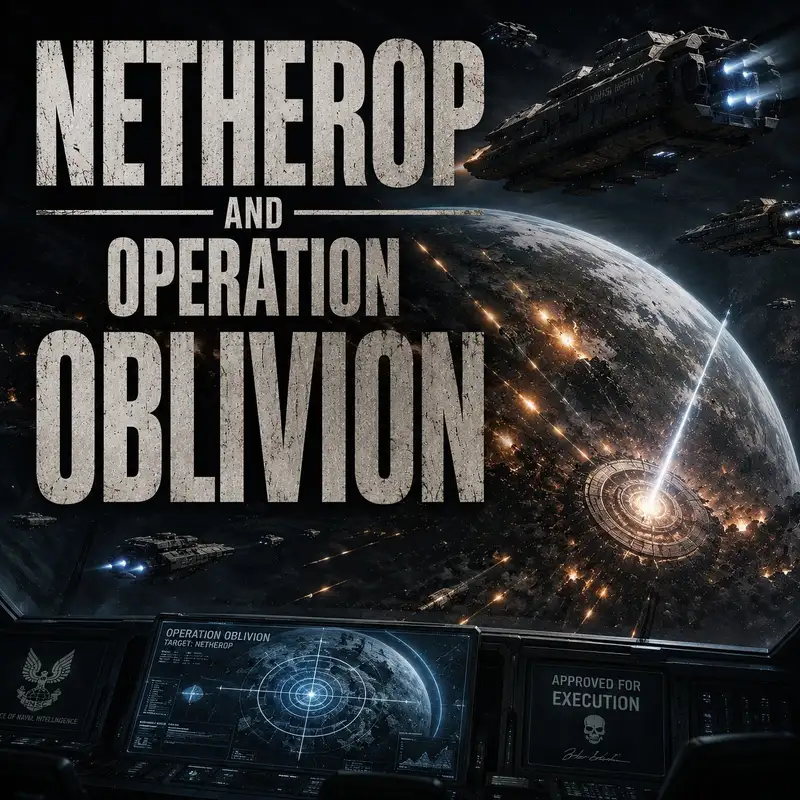
Netherop and Operation OBLIVION
Captain Greyveld had a disabled Covenant frigate in front of his destroyer group and a choice that rarely appears twice in the same war. He could finish the alien ship with another magnetic accelerator cannon volley, or preserve it for capture. On June third, twenty-five twenty-six, he chose the second option. The frigate fell into Netherop’s atmosphere and crashed largely intact. Human intelligence officers called the wreck the Lucky Break. The name proved accurate only in the sense that someone had been very lucky to find an enemy willing to provide exactly the prize they wanted.
The mission remembered as Operation Oblivion began with that apparent opportunity. Humanity had been fighting the Covenant for little more than a year and still understood very little about the empire destroying its colonies. Covenant shields defeated most missile attacks. Plasma weapons could cripple human warships in a few exchanges. Alien navigation, communications, power systems, and metallurgy remained largely inaccessible. Capturing one intact frigate could produce intelligence worth more than several conventional victories. A grounded vessel with damaged weapons seemed to offer the kind of advantage the United Nations Space Command could not manufacture for itself.
It also had every feature of a trap. The ship had gone down on a remote greenhouse world already associated with an earlier Covenant encounter. Its defenders remained active after impact. A Pelican sent to inspect the wreck had been destroyed. The United Nations Space Command knew the situation was suspicious and committed Blue Team anyway. That was not simple recklessness. The early war had reduced the difference between a dangerous opportunity and no opportunity at all. A Covenant frigate on the ground was too valuable to ignore, even when the enemy appeared unusually cooperative about putting it there.
The enemy had been cooperative because Fleetmaster Nizat ‘Kvarosee had arranged the entire event. Only weeks earlier, the Spartans and Orbital Drop Shock Troopers of Operation Silent Storm had devastated Covenant facilities at Zhoist. They destroyed the Ring of Mighty Abundance, an unfinished supercarrier, and sacred-industrial sites the Covenant considered irreplaceable. Nizat had commanded forces responsible for preventing exactly that outcome. Covenant leaders needed someone to carry the blame, and the fleetmaster was ordered back to High Charity for what official language described as reassignment. Covenant officers understood that particular personnel process without requiring a briefing slide.
Nizat refused to accept execution. He gathered loyal shipmasters and warriors into the Flotilla of Unsung Piety, seized stealth-capable intrusion corvettes, and stole two Luminal Beacons from High Charity. These rare Forerunner devices could report their own location to dedicated receivers across interstellar distance. Nizat’s plan was to conceal the beacons inside equipment that human intelligence officers would recover, then follow the signal to an Office of Naval Intelligence headquarters, research center, or perhaps Earth itself. He could destroy the institution he believed had organized the attacks at Zhoist, kill or capture the Spartans responsible, and present the result as proof that his disgrace had been undeserved.
The bait was Steadfast Strike, one of Nizat’s frigates. On June third, the ship allowed itself to be discovered near Netherop by Task Force Pantea, a wolfpack of Halberd-class light destroyers operating against Covenant supply lines. The human ships disabled its shields and main weapons. Steadfast Strike then descended into the atmosphere as though control had been lost. Nizat expected the United Nations Space Command to preserve the wreck, dispatch salvage specialists, and bring the recovered technology home. If Spartans boarded, the frigate could destroy itself. If ordinary technicians recovered the planted beacons, they would lead his surviving ships toward a more important target.
Netherop was well chosen. Human survey data described it as uninhabited, marginally survivable, and almost devoid of useful resources. Thick clouds covered a barren surface. The days were punishingly long, and the heat could become lethal even to personnel carrying military survival equipment. The planet offered no obvious reason for a large force to remain after the wreck was removed. It also provided canyons, mountains, atmospheric interference, and enough terrain to conceal Nizat’s small flotilla and ground parties. A strategist planning an ambush could hardly request a better empty world.
The world was not empty. Generations earlier, human authorities had marooned a group of pirates with Insurrectionist sympathies on Netherop, despite the practice already being illegal. Their descendants survived by using cave networks and machinery left by a long-dead native civilization. They called themselves the Castoffs. They had no regular contact with the Unified Earth Government, no reason to trust its armed forces, and no intention of becoming incidental casualties in a war that had arrived without consulting them. Their presence would reshape the mission, but no intelligence estimate had included them because no one knew they existed.
Blue Team received the assignment while fighting on Mesra. John One One Seven, Frederic One Zero Four, Kelly Zero Eight Seven, and Linda Zero Five Eight were extracted by the prowler Night Watch and redirected toward Netherop. Lieutenant Commander Amalea Petrov commanded the prowler and the immediate insertion. The Office of Naval Intelligence also committed the salvage ship Phyllis Wheatley, whose enormous lifting structure was designed to descend around a crashed vessel, secure it with mechanical claws, and carry it back into space. Task Force Pantea would cover the operation from orbit. Conventional personnel and aircraft provided the support that even Spartans required.
The plan depended on deception and speed. The Wheatley was visible enough to appear as the main recovery effort. Night Watch would remain concealed, determine whether the site was defended, and place Blue Team close enough to clear the wreck before Covenant forces could destroy it. A reconnaissance Pelican entered the atmosphere and was shot down. Petrov correctly concluded that someone wanted to control access to the frigate rather than simply destroy every human ship approaching it. She responded by committing the prowler itself, descending before a complete reconnaissance picture could be assembled.
Night Watch was attacked during the insertion and crash-landed roughly sixty kilometers from the intended landing zone. The prowler survived the impact, but it was no longer a practical extraction platform. Petrov’s crew and embarked Marines now had to defend a damaged classified vessel on a hostile planet while Blue Team moved toward the Lucky Break. When Covenant troops later attempted to recover Night Watch, Petrov detonated its Fury tactical nuclear self-destruct. The blast denied the enemy its stealth systems, navigation data, and intelligence equipment. It also removed the ship that had brought the force to Netherop.
Operation Oblivion had changed before Blue Team reached its objective. The original mission was to capture a Covenant frigate. The immediate mission became surviving long enough to reach the salvage ship, seize another transport, or create an evacuation route. Heat slowed movement and threatened even armored personnel. Communications were limited by terrain and enemy activity. The force was split among the Night Watch crash site, the Wheatley, and the route to Steadfast Strike. The planet imposed a logistical problem before the Covenant finished creating a tactical one.
Fred’s first evidence that the intelligence estimate was wrong appeared as children watching the Spartans from a distance. The team initially considered heat injury or hallucination. The explanation sounded more reasonable than human descendants living on a supposedly uninhabited death world. Blue Team eventually encountered the Castoffs and their mountain runners, ancient multi-legged vehicles capable of crossing terrain that would stop normal wheeled transport. The meeting began with mistrust and injuries, then moved toward negotiation after the Spartans provided medical care.
The Castoffs wanted passage off Netherop. Blue Team needed guides, transport, and local knowledge. John promised evacuation in return for assistance. That promise created a new mission requirement without adding a single seat to the available Pelicans. It was nevertheless the correct operational bargain. The Castoffs knew routes through the canyons, understood the climate, and could move personnel faster than the United Nations Space Command survivors could travel on foot. They were not passive civilians waiting for rescue. They were an independent force deciding which armed outsiders offered the better chance of survival.
Nizat’s ground teams were attempting to shape the same battlefield. His Rangers and other warriors occupied approaches to Steadfast Strike, supported by Banshees, heavy weapons, and stealth ships above the atmosphere. The objective was not simply to kill every human. Nizat needed the recovery effort to remain credible long enough for the Luminal Beacons to enter human custody. His forces therefore alternated between protecting the wreck, attacking the salvage operation, and exposing selected equipment to capture. The apparent inconsistency was deliberate. The humans were supposed to believe they were overcoming resistance while collecting the objects the enemy wanted them to take.
The Phyllis Wheatley became the center of the ground fight. It was a massive direct-lift salvage ship, not a warship, and its defensive guns were intended to protect an industrial operation rather than defeat a prepared assault force. Captain Dkani warned that Covenant troops with vehicles and heavy weapons were approaching. John estimated Blue Team could reach the ship in thirty to forty minutes. Dkani replied that the defense would not last that long. If the attackers crossed the canyon, he would scuttle the Wheatley rather than allow its crews, records, and machinery to be captured.
Blue Team divided its effort. Kelly returned toward the Night Watch survivors. Linda provided overwatch for Wheatley personnel. John and Fred continued toward the frigate and attacked Covenant positions along the route. The Spartans captured an alien Umbra transport, gaining mobility and a possible evacuation asset. These actions kept the scattered human groups connected, but they did not restore the original plan. Every force was spending ammunition, time, and people merely to remain capable of leaving.
The battle in orbit then became more complicated than either human commanders or Nizat had planned. The Covenant’s Fleet of Swift Justice arrived with a carrier-led force and Silent Shadow personnel under orders to eliminate the mutineers. It emerged on the far side of Netherop, attempting to trap the Flotilla of Unsung Piety between loyal Covenant ships and Task Force Pantea. The human wolfpack interpreted the arriving fleet as reinforcement for the enemy on the ground and engaged. Its commanders knew they could not hold for long, but their attack bought time for extraction.
Nizat exploited the confusion. His intrusion corvettes maneuvered to draw the human ships toward the larger Covenant fleet while his remaining loyal vessels searched for a route out. The Fleet of Swift Justice was not primarily trying to defeat the United Nations Space Command. It was conducting an internal purge while preserving the stolen beacons. That requirement restrained its use of orbital bombardment and forced it to send troops to the surface. Humanity survived parts of the engagement because Covenant religious and political authorities valued recovering their artifacts more than quickly sterilizing the battlefield.
The resulting action was a three-sided battle in which each force misunderstood at least one opponent. Task Force Pantea believed it was fighting a unified Covenant response. The Fleet of Swift Justice viewed Nizat’s mutineers as the principal objects of punishment, with the humans as dangerous interference. Nizat tried to use both fleets against each other while completing his tracking plan. Blue Team knew only that additional Covenant ships had arrived and that friendly orbital support was disappearing. Intelligence was not absent. It was arriving in fragments too late to produce a common picture.
On the ground, Nizat’s beacon plan reached its most effective form. First Blade Gri ‘Waqilsee volunteered to carry one Luminal Beacon inside an external shield generator attached to his armor. The generator’s automatic destruction feature was disabled so that it would remain intact after his death. He then entered battle intending to be killed where Office of Naval Intelligence personnel could recover the body. Linda brought him down during the defense of the Wheatley survivors. The unusual shield system immediately attracted the attention Nizat expected.
A second beacon was concealed within an emergency locator device that reached the human force. The objects looked like valuable battlefield salvage rather than strategic threats. Captain Stocken of Office of Naval Intelligence insisted that Gri’s body and shield generator be evacuated intact, fearing that removal might damage the technology. John considered separating the equipment, but the intelligence specialists prevailed. Transport space was reserved for the alien body because the shield could help humanity understand a capability it desperately needed. The decision was technically defensible. It was also exactly the decision the dead Ranger had volunteered to produce.
The mission’s central prize did not survive. John and Fred drove Covenant forces back toward Steadfast Strike, only to discover that the frigate had moved and was preparing to escape. Nizat intended to reach it, recover control of the situation, and preserve enough of his force to complete the plan. Before he could board, a Covenant fighter-bomber from the Fleet of Swift Justice struck the frigate with plasma fire. Steadfast Strike vanished into a glass-bottomed crater. The loyal Covenant force destroyed the ship to deny it to both humanity and the mutineers.
With the Lucky Break gone, the operation became an evacuation under collapsing orbital cover. Task Force Pantea’s surviving ships prepared to withdraw. Pelicans descended to collect Blue Team, the Wheatley survivors, Night Watch personnel, and the Castoffs. The salvage ship had suffered devastating casualties and could not leave. Its surviving crew abandoned it and activated the self-destruct after the last recoverable personnel lifted clear. Humanity had committed two specialized ships to capture one alien frigate and was leaving without any of the three.
Available seats became the final battlefield. Petrov indicated that she was willing to remain behind if necessary, but Roselle ensured that this outcome occurred. The Castoff leader assigned Petrov and several Night Watch survivors a mountain runner with a weakened battery. Their vehicle failed to reach the extraction point in time, creating room for more Castoffs aboard the departing Pelicans. Roselle later allowed investigators to believe Petrov had volunteered. From the Castoffs’ perspective, this was not treachery against a trusted government. It was the action required to prevent the government from abandoning their people first.
Nizat suffered a parallel defeat. Most of his flotilla was destroyed. Two vessels escaped, but he, his steward Tam ‘Lakosee, and a small group of Sangheili were left on Netherop. Silent Shadow personnel chose marooning as punishment, and the Fleet of Swift Justice surrounded the planet with an orbital mine shell intended to prevent rescue. The mines trapped Petrov’s people as effectively as Nizat’s. Operation Oblivion ended with human and Sangheili survivors stranded on the same lethal world, each group still viewing the other as the reason it could not go home.
The immediate accounting was poor. The United Nations Space Command failed to recover Steadfast Strike. Night Watch and Phyllis Wheatley were destroyed. Task Force Pantea lost ships and suffered damage. The Wheatley’s crew took catastrophic casualties. Petrov and members of her command were missing. Blue Team, many human survivors, and the Castoffs escaped, while the recovered shield generator offered an important technical specimen. Halsey later argued that the mission could not be called a complete failure because the trap had failed to kill the Spartans and because human researchers now possessed shield technology of a kind they had not previously examined.
Admiral Cole was less generous. A captured generator was useful, but useful research was not the same as a fielded defensive system. Humanity had obtained hardware, not the Covenant factories, engineers, power architecture, or scientific history required to reproduce it quickly. Even worse, the specimen carried a Luminal Beacon. Nizat had lost the battle and still achieved the intelligence placement at the heart of his plan. His surviving ships never converted that success into the destruction of Office of Naval Intelligence, but the human force left Netherop carrying a tracker it believed was a prize.
A court of inquiry examined how Petrov had been stranded and what should happen to the Castoffs. Roselle and Samson requested settlement on Gao, a world known for resisting close Unified Earth Government control. Senior intelligence officials disliked the choice, particularly because the Castoffs now knew the Spartans existed. The request was nevertheless approved. They had assisted Blue Team, kept their bargain under fire, and possessed no reason to trust authorities whose predecessors had marooned their ancestors. The government gained their silence by honoring one promise after generations of violating another.
Petrov did not receive the same relief. The orbital mine shell defeated later rescue attempts, and she and her people remained on Netherop for thirty-three years. Nizat’s stranded followers also survived, creating an isolated war fought beyond the knowledge of governments that had moved on to larger crises. One June operation thus produced a battlefield that outlived the Human-Covenant War itself. The official fleets departed. The people left below continued paying for their decisions.
Operation Oblivion mattered because it exposed the desperation beneath early human innovation. The United Nations Space Command was willing to risk Spartans, a prowler, a salvage ship, Marines, and a destroyer task force for one chance to study an intact Covenant vessel. That decision was strategically understandable. The same desperation made the trap effective. Nizat did not need to force humanity to take his bait. He needed only to understand how badly it required what the bait appeared to contain.
Netherop also revealed the Covenant as something more complicated than one technologically superior enemy. Nizat fought humanity, rebelled against his own rulers, manipulated loyal Covenant forces, and sacrificed followers to restore his standing within a religious hierarchy that had already condemned him. The Fleet of Swift Justice attacked human ships while hunting Covenant mutineers. Internal discipline destroyed the frigate the United Nations Space Command hoped to capture and then sealed survivors of both sides beneath the same mine shell. Covenant division saved Blue Team from part of Nizat’s plan, but it did not make the empire less dangerous.
The defining image is the shield generator carried aboard a departing Pelican while Petrov watched the extraction leave without her. To the Office of Naval Intelligence, the device represented knowledge that might narrow the technological gap. To Nizat, it was a signal intended to guide destruction toward humanity’s hidden command centers. To the Castoffs, its weight meant fewer seats for people who had spent their lives waiting to escape. Operation Oblivion failed to capture a frigate and succeeded in revealing a harsher truth. On Netherop, every side understood the value of alien technology. None of them agreed on which lives could be left behind to possess it.