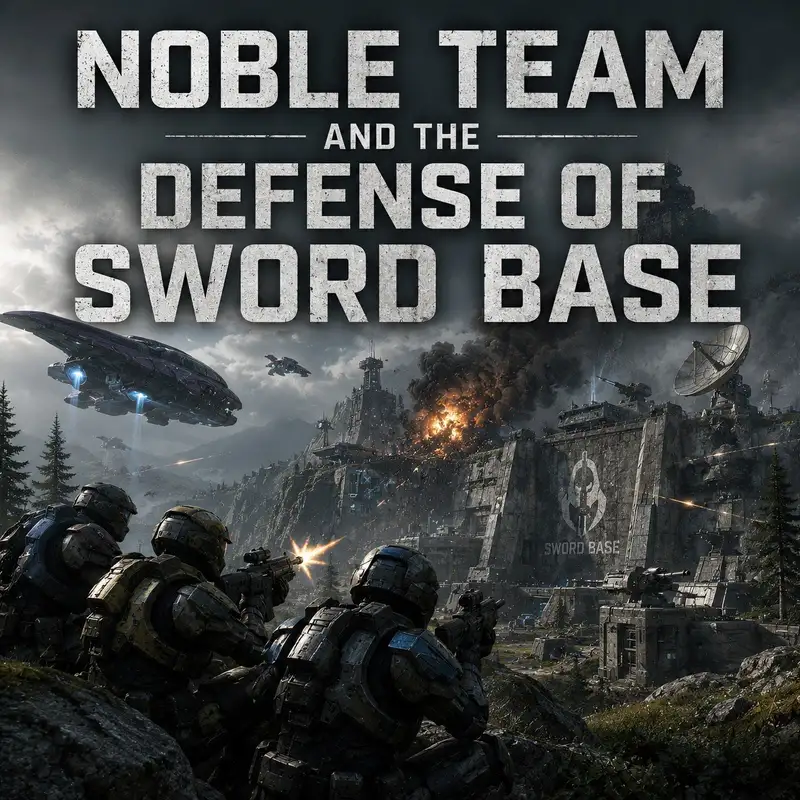
Noble Team and the Defense of Sword Base
The first order denied Noble Team the weapon that could have ended the engagement fastest. On July twenty-sixth, twenty-five fifty-two, a Covenant corvette was holding position over Sword Base while its troops attacked the facility below. Reach possessed orbital magnetic accelerator weapons capable of destroying the ship, but those rounds were temporarily prohibited. The Office of Naval Intelligence considered the base too sensitive to risk a strike against a target hovering almost directly above it. That left an uncomfortable alternative. A six-person Spartan team, supported by conventional soldiers, aircraft, artillery, and whatever local systems still functioned, would have to push the Covenant away from the installation before heavier firepower could be used. Noble Team was not being sent to destroy the enemy ship. It was being sent to create the conditions under which Reach’s orbital defenses could destroy it without also erasing the reason the base existed.
Sword Base stood on the Babd Catha Ice Shelf in the Eposz region of Reach. On the surface, it appeared to be a hardened Office of Naval Intelligence research and command facility, linked to nearby communications sites, air-defense positions, roads, landing areas, and the wider military network protecting the planet. Beneath it lay the more important secret. Human researchers had discovered a massive Forerunner vessel or complex embedded within the ice, part of an ancient presence on Reach that the United Nations Space Command understood only in fragments. Dr. Catherine Halsey and her staff were studying data that might help humanity interpret Forerunner technology, navigation, and history. Sword Base was therefore more than a bunker. It was an intelligence collection site, archaeological laboratory, communications node, and strategic research program occupying the same piece of vulnerable terrain.
Noble Team had confirmed the Covenant presence on Reach only two days earlier at Visegrád Relay. The unit served under United Nations Space Command Army Special Warfare and was composed primarily of Spartan Threes, with Jorge-Zero Five Two representing the earlier Spartan Two program. Carter-A Two Five Nine commanded. Kat-B Three Two Zero served as his second and brought exceptional technical and tactical skill. Jun-A Two Six Six specialized in reconnaissance and precision fire. Emile-A Two Three Nine was suited to close assault. Jorge provided heavy-weapons experience and a personal connection to Reach. The newest member, Spartan-B Three One Two, occupied the position of Noble Six and had a record built around missions requiring unusual independence. Their armor made them extraordinarily capable. Their real value at Sword Base was that Carter could divide the team across several problems and still expect each element to keep functioning when communications, transport, and plans began to fail.
The Covenant force attacking the region was not conducting a simple raid for destruction’s sake. The Fleet of Valiant Prudence, commanded by Rho ‘Barutamee, was pursuing Forerunner relics on Reach. Its Devoted Sentries had silenced Visegrád and tracked Professor Laszlo Sorvad because intercepted human communications suggested his research mattered. Noble Team had recovered Sorvad’s data module after the fighting there, although the significance of its contents was not yet clear to the Spartans. This helps explain the pressure on Sword Base. Covenant forces often destroyed human installations once their military value had been exhausted. Artifact-retrieval units had a reason to enter, search, capture records, and preserve selected systems. The enemy wanted access as well as victory. For the defenders, that made denial more complicated. Destroying everything would secure the secrets, but it would also end humanity’s own research.
As Noble Team approached in Falcon transports, Auntie Dot reported that the base was under siege, the current defenders were insufficient, and the available intelligence on enemy strength was poor. That was not a minor caveat. A commander can compensate for a stronger enemy if its position, movement, and purpose are understood. At Sword Base, the Covenant corvette controlled the immediate airspace while its ground forces attacked from several directions. The Falcons could not use the intended landing zone safely. Carter redirected the insertion and placed Kat and Noble Six outside the facility to reinforce Army troopers already fighting in the courtyard. Jorge, Emile, Jun, and Carter were committed elsewhere around the base. Noble Team entered the battle as several linked strike elements rather than one armored block. The arrangement increased coverage, but it also made coordination dependent on the very communications network the Covenant was disrupting.
The courtyard fight was only the visible front of the defense. Covenant infantry had reached the approaches, Wraith mortar tanks threatened the gate, and the corvette continued firing on the installation. Kat and Six helped the surviving troopers regain local control, then used a target locator to direct limited supporting fires against the armored threat. That device mattered because it translated a Spartan’s observation into a firing solution for weapons positioned elsewhere. The armor, the operator, the communications link, and the supporting battery all had to work together. Six did not carry enough firepower to replace artillery. Six carried the sensors and access needed to employ it accurately. The distinction is central to understanding Noble Team. Spartans could act at the point where a defense was breaking, but their greatest effect often came from reconnecting conventional capabilities that were already present and temporarily unable to reach the fight.
Two nearby positions then became the operational center of the battle. Farragut Station contained a communications array needed to restore contact with command. Airview Base held an M seventy-one Scythe anti-aircraft gun that could contest the Covenant’s aircraft. Both sites had been overrun or disabled. Kat and Six moved between them by Warthog while Covenant patrols, aircraft, and vehicles attempted to keep the network down. Retaking the communications site allowed the defenders to exchange current information rather than fight from isolated reports. Reactivating the Scythe imposed risk on Banshees and dropships that had been operating with far greater freedom. Neither action destroyed the corvette. Together, they changed the environment around it. Friendly aircraft could approach with better coordination, the base could direct its defenders, and Covenant air support could no longer treat the ice shelf as uncontested space.
With the outer network restored, Kat and Six returned to Sword Base as the rest of Noble Team converged. Covenant forces had penetrated the structure and continued using Phantoms and Banshees to support the assault. The Spartans and conventional defenders fought upward through the atrium and toward the upper levels, clearing access routes and preventing the attackers from consolidating inside. Sword Base’s vertical architecture offered observation and defensible choke points, but it also created multiple levels from which a small enemy force could interfere with movement. The defenders could not assume that retaking the entrance secured the laboratories above or the systems below. Noble Team’s internal advance was less a sweep of every room than an effort to restore control of the key routes and fire positions needed to keep the installation functioning until air and orbital forces could act.
The decisive change came when friendly Longsword strike craft reached the base and forced the Covenant corvette to move away from the facility. Once the ship was clear of the most sensitive ground, the earlier restriction on orbital fire no longer protected it. The Longswords broke away, and a magnetic accelerator round destroyed the corvette. The sequence is easy to remember as one dramatic shot, but the shot was the final act of a much longer chain. The target had to be detected, pressured, displaced, tracked, and separated from the installation. Ground forces restored the systems that made air action possible. Aircraft drove the corvette into a position where orbital fire could be authorized. The orbital weapon then delivered the killing blow. Noble Team did not replace Reach’s larger defenses. It made those defenses usable at the exact moment when policy, terrain, and enemy positioning had temporarily neutralized them.
The battle ended with the base still in human hands, but Dr. Halsey’s debrief changed the meaning of the victory. She focused on the Sangheili Zealots encountered at Visegrád and the data module taken from Sorvad’s research. Her concern was not simply that Covenant troops had reached Reach. She believed they were part of an artifact-retrieval effort and that their objective was connected to the work beneath Sword Base. Carter had followed the immediate military requirement at Visegrád by protecting survivors, confirming the invasion, and preserving his team. Halsey viewed the escaped Zealots and their interest in the data as the more important intelligence problem. Their exchange exposed a recurring command tension. Field leaders were judged by the people and terrain they could save. Intelligence leaders were judged by the information they could preserve or deny, even when the person in the firefight had not been told why it mattered.
Kat’s recovery of Sorvad’s module prevented that dispute from becoming a complete failure. She had recognized that the device might be important and carried it from Visegrád to Sword Base. Once Halsey received it, the defense of the base acquired a second result beyond the destroyed corvette. The United Nations Space Command had retained a piece of the enemy’s objective and a clue to the Forerunner system beneath the ice. This was precisely the kind of advantage the Covenant normally denied humanity. Human forces usually saw a colony after the enemy had selected the time, place, and purpose of attack. At Sword Base, the defenders had captured evidence revealing what one Covenant commander wanted. The information did not stop the invasion, but it allowed Halsey and Cortana to continue work whose importance would extend beyond Reach.
The first defense was a tactical success with a limited life. The base remained operational, the attacking corvette was destroyed, and the Covenant failed to seize the research complex that day. None of those results eliminated the Fleet of Valiant Prudence or the larger invasion forming around Reach. Sword Base was attacked again as the campaign expanded. By the middle and later stages of August, the surrounding region had suffered Covenant occupation and bombardment, and the facility’s exposed structures were left in ruins. Fixed defenses that had been restored in July were captured, destroyed, or replaced by enemy systems. The United Nations Space Command could not keep assigning aircraft, artillery, and elite troops to one research site while the planet’s entire defensive network collapsed. Sword Base had been saved from one assault. It had not been made strategically secure.
When Noble Team returned on August twenty-ninth, it was no longer the unit that had defended the base in July. Jorge had died during Operation Upper Cut while destroying the supercarrier Long Night of Solace. Kat had been killed during the final withdrawal from New Alexandria. Carter, Jun, Emile, and Noble Six approached Sword Base with a reduced team, a damaged campaign behind them, and no expectation that the facility could be held. Colonel Urban Holland’s order was a torch-and-burn mission under Operation White Glove. The objective was to destroy the base and its sensitive material before the Covenant could exploit it. The language of defense had reversed. In July, protecting Sword Base meant preventing damage. In August, protecting what Sword Base represented meant ensuring that almost none of the physical installation survived.
Noble Six advanced with Orbital Drop Shock Troopers through the ruins near Farragut Station and Airview Base. The terrain repeated the geography of the first battle, but every military relationship had changed. Human communications and air-defense positions were now shattered or occupied. Covenant Tyrant guns prevented friendly Falcons from reaching the base. Six used a Scorpion tank and supporting troops to break through the enemy positions and destroy the anti-aircraft weapons. In July, Noble Team had restored a human gun so friendly aircraft could enter. In August, it destroyed Covenant guns for the same reason. The symmetry is instructive. Airspace is not controlled by possessing aircraft alone. It is controlled by sensors, weapons, communications, and ground positions that determine where aircraft can survive. Noble Team again reopened the route, but this time only long enough for the remaining force to reach a condemned facility.
Inside the damaged base, Noble Team followed coordinates that did not appear to lead toward a sensible demolition point. Auntie Dot received revised instructions from an artificial intelligence whose clearance exceeded her own. A concealed passage opened, and the Spartans were taken deeper into the ice to Halsey’s laboratory within the Forerunner complex. Their official orders had been a pretext to bring them to her. This was compartmentalization functioning exactly as designed and nearly as badly as expected. The team conducting the mission did not know its real objective until it had already penetrated enemy territory. Holland’s command authority, Halsey’s scientific priorities, and higher-level artificial-intelligence access intersected below a base already being abandoned and prepared for destruction above them. Secrecy kept the Covenant from understanding the plan. It also ensured that Noble Team had to adapt to the plan after committing its people and transport.
The last defense of Sword Base occurred underground. Halsey needed time to complete the work and transfer what had been learned. Covenant forces were approaching through the complex, and Noble Team used fixed Wolf Spider turrets and its remaining weapons to hold the laboratory. The tactical problem was narrower than the July battle but more absolute. There was no effort to retake the region, restore the base, or preserve an evacuation hub. The Spartans had to prevent enemy entry for a limited period while a technical process finished. Every minute gained mattered only if the data could then leave. This was a rear-guard action conducted before the main party had even been told what it was guarding. Noble Team’s success was measured not in ground retained, but in whether Halsey could place a portable intelligence asset into a soldier’s hands before the defenders were overwhelmed.
That asset was a fragment of Cortana carrying analysis derived from the Forerunner discoveries beneath Sword Base. Combined with other recovered data, including information from Sigma Octanus Four, the work helped identify coordinates leading to what humanity would know as Installation Zero Four. Halsey ordered the fragment delivered to Captain Jacob Keyes aboard the Pillar of Autumn at the ship-breaking yards in Asźod. Noble Six became its custodian. Jun was separated from the team to escort Halsey toward Castle Base, while Carter, Emile, and Six began the overland and airborne movement to the Autumn. At that point, the defense of Sword Base ended in the strict military sense. The surviving value of the installation had been compressed into information small enough to carry away. The buildings, laboratories, and buried infrastructure could now be destroyed without erasing the entire purpose of the research.
The demolition denied the Covenant a clean seizure, but it did not turn the operation into an uncomplicated victory. Sword Base was lost. Personnel, equipment, and years of research could not all be evacuated. The conventional defenders who held the approaches and the specialists who maintained the facility had absorbed a campaign that official summaries naturally reduce to the movements of Noble Team. The Spartans themselves paid the cost after leaving. Carter died clearing the route to Asźod. Emile was killed defending the landing area near the Pillar of Autumn. Noble Six delivered the Cortana fragment and remained behind to keep the ship’s departure possible. The package reached Keyes, but the team assigned to carry it ceased to exist as a functioning unit. Military organizations sometimes preserve an institution by evacuating its people. At Sword Base, the institution’s most important product escaped while most of the unit protecting it did not.
Noble Team’s two actions at Sword Base show why special operations are most valuable when connected to a larger force. In July, the Spartans restored communications, reactivated air defense, directed supporting fires, reinforced conventional troops, and created the opening for Longswords and orbital weapons. In August, they destroyed enemy air defenses, penetrated an occupied installation, protected Halsey’s lab, and extracted the one item that still justified the risk. Neither mission was a solitary Spartan victory. Each depended on troopers, pilots, controllers, artillery crews, armored vehicles, technicians, artificial intelligences, and commanders operating at different levels of the campaign. Noble Team succeeded because it could move between those systems and solve the problem preventing the next system from acting. Its members were force multipliers in the literal sense. Without a force to multiply, even Spartans would have been heavily armored personnel standing beneath a Covenant corvette.
Sword Base also exposes the difference between defending terrain and defending purpose. The first battle preserved the installation because its laboratories, networks, and personnel were still useful on site. The second battle abandoned the installation because its continued physical existence had become a liability. In both cases, Noble Team protected the same strategic purpose: deny the Covenant access to Forerunner knowledge while preserving whatever humanity could still use. That purpose required opposite tactical actions at different moments. Hold the courtyard. Restore the gun. Clear the atrium. Then return weeks later, destroy the guns, enter through the ruins, extract the data, and leave demolition teams to erase what remained. A rigid force might have defended the building after its value had already moved elsewhere. Noble Team adapted because the mission was not the concrete. It was what the concrete concealed.
The defense of Sword Base mattered because it converted a doomed facility into a surviving intelligence advantage. Noble Team did not save the base permanently, defeat the invasion, or prevent Reach from falling. It bought Halsey and Cortana time, preserved Sorvad’s discovery, denied the Covenant immediate control of the buried complex, and carried the resulting analysis to the Pillar of Autumn. The tactical victory in July kept the research alive. The rear-guard action in August allowed the research to leave. Everything between those moments was the steady collapse of the military system that had made Sword Base defensible in the first place. When the base was finally destroyed, its most important contribution was no longer inside it. Sword Base fell beneath the ice and fire of Reach, while the knowledge recovered there departed aboard a ship headed toward a ring no human commander yet understood.