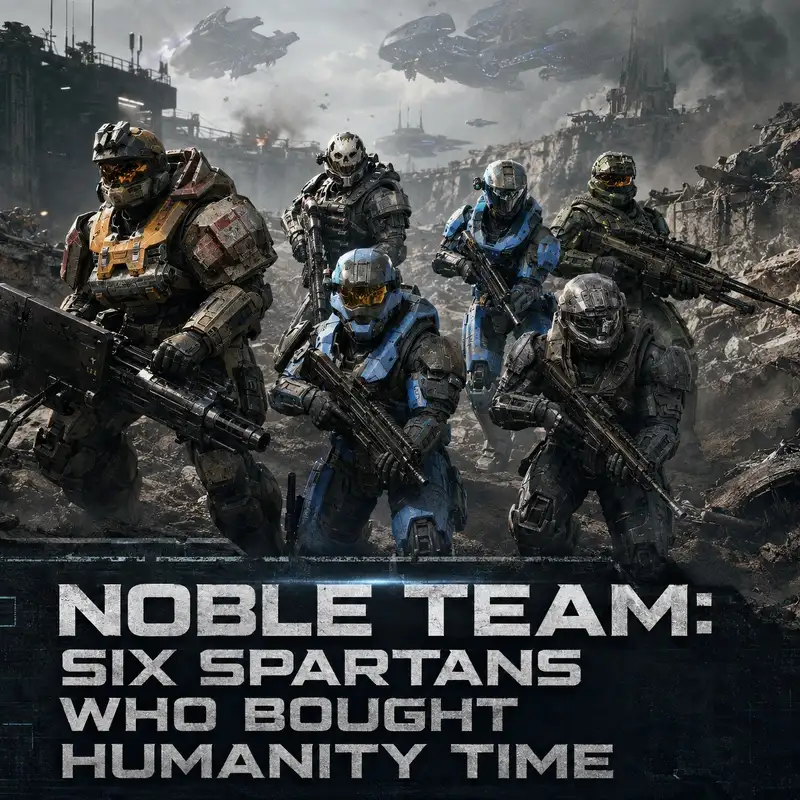
Noble Team: Six Spartans Who Bought Humanity Time
On August thirtieth, twenty-five fifty-two, Commander Carter A Two Five Nine was flying a damaged Pelican toward the Aszod ship-breaking yards with two Spartans and a sealed artificial-intelligence matrix aboard. A Covenant Scarab blocked the only practical route to the United Nations Space Command Pillar of Autumn. Carter could no longer land, reinforce the ground force, or survive the trip. He ordered Emile and Noble Six out of the aircraft, turned the Pelican toward the Scarab, and converted the team’s command platform into a weapon.
By that point, Noble Team had been reduced from six Spartans to three. Jorge had died in orbit. Kat had been killed in New Alexandria. Jun had been detached to escort Catherine Halsey. Carter’s final attack would leave Emile and Noble Six to complete a mission that no longer concerned saving Reach. The planet was already being lost. Their objective was to preserve one ship, one intelligence package, and one remaining path by which humanity might learn how to survive what came next.
That is the meaning of Noble Team’s last campaign. They did not defeat the invasion or prevent the fall of humanity’s most heavily defended military world. They bought time, preserved information, protected evacuations, and kept strategic options alive after the original plan collapsed. Their achievement was ensuring that defeat on Reach did not become humanity’s final defeat.
Noble Team was an unusual formation. Most members were Spartan Threes, war orphans trained for missions conventional forces could not perform. Unlike the large companies sent on deep strikes in Semi-Powered Infiltration armor, Noble’s personnel had been removed as exceptional candidates. They received Mjolnir Mark Five B and operated as a persistent special-operations team rather than a company built around one major attack.
The team also sat inside an unusual chain of command. Its Spartans remained naval personnel, but Noble operated under the Army’s Special Warfare Group Three and answered during the Reach campaign to Colonel Urban Holland. The arrangement connected Spartan capabilities to Army troopers, Rangers, pilots, artillery units, and planetary-defense forces already holding the ground.
Its roster was never as permanent as later memorials made it appear. Spartans rotated in and out, and losses were replaced when replacements existed. Carter and Kat were the longest-serving core by twenty-five fifty-two. Rosenda A Three Four Four had served as Noble Four before being reassigned. Thom A Two Nine Three had been the previous Noble Six until he carried a tactical nuclear weapon into a Covenant cruiser over Fumirole and died destroying it. Kat lost an arm during the same operation. The team arrived on Reach already familiar with the price of successful missions.
Carter was the organizing center. He understood how to divide the formation, when to let Kat shape a plan, when to use Jun for reconnaissance, and when Emile’s aggression needed direction. His authority rested less on speeches than on consistency. The others knew he would accept responsibility and would not ask them to take a risk he considered unnecessary.
Kat B Three Two Zero served as second-in-command, intelligence specialist, and technical problem solver. Her prosthetic arm made earlier sacrifice visible, but her greater contribution was cognitive. Kat saw infrastructure as opportunity. A damaged network could become a sensor. An enemy flight path could become an insertion route. A slipspace drive could become a weapon. Her plans were sometimes fragile, but they kept producing options.
Jun A Two Six Six was the team’s scout and precision marksman. His task was not simply to kill targets at long range. He extended the team’s awareness, watched routes the others could not see, and provided the information required for Carter and Kat to make decisions. Jun had previously served as a Headhunter, conducting high-priority reconnaissance, sabotage, and assassination missions in very small teams. That background made him comfortable operating apart from Noble without becoming disconnected from its purpose.
Emile A Two Three Nine was the assault specialist. His armor and carved visor projected intimidation, and his reputation made commanders wary of using him against human rebels. Against the Covenant, his willingness to close with fortified positions became an asset. The danger was that he accepted extreme risk so readily that the team had to ensure it still served the mission.
Jorge Zero Five Two was the formation’s only Spartan Two and its heavy-weapons specialist. He was older than the Spartan Threes, larger even by Spartan standards, and personally connected to Reach, where he had been raised and trained. Jorge could carry firepower normally assigned to a crew-served position, but his importance was not limited to ammunition weight. He showed more visible concern for civilians than some of his younger teammates and often translated the urgency of a mission into the lives immediately in front of him.
The newest Noble Six, Spartan B Three One Two, joined on the day the Reach campaign began. The earlier record was heavily classified and associated with unusually independent Office of Naval Intelligence operations. Carter’s requirement was simple: stop behaving like a solitary asset. Noble Six became the flexible element, able to scout, assault, pilot, carry sensitive material, or reinforce conventional troops wherever the situation broke fastest.
The first mission looked like counterinsurgency. Visegrad Relay had gone silent, Army personnel were missing, and rebel sabotage appeared more likely than a Covenant landing on Reach. Noble moved through farms and settlements and found evidence that did not fit the report. Covenant strike teams had jammed communications and attacked the relay while searching for intelligence connected to a human scientist and the Forerunner discoveries beneath the region.
Noble’s most important action at Visegrad was not the destruction of an enemy unit. It was identification. The team confirmed that Covenant forces were already on Reach and triggered Winter Contingency, the emergency response for an alien attack. That warning did not reveal the full size of the enemy force or prevent later surprise, but it changed the command problem. What had been treated as local sabotage became evidence of a planetary infiltration campaign. Noble Team served as the sensor that forced the institution to acknowledge the war had reached its fortress.
Two days later, the Covenant attacked Sword Base, a major Office of Naval Intelligence facility. Noble Team restored local defenses, fought through the base, and helped coordinate fire against an enemy corvette operating above it. The defense succeeded because Spartans, Army personnel, aircraft, fixed weapons, and a supporting frigate contributed different effects. Noble could clear positions and restore systems. It still required naval firepower to remove the warship threatening the installation.
Sword Base also exposed the limits of compartmentalization. Halsey understood that the Covenant at Visegrad had searched for data linked to her research. Noble had fought the correct enemy without being told what the enemy wanted. Secrecy protected the program, but forced operators to act without context that might have revealed the pattern earlier.
In August, Jun and Noble Six conducted reconnaissance beyond the immediate defensive perimeter. They confirmed that the Covenant had established a much larger presence than local commands had appreciated. The discovery allowed the Army to organize a counterattack at Szurdok Ridge. Noble Team worked inside a combined-arms effort involving armor, aircraft, infantry, and supporting fires. The Spartans broke key positions and helped disable a shielded Covenant spire. Then the larger truth became visible.
The spire had concealed the Long Night of Solace, a Covenant supercarrier whose presence changed the scale of the battle. Local tactical success had revealed a strategic problem that the available fleet could not solve through a normal exchange of fire. The carrier could deploy troops, aircraft, and smaller vessels while remaining protected by defenses far beyond the reach of the ground force. Destroying one spire had not removed the invasion. It had merely made the invasion’s command platform impossible to ignore.
Kat proposed Operation Upper Cut. The plan would remove the slipspace drive from the frigate Savannah, transport it aboard the captured Covenant corvette Ardent Prayer, and send that corvette toward the supercarrier on a routine refueling approach. Activating the drive inside the target’s defensive envelope would create a slipspace rupture destructive enough to tear apart the carrier. It was technically imaginative, operationally fragile, and expensive even before anyone began counting casualties.
The mission required a Sabre launch facility, orbital pilots, Anchor Nine, the Savannah, a Pelican carrying the drive, and personnel able to seize an alien ship. Noble Six and Jorge became the assault element because the device had to be protected inside the corvette. The operation is remembered as two Spartans carrying a bomb. It was a joint aerospace and naval effort that delivered them to the decisive point.
The Savannah was destroyed during the engagement. The corvette was captured and placed on course, but damage left the slipspace device requiring manual activation. Jorge chose to remain aboard. He forced Noble Six clear of the vessel, triggered the rupture, and destroyed the Long Night of Solace. For a brief moment, the largest visible threat over Reach disappeared. Jorge died believing the action had saved his homeworld.
Then a far larger Covenant fleet arrived.
That sequence defines tactical success without strategic reversal. Operation Upper Cut worked, and the target was destroyed. Yet the Covenant possessed more fleets, more carriers, and the industrial depth to continue. The United Nations Space Command had spent a frigate, fighters, crews, and a Spartan to remove one ship. Noble had bought time without changing who controlled orbit.
Noble Six returned to the surface alone and reached New Alexandria, where the campaign had shifted from counterattack to survival. Army units, pilots, civilian authorities, and scattered naval personnel were evacuating residents while Covenant forces cut communications and struck transport routes. Noble Six supported local defenses, restored parts of the network, and helped keep evacuation corridors open.
When Noble Team regrouped, only five members remained, and the city was already under orbital attack. Kat continued working the communications problem as the team moved toward shelter. A Covenant marksman killed her with a single Needle Rifle shot before she reached the bunker. There was no extended last stand and no opportunity to convert her death into a planned tactical effect. One moment she was solving the next problem. The next moment the team had lost its deputy, planner, and communications specialist.
Kat’s death changed more than the roster. Carter now had fewer people with whom he could share command judgment. The team had lost the officer most likely to turn damaged infrastructure into a new plan. It also demonstrated what Mjolnir could not guarantee. Armor, shields, augmentation, and experience improved survival. They did not remove exposure, surprise, or the possibility that one accurate shot during a collapsing defense could eliminate an irreplaceable specialist.
On August twenty-ninth, the surviving team was ordered back to Sword Base for Operation White Glove. The mission was denial. Classified material and facilities had to be destroyed before the Covenant captured them. Halsey redirected Noble underground, where her team had been studying a Forerunner vessel beneath the ice. A fragment of Cortana had analyzed the artifact and recovered information Halsey believed could provide humanity with a path beyond the losing war.
The package was not a weapon Noble could use on Reach. It was an armored matrix carrying the Cortana fragment and its findings to Captain Jacob Keyes and the Pillar of Autumn. Noble was ordered to leave the immediate battlefield and protect information whose value might not be realized until another ship, system, and commander acted on it.
Halsey divided the remaining force. Jun would escort her toward Castle Base, while Carter, Emile, and Noble Six carried the package to Aszod. Jun’s departure is sometimes treated as absence from Noble Team’s final sacrifice. It was another part of the same mission. Halsey possessed knowledge of the Spartans, Mjolnir, artificial intelligence, and Forerunner technology that humanity could not replace. Preserving her was a strategic task, and Jun was the scout most capable of moving her through a battlefield whose normal evacuation routes had failed.
The details of Jun’s escape remain obscured by contradictory reports, but he survived. After the war, he recruited for the Spartan Four program and eventually served as Chief of Staff of Spartan Operations. Noble Team therefore left more than a casualty list. One member carried its training culture into a new institution built around adult volunteers.
Carter, already badly wounded, continued flying the package toward Aszod until the Scarab blocked the route. His decision to ram it was not simply an act of defiance. The team lacked time, heavy support, and another airframe. The Scarab could stop Emile and Noble Six or destroy the approach to the shipyard. Carter used the only weapon still under his control and transferred command of the final movement to the two Spartans on the ground.
At the ship-breaking yards, Emile took control of a mass-driver emplacement overlooking the Pillar of Autumn’s departure route. The weapon could engage Covenant aircraft and threaten larger vessels approaching the grounded cruiser, but it required an operator exposed to attack. Emile held the position while Noble Six carried the matrix to Keyes. Sangheili Zealots reached the emplacement and killed him at close range. The assault specialist died defending a fixed weapon because the mission no longer required him to advance.
Noble Six delivered the Cortana fragment to Keyes. The captain returned to the Pillar of Autumn, but an approaching Covenant cruiser still threatened the ship before it could escape. Noble Six remained behind, retook the mass driver, and fired on the enemy vessel. That shot cleared the Autumn’s departure corridor. The Spartan then had no transport, no team, and no realistic extraction plan. The final objective was not survival. It was making sure the ship carrying the package achieved it.
The Pillar of Autumn escaped Reach, and Cortana’s recovered data contributed to the route that brought the ship to Installation Zero Four. Events there exposed the Halo Array, the Flood, and the true scale of the Covenant’s religious war. John One One Seven and Cortana later destroyed the installation, and the intelligence carried away from Reach shaped the campaigns that followed. Noble Team did not foresee that sequence, and it did not win those later battles. It preserved the possibility that others could.
Noble Six remained on Reach and fought until Sangheili forces overwhelmed the position. The last stand did not reverse the invasion. By then, the decisive contribution had occurred. The package was gone, and the Autumn was in motion. Continuing to fight denied the Covenant a prisoner, an intelligence source, and an uncontested battlefield.
The six Spartans bought time at several different scales. At Visegrad, they bought warning. At Sword Base, they bought secrecy and continued research. At Szurdok Ridge, they bought the Army an opening. In orbit, Jorge bought a temporary reduction in Covenant naval pressure. In New Alexandria, Noble Six bought civilians and defenders additional movement. At Aszod, Carter, Emile, and Noble Six bought the minutes required for the Pillar of Autumn to leave.
None of those actions would have mattered without conventional forces. Army troopers held roads and facilities. Pilots flew Sabres, Falcons, Pelicans, and evacuation craft. The Savannah’s crew brought the slipspace device into reach of the target and paid for it with their ship. Technicians kept weapons, armor, and communications functioning. Marines and shipyard personnel defended the Autumn. Noble Team concentrated capability at decisive points, but the points existed because a much larger force was still fighting around them.
Their story also exposes a dangerous habit in military memory. When a special-operations unit performs brilliantly during strategic collapse, institutions can use the bravery to avoid examining the collapse. Noble Team could not compensate for compromised intelligence, delayed recognition of the invasion, Covenant control of orbit, insufficient fleet strength, or the industrial imbalance between the two sides. Six Spartans were repeatedly asked to create local solutions because the larger defense no longer possessed reliable ones.
They succeeded often enough to make each request appear reasonable. Jorge destroyed the target and still failed to save Reach. Kat produced alternatives until one shot removed her from the command network. Carter maintained the mission, then spent his life as the final available munition. Emile held a gun instead of seeking another assault. Noble Six completed the delivery and stayed because someone still had to fire.
Jun’s survival prevents the story from becoming a simple argument that sacrifice is the highest military virtue. A force that only knows how to die cannot preserve its experience, train replacements, or improve the institution that sent it. Jun carried Noble Team beyond Reach in a way the others could not. His later work with Spartan recruits turned a destroyed fireteam into part of the professional memory of a new generation.
Noble Team bought humanity time because each member accepted that the mission had changed. They stopped trying to save a planet that could no longer be held and protected the people, information, routes, and weapons that could still influence the war. Their deaths were not interchangeable, and they were not all tactically necessary in the same way. What connected them was disciplined adaptation after the larger plan failed.
Reach fell behind them. The Pillar of Autumn escaped ahead of them. Between those two facts stood six Spartans who could not reverse defeat, but could decide what defeat was allowed to destroy. The Covenant took the world. Noble Team denied it the future carried away from Aszod.