Operation SILENT STORM: Humanity Strikes Back
Colonel Marmon Crowther promoted John One One Seven from petty officer first class to master chief petty officer shortly before the assault on Zhoist. John was fifteen years old. The promotion was not a reward for long service, because he had not lived long enough to have any. It was a field expedient. John needed unquestioned authority over veteran Orbital Drop Shock Troopers during an operation whose chain of command already contained a traitor. A Covenant fleet guarded the objective. Human prowlers had to penetrate its defenses. The officer controlling part of the insertion force intended to sabotage the attack. Crowther solved the first problem with rank. He would not live to solve the second.
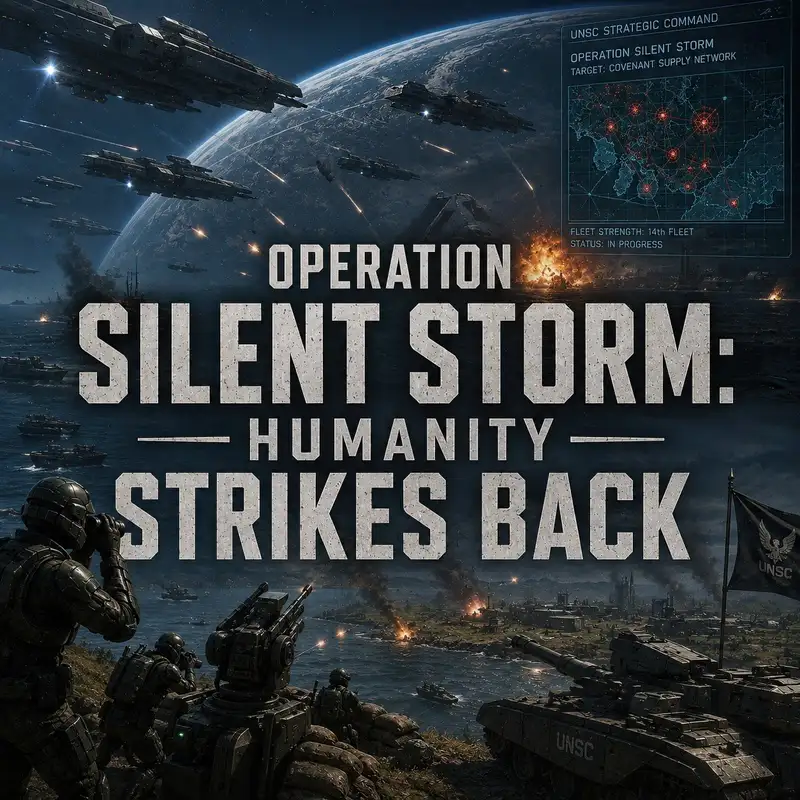
Operation Silent Storm was humanity’s first sustained attempt to seize the initiative in the Human-Covenant War. It did not seek to defend one colony until evacuation ended or trade ship losses for a temporary opening. Its purpose was to strike the machinery supporting the Covenant advance, destroy vessels and installations from inside their energy shields, and force the enemy to divert attention away from human worlds. The operation succeeded on a scale few planners could reasonably have expected. It also showed why one spectacular raid could not reverse a war shaped by industrial disparity, compromised intelligence, and an enemy committed to extermination.
By early twenty-five twenty-six, the United Nations Space Command understood only the most discouraging facts about the Covenant. Its ships were faster in slipspace, protected by energy shields, and armed with plasma weapons that could destroy human warships in a few exchanges. Harvest had been devastated. Other Outer Colonies were already under threat. The battle at Chi Ceti Four proved that Covenant vessels could be destroyed, but only when human naval fire opened a path for Spartans carrying nuclear weapons inside the target. That was an opportunity, not yet a repeatable fleet doctrine.
Vice Admiral Preston Cole and Vice Admiral Michael Stanforth therefore approved an operation built around asymmetry. If missiles and magnetic accelerator rounds struggled to penetrate Covenant shields, the attack would begin inside them. Spartan Two teams and the Twenty-First Space Assault Battalion, better known as the Black Daggers, would board enemy ships and stations, plant nuclear weapons or high-yield charges, and escape before detonation. Prowlers would provide stealthy insertion. Conventional naval forces would distract, recover, and exploit. The aim was not to defeat the Covenant empire in one campaign. It was to break forward logistics and buy time for humanity to learn how to survive.
A preliminary raid over Netherop demonstrated both the promise and the vulnerability of the concept. On March fifth, Blue, Green, and Gold Teams boarded the Covenant frigate Radiant Arrow and reached deep into the ship. A sensor operator supporting the mission then transmitted over an open channel. The Covenant crew was alerted, and the shipmaster initiated self-destruction before the Spartans could capture the vessel. The frigate was destroyed and every Spartan escaped, so the action could be reported as a qualified success. The open transmission was treated as an error. It was actually sabotage.
The person behind that sabotage was Lieutenant Commander Hector Nyeto, an Office of Naval Intelligence prowler officer and a clandestine Insurrectionist. Over years, Nyeto had quietly replaced the crews of the four prowlers in Ghost Flight with personnel loyal to his cause. He occupied a position of extraordinary trust. Prowlers carried classified sensors, navigation data, stealth systems, special-operations forces, and commanders who depended on silence. Nyeto did not need to defeat the operation openly. He could alter timing, delay support, leak information, and let the Covenant finish the work.
Task Force Yama was assembled as a splinter formation from Cole’s Battle Group X-Ray. Captain Halima Ascot commanded from the prowler Starry Night. The much larger Vanishing Point served as logistics and mission support. The force carried three Spartan teams, Crowther’s Black Daggers, Staff Sergeant Avery Johnson, several prowler flights, strike craft, nuclear weapons, and the technical personnel needed to support all of them. It was small enough to move covertly and powerful enough to devastate a target if it achieved surprise. It was also a collection of organizations that had never fought together against this enemy.
The Spartans and Black Daggers spent the slipspace voyage training against one another. The younger soldiers dominated the first exercises through speed, strength, and coordination. Johnson then taught the Orbital Drop Shock Troopers less predictable methods, and the contests became more difficult. That training mattered because Silent Storm was not simply a Spartan mission with conventional troops in the background. The Spartans could breach, fight, and carry demolition charges under conditions that defeated ordinary personnel. The Black Daggers understood massed boarding, zero-gravity assault, unit movement, and how to keep an operation functioning after individuals disappeared from the roster.
Crowther remained skeptical. The Spartans looked too young because they were too young, and battlefield ability did not change that fact. He also understood something the program’s sponsors sometimes preferred not to emphasize. A physically superior operator could still make a poor command decision through inexperience. Johnson became the practical bridge between the two forces. He taught John that leading from the front was not always leadership. A commander who personally solved every immediate problem could become the single point of failure for everyone following him.
The political environment made the mission more dangerous. A coalition of Insurrectionist leaders believed it could trade intelligence about the Spartans and the United Nations Space Command for protection from the Covenant. Its representatives hoped alien power would destroy the central military while sparing rebel-aligned colonies such as Biko. The plan was not shared by every separatist movement, and it grew from real hostility toward the Unified Earth Government. It was still a catastrophic misreading of Covenant policy. The aliens intended to collect the information, exploit the human division, and kill the people providing it.
Task Force Yama reached Seoba, one of Biko’s moons, on March eighteenth. Crowther had selected an ice quarry as a staging area and intended to use the arrival for a mass-insertion exercise called Operation Ice Dance. The quarry was already occupied by the Biko Independence Army and allied insurgents preparing their own campaign. A training drop became a live assault before the task force had fully understood the battlefield. The insurgents possessed fortified positions, heavy machine guns, anti-aircraft weapons, and a communications relay that could expose the human force.
Ghost Flight began the insertion while the Vanishing Point attempted to block transmissions. The first Orbital Drop Shock Troopers entered concentrated fire. When Nyeto ordered the drop aborted, John disobeyed, jumped into the quarry, and attacked the positions pinning the troops below. The other Spartans followed. One Black Dagger company suffered more than thirty percent casualties, and the prowler Ghost Star was shot down. The Spartan intervention disrupted the defense long enough for the Black Daggers to clear anti-aircraft sites, reopen the insertion route, and seize the quarry.
John’s decision saved personnel and helped win the engagement. It also reinforced Crowther’s concern. The Spartan commander had recognized that the force below would be destroyed if no one acted, but he had committed himself before establishing whether his team could be recovered. Silent Storm repeatedly placed John in situations where disobedience produced the tactically correct result. Johnson and Crowther had to teach him that an officer cannot build doctrine around always surviving the consequences of being right.
The cost at Seoba continued after the quarry fell. Several hundred insurgents were captured, including experienced former military personnel. Evidence showed that the rebels had been preparing to meet the Covenant, not simply defend against the United Nations Space Command. Before Task Force Yama could reorganize, a flotilla of Covenant intrusion corvettes arrived under First Blade Tel ‘Szatulai. The alien vessels could not reliably detect the prowlers with sensors, but their crews visually spotted the human craft. The Covenant responded by firing into the quarry in hopes of bringing one down intact for study.
Captain Ascot launched Starry Night with the last Black Dagger company aboard. A Covenant strike knocked the prowler into the quarry. Ascot and most of her crew were killed. The wreck remained sufficiently intact to expose navigation data, force deployments, and potentially Earth itself. The Spartans reached the crash while a Covenant corvette moved to recover it. The Spartans activated the prowler’s Fury tactical nuclear weapon and destroyed the ship, its data, and the enemy vessel attempting to claim it. The decision denied the Covenant an intelligence prize. It also erased Task Force Yama’s commander and flagship from the campaign.
Nyeto had tried to delay support long enough for the Spartans to die near the wreck. He failed, but the pattern became harder to dismiss. The operation had suffered an inexplicable open transmission at Netherop, an insertion whose enemy appeared prepared, mistimed support, and a commander who seemed unusually interested in the Spartans’ ages and origins. Crowther did not yet possess proof. Counterintelligence rarely delivers a useful confession at the moment the fleet most needs one. It delivers irregularities, each individually survivable, until the combined pattern becomes more dangerous than the enemy outside the hull.
The surviving force committed two hundred three dead to space and reorganized. Ascot’s death elevated Nyeto within the command structure, placing more of the operation under the man sabotaging it. Crowther restricted the Spartans’ employment while continuing to investigate. The compromise created an unpleasant arithmetic. Canceling Silent Storm would preserve the remaining task force but surrender the initiative and allow the Covenant advance to continue. Proceeding meant relying on a formation whose communications, crews, and operational plans might already be penetrated. The United Nations Space Command chose to continue, which is often what military organizations do when every available option has become unsatisfactory.
The Covenant’s Fleet of Inexorable Obedience then attacked Biko. Human defenses resisted for five days and were destroyed. Black Dagger teams attempted to exploit boarding opportunities, and some personnel were captured. The larger plan could not save the colony. Biko was glassed while Task Force Yama withdrew. This was the clearest measure of the operation’s limitation. A special-operations force could destroy ships, obtain intelligence, and impose disproportionate cost. It could not replace the fleet strength required to hold orbit over an inhabited world.
Crowther sent the Spartans and Johnson toward nearby Etalan, a colony the Covenant had already devastated. Their target was not the main battle fleet. It was the logistics formation supporting that fleet. Covenant plasma weapons required carrier gas, vessels required repair and replenishment, and even a technologically superior empire had to move supplies toward the front. Blue, Green, and Gold Teams attacked air-skimmers and support craft, using nuclear weapons and precision fire to destroy much of the logistics flotilla. The raid did not stop the glassing of Biko. It forced the enemy to reveal how it sustained the process.
Fleetmaster Nizat ‘Kvarosee began running short of carrier gas and requested another convoy from Zhoist. The United Nations Space Command had recovered a Covenant navigation device, known as a kelguid, from the fighting at Seoba. The captured system did not provide effortless mastery of alien navigation, but combined with the expected resupply route it allowed human analysts to identify the source. Silent Storm had found its true strategic target through logistics. The Covenant fleet had survived human attack. Its need for fuel had exposed the industrial and religious center keeping it in the field.
Zhoist was not an ordinary supply base. It was a Covenant relic world whose Ten Cities of Edification preserved ancient guild halls and technical traditions. Above the planet, ten installations formed the Ring of Mighty Abundance, an orbital network supporting research, repair, supply, and ship construction. The unfinished supercarrier Hammer of Faith occupied part of that system. Gravity lifts connected the ring to the surface. Destroying Zhoist’s infrastructure would damage the Fleet of Inexorable Obedience, interrupt future operations, and strike a location the Covenant considered sacred.
The final plan divided Task Force Yama into Dagger Force and Sierra Force. Dagger Force would attack defensive positions near the system’s Lagrange points and draw Covenant attention. Sierra Force would penetrate toward the planet, insert Spartans and Black Daggers, and destroy the ring, surface facilities, and ships under construction. The plan required separate groups to act with limited communication while the enemy controlled a larger fleet. It also required John to command conventional troops whose officers outranked him in experience and age.
Crowther’s field promotion solved the legal portion of that problem. He elevated John to master chief petty officer so the Black Daggers would recognize his operational authority. Johnson and Crowther then gave him the harder guidance. A commander could not always be the first person through every hatch. John had to place teams where they could succeed, accept that some would be lost, and remain able to coordinate the wider force. The advice was not designed to make him less courageous. It was designed to keep courage from becoming an organizational hazard.
Crowther also prepared for Nyeto. He selected Earth-born commanders for Sierra Force, limited what the suspected traitor knew, and arranged to relieve him once his betrayal became unmistakable. Nyeto revealed himself during the Zhoist attack by trying to expose Sierra Force to Covenant detection. Crowther moved to arrest him aboard Ghost Song. The bridge crew belonged to the same insurgent network. They killed Crowther before the arrest could be completed.
Johnson fought his way through the mutinous prowler, killing several of the rebels and escaping immediate capture. Nyeto vented Black Daggers into space, relying on decompression to remove the troops who might resist him. Their sealed assault armor kept some alive long enough for rescue. Johnson briefly activated a distress beacon to draw Covenant attention toward Ghost Flight, forcing Nyeto to flee rather than continue hunting Sierra Force. The traitor escaped into slipspace with surviving prowlers. Crowther did not. The operation lost its ground commander at the moment his plan entered its most demanding phase.
Sierra Force continued because its teams already understood the objective. Spartans and Black Daggers moved toward Zhoist’s surface installations and gravity lifts while Dagger Force drew away part of the defense. Covenant religious restrictions complicated the response. Reversing the lifts could have disrupted the human assault, but doing so risked carrying enemy personnel onto holy ground or damaging sacred facilities. The Covenant possessed the technical means to create a harsher tactical problem and hesitated because doctrine constrained how that technology could be used.
Human teams reached the Ring of Mighty Abundance and spread demolition charges through the orbital network. They used compact octa demolition charges and nuclear weapons against structural connections, ships, and critical systems. The Black Daggers supplied the mass and specialized boarding experience required to attack several objectives at once. The Spartans supplied the speed, strength, and survivability needed to reach places where resistance was concentrated. Neither force could have produced the full effect alone.
The assault was costly. The Black Daggers suffered heavy losses through death, wounds, capture, and separation. Lieutenant Small Bear became trapped by decompression and ordered the mission to continue without him. Other captured troopers had concealed explosives that later destroyed Covenant ships from within. These deaths did not appear as a clean supporting line beneath a Spartan victory. They were the mechanism that allowed simultaneous sabotage across a network too large for twelve Spartans to destroy by themselves.
Blue Team also encountered Tel ‘Szatulai and the Silent Shadow warriors hunting the Spartans. The clash ended with the Covenant commander dead, removing the specialist who had come to learn how humanity’s new soldiers fought. John and Kelly then delivered nuclear weapons into the unfinished Hammer of Faith and escaped through the lift system. The detonations helped destabilize the ring and destroyed the supercarrier before it could enter service.
On April fifteenth, the Ring of Mighty Abundance broke apart above Zhoist. The Hammer of Faith was destroyed. Two of the Ten Cities of Edification and a Luminal Beacon were lost. Debris and planted charges destroyed additional Covenant ships, and the Fleet of Inexorable Obedience was decimated. Nizat survived, but his command and reputation did not emerge intact. The Covenant had expected to erase human colonies while protecting its own sacred-industrial network. Silent Storm showed that its rear areas were not beyond reach.
The victory came from selecting the correct level of war. Humanity could not yet defeat a major Covenant force through a conventional exchange in open space. It could attack the relationships that made that force effective. Prowlers defeated detection. Intelligence identified a supply dependency. Boarding forces bypassed shields. Demolition charges converted small teams into strategic weapons. The attack struck fuel, repair, construction, navigation, and religious prestige at the same time. It was not a triumph of one supersoldier over an empire. It was a combined special operation against an exposed logistics system.
The success also had strict limits. Biko was gone. Captain Ascot and Colonel Crowther were dead. Task Force Yama had lost prowlers and much of the Twenty-First Space Assault Battalion. Nyeto escaped with trained crews and classified knowledge. The Covenant empire still possessed vastly greater industrial capacity, more fleets, and an extermination policy that damage to one sacred-industrial world could not alter. Zhoist damaged a forward war machine. It did not remove the political authority ordering that machine to continue.
Covenant leaders reacted with anger and fear rather than restraint. The operation demonstrated that humans could penetrate stealth defenses, kill elite warriors, destroy sacred sites, and turn captured personnel into saboteurs. That knowledge encouraged more aggressive efforts to find and eliminate the Spartans. Humanity had bought time, but it had also taught the enemy which human capability deserved special attention. A successful weapons test often produces procurement interest on both sides.
Operation Silent Storm was humanity striking back because it replaced passive survival with a deliberate campaign against the enemy’s depth. Its planners refused to fight only where Covenant shields and plasma weapons were strongest. Its personnel found a vulnerable system, entered it, and destroyed assets the Covenant could not immediately replace at the front. The operation proved that technological inferiority did not require strategic helplessness.
The final image is the Ring of Mighty Abundance falling through Zhoist’s sky while the surviving human force counted missing prowlers, dead Black Daggers, and commanders who would not return. John had received the authority to lead veterans into that battle, then learned why command could not be measured by who reached the target first. Humanity struck back by making the Covenant pay for its advance. The payment purchased time, intelligence, and confidence. It did not purchase safety.