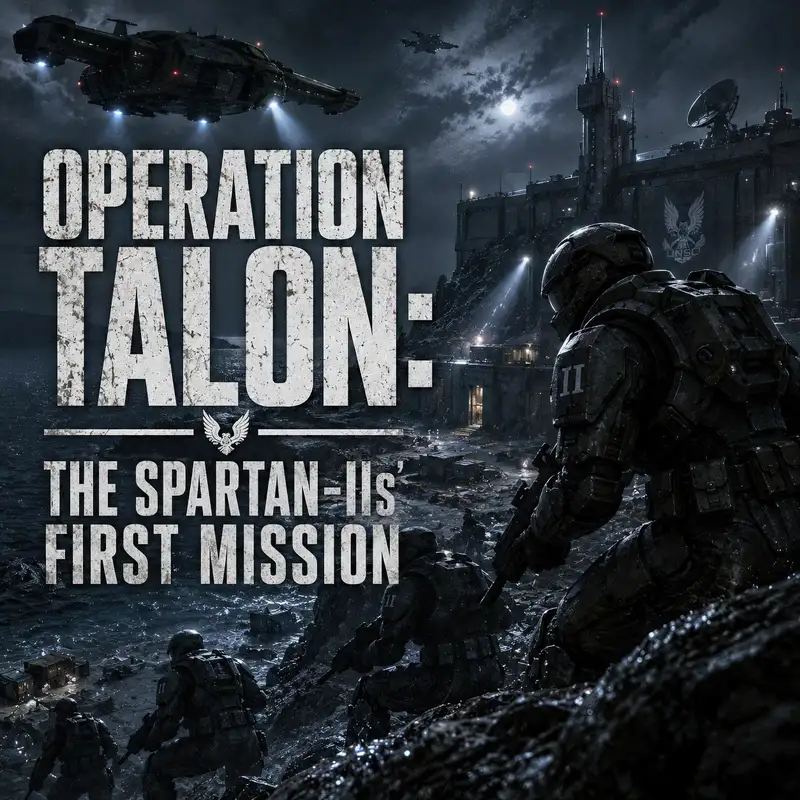
Operation TALON: The Spartan-IIs’ First Mission
John One One Seven had thirteen hours to enter a hidden asteroid settlement, capture the commander of the United Rebel Front alive, and return to friendly control before the rebels closed every route behind him. He would take four other Spartans. They had no Mjolnir armor, no energy shields, and no conventional assault force waiting to clear the objective. Their route into the target depended on a civilian freighter, a disguised boarding, and a water reservoir large enough to hide five newly augmented teenagers. Operation Talon was designed as a test of the Spartan Two program. It was also a test of a strategic idea: whether a small, exquisitely trained force could accomplish in hours what fleets and counterinsurgency campaigns had failed to achieve in years.
The target was Colonel Robert Watts, a former United Nations Space Command Marine officer who had become one of the Insurrection’s most capable leaders. Watts understood the military he opposed because he had served inside it. He knew its habits, its reporting systems, its dependence on regular routes, and the difficulty of searching an asteroid belt where almost any rock could conceal a fuel depot, habitat, sensor post, or ambush position. He had survived Operation Charlemagne, rebuilt after defeat, and helped unite scattered rebel groups under the name United Rebel Front. Capturing him required more than finding a man. It required penetrating a political and military network designed to disappear whenever conventional force arrived.
Eridanus Secundus was the physical expression of that strategy. The United Rebel Front had hollowed out an asteroid in the Eridanus system’s largest belt and turned it into a concealed settlement with docking facilities, residences, barracks, and defensive personnel. The United Nations Space Command knew Watts and his followers were somewhere among the asteroids, but previous searches had produced little intelligence or had drawn government ships into prepared resistance. Space is large. An asteroid belt makes it larger in every operationally inconvenient way. A fleet can destroy a base after locating it. It cannot fire on every rock merely because one may contain a city.
The intelligence picture contained a second problem. Rebel sympathizers inside Fleet Command were leaking information to the United Rebel Front. Watts was therefore both an operational target and a counterintelligence opportunity. Office of Naval Intelligence planners wanted him alive so interrogators could identify rebel networks, future operations, and government personnel passing classified information to the enemy. Killing Watts might produce a martyr and destroy the best available source. Capturing him could disrupt leadership and expose the machinery supporting it. The mission’s most restrictive word was not infiltrate. It was alive.
A United Rebel Front member eventually provided the opening. The source did not know Eridanus Secundus’s exact coordinates, but identified the Parabola-class freighter Laden as a supply ship serving the hidden settlement. Further investigation supported the claim. Laden was commanded by an officer previously believed dead and carried enough food and water to sustain a small city. Office of Naval Intelligence now possessed a route without possessing a destination. Rather than searching the asteroid belt, the operation would let the rebels navigate to their own base and carry the assault team through its security perimeter.
The alternatives were less attractive. A visible naval approach would give the settlement time to scatter, destroy records, move Watts, or prepare an ambush. Bombardment could eliminate the base but would also eliminate the prisoner and much of the intelligence he represented. A large boarding force required transports, staging, and communications that rebel sympathizers might detect. Blue Team offered something the regular force could not: a unit small enough to hide inside commercial traffic, capable enough to survive after discovery, and classified so tightly that even personnel supporting the wider operation knew only what their assignments required. Secrecy was not protection around the mission. It was one of the mission’s principal weapons.
On September twelfth, twenty-five twenty-five, Doctor Catherine Halsey and Chief Petty Officer Franklin Mendez briefed the Spartans aboard the destroyer Pioneer. The unit had only recently recovered from augmentation. Thirty of the original candidates had died during the procedures, and others had been left unable to continue as combat troops. The survivors were faster, stronger, and more resilient than conventional personnel, but Operation Talon would be their first real mission. There would be no training reset, no instructor ending the exercise, and no acceptable substitute for bringing Watts back alive.
Mendez promoted John to petty officer, third class and ordered him to choose the team. John selected Samuel Zero Three Four, Kelly Zero Eight Seven, Linda Zero Five Eight, and Frederic One Zero Four. The choice reflected more than friendship. Samuel combined exceptional strength with demolition skill. Kelly provided speed, reconnaissance, and rapid movement between problems. Linda offered precision fire and patient observation. Fred was adaptable, disciplined, and capable of assuming control if John became incapacitated. Blue Team’s first combat roster was built as a compact system of complementary abilities rather than five identical supersoldiers.
Their equipment reflected the mission’s need for concealment. The Spartans wore form-fitting black polymer body armor beneath clothing associated with Laden’s crew. The suits offered limited protection against small-caliber fire, controlled temperature, reduced infrared visibility, and carried communications and sensor equipment. Most of the team carried M A two B assault rifles and combat knives. Linda selected a sniper rifle. Samuel carried C twelve explosive charges. The team also received a panic transmitter that could summon support and reveal the base’s location if secrecy collapsed. The equipment was advanced, but it was not Mjolnir. A bullet could still penetrate it, as John would shortly demonstrate in a particularly direct field test.
That absence is essential to understanding Talon. The operation did not succeed because powered armor made the Spartans walking vehicles. They had no energy shielding, no integrated artificial intelligence, and none of the protection later associated with their public image. Their advantage came from augmentation joined to years of common training. They could move faster, carry more, recover from shock, and process danger with unusual speed, but they still needed concealment and surprise. Talon tested the people before it tested the armor system. The result gave the program evidence that Mjolnir would later amplify an already functional special-operations force rather than compensate for one that could not perform without it.
On September fourteenth, Pioneer placed Blue Team near the Eridanus Two space docks while Laden underwent routine engine recertification. The Spartans approached in disguise, bypassed a guard, and entered the freighter without raising an alarm. The insertion succeeded because the plan exploited normal commercial activity. Laden had to dock, load supplies, service its engines, and employ workers. Every logistical requirement created access. The United Rebel Front’s hidden base could remain invisible in the asteroid belt, but it could not manufacture every meal, replacement component, medicine, and luxury item required by the people inside it.
Samuel altered the fill sensor on Laden’s water reservoir so the tank would not completely fill. The Spartans climbed into the upper structure and suspended themselves in support netting above the water. The reservoir’s mass masked heat and interfered with motion detection. It was an elegant solution built from the freighter’s own systems, though it offered few comforts beyond not being discovered. The voyage into the asteroid belt took approximately ten hours. Blue Team used rotating sleep periods rather than spending the entire transit alert and exhausted. Special operations often reward drama in the retelling. In practice, disciplined rest can be as important as marksmanship.
Kelly accessed the freighter’s systems and examined its destination data and cargo. Most of the manifest was ordinary. One shipment was not. A container held expensive cigars, vintage champagne, and other luxury goods unlikely to be distributed among dockworkers or general stores. Blue Team concluded that the crate was intended for Watts or his senior staff and attached a navigation marker. The inference replaced a map they did not possess. The Spartans would not search the entire settlement for the rebel commander. They would follow his preferences.
Laden entered Eridanus Secundus and docked inside the asteroid. Blue Team left the reservoir, moved through the freighter’s cargo spaces, and blended with activity in the bay. John established public showers near the docks as a fallback point. That decision created a simple reference location for regrouping and extraction planning in an unfamiliar settlement. The team then tracked the marked container onto a cargo tram. Rather than clustering together, the Spartans spread out as they followed it through residential areas. Five unusually large teenagers moving in formation attract attention. Five workers traveling separately are merely another shift change.
The marker led to a twelve-story barracks building. Armed guards protected the entrance, and additional personnel moved the container inside. John and Kelly silently neutralized the exterior guards. Blue Team then entered the lobby, killed more rebels, concealed the bodies, and moved upward. The operation had crossed from covert infiltration into controlled violence, but the alarm had not yet spread through the settlement. Every engagement had to be fast enough to preserve surprise and restrained enough to avoid turning the entire asteroid into a defensive position before Watts was secured.
The team avoided the final exposed stairways by opening the elevator shaft and climbing the cable. Near the twelfth floor, Fred, Kelly, and Linda engaged guards while John and Samuel forced the doors. The movement illustrated what augmentation contributed. The Spartans could climb, accelerate, and apply force at levels beyond ordinary troops. Training made those capabilities useful. They did not simply charge upward. They divided tasks, controlled angles, and used the building’s infrastructure to bypass the most predictable approach.
John breached Watts’s apartment and immediately encountered the limit of physical superiority. Three guards opened fire from around the luxury container. John had no clean shot and tried to move out of the line of fire. Three rounds struck his side. The black body armor reduced some of the damage but did not stop the attack from producing internal bleeding. Fred and Samuel killed the remaining guards while John recovered enough to continue. The first Spartan combat mission did not prove that the candidates were invulnerable. It proved that they could absorb injury, preserve command, and continue functioning while the mission was collapsing around them.
Watts drew a pistol and tried to delay the team until reinforcements arrived. Fred and Samuel suppressed his position. John crossed the remaining distance, broke the colonel’s finger, and rendered him unconscious. Kelly administered a sedative intended to keep the prisoner under control for the extraction. Watts was placed inside the same kind of sealed cargo container that had led Blue Team to him. John received biofoam to limit internal bleeding. The mission’s principal objective was complete, but possession of a prisoner inside an alerted enemy settlement is not the same as successful capture. Capture becomes success only after extraction.
Rebel vehicles and infantry were already converging on the barracks. Blue Team moved to a balcony, rappelled down the exterior, and carried the sealed container through the settlement toward the docks. The prisoner complicated every movement. Watts could not run, climb, shoot, or protect himself. He had to be transported as cargo while John remained wounded and the defenders gained a clearer picture of the intrusion. The team’s strength mattered here, but so did its earlier decision to identify the showers as a fallback point. In a rapidly changing environment, a simple plan remembered by everyone is usually more valuable than a sophisticated plan requiring uninterrupted communications.
At the docking complex, John activated the panic transmitter and left it behind. The beacon gave the United Nations Space Command the location it had sought for years and provided Pioneer and supporting assets with a way to track the team. Samuel placed shaped charges on the bay doors while the Spartans commandeered a Pelican dropship. The charges opened the facility to vacuum as the aircraft departed. The decompression disrupted pursuit and cleared the flight path. It also killed workers and other personnel caught inside the bay. The exact number is less important than the fact that the first Spartan mission achieved extraction through an action that did not distinguish neatly between armed defenders and people performing support work.
Blue Team reached the extraction point approximately two hours later with Watts alive. No Spartan had been killed. John had been wounded badly enough to receive a Purple Heart, and the team had left a trail of dead guards, damaged infrastructure, and decompressed docking spaces behind it. On the mission report, the result was decisive. Five operators had infiltrated a base that fleets could not locate, captured its commander, transmitted its position, stolen a transport, and escaped with the prisoner. The operation had met its stated objectives within a narrow window and without committing a conventional assault force.
The success depended on much more than augmentation. Intelligence identified Laden. The freighter’s logistics carried the team to the target. Pioneer delivered and recovered them. Specialized armor concealed their signatures. Medical supplies kept John operational. A navigation marker converted a shipment of luxury goods into targeting information. Explosives opened the route out. A Pelican provided mobility once stealth failed. Blue Team supplied judgment, speed, violence, and cohesion, but it did not operate outside the military system. Operation Talon proved that Spartans could create extraordinary effects from limited opportunities. It did not prove that five soldiers had become independent of ships, intelligence, maintenance, medicine, or extraction support.
The mission also demonstrated John’s emerging command style. He selected a team small enough to hide and broad enough to solve several kinds of problem. He used the freighter’s systems rather than forcing a direct entry. He established a fallback point before contact. He shifted from concealment to assault without losing the objective. After being shot, he continued directing the team rather than allowing the injury to fragment command. Most importantly, he kept Watts alive when killing him would have been easier. John’s later reputation often emphasizes personal combat performance. Talon showed that his more important ability was organizing other specialists around a clear objective.
Office of Naval Intelligence took custody of Watts and interrogated him. His later fate remained classified. Publicly, the government announced that the rebel leader had been captured while concealing the identity and nature of the force responsible. Some observers assumed Orbital Drop Shock Troopers had conducted the operation. That ambiguity served operational security and propaganda at the same time. The United Nations Space Command could advertise a major counterinsurgency success without admitting that it had abducted, trained, and biologically altered children to carry it out.
Watts’s removal temporarily disrupted the United Rebel Front. Its network scrambled to replace him, and the capture demonstrated that even a commander hidden inside an asteroid settlement was not beyond government reach. Yet the organization survived. Jacob Jiles eventually emerged as the leader of Eridanus Secundus, and rebel activity continued elsewhere. The government now knew the asteroid’s location because John had left the beacon, but the growing Covenant crisis soon redirected ships and attention. A successful special operation had removed a leader and exposed a base. It had not eliminated the political movement, occupied the settlement, or resolved the grievances sustaining the Insurrection.
This distinction matters because leadership strikes are often most impressive at the tactical level. Removing a commander can interrupt planning, damage morale, expose networks, and force rivals into a succession struggle. It can also produce new leaders, harden security, and strengthen the belief that negotiation is impossible. Watts had unified factions through experience and charisma. His capture deprived the rebels of those qualities. It did not make the Unified Earth Government more representative, reduce colonial resentment, or erase memories of military repression. Talon bought time. It did not purchase consent.
The operation’s moral cost was not hidden from John. Afterward, he remained troubled by the unarmed personnel and civilians killed during the escape. He understood that they supported or lived within a United Rebel Front stronghold, but the classification did not make the deaths comfortable. His response was to place the concern behind the requirement to obey orders and complete the mission. That reaction was exactly what the program had trained him to do. It was also a warning about what the program had created: soldiers capable of moral recognition whose freedom to act on that recognition had been narrowed by lifelong conditioning.
For Halsey and Office of Naval Intelligence, Talon validated the investment. The newly augmented Spartans had penetrated a target inaccessible to ordinary forces and returned with the one person the intelligence service most wanted to question. The program could now claim operational proof rather than laboratory promise. That proof helped secure the Spartans’ future even before Mjolnir armor multiplied their capabilities. It also established the pattern of their early employment. The Spartan Twos had been created first as counterinsurgency weapons, and their inaugural mission was directed against other humans, not the Covenant.
Operation Talon therefore mattered for three separate reasons. Militarily, it showed that Blue Team could combine stealth, intelligence, speed, and controlled force against a hardened target. Institutionally, it demonstrated that the Spartan Two program could produce strategic effects from a very small unit. Politically, it revealed the limit of those effects. Watts could be removed from Eridanus Secundus, but the Insurrection could not be carried away in the same container. The movement survived because its causes existed across colonies, institutions, and memories rather than inside one commander’s apartment.
The defining image is Blue Team suspended above the water inside Laden, hidden by the supply system keeping the rebel settlement alive. Five teenagers waited in darkness while the enemy unknowingly transported them through defenses the United Nations Space Command had been unable to penetrate. Hours later, the same team escaped through a docking bay opened to vacuum, carrying Watts inside a sealed crate while workers died behind them. The mission proved that the Spartans could reach almost any person. It also proved that precision at the point of capture did not make the operation clean, and that removing a leader remained easier than ending the war that had made him one.