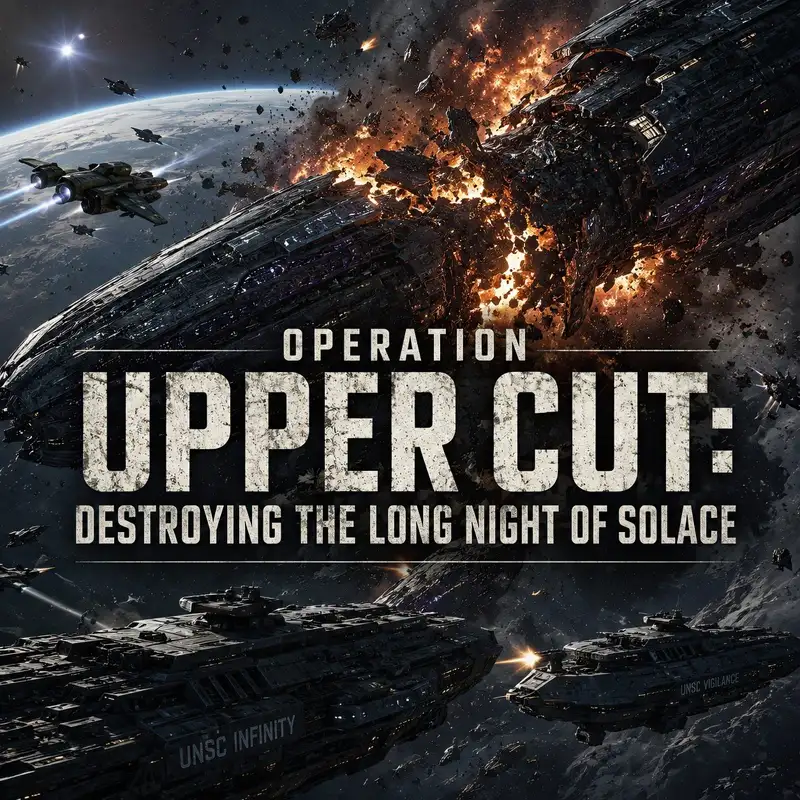
Operation UPPER CUT: Destroying the Long Night of Solace
On August fourteenth, twenty-five fifty-two, Kat-B Three Two Zero's plan began by disabling a friendly warship. The Paris-class heavy frigate Savannah would surrender its slipspace drive, losing the one system that could carry it away from Reach. Engineers would turn that drive into an improvised weapon, load it aboard a Pelican, and deliver it to a Covenant corvette. A boarding party would then seize the alien ship, place it on a routine refueling approach to the supercarrier Long Night of Solace, and open a slipspace rupture at point-blank range. The plan required secret spaceplanes, an orbital station, a fleet diversion, a captured enemy vessel, and an extraction route that existed mainly on the briefing display. It was approved because every conventional solution was worse.
Two days earlier, the Long Night of Solace had revealed itself above the Viery Territory. The supercarrier supported the Fleet of Valiant Prudence's hidden deployment network while human commanders underestimated the invasion's scale. When Noble Team brought down one of the deployment spires at Szurdok Ridge, the camouflage surrounding the carrier failed. The frigate Grafton fired on the exposed structure below and was immediately destroyed by an energy-projector strike from the ship overhead. The exchange clarified the problem. Reach's defenders had located the naval center of the bridgehead, but the first human warship caught beneath it demonstrated how dangerous a direct approach would be.
Long Night of Solace was not merely a large target. It was the flagship of Supreme Commander Rho 'Barutamee and the operational foundation of the Covenant advance force. Its hangars, command systems, sensors, embarked troops, and support for smaller vessels gave the Fleet of Valiant Prudence a protected base above the battlefield. Its energy shields and weapons made it capable of destroying human frigates before they could inflict meaningful damage. Its size created a deceptive temptation. A larger target appears easier to hit. In naval warfare, that matters only if the attacker can reach a firing position, survive the enemy's return fire, and deliver enough energy to penetrate the defenses. The United Nations Space Command could see the carrier. It still lacked a practical way to kill it.
Kat's proposal attacked the problem sideways. A Shaw-Fujikawa translight engine normally opened a controlled passage into slipspace so a properly equipped ship could leave normal space and survive the transition. Used outside the protections and safety margins of a normal translation, the same system could create a destructive rupture. The improvised device did not need to batter through the supercarrier's hull with explosive force. It needed to open the boundary between normal space and slipspace close enough that part of the carrier would be caught inside the event. The target's armor and conventional defenses would become less relevant. Upper Cut was therefore not a plan to outgun Long Night of Solace. It was a plan to place an abnormal physical event where the ship's own defenses could not solve it.
The plan still had to overcome the oldest problem in weapons employment: delivery. A slipspace drive at a human station was no threat to an escorted carrier in Covenant-controlled space. A Pelican could transport the device but could not simply enter a supercarrier's hangar. A human frigate carrying it would be detected and attacked. The answer was Ardent Prayer, a Ceudar-pattern heavy corvette commanded by General Ardo 'Moretumee. The vessel was scheduled to approach Long Night of Solace on a refueling run. If captured quietly, the corvette could carry the weapon through a route the supercarrier expected. Upper Cut depended less on concealment than on appearing routine at the correct moment. The most powerful ship over Reach would be attacked through its logistics.
Colonel Urban Holland approved the operation, but Upper Cut was only the striking arm. A concurrent fleet action, Operation Left Jab, would draw the Fleet of Valiant Prudence away from the carrier and stretch its escorts across a broader fight. That diversion mattered as much as the boarding team. Long Night of Solace could not be approached by a few human fighters if its fleet remained concentrated around it. Human ships elsewhere in Epsilon Eridani had to present threats serious enough to draw a Covenant response. Those crews created the temporary absence in which Upper Cut could exist. The official codename made the relationship clear. Left Jab occupied the enemy's attention. Upper Cut aimed for the opening.
The ground phase began at a concealed Sabre launch facility already under Covenant attack. The Sabre was a highly classified anti-ship spaceplane designed for rapid planetary defense and orbital combat. It could launch from Reach on a multistage booster and join an orbital fight without first being carried by a warship. It also possessed energy shielding, a rare capability among human small craft at the time. Those features made it valuable, expensive, and highly classified. The Covenant invasion settled that argument. A secret weapon that never left its bunker would remain impressively secure and operationally irrelevant. Noble Team and Army personnel reopened the facility because Upper Cut required fighters able to reach orbit quickly and protect the boarding force.
Noble Six and Jorge-Zero Five Two launched with a small Sabre formation toward Anchor Nine, an orbital refit station supporting the Savannah. The station was not safe. Covenant Seraphs and space-capable Banshees were attacking the area while the station's point-defense guns were offline. Phantoms attempted to close with the installation and insert boarding forces. The Sabres defended the station and frigate while technicians prepared the weapon. This was not a preliminary engagement. If Anchor Nine fell, the drive could not be prepared. If Savannah was destroyed before the transfer, the weapon disappeared with it. If the Sabres were lost, there would be no force able to clear Ardent Prayer's escorts or land the boarders.
Inside the station's support network, engineering teams removed Savannah's slipspace drive and mounted it to a Pelican for transport. The work converted one of the frigate's most valuable systems into a single-use device under combat conditions. A translight engine was not a bomb casing sitting in an armory. It was integrated into the ship's power, control, and structural systems. Removing it required specialized personnel, heavy equipment, access to the frigate, and time while enemy craft attacked outside. Humanity gained no production advantage. It had sacrificed a functioning drive and committed the Savannah to a battle from which it could no longer escape through slipspace. The weapon was improvised. The cost was not.
Once Anchor Nine's defenses returned to service and the immediate attack was broken, Jorge transferred from Noble Six's Sabre to the Pelican carrying the drive. He would remain with the package during boarding. Noble Six and the Army Sabre crews would clear the approach, secure the corvette, and open a path for the Pelican. Savannah would accompany them despite the removal of its drive. Its engines, sensors, electronic warfare, point defenses, and weapons remained useful. The frigate remained officially combat effective. In practical terms, that meant its crew could continue the mission as long as no one required the ship to leave the system faster than light. Upper Cut had converted a warship into both escort and expendable support platform.
The attack on Ardent Prayer required restraint. Destroying a Covenant corvette was difficult. Capturing one intact was a different mission. Savannah jammed the ship's communications so it could not warn Long Night of Solace, then used suppressive fire against the corvette and its fighter screen. The Sabres engaged Seraphs, Banshees, and the ship's defensive fire while targeting its engines. The goal was to cripple maneuver without destroying the hull, navigation, docking areas, or refueling capability. Every weapon served two purposes. It had to defeat the current enemy and preserve the future delivery vehicle. That requirement placed the human force inside the corvette's effective range longer than a normal attack would have demanded.
With the escort cleared and engines disabled, the Sabres landed on Ardent Prayer. Noble Six and the surviving Army aircrews entered through the communications section. Artificial gravity and life support were offline, leaving the boarders to fight in vacuum and weightlessness. Their first priority was the communications array. Savannah's jamming prevented an immediate warning, but electronic suppression consumed power and remained vulnerable. Destroying the array made the silence permanent and allowed the frigate to redirect power toward weapons. The boarders were doing more than clearing compartments. They were isolating the corvette from its fleet, turning a Covenant warship into a disconnected object whose absence had not yet become an alarm.
The force then secured the docking bay so the Pelican could enter with Jorge, the drive, and additional Army personnel. The hangar became the operation's center of gravity. The weapon had to be protected while another team captured the bridge and set the course. The corvette's surviving crew understood the same problem. They did not need to retake every compartment. They needed to destroy the Pelican, disable the bomb, restore communications, or alter the approach. A boarding action compresses naval warfare into corridors and control rooms. The ship's engines, navigation, atmosphere, doors, and sensors become terrain. A single surviving technician at the right console can matter more than a squad holding an empty passage.
Savannah continued fighting outside while Noble Six and the Army personnel moved toward the bridge. The frigate's jamming and suppressive fire kept Ardent Prayer from concentrating on the boarders. That support ended under Covenant plasma fire. The corvette damaged the frigate, tore through its hull, and destroyed it with its crew aboard. Savannah had already given up the drive that might have carried it away. Its loss was not an unforeseen accident. The plan placed an unshielded human frigate close to a Covenant warship and required it to remain there after surrendering its strategic mobility. The crew bought time with a ship made unable to retreat by the plan it protected.
Noble Six reached Ardent Prayer's bridge and defeated the command crew, including General Ardo 'Moretumee. His death removed an officer close to Rho 'Barutamee and ended the bridge crew's control of the corvette. Noble Six locked the vessel onto its scheduled refueling track toward Long Night of Solace. That action completed the essential deception. The corvette no longer needed to fight toward the carrier. It needed to continue along an expected service route while the supercarrier's attention remained divided by Left Jab. The human force had transformed Ardent Prayer from an enemy escort into a guided weapon. It was elegant, provided no one restored control, warned the carrier, or damaged the device.
The surviving Covenant crew launched its final counterattack in the docking bay. The Army pilots and troopers aboard were killed. The Pelican's propulsion was damaged, and wreckage blocked access back to the Sabres. Plasma fire also destroyed the timer intended to trigger the slipspace drive automatically. Each failure removed another extraction option. The boarders no longer possessed a functioning dropship. They could not reliably reach the fighters. The weapon would not activate by itself. A timed escape had become a choice between abandoning the objective or leaving someone to initiate the rupture manually. Upper Cut still had a route to success. It no longer had a route by which every survivor could share it.
Jorge volunteered. He was a Spartan Two, trained from childhood for missions where survival could be subordinated to the objective, but that history does not make the decision mechanical. He had spent the campaign defending his homeworld. He also understood the immediate arithmetic. Noble Six could survive a controlled fall from orbit using the reentry equipment available to the team. Someone had to remain at the controls until Ardent Prayer reached position. Jorge chose the task that could not be delegated to a dead timer. He forced Noble Six away from the ship and stayed with the drive. The official record can classify that as mission completion. It was also one soldier accepting that the extraction plan had ended.
Ardent Prayer continued toward Long Night of Solace. At the required distance, Jorge activated the drive. The resulting rupture consumed the corvette and caught the center section of the supercarrier. Part of Long Night of Solace was translated into slipspace while the remaining hull lost the structure needed to remain a ship. The vessel broke apart, and its surviving sections fell toward Reach. The operation bypassed shields, armor, point defense, and normal naval fire by placing the rupture inside the expected approach corridor. The bomb did exactly what Kat's plan required. Long Night of Solace, the ship that had hidden an invasion force and destroyed Grafton with a single decisive strike, was gone.
Noble Six fell back toward Reach as the wreckage descended. For the personnel who had spent weeks fighting the Fleet of Valiant Prudence, the sight appeared to confirm that the campaign had turned. The enemy's flagship was destroyed. Its supreme commander was presumed dead. Its deployment network had lost the ship that sustained it. Human forces had executed an operation that combined Army special warfare, Air Force technology, Navy support, orbital infrastructure, electronic warfare, fleet deception, and a captured Covenant vessel. This was not luck in the simple sense. The plan identified a vulnerability, assembled scarce capabilities, and carried them through multiple failures. At the tactical level, Upper Cut was an extraordinary success.
Then Covenant ships began emerging from slipspace above Reach. The new arrivals were not a handful of escorts returning late to the fight. They represented a force large enough to make the destruction of one supercarrier look like the removal of an advance element rather than the defeat of the invasion. Human commanders had correctly identified Long Night of Solace as the operational center of the force they were fighting. They had incorrectly assumed that destroying that center would restore control of the theater. The distinction was intelligence, not courage. Upper Cut answered the enemy order of battle that the United Nations Space Command could see. Slipspace delivered the part it had not seen almost immediately afterward.
That arrival did not make the operation meaningless. Long Night of Solace remained a supercarrier supporting troops on Reach, commanding the Fleet of Valiant Prudence, and capable of destroying human ships and surface positions. Leaving it intact would have added its strength to the larger Covenant force. Its destruction removed a flagship, command staff, embarked forces, aircraft, equipment, and a platform whose scale made it a continuing threat to every evacuation route and defensive concentration below. The operation also disrupted Rho 'Barutamee's artifact-recovery campaign and forced the remnants of his fleet to reorganize under new command. Tactical success did not save Reach. It prevented the strategic situation from becoming even worse.
The cost was severe. Savannah and its crew were lost. Army pilots and troopers died aboard Ardent Prayer. Rare Sabres and supporting personnel were committed to a mission whose equipment could not be replaced easily during a collapsing campaign. A military-grade slipspace drive was expended as a weapon. Jorge died at the point of detonation. Left Jab exposed other human ships to a fleet action designed primarily to create an opening elsewhere. The exchange was acceptable only because the target was so dangerous and because conventional alternatives offered little chance of success. Upper Cut was economical in concept, not in lives or hardware. It used one captured corvette to kill a supercarrier, but the corvette was only the final item on a much longer casualty list.
The operation also revealed a tension inside Reach's defense. Long Night of Solace would have been a valuable candidate for Operation Red Flag, the plan to capture a Covenant capital ship and use it to reach the enemy's political center. Yet the carrier's immediate role over Reach made preservation unrealistic. Ground formations were being attacked, ships were being destroyed, and the enemy bridgehead was expanding. A commander responsible for the present battle could not protect a supercarrier for a future special operation whose success remained speculative. Upper Cut destroyed the kind of target Red Flag needed because Reach needed the target destroyed first. Strategic plans tend to lose arguments with enemy weapons already firing.
From a campaign perspective, Upper Cut worked because it treated the enemy as a system rather than a single hull. Left Jab displaced the escorts. Sabres secured the orbital corridor. Anchor Nine enabled the engineering work. Savannah provided the drive, jamming, and fire support. Ardent Prayer supplied the trusted approach. Noble Six seized navigation. Jorge guaranteed detonation. Remove any one of those functions and the operation probably fails. The public image of the mission centers naturally on the Spartan who stayed behind, but his sacrifice was the final link in a joint operation built by crews, technicians, soldiers, pilots, and commanders whose names are less often recorded.
Its failure to save Reach came from a different level of war. Upper Cut solved the problem of one supercarrier. It did not solve the problem of Covenant strategic depth, superior slipspace mobility, incomplete human intelligence, or the arrival of additional fleets. No special operation could manufacture enough ships to defend the planet once the full enemy force appeared. No boarding team could seize every carrier. No improvised weapon could be repeated indefinitely after the enemy understood the method and the United Nations Space Command ran out of drives, frigates, stations, and trained crews. Tactical ingenuity had found one opening. Strategy required a supply of openings that did not exist.
The remains of Long Night of Solace eventually came to rest across Reach's mountains, too unstable and dangerous for easy salvage even after the war. The wreck became evidence of two truths that coexist without canceling one another. Human forces had destroyed a warship far beyond anything they could defeat through normal combat. They had done so with a plan that consumed the people and machines needed to attempt it, only to watch another fleet arrive. Operation Upper Cut succeeded because it turned Covenant logistics into a delivery route and a human slipspace drive into a blade. Reach still fell because the blade cut one ship, while the invasion extended far beyond it.