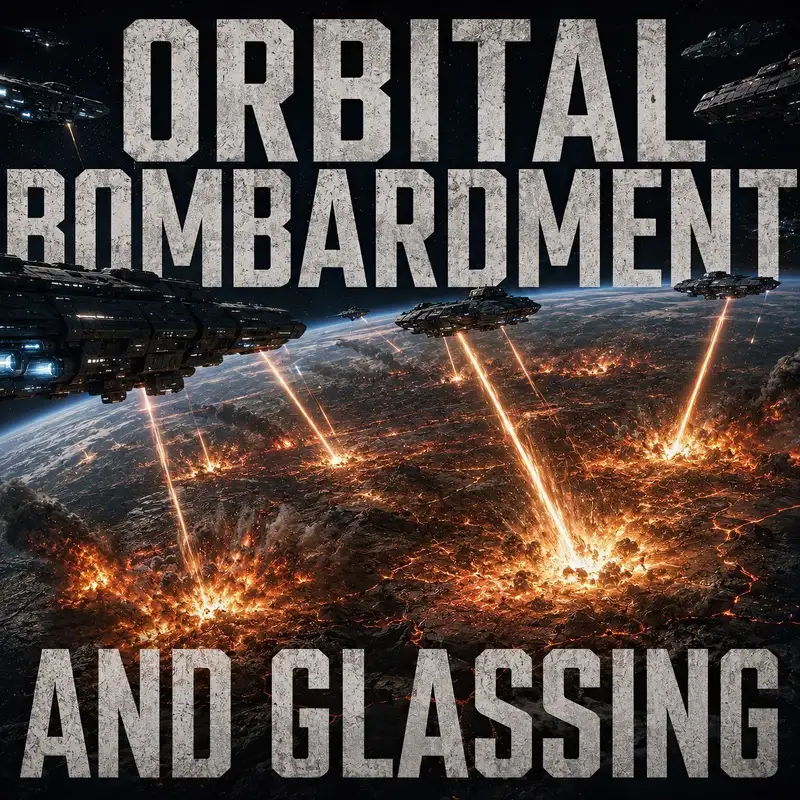
Orbital Bombardment and Glassing
When Covenant ships descended over a human city, they were not always carrying troops. Some came down to firing altitude. Their energy projectors traced across military districts, industrial zones, and evacuation routes while defenders were still moving below. On Reach, orbital bombardment began before the ground campaign had ended. Soldiers could be fighting for a generator complex while another region was already being burned. The image is often remembered as a single beam striking a doomed world. The military reality was slower, organized, and in some ways more disturbing. Glassing was not one shot. It was a campaign conducted against a planet’s ability to remain a society.
Orbital bombardment is the broader category. Any force attacking a planetary surface from space is conducting it, whether the weapon is a missile, a nuclear device, a magnetic accelerator projectile, or a directed-energy system. Glassing was the Covenant’s characteristic form of sustained close-orbit and near-surface bombardment with massed energy projectors. The name came from the visible result. Soil and rock containing silicate material could melt and fuse into glasslike terrain. The military purpose, however, was not to produce a particular surface texture. It was to destroy defenses, cities, industry, agriculture, transportation, and habitability on a scale ground forces could not match.
That distinction prevents several common errors. A plasma lance fired at a warship is not automatically glassing. A human cruiser striking a surface target with missiles is orbital bombardment, but it is not Covenant glassing. The destruction of an entire planet by a different strategic weapon is not simply a larger version of the same operation. Similar light in the sky can conceal very different weapons, firing methods, and political purposes. Military history becomes unreliable when every beam is treated as the same beam and every ruined world is assigned the same cause.
The Covenant’s energy-projector technology had several applications. Some systems served as excavation beams for mining and artifact recovery. Others were configured for anti-ship combat or surface attack. In a glassing operation, ships maintained a destructive beam against selected terrain long enough to burn through structures, melt the ground, and spread damage beyond the immediate point of impact. The beam was only the visible end of the system. Power generation, targeting, cooling, navigation, command authority, and protection from surviving defenders all had to function before the surface began to glow.
A fleet could not glass a defended world merely because its commander desired it. The attacker first needed sufficient control of local space. Defending warships, orbital platforms, fighters, and planetary batteries could threaten bombardment vessels, especially when those vessels descended into predictable firing positions. The Covenant might destroy or bypass the main orbital network, open a corridor, and then assign ships to surface attack while the rest of the fleet screened them. The bombardment plan looked simple after every inconvenient dependency had been removed from the briefing.
Near-surface work was particularly dangerous. Atmosphere complicated sensors and maneuver. A ship concentrating on a fixed target became easier to track. Remaining surface installations could still fire. Human aircraft might exploit terrain or cloud cover. Covenant heavy destroyers used for early bombardment missions sometimes operated close enough to cities, factories, and farms that ground defenses could contest them. The Covenant possessed the technological advantage, but it still lost ships performing the work. Glassing was an act of dominance conducted from a position that could remain tactically exposed.
Target selection began with the invader’s objective. A commander seeking extermination had different priorities from one searching for a Forerunner relic. Military headquarters, airfields, shipyards, reactors, communications centers, spaceports, and major urban concentrations offered obvious targets. Agricultural regions and transportation networks mattered because populations could not survive on courage alone. Destroying a port or power grid might kill fewer people in the first minute than striking a city center, yet produce greater long-term collapse. Orbital fire allowed the attacker to dismantle the systems connecting a colony to itself.
The Covenant often delayed widespread bombardment because it wanted something on the surface. Luminaries identified Forerunner material. Ground forces searched ruins, captured personnel, recovered navigation data, and protected excavation teams. Religious restrictions could make one valley sacred and the surrounding continent expendable. A fleet might land an army, fight for weeks, and only then begin systematic glassing after the desired artifact had been removed. The sequence was not evidence of mercy. It was evidence that annihilation had to wait for collection.
This also explains why Covenant troops sometimes remained on a world while bombardment began elsewhere. The operation could be divided geographically. One region contained active ground forces and protected sites. Another had been cleared for destruction. Communications failures, changing orders, or simple disregard for subordinate units could make that separation imperfect. A beam fired from orbit did not distinguish between an enemy position and a friendly unit whose evacuation had fallen behind schedule. Superior technology did not improve the prospects of soldiers omitted from the deconfliction plan.
Ship classes shaped how the operation was carried out. C P V-class heavy destroyers became associated with dangerous orbital bombardment duties, particularly early in the war. Their crews could be treated as politically suspect or dishonored, turning surface attack into both military service and institutional punishment. Larger assault carriers brought troops, strike craft, command facilities, and energy projectors powerful enough to devastate immense regions. Not every fleet contained the same mix, and not every vessel could produce the same effect. Glassing was a fleet capability assembled from particular ships, not a universal switch installed on every Covenant hull.
Power and time placed limits on the campaign. Energy projectors drew from shipboard reactors that also supported propulsion, shields, sensors, and other weapons. Firing for extended periods created engineering demands and kept the ship committed to a narrow task. Multiple vessels could divide the target area and accelerate destruction, but those ships were then unavailable for pursuit, convoy interception, or other missions. A commander could burn a world faster by assigning more of the fleet. The commander also made the fleet less responsive while doing so.
The geometry of the planet mattered. Curvature, atmosphere, mountain ranges, oceans, weather, and the location of infrastructure shaped firing plans. A ship could reposition to attack another hemisphere, but repositioning took time and required continued control of orbit. Coastal cities, underground facilities, islands, and deep shelters presented different problems. A beam could erase an exposed industrial district while leaving personnel alive beneath sufficient rock. The Covenant could destroy a civilization’s surface systems without confirming the death of every person. In many campaigns, that was enough.
Accuracy depended on what the commander meant by accurate. A city, shipyard, or agricultural basin was a large fixed target. A bunker entrance beside a desired artifact was not. Atmospheric interference, incomplete maps, damaged relays, and moving friendly units could all corrupt the firing picture. Energy projectors offered overwhelming area effects, but the same power made them poorly suited to delicate work near Covenant troops or sacred sites. Ground reconnaissance therefore remained necessary even after the fleet controlled orbit. The beam could destroy what had been identified. It could not decide on its own what should be preserved.
For this reason, the word glassed should not be treated as a precise scientific measurement. It describes a method and a strategic result, not one uniform percentage of planetary destruction. Some worlds suffered broad continental devastation. Others lost selected population centers, military regions, or industrial zones. Atmospheres could remain intact even when climates became unstable and normal settlement collapsed. Pockets of land, water, infrastructure, and population might survive. A planet could be accurately described as glassed while still containing places the beam never touched.
Camber makes the point clearly. The colony was an important manufacturing center for United Nations Space Command fleet material. Covenant attacks first struck targets of strategic value, and Thel ‘Vadamee later led the decisive assault. The subsequent glassing left large portions of Camber desolate, but the atmosphere remained. The damaged climate produced violent weather rather than perfect lifeless silence. Years later, the Banished moved into parts of the ruin and converted abandoned human assets into a ship-breaking and salvage operation. The Covenant had destroyed a colony. It had not removed every useful kilogram from the planet.
That postwar salvage reveals an important strategic irony. Glassing could deny a world to its population and government without eliminating its value to every later occupier. Titanium, wreckage, buried installations, and surviving industrial sites could still be recovered. The Banished did not require Camber to become a healthy human society. They required material, machinery, and a place where coercive labor and plasma tools could turn ruins into military supply. One empire’s monument to extermination became another force’s warehouse.
Arcadia offers a different pattern. Covenant forces devastated much of the world, yet some regions escaped direct glassing. At least one surviving area had been protected or avoided because of Forerunner structures and earlier Covenant activity. Trees, swamp, and old human installations remained amid the wider glasslands. That surviving landscape was not proof that the attack had failed. It showed that target selection followed Covenant priorities. The presence of desired ancient technology could preserve a small area more effectively than the presence of human civilians.
Meridian demonstrates that even a severely damaged world can remain politically and humanly occupied. The colony was glassed during the war, but people later returned or remained among its industrial ruins. Mining, salvage, reconstruction, and local government continued under harsh conditions. Some inhabitants were later stranded when the wider strategic situation collapsed around them. A glassed world could therefore be both a graveyard and a workplace. The same fused horizon seen as total destruction from orbit could contain families trying to repair water systems beneath it.
Reach remains the most famous example because its destruction followed a campaign the audience sees from several scales. The Covenant first infiltrated, disrupted communications, and attacked military infrastructure. Human forces fought to preserve orbital defenses and evacuation routes. As control shifted, Covenant ships began burning selected areas while combat continued elsewhere. The fall of Reach was not a clean transition from battle to bombardment. It was an overlap. Some units were still receiving orders from a defense network that no longer existed in other regions.
That overlap shaped the choices available to defenders. Once widespread bombardment began, holding territory for its own sake became less useful. Ground units protected launch sites, escorted civilians, denied intelligence, destroyed equipment, and tried to reach extraction points. Aircraft avoided regions where the atmosphere itself had become part of the hazard. Commanders could not defend every settlement from ships overhead, but they could preserve people, records, and military capability if they understood which corridors remained open. Losing the world did not make every remaining decision meaningless.
Evacuation was constrained by capacity. A colony might contain millions of people and only a fraction of the transports required to remove them. Ships needed crews, fuel, life support, navigation data, and escorts. Spaceports had limited loading rates. Roads and rail systems could be severed before civilians reached them. Once the Covenant controlled the approaches, every departing transport became a target or a trail to another human system. The official phrase population evacuated could conceal the more difficult question of which population, from where, and at whose expense.
Civil defense could improve survival without making the attack survivable in any broad sense. Deep shelters, mines, tunnels, remote settlements, submarines, and protected research facilities could preserve small groups. Stockpiles mattered because surface agriculture and water processing might be destroyed. Communications mattered because isolated survivors could remain alive without knowing whether rescue was possible. A world after glassing was not merely hot ground. It was a logistics emergency spread across a damaged planet whose ports, hospitals, and government might all have disappeared.
The environmental consequences varied with the extent and location of the attack. Fused soil could stretch across enormous regions. Fires, vaporized material, damaged watersheds, and atmospheric disturbance could alter weather and make exposed travel lethal. Industrial sites added chemical hazards and debris. Orbital wreckage could continue falling after the fleet moved on. Areas outside the direct strike zone might still lose food, power, and breathable shelter. Habitability is a system. The Covenant did not need to melt every mountain if it destroyed enough of the systems keeping people alive between them.
Glassing also carried religious meaning. Covenant forces described humanity as an offense against the sacred order proclaimed by the Prophets. Burning a world could be presented as cleansing apostasy, not merely removing a military base. Some crews carved sigils into destroyed landscapes, turning mass death into liturgy and evidence of obedience. The pattern communicated to Covenant personnel as well as to human survivors. It said the empire had not only defeated resistance. It had judged the world itself.
That religious framing does not remove command responsibility. Orders originated within Covenant institutions, but shipmasters and crews executed them. Knowledge was unequal. Many Sangheili believed the Prophets’ claims and understood the war through sincere faith. Others pursued rank, honor, or political security. Unggoy, Kig-Yar, and other personnel served under varying levels of coercion and commitment. These differences matter when explaining participation. They do not make the people beneath the beams less dead.
The postwar story of Kholo makes that reckoning personal. An unnamed Sangheili shipmaster returned to the human colony he had once glassed. During the war, he had carried out the act under the certainty that the Prophets spoke for the gods. After the Covenant collapsed and the Great Journey was exposed as a lie, the same landscape no longer confirmed righteousness. It confronted him with what obedience had produced. The glass remained after the doctrine that justified it had failed.
Human memory also compressed these varied operations into one word. Glassing became shorthand for the loss of a colony, even when the exact area destroyed, number of survivors, and duration of bombardment differed. That shorthand was understandable. Families rarely needed a technical classification for the weapon that erased their home. Historians do. Without separating partial bombardment, widespread surface destruction, evacuation, continued resistance, and postwar survival, the record turns every colony into the same silent sphere.
The distinction matters for military assessment. A bombardment that destroyed a shipyard could be strategically effective even if most of the planet remained physically intact. An attack that burned empty wilderness might create a dramatic image while failing to remove the defended objective. A campaign that killed civilians but left navigation archives unsecured could be genocidal and operationally incomplete at the same time. Moral horror and military effectiveness are different judgments. Both must be made.
It also matters when comparing orbital bombardment with glassing. Human forces used missiles, magnetic accelerator weapons, and nuclear devices against surface targets under particular circumstances. Those attacks could be devastating, but they operated through different doctrines, supply systems, and political constraints. The Banished have employed heavy orbital and surface fire while seeking resources and control. Forerunner systems can produce effects on another scale entirely. None should be called glassing simply because the target is below and the weapon is above.
The Covenant chose glassing because it matched both its technology and its war aim. Humanity was not being compelled to surrender and join the empire. It was marked for extermination. Once artifacts and intelligence were removed, preserving the colony’s economy or population offered little value to the Hierarchs. Energy projectors allowed fleets to convert orbital superiority into permanent denial. A world that could no longer feed, house, transport, or govern its people no longer supported the human war effort, even if survivors remained.
Yet glassing was never strategically free. Ships spent time and energy. Crews accepted risk. Valuable infrastructure was destroyed rather than captured. The operation could delay a fleet that might have pursued escaping vessels. It created ruins that later factions could exploit and refugees whose experience hardened human resistance. It also bound Covenant officers to crimes that became politically and morally destabilizing once the empire’s religious foundation collapsed. The weapon destroyed worlds and accumulated evidence against the civilization using it.
A military historian should therefore ask several questions whenever a record says a colony was glassed. Who ordered the bombardment? What did the fleet want before it began? Which targets were struck, and which were spared? Were human forces still operating? Did evacuation continue? How much of the atmosphere and ecology survived? What infrastructure remained? How long did the fleet stay? What did the operation cost the attacker? What did later settlers, salvagers, or occupiers find when they returned?
Those questions do not diminish the scale of the atrocity. They reveal it. A simple image of a dead planet can hide the hours of target selection, the troops abandoned in uncleared zones, the transports that left half full because the next road had been cut, and the survivors who spent years beneath fused soil repairing machines designed for a climate that no longer existed. Glassing was not terrible because it erased every trace of life. It was terrible because it could leave life behind after destroying the conditions that made ordinary life possible.
Orbital bombardment turns control of space into force against the surface. Glassing carried that principle to its Covenant conclusion. It was a sustained method for breaking a world as a military base, an economy, a homeland, and a political community. The beam decided the immediate contest because almost nothing on the ground could answer it. The glasslands decided what came afterward. Soldiers withdrew, refugees carried the colony’s memory elsewhere, salvagers returned to the wreckage, and former Covenant commanders confronted a landscape that preserved their obedience more faithfully than their religion did.