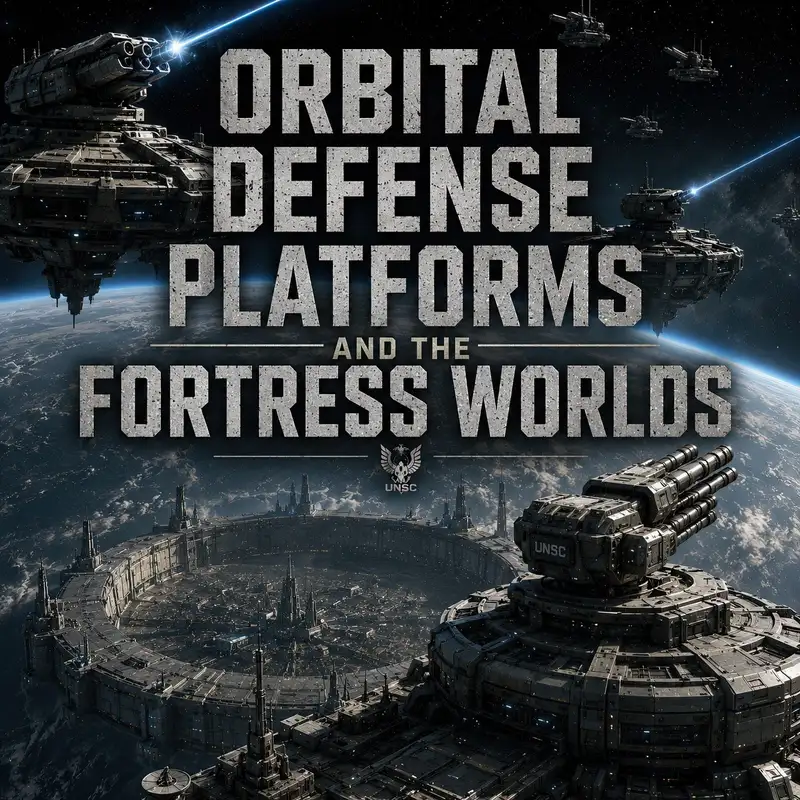
Orbital Defense Platforms and the Fortress Worlds
On August thirtieth, twenty-five fifty-two, Facility Alpha three three one on Reach went offline. The generators in that defense zone were not ordinary power plants. They fed the orbital super magnetic accelerator platforms above the planet, weapons capable of tearing through Covenant capital ships. As Covenant armor pressed toward the remaining facilities, Spartan teams and conventional soldiers were ordered to hold ground whose strategic effect lay thousands of kilometers overhead. Reach’s strongest naval weapon had become a ground-defense problem.
That contradiction defines the orbital defense platform. It was a fixed station built around a magnetic accelerator cannon too large, too power-hungry, or too strategically important to place aboard an ordinary warship. The platform could remain on station, watch a known approach, and fire a projectile with enough energy to threaten ships humanity otherwise needed entire battle groups to destroy. It could not pursue an enemy, retreat to another system, or defend a different colony once the battle moved elsewhere.
Human commanders built these platforms because a fortress world required more than a fleet. Warships were mobile and flexible, but they carried slipspace drives, long-duration stores, crews, hangars, armor, and propulsion systems that competed with weapon size. A stationary platform could devote far more of its structure to the gun, its power system, capacitors, ammunition handling, targeting equipment, and defensive support. It traded strategic mobility for concentrated firepower. That was a good exchange only when the world beneath it was worth defending at almost any cost.
The term fortress world was not a single technical classification in human military doctrine. It described a strategic condition. Reach and Earth became fortresses because military command, industry, population, communications, shipyards, training facilities, and political authority were concentrated there. Their defenses formed layers. Sensors detected the approach. Prowlers and satellites provided warning. Aerospace forces contested the upper atmosphere. Warships screened the orbital line. Ground forces protected power, airfields, and command centers. The orbital platforms were the heaviest guns inside that larger system.
Most platforms were manned stations rather than automated weapons waiting silently above a planet. Air Force personnel commonly operated the orbital-defense mission, while naval specialists, command staffs, technicians, and Marine security forces served aboard major installations. Hangars supported fighters, dropships, and maintenance craft. Docking ports allowed ships to transfer personnel or supplies. Lifeboats provided some chance of evacuation. The station was a gun, but it was also a small military community whose people ate, slept, repaired machinery, and prepared to repel boarders beside the weapon they served.
Earth’s Moncton-class platforms showed the more self-contained approach. They carried onboard fusion power and large capacitor systems that stored the energy required by the main cannon. If the internal power plant failed, a docked warship could help feed the station through its umbilicals. The platform also carried point-defense weapons and aviation support. Several stations could operate as a battle cluster, combining their firing arcs and dividing support duties among fighters, interceptors, utility craft, and maintenance systems.
Reach’s most powerful platforms accepted a different compromise. Their rapid-fire super magnetic accelerator cannons demanded more energy than practical onboard reactors could provide. Buried fusion-generator complexes on the surface supplied that power. The arrangement gave Reach’s guns exceptional performance and allowed them to cycle rapidly against a major fleet. It also connected the survival of an orbital battery to power stations, transmission systems, communications, and soldiers on the ground. A platform could have ammunition loaded, crews alive, and a target in sight, yet become silent because a distant generator had been captured.
The gun itself was only the visible end of a firing process. Sensors had to identify and track the target. Commanders had to assign priorities. The station had to align its weapon and complete a firing solution against a vessel moving through three-dimensional space. Capacitors had to be charged. The projectile had to be loaded and the firing lane kept clear of friendly ships. A hit against a shielded Covenant vessel might still depend on timing, target aspect, and coordinated fire from other platforms or warships.
This made an orbital-defense grid more useful than the same number of isolated stations. Platforms could cover one another, share tracks, and mass fire on selected targets. Naval forces could maneuver the enemy into their engagement zones or finish ships damaged by the larger guns. Fighters could intercept boarding craft and strikecraft attempting to exploit blind approaches. The grid turned fixed stations into a defensive formation. It also meant that damaged communications or false sensor data could weaken several batteries at once.
Reach was the natural place to build the strongest version of that system. It was close to Earth, central to United Nations Space Command operations, and filled with shipyards, depots, training facilities, research sites, and military headquarters. Its mines supplied titanium to the wider war economy. Its cities and settlements held an enormous civilian population. The planet was not merely a military base wearing mountains and forests as decoration. It was a major human society whose industry and people sustained forces fighting across the colonies.
By August of twenty-five fifty-two, Reach possessed twenty orbital defense platforms. Its super guns could accelerate enormous projectiles to roughly four percent of the speed of light and gut Covenant capital ships with a successful hit. Against an enemy whose shields and plasma weapons dominated ordinary fleet exchanges, this mattered. The platforms gave human defenders a way to kill major Covenant vessels without sacrificing several mobile warships for each target. Reach’s guns did not eliminate the technological imbalance. They made the enemy pay for entering their field of fire.
The Epsilon Eridani Defense Fleet and the orbital platforms were meant to fight together. Warships supplied mobility, reconnaissance, screening, missiles, fighters, and additional magnetic accelerator fire. The platforms supplied the heavy blows. If the Covenant approached in an orderly formation, human commanders could concentrate fire and remove ships faster than the attackers expected. A defended world could therefore impose losses far beyond what its mobile fleet could achieve in open space.
The Covenant did not need to accept that kind of engagement indefinitely. Its commanders could observe firing cycles, identify gaps, deploy strikecraft, insert boarding teams, and land forces beyond the immediate reach of the main fleet battle. Most importantly, they could attack the buried generators feeding Reach’s strongest platforms. The defensive architecture had created a target whose destruction could silence a weapon far more expensive than the ground facility itself. The Covenant did not have to outshoot every gun if it could turn off the grid.
That was why so many human forces were committed to the generator complexes on August thirtieth. Most of the available Spartan Twos on Reach were divided into teams and sent to protect them. Army, Marine, Air Force, and local forces fought around the same facilities. The mission was not glamorous in strategic language. Hold a power plant. Preserve the transmission network. Keep one more orbital cannon firing. In practical terms, each minute of ground defense allowed another shot at the fleet threatening the planet.
The battles around those facilities showed the scale mismatch built into the system. A handful of Spartans and conventional units faced armored formations whose objective was not the soldiers themselves, but the power behind the orbital guns. Human defenders could ambush columns, delay movement, and call for fire. They could not easily replace destroyed generators or transmission equipment. Once a facility went offline, the surviving troops might still hold nearby terrain while the strategic reason for holding it had already disappeared.
The platforms could also support operations below, but orbital fire was never a simple answer to a ground problem. A kinetic strike carried enormous destructive effect and demanded precise targeting, clear authorization, and acceptance of what lay around and beyond the aim point. Friendly forces, civilians, infrastructure, and the planet’s atmosphere all complicated the shot. The platforms were designed first to kill ships. Their value to ground forces came mainly from keeping hostile capital vessels occupied or destroyed before those vessels could bombard the surface freely.
When the generator network collapsed, the orbital defense line weakened with it. Covenant ships that had been forced to respect the super guns could close, maneuver, and strike the remaining fleet with greater freedom. Platforms that had survived physically became less relevant as weapons. Their crews remained aboard fixed installations with no slipspace drives and limited evacuation capacity. A fortress battery cannot withdraw when the fortress is lost. It can only keep firing, fall silent, or be destroyed.
Reach therefore did not fall because orbital-defense platforms were useless. The opposite is closer to the truth. They were dangerous enough that the Covenant altered the campaign to neutralize them. The defense failed because the platforms were one part of an interconnected system, and the enemy attacked the connections. Communications had already been disrupted. Ground forces were pulled across multiple fronts. The scale of the invasion had been underestimated. Once the generators, fleet, and command structure failed together, the guns could no longer compensate.
The loss was larger than twenty stations. Reach’s shipyards, depots, training centers, communications hubs, and industrial facilities supported military operations across human space. Defending the planet protected the means to repair and replace forces elsewhere. Losing it removed those means while also destroying much of the fleet that had come to the defense. A fortress world concentrates strength. It also concentrates consequences. The enemy does not have to capture every facility when destroying the system removes the value of the whole.
Earth’s orbital grid represented a different answer to the same problem. By October of twenty-five fifty-two, roughly three hundred Moncton-class platforms guarded the human homeworld. They were part of a layered defense that included the Home Fleet, aerospace forces, satellites, ground commands, and planetary installations. The number was impressive because Earth was not only the political center of the Unified Earth Government. It was the final major refuge for much of the command, population, and industry that remained after the fall of the colonies.
The Earth platforms were distributed in clusters rather than assembled as one wall in space. Many occupied geosynchronous positions and guarded defined approaches or regions. A battle cluster combined several guns with aviation and maintenance support. The arrangement provided depth and redundancy. Destroying one platform did not silence the entire grid. It also created seams between clusters, and every fixed station remained dependent on its sensors, power, crew, ammunition, and the forces screening it.
Cairo Station demonstrated how much more than a gun one of these platforms could become. It served as Fleet Admiral Terrence Hood’s command center during the defense of Earth. From its exposed command spaces, staff officers coordinated ships, stations, and aerospace forces while the station’s own cannon engaged the enemy. Its hangars and docks supported smaller craft. Its Marines protected internal spaces. Cairo was simultaneously a weapon, headquarters, fortress, and target, which is efficient until every enemy mission recognizes the same concentration of value.
On October twentieth, the Prophet of Regret’s relatively small fleet arrived in the Sol system without expecting to encounter humanity’s homeworld. The orbital grid immediately placed the Covenant force in a dangerous position. Human platforms could engage at range, and the attackers lacked the mass normally required to overwhelm Earth directly. The Covenant response was not to continue trading capital ships against the main guns. Boarding craft moved toward the stations carrying antimatter charges.
Athens and Malta stations were destroyed from within. Cairo narrowly avoided the same fate after its bomb was removed. The attacks exposed a basic weakness of every fixed battery. Armor and point defense were designed to stop weapons approaching from outside. Once a boarding force entered the station, the battle became infantry combat fought around magazines, power systems, airlocks, command centers, and the main cannon. A small team carrying the correct explosive could accomplish what a cruiser might not survive long enough to attempt.
The destruction of Athens and Malta opened a path through their cluster. One Covenant assault carrier penetrated the defense and reached New Mombasa. The grid had not been erased, and Earth had not been conquered. A local breach had allowed a strategic target to move from orbital battle into the atmosphere. That is the difference between a defensive line and an impenetrable wall. Space offers too many directions, and a mobile enemy needs only one usable corridor.
The following weeks placed the larger grid under sustained pressure. Additional Covenant forces entered the system. Platforms and the Home Fleet fought repeated engagements while ground battles spread across Earth. Ships expended missiles and magnetic accelerator rounds. Stations suffered damage and boarding attempts. Crews remained at action stations. Repair capacity and replacement personnel were consumed. A defense that could devastate one small fleet was gradually worn down by successive attacks and then confronted by a much larger force under the Prophet of Truth.
Much of the grid and most of the Home Fleet were eventually overwhelmed. Cairo survived, damaged but operational, while many other stations and ships did not. Earth’s platforms had imposed severe losses and prevented immediate conquest. They had not made the planet invulnerable. Fixed defenses can multiply the strength of a fleet, but they cannot create endless ammunition, repair damage instantly, or reposition themselves to meet every reinforcement arriving through slipspace.
The contrast between Reach and Earth is instructive. Reach relied on a smaller number of exceptionally powerful platforms whose ground-based generators allowed rapid super magnetic accelerator fire. Earth fielded a far larger constellation of more independent Moncton-class stations integrated with the Home Fleet and aerospace defense. Reach’s concentrated power created a clear ground vulnerability. Earth’s distributed grid offered more redundancy, but remained vulnerable to boarding, attrition, and massed attack. Neither model removed the need for mobile forces.
Other human worlds received orbital platforms when their industrial or strategic value justified the cost. Meridian’s importance as a supplier supported its own orbital defenses. Camber also had platforms before the Covenant destroyed them. New Carthage maintained orbital installations in the postwar era. These examples show that Earth and Reach were not unique in possessing fixed orbital weapons. They were unique in the scale of defense the central government could afford to concentrate around them.
That concentration had a political meaning. Every platform represented shipyard capacity, trained crews, fusion technology, magnetic accelerator components, ammunition, maintenance, and a permanent commitment to one world. Most Outer Colonies never received anything comparable. Their populations were not less interested in survival. Their worlds were simply lower in the strategic hierarchy or beyond the industrial capacity available for protection. A fortress world is built partly by engineering and partly by the decision that some places will receive defenses others will not.
The platforms also carried an opportunity cost. The labor, materials, and reactors placed into a fixed station could not be used in a mobile ship at the same time. A platform defended one orbit exceptionally well. A frigate could escort convoys, reinforce colonies, evacuate civilians, and withdraw to fight elsewhere. Senior leaders had to choose between depth around critical centers and reach across a scattered civilization. The Covenant War punished both choices. Concentrate too little and the fortress falls quickly. Concentrate too much and the frontier is left exposed.
Their fixed position created other operational limits. Platforms could not hide their general location or abandon a threatened orbit. Enemy reconnaissance could study the grid, identify firing arcs, and plan approach routes. Resupply and repair craft had to travel to known stations. Civilian traffic moved through the same orbital environment. The defenders could alter readiness and tactics, but they could not move the planet or persuade a geosynchronous battery to become a task force after the enemy changed objectives.
Later enemies exposed how closely the platforms were designed around the Covenant naval problem. In twenty-five fifty-seven, Earth’s guns and Home Fleet could not penetrate the defenses of the Forerunner warship Mantle’s Approach. The weapon that could tear through a Covenant capital ship was inadequate against a vessel built by a far older civilization. During the Created takeover, Guardian attenuation pulses disrupted ships and orbital defenses through effects the grid had not been designed to resist. A fortress optimized against one threat can become obsolete without any of its guns becoming mechanically weaker.
The station crews remained the human center of all these systems. They maintained capacitors, loaded projectiles, tracked targets, directed fighters, repaired damage, and fought boarders in passages never intended to become infantry terrain. Marine security forces defended command spaces and magazines. Technicians continued working while the station shook from impacts. A platform’s firepower made it a strategic asset. Its immobility made every person aboard part of a garrison that could not retreat with the fleet.
Orbital defense platforms turned selected planets into fortress worlds because they allowed humanity to concentrate industrial power into guns capable of killing ships better than most human warships could. They created protected zones in which a weaker fleet could fight with a heavier hand. They bought time for mobilization, evacuation, and resistance. They also tied enormous military capability to fixed orbits, vulnerable networks, ground facilities, and crews who had nowhere else to take the weapon.
Reach’s platforms were not defeated only in space. They were defeated at generator compounds where soldiers fought to keep power flowing upward. Earth’s grid was not breached only by heavier ships. It was breached by boarding parties, bombs, attrition, and one opening wide enough for an assault carrier. The fortress was never the cannon alone. It was the complete chain from the buried reactor to the firing platform, from the sensor track to the fleet screen, and from the crew at the controls to the people living beneath them. When that chain broke, the largest gun in human orbit became a silent monument above a world it could no longer save.