Peace Without Victory: The Galaxy After 2552
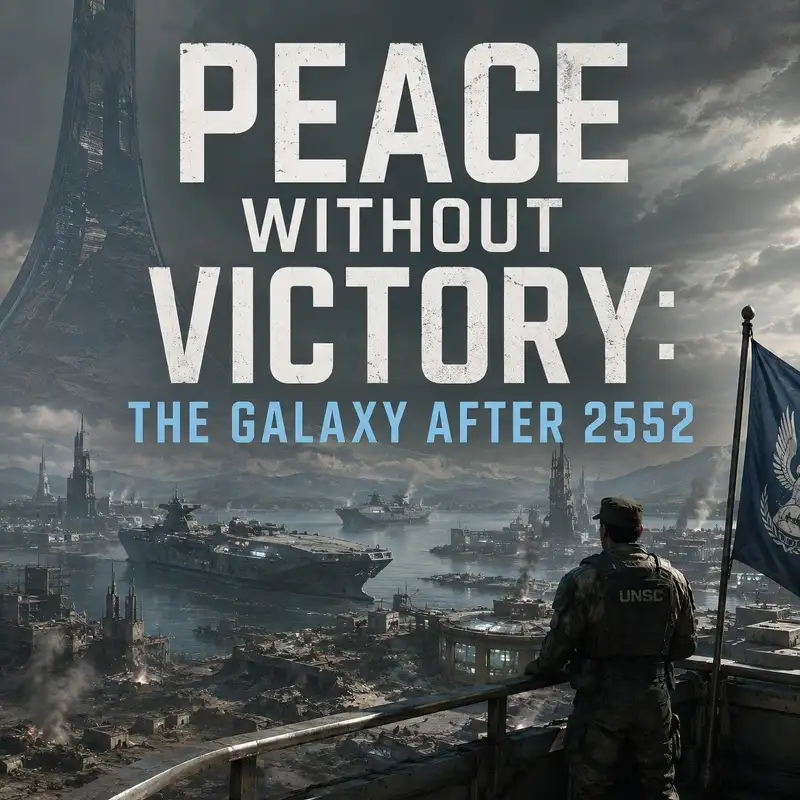
On March third of twenty-five fifty-three, Admiral Terrence Hood stood before a memorial outside Voi and marked the Human-Covenant War as formally over. The ceremony honored the dead, but it could not answer a basic military question. Who, exactly, had surrendered? The Covenant no longer existed as a unified government. Its holy capital was lost, its Hierarchs were dead, its fleets were scattered, and many of its surviving commanders still possessed warships capable of burning cities from orbit. Humanity had survived, and the Sangheili allied with Thel ‘Vadam had helped prevent the Halo Array from firing. Yet no victorious coalition had occupied an enemy capital, disarmed every fleet, or imposed a settlement across former Covenant space. The war had ended because the enemy empire collapsed faster than its surviving pieces could continue the same campaign. That was peace, but it was not victory in the traditional sense.
The distinction matters because humanity did not defeat the Covenant by becoming stronger than it. The Great Schism broke the empire’s chain of command at the moment its war against humanity reached Earth and the Ark. The High Prophet of Truth attempted to replace Sangheili authority with Jiralhanae power, turning political consolidation into civil war. High Charity fell to the Flood. Covenant forces fought one another while human and Sangheili units cooperated against a narrower set of enemies. Truth was killed before he could fire the Array, and the unfinished replacement for Installation Zero Four was destroyed during the escape from the Ark. These were decisive events, but they did not amount to the systematic destruction of every Covenant military formation. Humanity reached the end of twenty-five fifty-two alive because the empire trying to exterminate it fractured, not because the United Nations Space Command acquired enough ships to conquer that empire.
Humanity entered the postwar period with a functioning government, experienced armed forces, and a powerful claim to survival. It also entered with devastated colonies, exhausted crews, shattered logistics, and a fleet that had spent twenty-seven years exchanging vessels it could not easily replace for time it desperately needed. Reach had fallen. Earth had been attacked. Major shipyards, depots, population centers, and transportation networks had been lost or damaged. Many Outer Colonies had ceased to exist as organized communities, while others had survived through isolation, evacuation, resistance, or simple neglect by an enemy focused elsewhere. The end of the extermination campaign removed the most immediate threat. It did not rebuild a single dry dock, train a replacement engineering watch, or restore the civilian shipping needed to reconnect scattered worlds. A government can declare a war finished in an afternoon. Rebuilding the machinery that made interstellar society possible takes considerably longer.
The first postwar campaigns were therefore campaigns of restoration. Routes had to be surveyed. Navigation data had to be verified. Communications relays had to be repaired. Convoys had to carry food, medical supplies, reactor components, and construction equipment to colonies that had lived for years under emergency conditions. Refugees needed transport, while military commanders still demanded escorts for artifact teams, reconnaissance missions, and remnant suppression. Every available hull had competing uses. A freighter assigned to carry prefabricated shelters could not simultaneously move ammunition. A frigate protecting that freighter could not patrol another system. Even worlds that had escaped direct attack felt the shortage of skilled labor, replacement parts, and reliable information. The United Nations Space Command had survived as an institution, but much of the civilization it defended had become a collection of damaged nodes separated by uncertain travel times.
That reconstruction also revived the political dispute humanity had postponed rather than solved. Before first contact with the Covenant, the Unified Earth Government had faced separatism, terrorism, and armed rebellion across the colonies. The external war did not erase the grievances behind the Insurrection. It suspended some conflicts, transformed others, and gave the military extraordinary authority over transportation, information, industry, and local security. After twenty-five fifty-two, colonies that had fought alone did not always welcome the return of central control. Some saw relief forces. Others saw the same government that had restricted autonomy before the Covenant arrived. Former rebels had weapons, networks, and veterans. Criminal markets connected human smugglers with Kig-Yar traders and alien matériel. By twenty-five fifty-three, human forces were again conducting operations against other humans. The species had survived a war of extinction and resumed its internal arguments with remarkable administrative efficiency.
Former Covenant space was even less orderly. The empire had not been a single army with a single supply depot. It had been a political, religious, and economic system of ministries, fleets, keeps, tithe worlds, shipyards, client species, and local commanders. When central authority collapsed, those components did not vanish. They changed owners. A shipmaster might pledge to the Arbiter, a surviving minister, a regional warlord, a religious revivalist, or no one beyond the crew and clan that controlled the vessel. Garrisons became local powers. Depots became prizes. Pilgrimage routes became smuggling corridors. The fragmentation sharply reduced the chance that one unified Covenant armada could resume the old war of annihilation. It also made the remaining danger harder to map. Instead of one enemy order of battle, commanders faced dozens of armed organizations whose names, loyalties, and objectives could change between intelligence reports.
The Sangheili confronted the deepest institutional shock. They had been the principal military arm of the Covenant, but the Prophets’ betrayal and the exposure of the Great Journey’s false promise destroyed the political framework that had given that service meaning. Thel ‘Vadam emerged as the leader of the Swords of Sanghelios, not as the unquestioned ruler of every Sangheili world. Keeps, clans, shipmasters, traditionalists, reformers, and religious factions made their own calculations. The Blooding Years began almost immediately. An uprising by enslaved Jiralhanae in Ontom helped ignite wider violence, while the Servants of the Abiding Truth attacked Vadam Keep and opposed the Arbiter’s reforms. Sangheili fought Sangheili with weapons built for imperial conquest. The species had escaped San’Shyuum rule, but liberation did not produce a ready-made government capable of replacing the Covenant across all its former territory.
The military problem was matched by an economic one. Covenant society had deliberately divided technical knowledge, labor, and authority among species and institutions. The Sangheili inherited many warships, but not the complete political economy that had designed, supplied, and coordinated them. San’Shyuum ministries had controlled patterns, doctrine, and access to sacred technology. Huragok had performed work that many commanders could request without fully understanding. Trade had moved through imperial networks that no longer possessed a central guarantor. A carrier remained formidable, but it still required power systems, trained crews, munitions, repair facilities, and dependable access to food and fuel. The postwar galaxy contained many advanced weapons and surprisingly few intact systems for sustaining them. Possession of a plasma cannon was useful. Possession of the factory, technicians, transport schedule, and replacement components was better.
Human strategy toward the Sangheili reflected the contradiction at the center of the new order. Admiral Hood treated the alliance with the Arbiter as a hard-won strategic relationship that could prevent another war. Within the Office of Naval Intelligence, Admiral Margaret Parangosky pursued a different form of insurance. Kilo-Five personnel covertly armed Sangheili dissidents and assisted attacks against the Arbiter’s forces, while classified research explored the possibility of attacking the Sangheili food supply. The logic was cold and recognizable. A divided former enemy would have less capacity to threaten a weakened humanity. The danger was equally recognizable. If exposed, the policy could transform an ally into an enemy and confirm every claim that human diplomacy was merely preparation for a more favorable war. Hood did not control every secret carried out in humanity’s name, which made the alliance both genuine and structurally vulnerable.
There was another policy, less dramatic but more durable. Human and Sangheili personnel began working together because shared missions created interests that speeches could not. The Anvil Initiative grew from Hood’s effort to build a long-term partnership with the Arbiter. Joint teams trained, tested equipment, and conducted operations against threats neither side could manage as efficiently alone. In the Joint Occupation Zone, military and diplomatic personnel delivered relief, protected settlements, and confronted pirates and insurgents across regions claimed by more than one species. Cooperation remained uneven. Veterans carried memories of glassed worlds, dead crews, betrayed keeps, and murdered relatives. Trust was not a switch activated by a treaty. It was a logistical process, built through compatible communications, shared rules, reliable resupply, and the repeated discovery that the other side arrived when promised.
The collapse also freed species that had experienced the Covenant very differently. Jiralhanae forces emerged from the Great Schism with their own clans, packs, warships, and grievances against the Sangheili. Unggoy communities faced choices shaped by coercion, faith, survival, and the opportunity to escape old hierarchies. Kig-Yar captains expanded trade, piracy, and mercenary work across borders that no longer had effective customs enforcement. Huragok became intensely valuable to every faction able to protect, persuade, purchase, or capture them. None of these species automatically formed a unified successor state. Local loyalties often mattered more than imperial identity. A former Covenant base might contain Sangheili officers, Unggoy laborers, Kig-Yar contractors, and Jiralhanae prisoners, all responding differently when the orders from High Charity stopped. The empire ended at the top. On the ground, its people still had to decide who controlled the gate, the armory, and the next meal.
Naval warfare changed accordingly. During the Human-Covenant War, the silhouette of a Covenant cruiser usually told a human commander enough about its allegiance and probable mission. After the war, the same hull might serve the Swords of Sanghelios, a fundamentalist remnant, a pirate coalition, a mercenary band, or a local ruler protecting one system. Identification became as important as detection. A captain escorting a convoy had to determine not only whether an approaching vessel could fire, but whether firing first would start a conflict with a potential ally. Fragmentation weakened fleet concentration, yet it favored raids, ambushes, and boarding actions. Small forces could seize matériel without holding territory. Civilian shipping became both an economic lifeline and an attractive target. The postwar naval map was not divided into clean fronts. It was a shifting pattern of safe corridors, disputed anchorages, hidden depots, and worlds defended by whatever ships could still launch.
Human technological recovery created optimism, some of it justified. Covenant equipment could be studied more openly. Huragok assistance accelerated repair and experimentation. Energy shielding, improved sensors, advanced slipspace systems, and new Mjolnir designs moved from improbable goals toward operational use. The United Nations Space Command Infinity embodied that ambition. It was a massive, heavily armed platform built around technology and resources gathered during the war, able to deploy forces and support operations on a scale few surviving human vessels could match. It was also exceptional. One flagship did not mean every frigate had shields, every colony had orbital defenses, or every shipyard could reproduce the systems installed aboard it. Humanity had captured advanced technology. It had not captured the industrial civilization that originally made such technology routine.
The Spartan Four program reflected the same transition. Adult volunteers with military experience could be augmented, equipped with new generations of Mjolnir, and organized as a distinct branch for postwar missions. Their work included counterinsurgency, reconnaissance, interdiction, artifact security, and combat against Covenant holdouts. The program expanded the number of personnel capable of operating in environments that had once required a much smaller pool of Spartans. It also served a political purpose. Spartans could now be presented openly as professional defenders rather than rumors attached to a classified child-abduction program. Yet their increased availability did not solve the strategic arithmetic. A Spartan fireteam could seize a command center, recover an artifact, or destroy a local threat. It could not escort every convoy, occupy every disputed colony, repair every relay, or replace the fleets needed to control interstellar space.
Religious war survived the empire that had organized it. The revelation that Halo was a weapon did not cause every believer to abandon Covenant doctrine. Some rejected the Prophets but preserved reverence for the Forerunners. Others concluded that the Covenant had failed because its leaders were corrupt, not because its central promises were false. Remnant leaders used old symbols, surviving warships, and access to sacred sites to claim legitimacy. Jul ‘Mdama would become the most visible example, but he was not the only commander to build authority from faith, grievance, and possession of military assets. Forerunner installations offered more than weapons. They offered political theater. A leader who appeared able to interpret or control ancient machinery could present local power as divine favor. The Covenant’s bureaucracy was gone. The ideas that had sustained it remained available for reuse.
The Banished exploited the same vacuum from a different direction. Atriox had rebelled against Covenant authority before the empire fell, creating an organization based less on the Great Journey than on strength, loyalty, profit, salvage, and opportunity. After twenty-five fifty-two, former Covenant territory offered recruits, shipyards, weapons caches, resource worlds, and commanders who no longer had an imperial employer. The Banished did not need to restore the old system. They could strip useful parts from it, combine technologies, and bargain with species the Covenant had ranked within a sacred hierarchy. Their rise demonstrated that rejecting the Prophets did not necessarily produce a peaceful or liberal order. It could produce a more flexible war machine, one that understood logistics, coercion, and local advantage without needing religious approval for every campaign.
The war also left the galaxy with an inheritance no peace conference could inventory. Humanity and its enemies now knew that Halo installations existed. They knew the Ark could build them. They had encountered the Flood, Forerunner ancillas, portals, shield worlds, and weapons designed for conflicts far older than their civilizations. Coordinates, fragments of research, captured navigational data, and damaged artifacts were scattered across military and intelligence archives. Every government had reason to secure them, and every rival had reason to move first. This turned archaeology into armed competition. A research expedition required escorts. A recovered device required containment. A control room required security against both attackers and the machine’s own incomplete instructions. The Human-Covenant War ended, but it revealed a strategic environment in which one successful salvage operation could upset the balance of power.
Intelligence agencies struggled to describe that environment. During the old war, human analysts had often lacked precise knowledge, but they understood the enemy’s broad identity and objective. Postwar analysis faced too many identities and too many objectives. A fleet could split over doctrine, merge for one campaign, then fragment again over spoils. A colony might trade with one alien faction while secretly supporting another. Slipspace delays made reports stale before they reached headquarters. Names translated poorly across languages and changed with allegiance. Office of Naval Intelligence assessments remained influential, but classification did not make them complete. The operational question was no longer simply where the enemy was. It was which enemy, serving whom, for how long, and whether the answer would remain true when friendly forces arrived.
For civilians, the difference between war and peace was often measured less by declarations than by transport schedules. Survivors of glassed worlds could not return to functioning homes merely because Covenant fleets had stopped arriving in formation. Displaced populations competed for housing and employment on colonies already under strain. Veterans returned with injuries, grief, and skills suited to combat economies. Human and alien communities met in ports, markets, occupation zones, and refugee settlements where official diplomacy was translated into daily choices about work, policing, worship, and revenge. Some places rebuilt. Others became salvage grounds, black markets, or political symbols claimed by people who no longer lived there. The official casualty report could count the dead. It could not easily count the communities that survived biologically but ceased to exist socially.
The weakness of the postwar order became clear when later crises struck. Humanity rebuilt centralized networks, advanced ships, and artificial-intelligence-supported infrastructure because those systems promised efficiency and recovery. Cortana’s Created uprising turned that dependence into a vulnerability. Guardians could impose an armed peace by threatening governments, disabling resistance, and controlling strategic infrastructure. That order was not the return of the Covenant, but it exploited the same fractured galaxy. When Created power receded, the Banished and other forces moved into the gaps. By twenty-five sixty, the destruction and dispersal of major United Nations Space Command formations showed how quickly the apparent postwar advantage could disappear. The years after twenty-five fifty-two had produced stronger weapons and new alliances. They had not produced a stable monopoly on force.
Peace without victory therefore describes more than an uneasy ceasefire. Humanity survived, but it lacked the strength to impose a comprehensive settlement. The Arbiter helped destroy the Covenant, but he did not inherit uncontested authority over the Sangheili. Former client species gained freedom of action, but not guaranteed security. Covenant fleets ceased operating as one extermination machine, yet their ships, crews, weapons, and beliefs remained active. The United Nations Space Command gained access to extraordinary technology, but most of its worlds still depended on vulnerable convoys and damaged infrastructure. Every major power left the war with something it could call success. None left with enough control to make its definition of peace binding on everyone else.
The memorial at Voi marked the end of a war whose central objective had been the destruction of humanity. In that narrow and essential sense, it marked success. Beyond the memorial, warships changed flags, colonies reconsidered old loyalties, intelligence services sabotaged their own diplomacy, and ancient machines waited for new claimants. The galaxy after twenty-five fifty-two was safer because no unified Covenant leadership could continue the campaign of annihilation. It was more dangerous because military power had been dispersed among governments, clans, remnants, mercenaries, insurgents, artificial intelligences, and ambitious commanders with no common rules. The guns had not fallen silent. They had lost a common chain of command. That was the peace the survivors inherited, and it was the clearest evidence that survival and victory had never been the same thing.