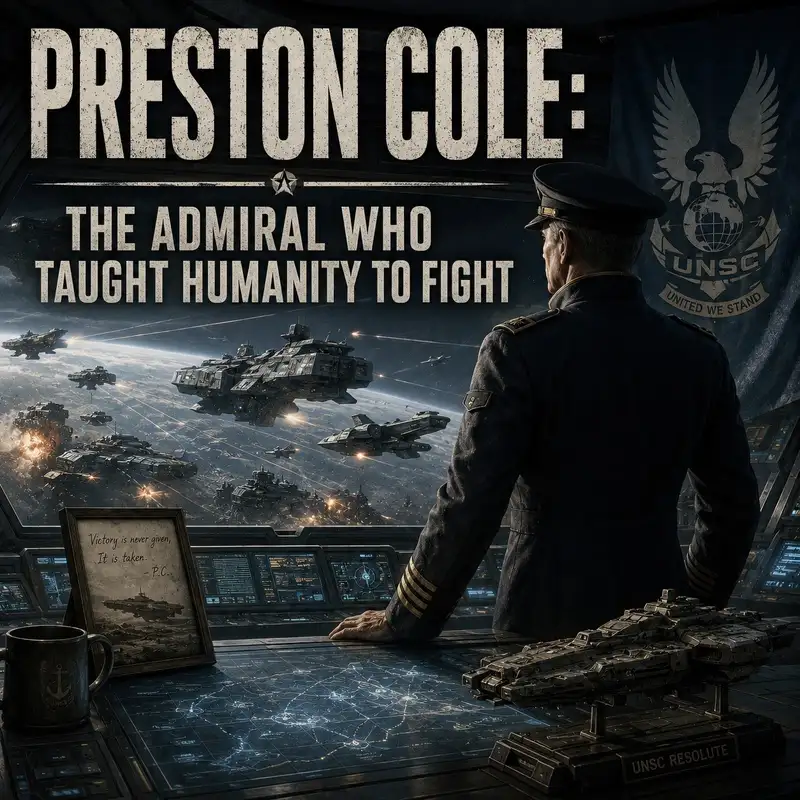
Preston Cole: The Admiral Who Taught Humanity to Fight
The Covenant vessel over Harvest had already burned through several human warships when a subordinate ordered the fleet to retreat. Magnetic accelerator rounds had struck its energy shields. Missiles had followed. Nuclear weapons had failed to produce the destruction human officers expected. Vice Admiral Preston Cole countermanded the withdrawal and ordered every surviving ship to fire together. The decision was less a display of confidence than an admission that the United Nations Space Command did not yet know how to fight this enemy.
Cole’s synchronized attack overwhelmed the shield and destroyed the alien vessel. Thirteen of his forty ships had been lost. That exchange established both the hope and the problem that would define his command. Covenant warships could be defeated, but not by applying old assumptions more aggressively. Humanity needed new doctrine, better coordination, disciplined deception, and commanders willing to treat the entire star system as part of the weapon. Cole did not teach the Navy how to become technologically equal. He taught it how to create moments when inequality mattered less.
Preston Jeremiah Cole was born in twenty-four seventy on a struggling family farm in the reconstituted Missouri township of Mark Twain. His childhood placed him inside one of the economic contradictions of human expansion. Colonial agriculture could supply enormous markets, while small producers on Earth struggled to compete. The boy who would later defend distant colonies first experienced them as places changing the conditions of life at home.
Cole was intelligent, overworked, and not especially interested in performing intelligence for teachers who failed to hold his attention. At fourteen, he wrote about the political consequences of extended colonization and anticipated that distant communities might eventually reject authority from Earth. The paper did not launch an academic career. His grades and family circumstances closed the easiest route into an elite military academy. He enlisted in the Navy instead.
His first assignment placed him aboard the Colonial Military Authority vessel Season of Plenty. Cole began as a crewman rather than a commissioned officer, learning ships from the level where maintenance, watches, and calculations had consequences before they became entries in a command brief. When an officer pushed slipspace navigation work onto him, Cole produced a better method for calculating the required parameters. The result earned him a recommendation to officer candidate school on Luna.
Navigation became the foundation of his military thinking. Space was not emptiness separating two fleets. It was geometry, acceleration, sensor limits, radiation, gravity, and uncertain arrival. Slipspace did not remove those factors. It added more. Ships departing together could emerge apart. Reinforcements could arrive after the battle they were meant to influence. A commander who understood movement could make a weaker ship appear where an enemy had not planned to fight it.
After commissioning, Cole served as a navigation officer aboard the destroyer Las Vegas. In twenty-four ninety-four, insurrectionists seized the corvette Callisto and drew a human battle group into the Twenty-six Draconis system. The rebels used a nuclear weapon and an asteroid as a trap. Buenos Aires was destroyed. Jericho and Las Vegas were crippled. Most of the command personnel aboard Cole’s ship were killed or incapacitated, leaving the young officer with a damaged vessel, wounded sailors, and one usable missile.
Cole transmitted a surrender and requested medical assistance. While the insurgents approached to take possession of Las Vegas, his crew removed the final Ares missile from its normal launcher and positioned it in a cargo bay. When Callisto docked, Cole fired at point-blank range, crippled the captured corvette, and forced its surrender by implying that his nearly empty ship still possessed additional weapons.
The action saved surviving personnel and recovered Callisto. It also abused the protections surrounding surrender and medical aid. Senior command considered decorating Cole or prosecuting him, then chose neither. The institution wanted the result without establishing the method as acceptable precedent. Cole learned that rules could become part of an enemy’s expectation, that expectation could be manipulated, and that headquarters often preferred useful ambiguity to a clear judgment about how victory had been obtained.
Promotions followed. Cole eventually commanded the heavy destroyer Gorgon during campaigns against insurgent and privateer forces. Its magnetic accelerator cannon gave him a weapon with greater reach and striking power than the ships on which he had begun. Technology expanded his options, but the Insurrection continued to teach him that possession of the larger weapon did not guarantee control. Rebels could choose the location, conceal among civilian traffic, exploit local support, and refuse the battle the Navy wanted.
His most persistent opponent was the frigate Bellicose, commanded by the insurrectionist Lyrenne Castilla. They fought repeatedly without destroying one another. Private communications followed the engagements, then a personal relationship, marriage, and a child. Cole did not initially know that Castilla was the opposing captain whose skill he respected. When the Office of Naval Intelligence uncovered the relationship, the scandal ended his operational career.
The Navy placed Cole behind a desk, promoted him out of immediate danger, and eventually offered retirement. The same institution that had turned him into a public hero during the Insurrection now treated him as a security risk whose fame made formal punishment inconvenient. His understanding of colonial politics had been unusually perceptive. His private life had crossed the boundary those politics created. Cole spent more than two decades outside operational command while the conflict he had studied continued without him.
By twenty-five twenty-five, he was older, physically worn, and largely absent from public memory. Then Harvest went silent. A scouting force found the colony devastated and encountered a warship whose weapons and defenses exceeded anything in human service. Most of the human ships were destroyed. The surviving vessel returned with proof that the threat was not another insurgent faction and could not be managed through familiar patrol doctrine.
Central Command recalled Cole because it needed experience and because a disgraced hero made a useful shield against failure. If the counterattack succeeded, the government could restore a legend. If it failed, officials could blame a retired admiral whose career already contained enough scandal to support several inquiries. Cole accepted reinstatement and received Battle Group X-Ray, forty warships gathered around the Valiant-class super-heavy cruiser Everest and its artificial intelligence, Sekmet.
Cole prepared by studying the limited evidence from Harvest and Chi Ceti Four. The reports established that Covenant energy shields could absorb attacks that would destroy an unshielded human ship. They also suggested that shields were not limitless. The problem was timing. Separate human salvos allowed the defensive field to endure, recover, or shift against each threat. Cole’s answer at Harvest was to concentrate destructive effect within one coordinated interval.
Magnetic accelerator fire struck first. Missiles and nuclear weapons followed while the shield was under maximum stress. Additional fire reached the hull after the field collapsed. The principle sounds simple after someone else proves it. Executing it required dozens of captains to share targeting data, hold fire under attack, synchronize weapons with different flight times, and continue the plan while ships disappeared from the formation.
That first victory taught the Navy that Covenant shielding was a tactical system rather than a supernatural barrier. It also demonstrated the price of learning. Thirteen human warships had been destroyed to kill one enemy vessel. Cole could show that the Covenant was vulnerable. He could not make the exchange sustainable. Every lost ship meant trained crews, slipspace drives, reactor systems, weapons, spare parts, and shipyard labor that the human industrial base could not quickly replace.
The campaigns bearing Cole’s name expanded the method. At Alpha Aurigae, Xi Boötis, and the Great Bear, he assembled large forces, studied local conditions, and used concentration to defeat smaller Covenant formations. The victories were costly enough to make triumph and attrition difficult to separate. A fleet might complete its mission and still return unable to defend the next colony. Cole’s reputation grew while the number of ships required to produce each victory remained an indictment of the wider balance.
He learned to arrange battles rather than merely enter them. Prowlers collected emissions and movement data. Artificial intelligences connected sensor tracks and calculated firing solutions. Asteroid fields, gravity wells, orbital planes, and planetary bodies shaped approach routes. Missiles could force defensive reactions even when they did not destroy the target. Nuclear weapons could blind sensors, break formations, or create opportunities for magnetic accelerator fire. Cole treated enemy decision-making as another system to attack.
This approach depended on preparation that legends tend to edit out. Ships needed compatible communications, ammunition allocations, trained crews, repair periods, medical support, and commanders who understood the plan before slipspace separated them. Battle damage changed acceleration and formation timing. A cruiser that could still fire might no longer be able to keep station. A destroyer listed as available might arrive with exhausted personnel and missile magazines already depleted by the previous engagement. Cole commanded fleets, not symbols on a map.
He also understood that special capabilities had to fit inside the wider campaign. During the opening years of the Covenant War, Cole worked with Catherine Halsey, Avery Johnson, Colonel Marmon Crowther, and the teenage Spartan leader John One One Seven. He encouraged conventional commanders to build plans around what the Spartans could actually do rather than treating them as unusually durable infantry. He also supported field judgment when rigid procedure threatened to waste intelligence, allies, or trust.
That mattered because Cole’s own career had been built on disobedient initiative. He knew the difference between an officer violating orders for convenience and one changing the method because the original assumptions had failed. The distinction could not be reduced to rank. Cole expected subordinates to understand the objective, the enemy, and the consequences. He was willing to protect a decision that served the mission, but he also expected the person making it to carry responsibility for the result.
The Battle of the Great Bear in twenty-five thirty gave him a strategic insight more valuable than another destroyed cruiser. Human forces recovered a living Sangheili after one enemy vessel crashed. Interrogation confirmed that the Covenant intended to eliminate humanity, not compel surrender or seize limited territory. The prisoner also revealed that the enemy knew remarkably little about human space. It possessed overwhelming weapons without a complete map of the civilization it had condemned.
Cole recognized that ignorance as a form of strategic depth. Humanity could not defend every colony with ships. It could deny the enemy the information needed to move efficiently from one population center to the next. The directive that became the Cole Protocol ordered crews to purge navigation databases, protect or destroy artificial intelligences, avoid direct retreat routes toward inhabited systems, and destroy compromised vessels when capture would expose human worlds.
The protocol taught every captain that a ship’s data could matter more than the ship. It also imposed severe costs. A damaged vessel might be denied the safest route home. A crew could be required to erase systems needed for navigation or repair. An artificial intelligence might have to be destroyed to prevent interrogation. A captain who saved one ship by leading the Covenant toward a colony had not achieved survival. The threat had simply been transferred to people who did not know the decision was being made.
The order was imperfect. The Covenant located worlds through captured records, tracking, betrayal, reconnaissance, and Forerunner-seeking instruments. Earth was eventually found. For much of the war, however, the enemy lacked a reliable route network connecting humanity’s major systems. The Cole Protocol forced search, uncertainty, and delay into Covenant operations. In a conflict where human fleets could not consistently stop an attack, making the enemy spend time finding the next target became a defensive achievement.
Cole returned to Harvest in twenty-five thirty-one and helped bring the five-year campaign for the system to an end. The operation showed how far the war had moved beyond one dramatic fleet engagement. Human forces needed to maintain orbital pressure, support ground operations, recover damaged ships, move troops, and respond to Covenant reinforcements across several years. When the cruiser Prophecy required assistance, Cole sent the support ship Spirit of Fire because no suitable combat vessel could be spared. Naval power included the ships that repaired, transported, and sustained the force, not only those exchanging fire.
His response to the crisis at the Rubble further reveals what he believed victory meant. Lieutenant Jacob Keyes helped evacuate a large population of civilians and insurrectionists while preventing navigation data from reaching the Covenant. Some officers saw the survivors primarily as political liabilities. Cole treated their rescue as success, promoted Keyes, and supported continued operations by Gray Team. Saving people, preserving secrecy, and rewarding initiative mattered more than whether every refugee had previously trusted Earth.
Cole had fought insurgents for much of his career, but he did not assume that colonial rebellion erased human identity. His relationship with Castilla made that distinction personal. Insurrectionists could oppose the Unified Earth Government and still resist extermination by the Covenant. Human unity during the war was therefore conditional, local, and frequently negotiated under fire. Cole’s willingness to work across that divide would become central to his final campaign.
The middle years of the war exposed the limit of everything he taught. Cole could defeat enemy formations and still watch colonies fall. In the Leonis Minoris system, human ships survived a comparatively favorable exchange while two colonies were glassed. That was not strategic victory. A fleet exists to protect populations, industry, bases, and freedom of movement. Destroying enemy ships matters because of what it prevents. When destruction came anyway, the battle record could be favorable while the campaign remained a loss.
Fleet Command continued giving Cole new ships and crews because he kept winning the engagements he accepted. The process consumed veterans and replaced them with personnel who had to learn under fire. Cole became both commander and institutional memory for a Navy shrinking while its experience grew. His reputation helped hold formations together. Captains knew he would not spend ships casually, although he would spend them when he believed the objective justified the cost.
The public version of Cole became a strategic asset of its own. Humanity needed evidence that Covenant fleets could be beaten. News of his victories supported morale, recruitment, and confidence in a government losing world after world. The Office of Naval Intelligence shaped that image, just as it had used him during the Insurrection. Propaganda did not invent his ability. It simplified the price and turned a commander who survived through preparation into a figure who seemed to produce victory through personal will.
Cole’s real lesson was less comforting. Human ships could not win a fair exchange against equivalent Covenant forces. The Navy had to refuse fairness. It had to mass weapons, manipulate geometry, conceal intent, exploit intelligence, and force local superiority before the enemy’s technology restored the wider balance. Commanders needed the judgment to retreat from impossible battles and the discipline to return with reinforcements rather than convert courage into wreckage.
By twenty-five forty-three, Cole commanded operations in Fleet Command Sector Three and had spent almost eighteen years applying that method. At Psi Serpentis, he assembled Battle Group India, supported by prowlers, repair vessels, rescue craft, and enormous stocks of missiles and nuclear weapons. He selected the gas giant Viperidae as terrain, prepared navigation beacons, and used an in-system slipspace maneuver to place his force where the Covenant did not expect it.
The resulting battle brought together every element of his career. Cole divided enemy attention, used local geometry, concentrated fire, accepted heavy losses, and relied on intelligence prepared before the fleet arrived. An independent human force associated with Castilla struck the Covenant formation at the critical moment. It did not join the United Nations Space Command or settle the Insurrection. It cooperated long enough to keep both human forces from being destroyed.
When a second Covenant fleet arrived, Cole ordered his surviving ships away and drew the enemy deeper toward Viperidae. He attacked the religious claim behind the Covenant war and made himself the target. The pursuing vessels entered the environment he had prepared. Nuclear detonations inside the gas giant triggered a catastrophic reaction that destroyed more than three hundred Covenant ships. The action removed an enormous enemy force and erased Cole’s flagship from the confirmed record.
Whether he died remains unresolved. Later analysis found evidence supporting the possibility that Everest escaped through a concealed slipspace transition while another damaged cruiser remained on the fatal course. Castilla’s presence supplied a possible partner and destination. The evidence is persuasive enough to sustain doubt and incomplete enough to prevent certainty. Cole may have died completing the largest victory of his career. He may have used that victory to leave the war.
Either outcome fits part of the man. Cole repeatedly placed himself and his command at extreme risk for objectives he believed necessary. He also spent a lifetime studying routes away from authority, imagining distant colonies, and protecting private loyalties from institutions that demanded access to everything. If he escaped, the admiral who wrote the order preventing ships from leading an enemy home may have ended by ensuring neither side could follow him to his own.
Cole taught humanity to fight by replacing technological confidence with operational discipline. He taught captains to synchronize rather than merely fire, to use intelligence before contact, to make terrain from planets and orbital mechanics, to preserve logistics, to deny information, and to reward initiative when the original plan no longer matched reality. He also taught that defeating a ship, winning a battle, saving a population, and preserving the war effort were different kinds of success.
He could not teach the Navy how to manufacture enough hulls, restore destroyed colonies, or overcome the Covenant’s industrial advantage. His victories bought time and confidence while consuming resources humanity could barely replace. That limitation is part of his legacy, not a criticism added afterward. Cole’s methods worked because he understood exactly how weak the human position was and refused to confuse necessity with equality.
The farm boy from Missouri entered the Navy hoping to travel among the colonies. He became the admiral who ordered sailors to erase the routes connecting them, the former counterinsurgent who accepted help from rebels, and the public hero whose greatest victory may have concealed a private escape. Humanity learned from Cole that an inferior fleet could still fight intelligently. It also learned the harder truth beneath every one of his victories: intelligence could postpone defeat, but only people, ships, industry, and time could turn survival into strategy.