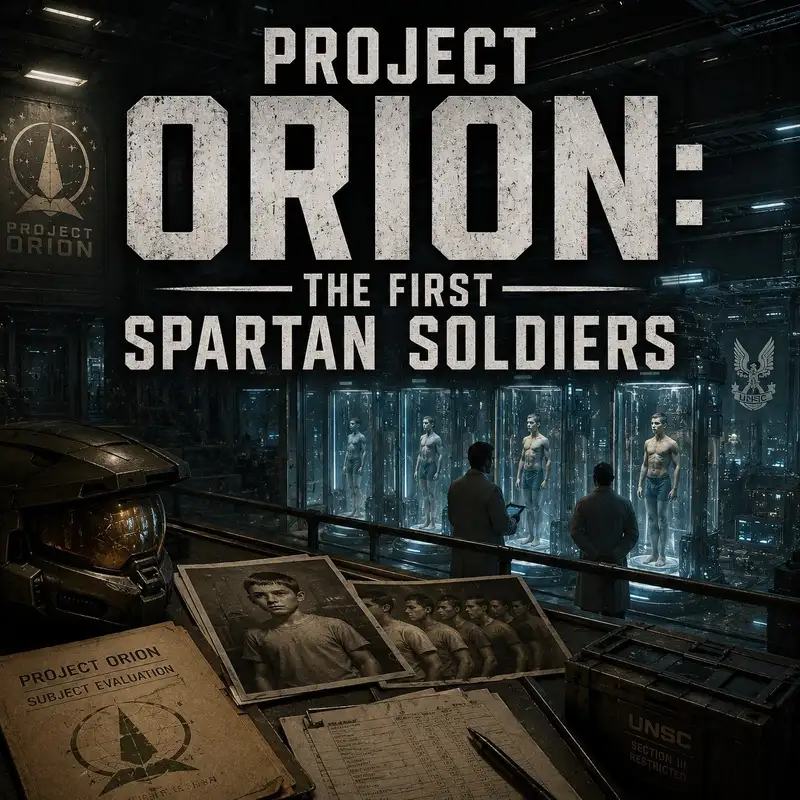
Project ORION: The First Spartan Soldiers
On January twelfth, twenty-four ninety-six, an entire unit of augmented soldiers moved against a suborbital transit station above Eridanus Two. Their mission was to recover the facility during Operation Charlemagne without revealing that the government possessed a new kind of operator. They completed the assault with one casualty and left no surviving witness able to identify who had taken the station. The tactical report was almost embarrassingly successful. The political problem below remained unresolved, and the soldiers themselves carried medical damage that no after-action summary could erase. Project ORION had produced humanity’s first supersoldiers. It had not produced a solution to the Insurrection.
The people later called Spartan Ones were not known by that name when they entered service. They were ORION operators, adult military volunteers selected from experienced Marines and other special forces personnel, then altered through experimental biochemical procedures. They did not wear the Mjolnir armor associated with later Spartans. They were not raised from childhood for a single purpose. They looked much more like conventional soldiers, which made their abilities easier to conceal and their suffering easier to classify. ORION’s importance lies in that contradiction. It proved that human performance could be deliberately enhanced for war, while demonstrating how quickly strategic urgency could turn serving personnel into laboratory material.
ORION’s roots reached back long before the Insurrection became an undeclared civil war. Before the great expansion beyond the Solar System, the Unified Earth Government funded speculative research intended to support the security and survival of future colonies. Doctor Ritsa Shephard and the KYKLOS Working Group explored biochemical methods of increasing a soldier’s effectiveness. The formal first effort was activated on April thirteenth, twenty-three twenty-one under the Office of Naval Intelligence and the Colonial Military Administration. The objective was practical rather than mythic. Colonial troops operating far from Earth needed greater endurance, sharper senses, and better performance where reinforcement and advanced medical care might be months away.
That first phase was small. At least five elite troops received experimental treatments intended to improve combat capability. The procedures produced inconsistent results, poor reliability, retention problems, and costs that the program could not justify. The operators were returned to ordinary service after the effort was closed, but all five died within the following year for reasons the surviving record does not fully explain. Later investigators found that important files from the period had degraded, vanished, or remained encrypted. ORION’s first lesson was therefore not a technological triumph. It was that a secret program could fail, disperse its personnel, and leave history with fewer answers than casualties.
The project remained dormant while human colonies multiplied and the relationship between the core and the frontier deteriorated. By the late twenty-fifth century, separatist movements had become armed networks capable of sabotaging infrastructure, infiltrating government offices, and contesting entire systems. The Colonial Military Administration was losing authority to the regular United Nations Space Command while also struggling to defend its own facilities from rebels. In that environment, ORION offered an attractive promise. A small number of superior operators might attack leadership, recover sensitive assets, and perform missions that conventional forces could not execute discreetly. The program was secretly relaunched on January twenty-ninth, twenty-four ninety-one.
The command arrangement reflected the politics of the era. ORION was administered through the Office of Naval Intelligence’s classified research structure, executed with the Colonial Military Administration, and placed operationally under Naval Special Warfare. Rear Admiral Pranav Sabanis directed the second phase, while facilities associated with the program operated from orbital infrastructure around Reach. This distribution of authority protected secrecy and provided access to scientists, military recruiters, and special-operations planners. It also made accountability wonderfully difficult, which is often the point of a compartmented organization. Success could belong to everyone. Medical failure, unlawful conduct, and political consequences could remain inside separate files.
Unlike the later Spartan Two program, ORION recruited adults who were already serving. The initial intake included sixty-five volunteers drawn from highly capable military personnel. After they completed training and augmentation, another hundred were accepted, and the active roster eventually rose to roughly three hundred at its height. By the program’s closure, one hundred sixty-five surviving participants remained. The records do not divide every missing name neatly among death, medical removal, discharge, incarceration, and reassignment. What is clear is that ORION did not need to teach its candidates basic military identity. It selected people who already understood orders, weapons, field discipline, and the risks of special operations.
Volunteer status matters, but it does not settle the ethical question. These service members chose to enter a classified program, unlike the children abducted for the later Spartan Two project. Their ability to consent depended on what they were told about procedures whose risks were not fully understood by the scientists administering them. Military volunteers can accept danger. They cannot evaluate dangers deliberately concealed from them or unknown to the institution making the offer. ORION was less coercive than its successor in recruitment, yet it still placed secrecy, mission demand, and institutional ambition above transparent medical accountability.
Training combined laboratory conditioning with the skills expected of elite raiders. Candidates endured severe physical and psychological testing, learned unfamiliar techniques at accelerated rates, and trained for direct action, unconventional warfare, counterinsurgency, and black operations. Individual operators developed specialties such as precision shooting, orbital insertion, close-quarters combat, reconnaissance, and clandestine entry. The aim was not to create a ceremonial guard or a visibly separate branch. ORION teams were designed to penetrate an insurgent system, identify the critical person or object, act quickly, and disappear before the enemy understood that a strategic asset had been committed.
The biochemical program attacked several limits at once. Muscular enhancement treatments sought greater strength and physical output. Pulmonary procedures improved respiratory performance and endurance. Retina-focused injections and cochlear tuning attempted to sharpen vision and hearing. Neural and cognitive interventions were intended to improve learning speed, motor control, reaction, and the coordination between perception and movement. None of these changes alone created a supersoldier. The concept depended on layering modest advantages onto personnel who were already exceptional. A faster reaction mattered because the operator also possessed the training to recognize the correct target. Better endurance mattered because the mission still required hours of movement, surveillance, or escape.
The body did not always cooperate with the briefing. Adult candidates varied in age, genetics, prior injuries, and response to treatment. ORION’s screening methods were not precise enough to predict who would tolerate every procedure. Immunosuppressive measures failed in many subjects, and some modifications produced genetic fragmentation or degenerative conditions rather than stable improvement. One surviving medical record for candidate zero forty-seven indicates a lethal reaction associated with dioxin poisoning during an augmentation process. The case is a useful warning against treating the program as a smooth progression toward Mjolnir-clad perfection. Experimental medicine develops through data, and some of ORION’s data had names.
Even successful candidates described the process as agony. Hormonal disruption could produce confusion and violent rage. Some operators later suffered severe psychological instability, post-traumatic stress, or worsening physical conditions. A number of participants whose sympathies remained with the colonial cause refused further service after augmentation and were imprisoned. That response combined a counterintelligence concern with a moral disaster. The government had altered their bodies, discovered that it could not control their political loyalties, and then treated refusal as a security threat. ORION could improve reflexes. It could not chemically manufacture consent.
The resulting operators were formidable, but they were not later-generation Spartans in older uniforms. Their enhancements improved strength, speed, agility, senses, and reaction time, yet the effects were often subtle enough that a former ORION soldier could pass among ordinary personnel without attracting attention. They lacked routine access to compact fusion-powered Mjolnir armor and energy shielding. Small-arms fire, explosives, fatigue, and bad intelligence remained dangerous. Their advantage came from cumulative margins: a little faster, a little stronger, harder to surprise, better able to learn, and experienced enough to use those gains before an opponent could recover.
ORION’s planners understood that an enhanced body was only one part of a complete weapon system. Parallel research examined armor, software interfaces, weapons, and new training methods. Project MELAENO attempted to create a powered exoframe that could increase protection and carrying capacity without becoming a laboratory curiosity too expensive to deploy. Prototype ORION armor included concepts for integrated countermeasures and small missile or decoy systems, while test components were evaluated on Mars and during field operations. Most designs never matured into standard equipment. The program had captured the idea of combining hardware and biology. It lacked the power systems, materials, control architecture, and funding needed to make the combination reliable.
This limitation shaped ORION doctrine. Operators were best used in small, intelligence-driven missions where surprise multiplied their physical advantages. They could seize a station, penetrate a headquarters, destroy a facility, or kill a leader. They were less useful as conventional assault infantry holding terrain against massed resistance. Every operator represented years of training, specialized medical investment, and classified knowledge. Losing one in a routine firefight was not merely a casualty. It was the destruction of a scarce program asset and a potential security breach. ORION teams therefore selected battles that justified their exposure, even while the wider counterinsurgency kept generating more targets than they could service.
Operation Charlemagne provided the ideal demonstration. On January twelfth, twenty-four ninety-six, the full available ORION unit deployed to recover the transit station above Eridanus Two. The force completed the mission with one casualty and without public identification. It was the only known occasion on which ORION committed an entire unit together. That fact matters. The famous result was achieved through concentration, surprise, and a carefully selected objective, not by scattering supersoldiers across every contested district. The raid created rumors of government operatives beyond normal human capability. Secrecy hid the unit, but success created a legend anyway.
The same year, an ORION team took part in Operation Veritas and recovered a list identifying Secessionist Union agents working under nonofficial cover inside senior Colonial Military Administration offices. The intelligence discovery helped expose the scale of insurgent penetration and accelerated the United Nations Space Command’s absorption of the colonial military. ORION had protected the government by revealing that its sponsor was compromised. It also damaged the institutional structure funding and supporting the project. This was a thoroughly intelligence-service outcome: the operation succeeded, the target network was exposed, and the organization responsible lost part of the bureaucracy it needed to survive.
As Operation Trebuchet expanded, ORION teams were used against rebel cells, commanders, and infrastructure across the colonies. They proved capable of removing specific threats soon after intelligence located them. The strategic environment still worsened. Insurgent organizations became more disciplined, dispersed, and effective at hiding among civilian traffic and sympathetic communities. Bombings continued. Government raids produced their own civilian casualties and resentment. An augmented team could destroy a bomb workshop or capture a courier. It could not provide political representation, reform colonial trade, or convince a population that central authority was legitimate. ORION repeatedly solved the mission placed in front of it while the campaign generating those missions grew larger.
Operation Kaleidoscope in twenty-five oh two illustrates both the precision and the narrowness of that success. On Harvest, ORION personnel targeted leaders of the Secessionist Union as part of a wider effort to dismantle rebel strongholds. Corporal Avery Johnson, supported by a spotter, positioned himself above a route used by Jerald Mulkey Ander. Johnson fired an M ninety-nine Stanchion special applications rifle through the target’s moving vehicle and killed him. The operation removed an important separatist leader with minimal friendly exposure. It did not remove the grievances, networks, or armed factions that had made Ander influential.
Johnson became ORION’s most famous survivor, but he should not be mistaken for the entire program. His later career demonstrated the value of its training and the durability some candidates gained. He remained an effective Marine for more than four decades after ORION closed, fought through the Human-Covenant War, and provided the kind of experienced leadership no laboratory could manufacture. His toughness was not evidence that every augmentation worked as intended. It was evidence that one unusually capable operator survived the procedures, adapted to their consequences, and continued serving after the institution that altered him had moved on.
The official diagnosis called Boren’s Syndrome became a cover for the lingering effects of ORION augmentation. That cover later created confusion about Johnson’s survival during the Flood outbreak on Alpha Halo. He was not protected by a convenient biological immunity. He escaped through combat skill, experience, and considerable determination, while traces of Flood material on his clothing and skin prompted dangerous speculation from investigators. The correction matters because ORION should not be granted a capability it never possessed. The project made Johnson harder to kill. It did not make him immune to the central biological threat of the Halo universe.
By twenty-five oh six, ORION’s costs, medical failures, declining performance, and limited strategic effect had become impossible to disguise inside favorable mission reports. Operation Tanglewood marked the program’s final known deployment. The project was quietly deactivated, and its surviving operators were reassigned to other special-operations units or returned to conventional service. Some were later discharged because of physical or psychological complications. Others remained useful enough that the military continued employing them while hiding the source of their condition. The government closed the program, but it did not close the medical files, family consequences, or classified obligations carried by the people who survived it.
Some former operators had children affected by their parents’ altered biology. Specially formulated injections were required to prevent developmental problems, and these descendants were later informally described as Spartan One Point Ones. The term can make inheritance sound like another generation of a weapons program. For the families involved, it meant that an experimental decision made before conception followed them into civilian life. ORION’s secrecy protected methods and identities, but it also made treatment dependent on the same institutions responsible for the risk. The program’s youngest subjects had never volunteered at all.
Judged tactically, ORION produced results. Its operators completed raids, recovered intelligence, eliminated leaders, and survived missions beyond the expected performance of ordinary troops. Judged as a program, it failed to deliver a reliable, scalable, and medically stable force. Judged strategically, it failed even more clearly. The Insurrection continued after ORION closed and expanded into the conflict that Operation Trebuchet could not finish before the Covenant arrived. A supersoldier can change the odds inside a building or across a firing lane. No augmentation can make one raid equal political settlement across hundreds of worlds.
The Office of Naval Intelligence did not discard the research. Doctor Catherine Halsey studied the earlier program while developing a far more ambitious successor. Her project was initially conceived as ORION Two before receiving the name Spartan Two. The earlier operators were retroactively honored as Spartan Ones, but the new title also separated Halsey’s work from ORION’s reputation for disappointing results. She intended to integrate biological enhancement, advanced training, neural interfaces, and powered armor into one system rather than fielding improved soldiers with incomplete equipment. ORION had demonstrated the concept. Halsey sought to remove the limits.
The most consequential lesson drawn from ORION concerned age and genetics. Adult bodies had responded unpredictably, so the successor program selected prepubescent candidates possessing extremely specific genetic markers. That choice improved the probability that radical augmentations would take hold. It also led the state from recruiting volunteers to abducting children, replacing them with short-lived flash clones, and shaping their identities before they could refuse. Technically, this was an answer to ORION’s medical problems. Politically and morally, it was an escalation. The failure of one secret program did not produce restraint. It produced a more tightly controlled population of subjects.
ORION also left a hardware and doctrinal inheritance. Exoframe studies contributed data later useful to Mjolnir powered assault armor and to semi-powered infiltration systems. Its work on range of motion, protection, integrated systems, and soldier-machine interaction helped define problems later engineers solved with better materials and compact power sources. The operators’ combat performance influenced the organization and employment of elite conventional forces, including the development of Orbital Drop Shock Trooper capabilities. None of this means ORION directly produced every later system. It provided costly experiments, partial answers, and a record of failures that competent designers could avoid repeating.
Decades of biomedical progress eventually allowed the Spartan Four program to revisit ORION’s original adult-volunteer model with far greater success. Experienced service members could be augmented after reaching maturity and paired with modern Mjolnir armor without relying on the narrow childhood selection used for Spartan Twos. That achievement did not vindicate ORION’s procedures. It showed how far medicine, cybernetics, materials science, and institutional support had advanced. The first program wanted adult volunteers because they were available immediately. The later program could use adult volunteers because the technology had finally become capable of meeting the promise with acceptable reliability.
Project ORION created the first Spartan soldiers because the government wanted a tactical instrument faster than it could create a political solution. The operators were volunteers, professionals, and in many cases exceptional warriors before a scientist touched them. Their augmentations made them more capable and also left some damaged, unstable, imprisoned, or dead. Their best missions proved that enhanced personnel could deliver precise violence with extraordinary efficiency. Their program proved that precision violence remained violence, and that the removal of a leader or recovery of a station did not resolve why colonies were rebelling.
The revealing image is not a giant in green armor. It is an adult soldier leaving a laboratory on Reach in equipment that still resembles ordinary combat gear, carrying abilities most people cannot see and injuries the government has renamed. That soldier may seize a station, uncover a spy network, or kill a separatist commander from beyond the range of return fire. The mission can succeed completely. The war can continue unchanged. ORION’s legacy was the discovery that humanity could manufacture better soldiers. Its failure was the belief that better soldiers could compensate for a strategy that kept producing enemies faster than any supersoldier could remove them.