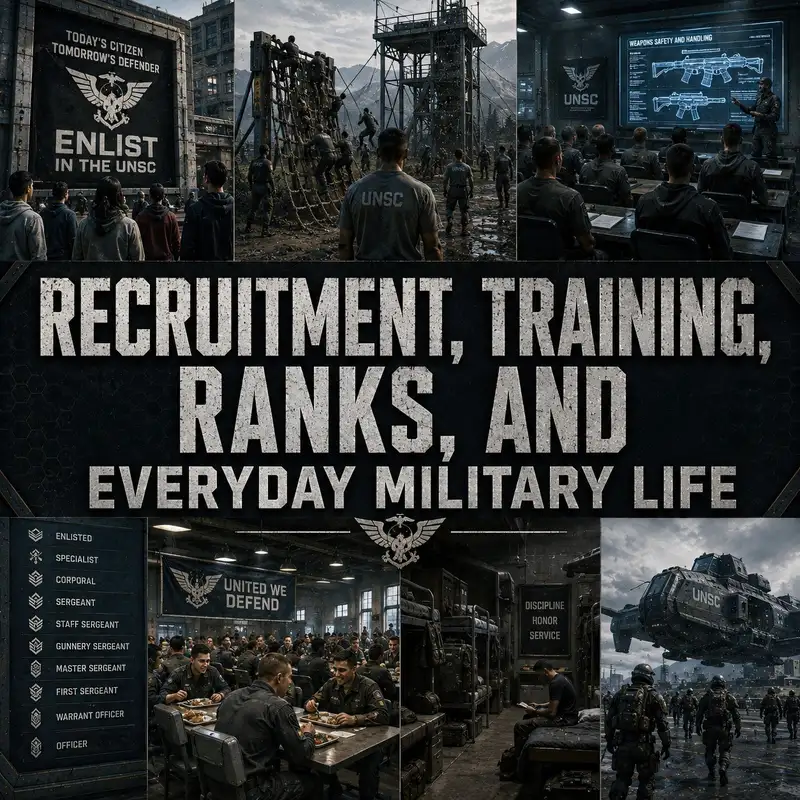
Recruitment, Training, Ranks, and Everyday Military Life
On November third, twenty-four eighty-eight, Petty Officer Second Class L. P. Graves completed an evaluation of a Navy recruit at Unified Combined Military Boot Camp Sierra Largo. Crewman Recruit Preston Cole had produced an average physical score, an above-average weapons score, and an exceptional assessment of command potential. Graves recommended placing him on the noncommissioned-officer track before a technical specialty or officer academy claimed him. The evaluation did not predict the fleets Cole would later command. It decided what the military should do next with one young person.
That was the personnel problem behind every United Nations Space Command campaign. Ships, aircraft, armored vehicles, orbital guns, and artificial intelligences only became military power when trained people operated them inside a functioning chain of command. Recruitment brought those people into the institution. Training gave them a common standard. Rank distributed authority. Everyday military life kept the force ready between the moments history remembered. The result was not an army of heroes. It was a system intended to produce reliable service members faster than distance, casualties, and war could consume them.
People entered that system for different reasons. Some wanted technical education, steady employment, travel, or advancement beyond the opportunities available on their homeworld. Others came from military families or colonial militias. Service could offer an escape from poverty, corporate dependency, or a future already chosen by local circumstance. During the Insurrection, one recruit might believe the uniform protected civilians from terrorism, while a colonist saw the same uniform as distant coercion. The recruiting station could promise purpose without resolving what that purpose meant politically.
The legal system normally required recruits to be eighteen, though sixteen-year-olds could enlist with parental consent. Most personnel were volunteers, militia veterans, reservists, officer candidates, or wartime draftees processed through accountable institutions. The Spartan Two and Spartan Three programs violated that framework rather than representing unusually demanding versions of it. The Covenant War then changed the emotional character of recruiting. Destroyed colonies produced refugees and survivors who enlisted to defend the next world, seek revenge, or find structure after losing everything familiar.
Enlisted recruits entered the Unified Combined Military Boot Camp system. The program was joint rather than completely separate for each branch, creating a common foundation before service-specific training began. Recruits held the lowest pay grade while in training and advanced after graduation and assignment. Facilities existed on Earth, Reach, and other human worlds. Their purpose was consistent: take civilians from different planets, cultures, educational systems, gravity environments, and political traditions, then teach them enough shared procedure to function inside one force.
The curriculum tested more than endurance. Recruits completed physical assessments, firearms evaluation, psychological screening, and an aptitude process intended to identify command potential. They also learned practical skills such as vehicle maintenance and off-road driving. The recruit had to shoot, move, follow instructions, recognize hazards, care for equipment, and remain reliable under stress. Cole's evaluation showed why the system measured several qualities. A future admiral could be physically average and still possess the judgment, discipline, and initiative the service needed.
Boot camp standardized behavior. Recruits learned how to report, wear the uniform, secure weapons, respond to alarms, and obey lawful orders. They also learned to depend on people they had not chosen. A bridge watch, maintenance section, or fireteam could not be built from friendship alone. After graduation came specialty training. Navy recruits completed additional vacuum and microgravity instruction. Marines, soldiers, and aviators entered pipelines for infantry, engineering, security, communications, medicine, mobility, maintenance, surveillance, flight, and orbital defense.
Training continued after assignment because technology, missions, and crews changed. Ships drilled evacuation, damage control, boarding defense, weapons release, and destruction of navigation data under the Cole Protocol. Ground units rehearsed communications loss, casualty evacuation, anti-armor defense, and air support. Pilots repeated emergency procedures until the response could survive panic. Technicians practiced isolating failures before a reactor, drive, or life-support system carried the rest of the installation with it. The enemy did not need to be present for readiness to decline. Time and neglect could manage that alone.
The officer path ran through Officer Candidate Schools that accepted civilians and experienced enlisted personnel. Their programs combined military science, physical training, field exercises, technical study, and leadership. A commission came through the authority of the Unified Earth Government and required an oath. It made the officer legally responsible for personnel and resources placed under that command. The insignia did not merely indicate better pay or a more comfortable briefing room. It marked accountability for decisions other people would have to execute.
After twenty-four eighty-nine, officer applicants were expected to have field experience. Junior officers could quickly become responsible for irreplaceable equipment, hundreds of lives, and civilians trapped inside military operations. Classroom excellence did not prove that a candidate could recognize an exhausted unit or an impossible evacuation schedule. The academies also reflected human inequality. Grades and militia experience improved access, but family status and political connections could matter, especially at prestigious institutions associated with senior military and government families.
Rank translated the personnel system into a chain of command. Naval Command used naval titles for the Navy and Office of Naval Intelligence. Unified Ground Command used a ground-force system across the Army, Air Force, and Marine Corps, with branch variations. Both divided personnel among enlisted members, noncommissioned officers, warrant officers, and commissioned officers. The titles differed, but the requirement did not. Someone performed the work, someone supervised it, someone supplied technical authority, and someone accepted command responsibility.
In the Navy, crewmen entered work sections before advancing through the petty-officer ranks and into the chief community. Petty officers led work parties, supervised compartments, and managed divisions. Chiefs oversaw broader portions of the ship and preserved experience that no artificial intelligence could manufacture on demand. Ground-force careers moved from private through corporal into the sergeant ranks. Corporals led fireteams, sergeants led squads, and senior noncommissioned officers translated an officer's intent into movement, maintenance, security, and discipline.
These leaders formed the practical center of everyday military life. A platoon could receive a new lieutenant, but it could not replace twenty years of judgment by changing a name on the duty roster. A chief knew which safety procedure existed because of a previous casualty. A gunnery sergeant knew which squad could carry another task and which one was about to fail. Noncommissioned officers enforced standards close enough to see whether the standards were producing readiness or only attractive reports.
Warrant officers occupied the technical space between enlisted and commissioned authority. They served as crew chiefs, pilots, engineering experts, advisers, and sometimes commanders of smaller utility vessels. The Air Force did not use them, and they were uncommon in the Marine Corps, but elsewhere they preserved expertise that did not fit ordinary promotion paths. The organization needed officers who could command. It also needed someone who understood why the same drive fault had returned after three repairs.
Commissioned officers progressed from initial postings into command of sections, companies, ships, battalions, battle groups, and fleets. Naval ensigns and junior lieutenants learned departments before commanding vessels. Ground-force lieutenants and captains led platoons and companies before higher responsibility. Rank and position were related without being identical. A ship's commanding officer was addressed as captain even when holding a lower formal rank, while a Navy captain could serve on a staff without a ship. Authority depended on rank, billet, mission orders, and circumstance.
War disrupted the orderly version of that system. Casualties created acting commanders. Promotions arrived faster because positions were empty, not because individuals had received every experience normally expected before advancement. Units absorbed survivors from destroyed formations. Specialists became leaders because no one else understood the equipment. Junior officers inherited ships, bases, and evacuation sectors after senior headquarters disappeared. Rank preserved lawful succession, but it could not provide the lost staff, communications, or confidence that had made the previous commander effective.
For most personnel, daily service did not resemble decisive campaign scenes. It consisted of watch rotations, inspections, physical training, maintenance, briefings, inventories, weapons checks, cleaning, meals, and repeated preparation for events that might never occur. On a ship, someone monitored propulsion, communications, tactical systems, atmosphere, navigation, and power at every hour. On a base, someone guarded the perimeter, repaired vehicles, tracked supplies, processed reports, and ensured aircraft could launch. Readiness accumulated through tasks too small for the battle summary.
Shipboard life was constrained by design. Warships included mess halls, armories, hangars, cryogenic facilities, medical spaces, and crew quarters, but every cubic meter competed with ammunition, machinery, stores, armor, and life support. Some destroyers had cramped quarters, and extra personnel could force sailors to share sleeping pods across different watches. Privacy was limited. A sailor's home might be a narrow berth beside machinery powerful enough to move a city-sized object through space, provided the engineering watch kept it functioning.
Cryogenic travel changed the experience of time. Personnel could spend long portions of interstellar transit asleep, reducing aging and supply consumption. Their families and civilian communities continued living while the ship crossed between assignments. A service member might leave a colony, sleep through much of the journey, fight elsewhere, and return after months or years had passed across several deployments. Military records counted service chronologically. The individual experienced part of it as repeated awakenings into another emergency.
Ground service offered more space but not always more stability. Army and Air Force personnel could live for years near the colonies they defended, using permanent barracks, depots, airfields, and training grounds. Marines rotated between ships, stations, garrisons, and expeditionary deployments. Reservists and militia personnel often served near home until the war moved through that home. The difference between garrison and battlefield could be one warning from orbit, followed by orders to turn familiar roads and warehouses into a defensive network.
Maintenance defined military life because Halo's technology remained physical. Rifles needed cleaning. Vehicles required parts. Pelicans needed inspection. Armor seals had to be tested. Reactors, slipspace drives, sensors, and environmental systems demanded technicians. Artificial intelligence could diagnose faults and schedule work, but someone still had to enter the compartment, isolate power, remove damaged hardware, and install a component that might already be scarce. The most advanced ship in the fleet remained dependent on people carrying tools.
Training filled the spaces between maintenance and operations. Units ran live-fire exercises, tactical simulations, vehicle drills, and combined-arms rehearsals. Postwar installations offered sophisticated War Games environments, but older forces relied on ranges, mock structures, maneuver areas, and repeated field problems. Good training created habits that survived confusion. Poor training created confidence that disappeared when the enemy behaved differently from the exercise controller.
Food, water, air, sleep, and medical care were military resources before they were comforts. A ship's life-support section determined how long the crew could remain aboard. Ground logisticians decided whether a battalion could keep moving. Medical personnel treated disease, burns, decompression, plasma trauma, and the ordinary injuries produced by heavy work. A unit could possess ammunition and still fail because its people had not slept. Equipment status was easier to measure than exhaustion among the personnel maintaining it.
Contact with home depended on distance, security, and whether a communications route survived. Messages could be delayed, censored, or overtaken by events. Personnel on classified operations often could not explain where they were or what they had seen. Families might know that a ship had stopped communicating without knowing whether it was destroyed, missing in slipspace, or operating under silence. A service member could receive a message from a homeworld after the military already knew that world had fallen.
The institution regulated personal behavior as well as duty. The military code restricted alcohol use, fraternization with civilians, and relationships across officer and enlisted boundaries. The Uniform Code of Military Justice governed obedience, truthfulness to superiors, misconduct, and punishment. These rules protected discipline and reduced abuses of authority, though enforcement depended on commanders and circumstance. A regulation could be precise in garrison and far harsher during a collapsing campaign. Law followed the force into space. Human inconsistency came aboard without additional cargo charges.
Personnel still created ordinary culture inside those limits. They ate together, played games, exercised, listened to music, argued over branch identity, and developed unit traditions. Dress uniforms appeared at ceremonies, promotions, memorials, and official events. Working uniforms and battle dress belonged to daily routine. Sailors, Marines, soldiers, and aviators developed separate slang because each experienced the same war through different systems. Interservice rivalry gave people something manageable to complain about when the strategic situation offered subjects considerably less amusing.
The rivalry reflected real differences. Sailors could view ground forces as passengers who consumed space and damaged equipment. Marines saw ship crews as people who transported them toward danger and remained aboard. Army personnel defended worlds after naval planners considered withdrawal. Air Force crews depended on ground bases while fighting toward orbit. Joint command worked when those perspectives became complementary. It failed when one branch mistook its portion of the campaign for the entire war.
Artificial intelligence reduced administrative overhead across the force. Personnel systems processed assignments, readiness data, maintenance schedules, and routine coordination faster than human staffs. That allowed junior officers and senior enlisted leaders to hold greater responsibility and supported a high proportion of fighting personnel. It did not remove bureaucracy. It accelerated it. A flawed readiness report could travel instantly, and an automated assignment could place a technically qualified person in a unit whose real needs were invisible to the database.
The Insurrection gave ordinary service a political weight many recruits had not expected. A checkpoint, patrol, boarding inspection, or intelligence report could affect civilians who viewed the military as an occupying power. Personnel were expected to distinguish armed rebels from local populations inside communities where support, fear, and resentment overlapped. Some units protected people from terrorism. Others enforced policies that deepened opposition to Earth. The service member rarely wrote those policies, but often became the person required to explain them at rifle range.
The Covenant War replaced that ambiguity with an enemy committed to humanity's destruction, but military life did not become simpler. Training establishments had to replace casualties while experienced instructors and equipment were needed at the front. Units prepared for counterinsurgency and found themselves fighting shielded aliens, defending evacuation routes, and destroying their own navigation data. Recruits learned from veterans who had survived battles no manual anticipated. Every new lesson carried the name of a world where someone had learned it too late.
Long war created uneven experience. A recruit might join a squad led by a corporal who had survived several destroyed colonies. A new officer could command veterans older in service and more familiar with the enemy. Replacement personnel entered ships whose crews had stopped learning every name because turnover made the effort painful. Promotions preserved the organization while grief hollowed out the relationships that had once made the unit coherent.
Memorials, decorations, casualty lists, and missing-person classifications became routine administration. The dead had equipment to recover, records to close, families to notify, and positions to fill. The wounded could return, move into noncombat roles, or retire into a society struggling to rebuild. Personnel whose homeworlds had been glassed could complete a deployment with nowhere familiar to take leave. The military provided structure after loss, but it also kept people inside because civilian life no longer offered a place to return.
Support personnel carried as much of the force as the fighters. Cooks, medics, quartermasters, engineers, analysts, controllers, pilots, drivers, mechanics, and shipyard workers determined whether combat units could operate. Infantry faced more visible danger. The maintenance crew beside a damaged reactor, the controller routing evacuation traffic, and the medical team aboard an overloaded transport faced different risks. Campaigns are remembered through attacks. They are sustained through occupations that rarely receive names.
The end of the Covenant War allowed some veterans to retire, reconnect with families, or discover that civilian life no longer fit. Others returned when new conflicts emerged. Experienced personnel became candidates for the Spartan Four program, but only a small portion entered augmentation. The conventional branches still required leaders, technicians, crews, and instructors. A military cannot promote every excellent sergeant into a supersoldier without eventually discovering that no one remains to train the platoon.
The Created uprising and Banished attacks stripped away systems that had made postwar service appear more advanced. Networks became untrustworthy. Headquarters were isolated. Ships and bases lost supply. Personnel operated under old orders and local command. In those conditions, boot-camp habits, technical competence, and junior leadership mattered more than polished plans. The recruit trained to maintain a vehicle and act without constant supervision was not receiving secondary instruction. That person was being prepared for the day the larger system failed.
Recruitment, training, rank, and daily life formed the hidden machinery of the United Nations Space Command. Recruitment decided who entered and why. Training turned difference into common procedure. Rank assigned responsibility without guaranteeing wisdom. Routine preserved equipment, discipline, and trust until crisis demanded them. The system produced commanders such as Preston Cole, but its larger achievement was producing the far larger body of personnel whose names never reached a history book.
Cole's evaluation at Sierra Largo did not identify a future legend. It identified a recruit who followed orders, worked hard, understood weapons, and showed unusual command potential. That was enough to justify another school and another assignment. Every military career began with a similar wager: that training and responsibility could turn potential into useful service before war, distance, bureaucracy, or loss intervened. The United Nations Space Command survived because that wager succeeded often enough. It paid for every failure with people it had spent years teaching how not to be replaceable.