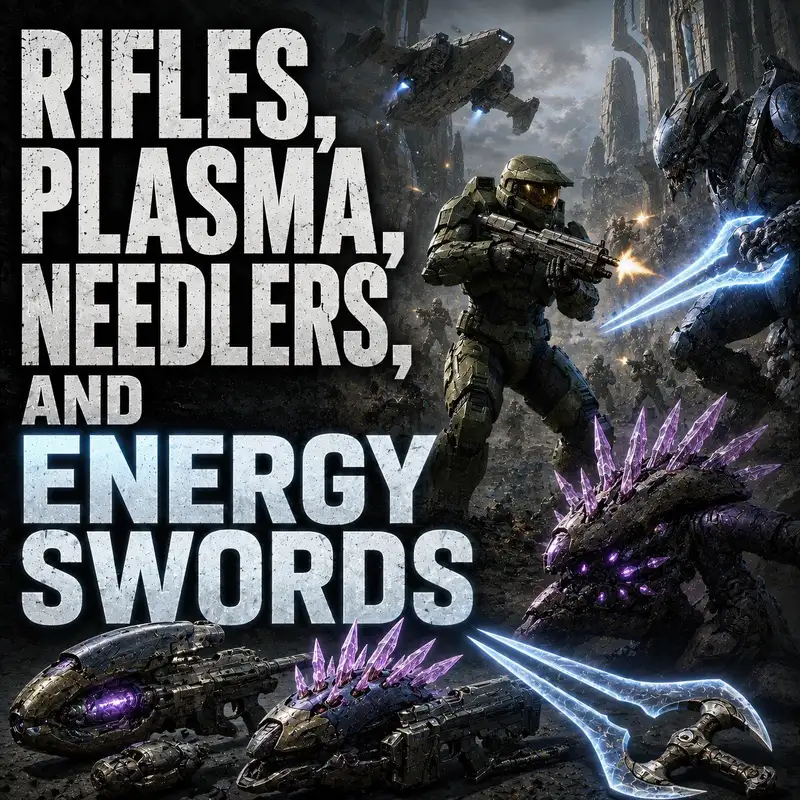
Rifles, Plasma, Needlers, and Energy Swords
At Alpha Base on Installation Zero Four, every serviceable weapon and usable magazine recovered from the wreck of the Pillar of Autumn became part of the defense. The survivors had no functioning supply line, no friendly ship in orbit, and no guarantee that another human vessel would ever find them. Covenant weapons lay across the ring in growing numbers. They could be picked up and fired. They could not be folded neatly into the logistics system that had arrived with the Marines.
That difference is the key to understanding infantry weapons in Halo. A weapon is not only a method for injuring an enemy. It is ammunition, power, training, maintenance, doctrine, transport, and industrial policy carried in two hands. Human rifles, Covenant plasma arms, Needlers, and energy swords all solved different battlefield problems. None was universally superior. Each became dangerous when used by the force whose organization, culture, and supply network had been built around it.
Humanity entered the Covenant War with firearms that would have been recognizable in principle to soldiers from much earlier centuries. The materials, electronics, manufacturing, and ammunition had improved, but the basic arrangement remained familiar. A magazine fed cartridges into a mechanical action. Expanding gas or another operating system cycled the weapon. A projectile left the barrel at high velocity. The rifle could be cleaned, repaired, reloaded, and issued in enormous numbers by an industrial civilization that already knew how to support it.
The M A five family became the most visible example. Different models served across branches, colonies, and decades, including the M A five B carried aboard the Pillar of Autumn, the M A five C used later in the war, the M A thirty-seven associated heavily with Army service on Reach, and the M A forty seen in the final years before the battle at Zeta Halo. These were not identical weapons and did not replace one another everywhere at once. Armies rarely discard every older rifle merely because a procurement office has discovered a newer designation.
Their shared purpose was dependable automatic fire at short and medium distances. An assault rifle let a Marine suppress a doorway, cover a movement, engage several targets quickly, and remain useful in ships, cities, forests, and landing zones. Controlled bursts improved accuracy and conserved ammunition. Full automatic fire offered volume when the situation required it. The integrated ammunition counter and electronic links made the rifle easier to manage, but they did not remove recoil, dispersion, or the need to identify what was standing beyond the target.
Battle rifles answered a different requirement. Weapons such as the B R fifty-five and later B R seventy-five emphasized precision at medium and longer infantry ranges. Their burst fire and optical systems allowed trained personnel to exploit brief exposure, strike vulnerable areas, and finish opponents whose shields had already been weakened. Designated marksman rifles extended that approach with semiautomatic fire and greater emphasis on deliberate shots. The distinction mattered because a squad did not need every weapon to solve the same problem.
Human rifles offered three advantages that are easy to overlook when comparing muzzle effects. The first was familiarity. Recruits could be trained through established marksmanship programs. The second was production. Factories across human space could manufacture rifles, magazines, cartridges, replacement barrels, optics, and cleaning equipment. The third was distribution. A crate of ammunition could be counted, loaded onto a Pelican, divided among squads, and carried into battle without requiring the user to understand alien power systems.
Human fire-control aids strengthened that system without replacing it. Rifles could connect to helmet displays, armor sensors, and optical sights, allowing the shooter to see ammunition status and aiming information while remaining behind the weapon. Spartans benefited from deeper integration through Mjolnir, but ordinary personnel also used electronics to improve coordination. Those systems still depended on calibration, batteries, communications security, and the user’s judgment. A reticle could show where the rifle was pointed. It could not determine whether the contact was an enemy, a civilian, or a friendly soldier moving through smoke.
Those advantages did not make bullets ideal against Covenant forces. Energy shields could absorb repeated impacts before the wearer’s armor or body became vulnerable. Covenant troops also varied greatly in size, protection, and anatomy. A burst that might kill an unshielded Unggoy could have a very different effect on a shielded Sangheili or a Mgalekgolo bond protected by heavy armor. Human squads compensated through concentrated fire, grenades, heavier weapons, precision shooting, and cooperation. The rifle was part of a system, not an argument that every target should be engaged in the same way.
Ammunition weight imposed another limit. Magazines occupied space and became useless when empty. A rifleman could carry only so many rounds without sacrificing water, medical equipment, batteries, explosives, or mobility. Sustained automatic fire could consume a load rapidly. Resupply required vehicles, dropships, stockpiles, and secure routes. The rifle remained reliable only because an extensive logistics organization kept placing the correct ammunition near the person expected to fire it.
Covenant plasma weapons approached the same battlefield from another technological tradition. A plasma rifle or plasma pistol did not launch a metal bullet. It generated and projected superheated plasma, shaped and directed by advanced electromagnetic systems. The bolt carried intense thermal energy. Against shields, armor, equipment, and living tissue, the result could be devastating. Human personnel encountering this fire for the first time discovered that body armor designed for fragments and bullets offered only limited reassurance against a weapon capable of transferring extreme heat into the surface it struck.
Plasma was especially effective against energy shielding. Repeated bolts could overload a shield faster than many human small arms, opening the target to a follow-up attack. The plasma pistol concentrated that principle in a compact weapon. Standard fire provided short-range energy attacks. A charged shot could deliver a much greater pulse and strip many personal shields in one impact. Some patterns and eras also allowed charged plasma fire to disrupt vehicle electronics. That effect should not be assigned to every model simply because several battlefields produced it.
The plasma rifle delivered sustained automatic fire at close and medium range. It needed no conventional magazine, but it was not free from ammunition concerns. Its internal power supply was finite, and its operating temperature had to be controlled. Rapid fire generated heat until the weapon forced a cooling cycle or became unreliable. A disciplined user fired bursts, managed the temperature, and preserved power. An inexperienced user could produce an impressive stream of blue light followed by a weapon that had chosen the least convenient moment to become a hand warmer.
The medical and engineering consequences were equally important. Ballistic wounds were terrible, but human medics had centuries of doctrine for controlling bleeding, stabilizing fractures, and moving casualties. Plasma added deep thermal injury, burning equipment, damaged seals, and fires inside vehicles or ships. A bolt did not have to penetrate completely to remove a soldier from the fight. Heat transferred through armor could injure the wearer, destroy electronics, and make the surrounding position unsafe. The weapon attacked the person, the protective system, and sometimes the terrain at the same time.
Covenant industry supported those weapons through assembly forges, power systems, specialist maintenance, and long-established patterns. Human soldiers could capture a plasma rifle and use its remaining charge. They could not normally insert a standard human battery, replace a damaged field generator from a Marine repair kit, or recharge every depleted weapon in a forward position. Covenant logistics saw a reusable energy arm. A stranded human squad often saw a temporary capability with an unknown remaining life.
The weapon’s ergonomics created further friction. Controls, grip geometry, status displays, heat warnings, and balance reflected the species and military system for which the design had been produced. Many Covenant arms could be used by humans, particularly Spartans with the strength, sensors, and time to adapt. Use did not equal mastery. A captured weapon could solve the next engagement. It did not instantly produce a training program, a technical manual, or a spare-parts inventory.
Plasma weapons also carried tactical disadvantages. Their bolts were visible and their thermal signature difficult to conceal. Heat management limited sustained output. Internal charge could not always be replenished at the point of use. Different plasma weapons had different effective ranges, firing patterns, and guidance. The plasma pistol, plasma rifle, plasma repeater, and pulse carbine were not one weapon with several shapes. They represented different attempts to balance range, volume, accuracy, cooling, and power consumption.
The Needler was stranger because it combined a firearm’s ammunition problem with guided alien projectiles. Its ammunition consisted of blamite crystals mined on Suban, one of the moons of Sanghelios. The weapon launched crystalline shards that could track a target within their intended engagement envelope. When enough shards struck or embedded in quick succession, they could supercombine into a violent secondary explosion. The Needler did not simply place holes in a target. It created the conditions for the ammunition already on the target to become the main explosive charge.
Tracking gave the weapon an important close and medium-range advantage. A target moving laterally, emerging briefly from cover, or attempting to evade could still be struck after the shard left the weapon. That reduced some demands on the shooter and increased pressure on the target. It did not guarantee a hit. Range, target movement, line of sight, acquisition quality, armor, shielding, and intervening terrain all mattered. Heavy vehicle armor and reinforced structures were not the Needler’s intended prey.
The supercombine effect rewarded concentration. Scattered impacts across several enemies produced less value than a rapid cluster on one vulnerable target. A trained user therefore had to understand when the weapon had acquired the correct opponent and when continued fire was wasting crystals. Against shielding, results depended on the model, the target, and the number of impacts. It is safer to describe the Needler as a specialized anti-personnel weapon than as a universal answer to every shielded soldier.
Blamite also created a supply chain unlike either human cartridges or plasma cells. The crystal was a strategic natural resource, not a substance every Covenant workshop could produce from common materials. Suban’s mines supported needle-based weaponry across generations. By the year twenty-five sixty, the Banished assault on the moon showed that the source of ammunition could become an operational objective. The Needler’s homing shards looked exotic on the battlefield. Behind them stood miners, shipping, processing, storage, and control of one violently contested moon.
Storage and battlefield handling also mattered. Blamite was valuable because it was both ammunition and a hazardous energetic material. Unharvested crystal formations on Suban could explode when disturbed, turning the mining environment itself into a tactical concern. Processed ammunition still had to move from mine to workshop, from workshop to ship, and from ship to the unit carrying the weapon. The guidance system made the final shot look almost effortless. Everything before the trigger pull was not.
The weapon’s compact form made it useful to several species and factions. Unggoy, Kig-Yar, Sangheili, Jiralhanae, human operators, Covenant remnants, and Banished forces could all employ Needler patterns under different circumstances. That did not mean they used them identically. A Kig-Yar raider might value tracking during a mobile ambush. An Unggoy formation might use concentrated volleys against exposed infantry. A Banished specialist could carry a modified pattern with improved acquisition. The technology remained consistent enough to recognize while doctrine changed around it.
Energy swords occupied the opposite end of the range problem. Their lineage extended into Sangheili history before the Covenant, with earlier weapons such as the burnblade preceding the more familiar modern form. The energy sword projected twin blades of superheated plasma from a compact hilt, held in shape by containment fields. In practical terms, it placed an intensely destructive cutting surface directly in the user’s hand. In cultural terms, it carried rank, reputation, ancestry, and the expectation that the wielder knew exactly what to do after closing the distance.
The sword was never standard equipment for every Sangheili infantryman. It was associated with senior warriors, officers, honor guards, skilled duelists, assassins, and special operators, though issue and custom varied across eras and factions. Some blades were personal heirlooms or master-crafted weapons. Bloodblades carried a more specific association with fear and covert killing. The object was therefore both armament and political language. Igniting it could announce authority, issue a challenge, or tell everyone in the corridor that the conversation had entered a less administrative phase.
Against a nearby target, the energy sword could defeat armor and personal shielding with terrifying speed. Its shape allowed cuts, thrusts, and hooking movements adapted to Sangheili anatomy and martial training. In boarding actions, urban interiors, tunnels, and other confined spaces, a skilled wielder could move through a formation before riflemen regained distance. Active camouflage made the approach even more dangerous. The weapon’s psychological effect also mattered. Troops who knew what the blade could do might break formation or fire prematurely.
The sword’s weakness was contained in the same sentence. The wielder had to reach the target. Open terrain, overlapping fields of fire, grenades, crew-served weapons, obstacles, and disciplined withdrawal could all make that approach fatal. A sword provided no suppressive fire and little influence over an enemy who remained beyond reach. Its battery or energy reserve also depleted through use. A deactivated hilt was easier to carry, but considerably less persuasive.
Training was therefore more important than the blade’s raw power. A warrior needed footwork, timing, control of distance, knowledge of armor, and the judgment to choose when a close attack offered more than a ranged one. Sangheili doctrine did not require every sword bearer to charge directly into gunfire. Skilled officers combined swords with plasma weapons, camouflage, supporting troops, and terrain. Honor did not remove tactics. It sometimes complicated them, which is a problem human militaries have also managed without the assistance of plasma blades.
Humans could use captured energy swords, and Spartans did so repeatedly. Their strength, reflexes, armor, and neural interfaces made them unusually capable with unfamiliar weapons. They still lacked the lifetime of cultural and technical training carried by an experienced Sangheili blademaster. A successful human use proved that the controls could be understood and the blade could kill. It did not make the weapon a practical replacement for rifles across the United Nations Space Command.
The most effective battlefield combinations came from understanding what each system did well. Plasma fire could collapse an energy shield. Ballistic fire could then exploit the opening with precision and conserve the more limited alien charge. Needler volleys could punish exposed movement or overwhelm a selected infantry target. An energy sword could finish a close engagement that would be dangerous to prolong. Spartans and conventional troops learned these combinations through combat, capture, and analysis, often because the original plan had already become obsolete.
That adaptation should not be confused with industrial parity. The Office of Naval Intelligence and military research organizations studied Covenant weapons throughout the war. Human engineers learned from plasma systems, shield technology, alien materials, and captured manufacturing methods. Yet a recovered plasma rifle did not reveal every stage of its production. A Needler did not provide ownership of Suban’s mines. An energy sword did not teach the traditions or precision manufacturing behind every blade. Humanity could operate many captured weapons long before it could reproduce their complete support system.
The Covenant faced a different limitation. Its weapons were technologically advanced, but access and understanding were shaped by religion, caste, and ministerial control. Assembly forges could produce large numbers of proven designs, while innovation and modification were not distributed equally. Jiralhanae forces sometimes favored overclocked plasma weapons with greater output and greater heat. Postwar Sangheili manufacturers, Covenant successor factions, and the Banished altered inherited designs for their own needs. The empire’s collapse did not make the arsenal disappear. It broke the institutions that had once supplied it as one system.
The Banished were particularly willing to mix sources. They used Covenant-derived plasma arms, Needlers, human firearms, shock weapons, spike projectiles, and locally modified equipment according to availability and purpose. Their approach treated the weapon as a tool before treating it as a religious artifact. That flexibility improved battlefield adaptation, but did not eliminate logistics. A captured human rifle still needed compatible ammunition. A Needler still consumed blamite. A plasma weapon still required energy and maintenance. Red paint has many virtues. It is not a substitute for a supply convoy.
At squad level, the lesson was straightforward. The rifle remained the foundation because it was common, trainable, repairable, and supported by the force’s transportation network. Plasma weapons offered superior effects against shields and severe thermal damage, but required heat and power management. Needlers provided tracking and explosive concentration against personnel, but depended on specialized ammunition and favorable target conditions. Energy swords offered extraordinary lethality at contact distance, but demanded skill, access, and a way to survive the approach.
At campaign level, the weapons revealed the civilizations behind them. Human rifles reflected standardization, mass mobilization, and an industry trying to arm millions across scattered colonies. Plasma weapons reflected Covenant access to compact power, advanced materials, and assembly forges. Needlers connected infantry combat to a rare mineral economy centered on Suban. Energy swords connected technology to Sangheili social authority and a martial tradition older than the empire that adopted it.
The soldiers at Alpha Base did not have the luxury of choosing one technological tradition. They counted magazines, recovered captured weapons, and used whatever still functioned. A Marine rifle could be resupplied from the wreck. A plasma rifle could strip a Sangheili shield until its charge failed. A Needler could destroy one advancing target if enough crystals found the same body. An energy sword could turn a corridor into a killing ground if its wielder survived the first burst of rifle fire.
That is why Halo’s infantry arsenal cannot be ranked by spectacle. The decisive weapon was the one matched to the target, carried by someone trained to use it, and supported long enough to remain available after the first firefight. Human rifles won through scale and logistics. Plasma won through energy transfer and shield disruption. Needlers won through guidance and concentrated detonation. Energy swords won through proximity, skill, and shock. Every one of them became less impressive when separated from the civilization that knew how to supply the next shot.