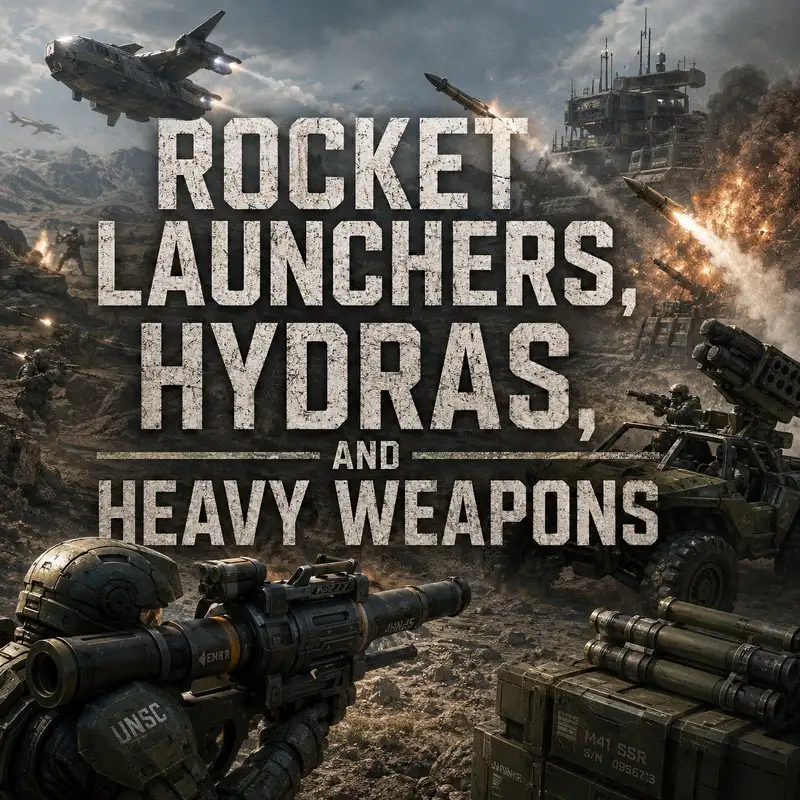
Rocket Launchers, Hydras, and Heavy Weapons
The heavy-weapons problem can be reduced to a scene repeated across the Human-Covenant War. A platoon has two rockets left. A Covenant Wraith is moving toward the position, screened by infantry and supported by aircraft. The first rocket might disable the tank, expose its crew, or merely announce the launcher team’s location. The second might finish the target, or it may be needed for the dropship that arrives afterward. The decision is not simply where to aim. It is which threat must be stopped now, which threat can be survived later, and whether any resupply is coming at all.
Heavy weapons exist because ordinary rifles cannot solve every battlefield problem. Infantry must sometimes destroy armored vehicles, break fortified positions, engage aircraft, suppress an avenue of approach, or kill a target protected by more armor than a rifle squad can defeat efficiently. The United Nations Space Command answered those requirements with rockets, guided micro-missiles, directed-energy weapons, railguns, grenade launchers, and crew-served machine guns. Their destructive power was obvious. Their real military value came from giving small units a temporary answer to threats that normally required tanks, artillery, aircraft, or orbital support.
The word heavy can be misleading. Some systems were heavy because of ammunition. Others required tripods, batteries, targeting systems, or crews. A Spartan could carry equipment conventional soldiers treated as crew-served, but strength did not change supply. Every rocket, power cell, ammunition belt, and replacement component still had to reach the battlefield. A weapon may be man-portable. Its combat capability is rarely carried by one person alone.
The most enduring human launcher was the M forty-one surface-to-surface rocket system, commonly called the Spanker. Misriah Armory had the weapon in United Nations Space Command service by twenty-four eighty-one, before the Insurrection and decades before first contact with the Covenant. By the time the Covenant War began, the design was already considered obsolete. It nevertheless remained heavily manufactured and widely issued because it worked, troops understood it, and factories could keep producing it. Military history contains many systems that survived replacement plans by being available when the replacement was not.
The M forty-one combined a reusable shoulder-fired launcher with a disposable twin-tube assembly. Each tube held one rocket. After the first shot, the assembly rotated the second tube into position. When both rounds were gone, the operator opened the launcher, removed the empty assembly, and locked in another. The arrangement provided two rapid heavy shots without forcing the soldier to discard the entire launcher. It also made every reload a bulky object that had to be manufactured, sealed, transported, carried, and protected from damage before the gunner ever saw a target.
Its most common ammunition was the M nineteen, a one-hundred-two-millimeter surface-to-surface missile. The launcher could also accept antipersonnel rockets, guided munitions, and more specialized loads. Some M forty-one configurations possessed target tracking against ground vehicles, aircraft, or both. Others were strictly dumb-fired. This variation matters. A launcher seen tracking a Banshee in one operation does not prove that every M forty-one in every armory had the same seeker, software, or ammunition. The model, fire-control package, and available round determined what the weapon could actually do.
Against armor, the launcher gave infantry a chance to create a mobility kill, penetrate a vulnerable aspect, destroy exposed systems, or force a vehicle crew to abandon its attack. A single hit did not guarantee the destruction of every Wraith, Ghost, Chopper, or armored emplacement. Angle, range, warhead, impact point, and target condition mattered. Firing at the most visible part of a vehicle was not always the same as firing at the most important part. A crew that struck propulsion, weapons, or control systems could remove the threat without producing a dramatic explosion. The battlefield generally accepted that result.
The two-round capacity encouraged a practical firing pattern. One shot established the result. The second corrected it. That was useful against a moving vehicle and dangerous for ammunition discipline. A gunner who fired both rockets at the first target might have nothing left when a second vehicle entered view. Reloading also exposed the team during the moment the enemy was most likely to return fire. The assistant gunner, ammunition bearer, riflemen providing security, and observer calling the target were therefore as important as the person holding the launcher.
Rocket teams became priority targets. The launch flash, smoke, exhaust, and detonation could reveal the firing position. Covenant infantry could suppress the team while the vehicle maneuvered. Aircraft could attack from outside a launcher’s easiest engagement angle. A Sangheili commander did not need to destroy every human defender if the unit’s only anti-armor weapon could be isolated and killed. Heavy-weapons doctrine therefore depended on concealment, alternate positions, crossfires, and immediate displacement after firing. The launcher was powerful. Staying in the same place after using it was an argument against future promotion.
The M forty-one’s broad ammunition options turned it from a dedicated anti-vehicle launcher into an all-purpose heavy weapon. Troops used it against fortifications, shielded heavy infantry, concentrations of enemy personnel, and structures that had to be breached or demolished. That flexibility was valuable during colonial fighting and indispensable against the Covenant. It was also politically and tactically dangerous. An explosive weapon used in a city, aboard a station, or near civilians could solve the immediate firing point while creating casualties, fires, decompression, and infrastructure damage beyond it.
The Human-Covenant War did not make the M forty-one modern. It made replacement less urgent than survival. Human industry had to produce ships, armor, missiles, rifles, medical equipment, and replacement parts while entire industrial worlds were being attacked. A familiar launcher with an established production line was preferable to a theoretically superior system that could not be fielded in quantity. The M forty-one remained in frontline use from Reach and Earth to the Ark, then reappeared in postwar conflicts and on Zeta Halo. Obsolescence is easier to declare in a procurement office than in an isolated armory.
The M fifty-seven Pilum represented the replacement effort. Issued to Army, Marine Corps, and Spartan personnel around October of twenty-five fifty-eight, it performed a similar battlefield role while being cheaper and substantially lighter. Its designers abandoned the M forty-one’s rotating disposable tube assembly. The Pilum used a single reusable launch tube and a two-round detachable box magazine. The change reduced weight and altered the reload process while preserving the rapid two-shot capability commanders already valued.
The Pilum was intended to counter vehicles and armored Promethean Knights during the unstable postwar era. It entered a military rebuilding its logistics while fielding new enemies and technologies. The design was a rational successor, but it did not erase every M forty-one. Older launchers remained in stores, training inventories, ships, and units that had not completed conversion. When the Infinity’s survivors fought on Zeta Halo, the M forty-one was still available and effective. Procurement transitions rarely respect dramatic narrative timing.
The Hydra family pursued a different answer. Chalybs Defense Solutions designed the Multiple Launch Rocket System One as a rifle-like launcher firing six nine X G high-explosive air-burst gyroc rockets from a revolving cylinder. Instead of concentrating most of the weapon’s effect into one large rocket, the Hydra gave the operator several smaller guided munitions that could be fired rapidly. It was intended for infantry and vehicle targets, with enough flexibility to function in close combat or at medium range.
The Hydra’s tracking system was its defining feature. Linked through the operator’s Visual Intelligence System, Reconnaissance software, the launcher could lock onto an individual soldier, a vehicle, or even a particular vehicle component. The rockets could then home on the selected point. In direct-fire use, the operator could launch them without a lock, relying on proximity air-burst fusing to detonate near the target. This gave the same weapon a guided mode for moving or exposed targets and an unguided mode for rapid fire when waiting for a lock would cost too much time.
That versatility changed the heavy-weapons team’s choices. A Hydra could pressure a fast aircraft, strike infantry behind imperfect cover, attack a vehicle from several angles in quick succession, or place multiple warheads onto a vulnerable system. Six ready rockets also reduced the all-or-nothing character of the M forty-one’s two-shot load. The trade was destructive concentration. A micro-missile was not automatically equal to a one-hundred-two-millimeter rocket. Some targets required several Hydra impacts, careful component selection, or support from other weapons.
Guidance also introduced dependence. The operator needed a working sensor picture, a target that could be acquired, and enough exposure time for the system to establish a lock. Terrain, structures, smoke, electronic interference, rapid target movement, and damaged helmet systems could reduce the advantage. The launcher could still dumb-fire, which was an important design choice. Human engineers had learned that a smart weapon becomes much less impressive when the smart portion loses power while the enemy remains professionally interested in the rest of the weapon.
The Multiple Launch Rocket System Two succeeded the first Hydra and was in use by twenty-five fifty-nine. It retained the six-round cylinder, guided fire, and air-burst capability, refining the portable micro-missile concept for the campaigns that followed. Hydras appeared during the Battle for Zeta Halo, where captured human weapons also entered Banished hands. That was a reminder that a portable system can change ownership quickly. The enemy does not need to reproduce a launcher to use the ammunition and intact examples already abandoned on the battlefield.
Experimental variants showed how far the concept could be pushed. The Echidna fired non-nuclear electromagnetic-pulse warheads intended to disable vehicles and electronics. A specialized Pilum called High Five launched clusters of Hydra mini-missiles. These systems demonstrated technical possibility, not universal issue. Experimental warheads, improved seekers, and hybrid ammunition demanded manufacturing capacity, testing, software support, and a supply chain able to deliver the correct round to the correct launcher. A clever prototype that reaches the wrong platoon is merely an expensive misunderstanding.
The M six Spartan Laser attacked armor without a rocket at all. Developed alongside the Gungnir Mjolnir project, it was a man-portable solid-state directed-energy weapon intended for anti-vehicle and anti-materiel work. The name reflected its connection to Spartan development, though the system was also used by Orbital Drop Shock Troopers and mounted in related forms on aircraft. During the Covenant War, ready access remained limited. The weapon was first ruinously expensive and, after refinement, merely extraordinarily expensive. This was considered progress.
The operator aimed through smart-linked optics and began a charging cycle lasting several seconds. A visible targeting beam and rising tone warned that the weapon was preparing to fire. When the charge completed, the M six released a brief, powerful pulse capable of burning through thick armor and penetrating aligned obstacles. The shot crossed the line of sight without the long flight time of a rocket. Against a moving vehicle at range, that reduced the need to predict where the target would be after a slower projectile arrived.
The same firing cycle created the laser’s greatest tactical weakness. The operator had to maintain aim while the weapon charged, and the target received warning. A vehicle could break line of sight, turn its strongest armor toward the threat, fire smoke, suppress the position, or attack the gunner before discharge. The charge could be aborted without spending the shot, but the opportunity might not return. The M six rewarded ambush, stable firing positions, and disciplined target selection. It punished anyone who attempted to use it as a very expensive flashlight.
Power replaced ammunition as the central logistical problem. Some M six variants used non-removable batteries that required dedicated chargers. Others used specialized cells. In either case, the weapon’s remaining shots were determined by stored energy and the condition of its power system, not by a Marine finding another crate of rockets. A depleted Spartan Laser could not be fed a common vehicle battery or persuaded by confidence. The weapon’s rarity, cost, charging equipment, and maintenance needs prevented it from replacing conventional launchers despite its exceptional performance.
The postwar A R C nine twenty railgun occupied another part of the same problem. Acheron Security used electromagnetic acceleration, a disposable power cell, and an explosive ferric projectile to place anti-materiel force into a compact weapon. It offered a flatter, faster shot than a conventional launcher and avoided carrying a large rocket motor. It still required a charge, a specialized power source, and accurate placement. Limited-production electromagnetic weapons expanded the infantry arsenal, but they did not make rockets obsolete. They gave commanders another expensive way to discover that every target has a preferred tool.
Heavy weapons also included systems whose purpose was sustained fire rather than a single decisive impact. The M two forty-seven H heavy machine gun fired large high-velocity explosive rounds from a tripod or vehicle mount. The older A I E four eighty-six H rotary gun used a three-barrel electrically driven system and a large ammunition belt. These weapons could suppress infantry, defend landing zones, attack light vehicles, and threaten slow aircraft. Their value came from keeping enemy personnel behind cover while friendly troops moved.
A conventional crew had to emplace the gun, carry ammunition, watch the flanks, manage heat, and relocate before enemy fire found the position. Spartans could detach some mounted guns and carry them temporarily, but that was not normal infantry doctrine. The mount absorbed weight and stabilized fire. The shield protected only part of the operator. The ammunition box emptied quickly under sustained use. Once detached, the weapon became less mobile than it appeared and lost the supply arrangement that made prolonged fire possible.
The lighter M seven thirty-nine squad automatic weapon and M two forty-seven general-purpose machine gun addressed suppression with greater mobility. They were heavy compared with rifles, but their job was not to destroy tanks. They established fire superiority, covered movement, and punished infantry crossing exposed ground. This distinction matters because the phrase heavy weapon can encourage the belief that all large guns solve the same problem. A machine gun may stop the soldiers protecting a Wraith. The rocket team still has to stop the Wraith.
Heavy weapons became most effective inside combined-arms teams. Reconnaissance located the target. Riflemen protected the crew. Machine guns suppressed enemy infantry. Rockets or lasers attacked the vehicle. Engineers cleared obstacles. Aircraft and artillery struck targets too distant or too hardened for shoulder-fired systems. Medical personnel treated the gunner if the enemy answered successfully. A launcher could save a platoon from one armored assault. It could not replace a tank company, maintain air defense over a colony, or provide continuous fire support across a campaign.
Shipboard and urban fighting imposed additional limits. Rocket exhaust, blast, fragmentation, and overpenetration threatened friendly personnel and critical systems. A passageway could place atmosphere controls, power conduits, fuel lines, and pressure boundaries behind the target. Lasers and railguns could pass through more material than intended. Heavy weapons remained useful during boarding actions, but the safest shot against the enemy was not always safe for the ship everyone was attempting to occupy.
Logistics determined how long the capability lasted. A squad carrying rockets sacrificed space and weight that might otherwise hold rifle ammunition, water, medical supplies, batteries, or demolition equipment. Hydra rounds could not be substituted for Spanker tubes. Pilum magazines did not fit the older launcher. Spartan Laser power systems required their own support. Machine guns consumed ammunition by the belt. The United Nations Space Command gained tactical choice by fielding many heavy systems and repaid that choice through a more complicated transport and maintenance burden.
Target information was equally important. A rocket fired at a decoy was still gone. A Hydra lock built on a misidentified sensor return could guide the weapon precisely to the wrong object. A Spartan Laser might destroy a vehicle that intelligence officers later wished had been captured. Heavy weapons compressed the time between identification and irreversible effect. Smart links improved accuracy, but they could not decide whether the target mattered more than the ammunition, the surrounding civilians, or the information that target might provide.
Enemy forces adapted. Covenant vehicles maneuvered behind terrain and infantry screens. Sangheili used speed, shields, and active camouflage to reach heavy-weapons positions. Jiralhanae forces attacked aggressively and learned to employ captured human launchers. Promethean constructs could reposition in ways that complicated tracking. Banished armor combined protection with crews willing to close the distance. The response was not a larger warhead for every problem. It was overlapping fields of fire, deception, alternate positions, mixed ammunition, and units trained to continue fighting after the first heavy shot failed.
The famous image of a Spartan carrying a rocket launcher alone is therefore accurate and incomplete. Spartans could move faster under the load, control heavy weapons more easily, use advanced sensors, and carry weapons that slowed ordinary personnel. They still benefited from target data, ammunition caches, repair facilities, and conventional forces controlling the terrain. Gameplay often places heavy weapons where one operator can find and use them immediately. Historical operations depended on who delivered the launcher, who carried its reloads, and whether the unit could recover it after the fight.
These weapons also spread beyond the force that purchased them. Insurrectionists used M forty-one launchers before the Covenant War. Covenant and Banished personnel captured human systems. Postwar militias, mercenaries, and fractured authorities drew from old depots and battlefield salvage. A launcher remains politically neutral after leaving the factory. The same weapon can defend a colony, attack a government convoy, destroy an alien vehicle, or be turned against its original owner. Proliferation is the logistical consequence that procurement documents generally place after the performance tables.
Rocket launchers, Hydras, lasers, railguns, and machine guns gave human infantry the ability to resist enemies that possessed superior armor, mobility, and energy technology. They did not remove the asymmetry. They created brief local opportunities. A Wraith could be disabled. A Phantom could be driven off. A fortified firing point could be broken. A Promethean Knight could be destroyed. The price was ammunition, power, weight, exposure, training, and the risk that the next target would arrive after the last heavy round had been fired.
That is what made these systems heavy in the military sense. Their mass mattered, but their consequences were heavier. Each shot represented manufacturing, transport, intelligence, and command judgment concentrated into a few seconds. The operator saw a reticle and a target. Behind the reticle stood a supply network, a maintenance crew, and a commander deciding what could not be allowed to survive. When the rocket left the tube, all of those decisions became irreversible. The explosion was only the final part of the weapon.