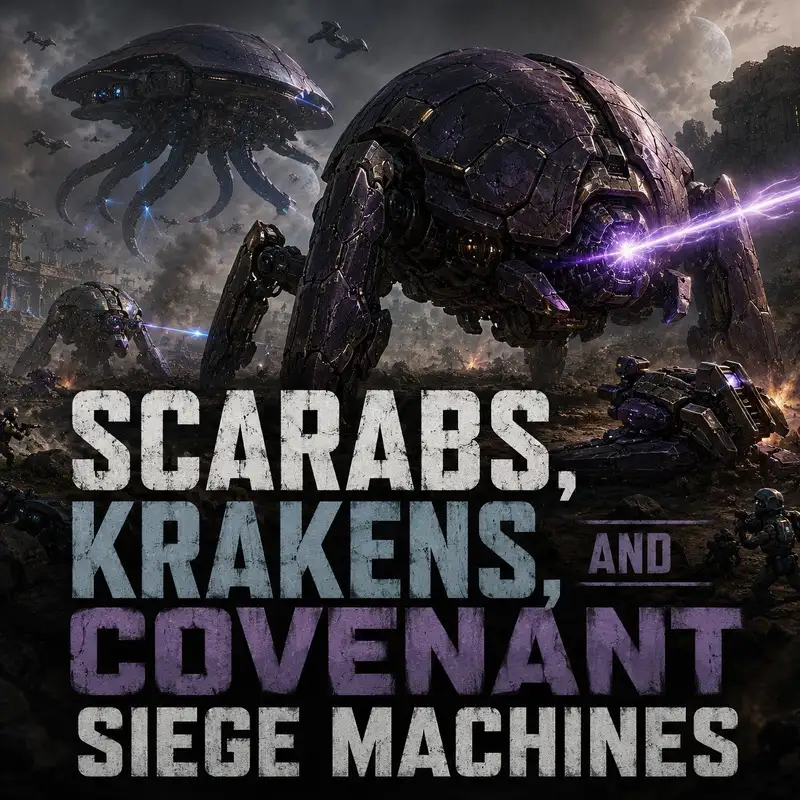
Scarabs, Krakens, and Covenant Siege Machines
The Kraken above Nuusra did not advance like a tank. It hung over the Sangheili ruins as a moving fortress, carrying troops, aircraft, defensive guns, and three immense grappler arms capable of tearing through the structures below. The Swords of Sanghelios attacked it from the air while Fireteam Osiris fought toward its vulnerable core. Jul ’Mdama’s Covenant had brought an old imperial siege machine to a civil war and expected size to restore the authority its government no longer possessed.
Scarabs and Krakens are often remembered as spectacle, the machines deployed when an ordinary armored vehicle no longer looks threatening enough. Their real importance is more revealing. They show how the Covenant combined excavation, religious archaeology, military engineering, and occupation. The same technologies used to expose buried Forerunner sites could cut through concrete, armor, and defensive works. A machine built to uncover the sacred could be retuned to destroy anyone standing above it.
Covenant siege warfare did not begin with the assumption that every position should be destroyed from orbit. A fleet might need the city, the population, the artifact, or the installation beneath the battlefield. Energy projectors could erase resistance and also erase the object that had brought the Covenant there. Ground siege machines gave commanders a slower and more selective option. They could break a perimeter, excavate a reliquary, move troops through the breach, and preserve whatever the ministry supervising the operation considered valuable.
The Covenant classified many of these machines as Excavators rather than ordinary combat vehicles. The category ranged from relatively light Locust walkers to Scarabs and much larger site-excavation platforms. Their focus cannons could remove rock and structural material with controlled energy. In war, the difference between excavation and demolition was often a change in target and power setting. Covenant procurement had produced an industrial tool whose military conversion required less imagination than the religious authorities might have preferred to admit.
The name Scarab was a United Nations Space Command label applied to several distinct quadrupedal patterns. Human troops confronting one in New Mombasa were not necessarily looking at the same design used on Reach, Trove, or the Ark. Some patterns were optimized for deep excavation. Others carried more accessible troop platforms, stronger defensive weapons, or different control arrangements. The common silhouette concealed a family of machines rather than one universal model.
The most familiar late-war Scarab was a tier-four excavator rebuilt as an ultra-heavy assault platform. Four articulated legs carried a fortified body over terrain that would stop conventional tracked armor. The legs could climb steep grades, brace against recoil, and lower the machine when required. Unlike most Covenant vehicles, the walker did not float on anti-gravity propulsion. It moved through a mechanical relationship with the ground, which made it unusually stable and gave human defenders something tangible to damage.
Deployment remained a naval and logistical operation. Some Scarabs could survive low-altitude or low-orbital insertion by using thrusters to slow their descent, but a fleet still had to transport the machine to the theater and select ground suitable for its employment. The largest Pathcarver pattern could not self-deploy at all and had to be assembled near the excavation site. A siege platform might look independent once it began walking. Its arrival depended on ships, assembly capacity, and a command willing to commit scarce heavy equipment.
A Scarab’s main weapon was an ultra-heavy focus cannon related to Covenant energy-projector technology. Properly controlled, the beam could cut through geological layers while exposing an artifact with far more care than orbital bombardment allowed. Directed against a fortification, it could burn through structural material, armor, and defensive positions. The machine usually carried additional plasma weapons for aircraft, infantry, and light vehicles. The main beam opened the position. The supporting guns prevented the position from opening the Scarab in return.
That armament made the walker a siege engine, not merely a large tank. A Wraith supported maneuver with plasma mortar fire. A Scarab could become the centerpiece of an entire ground assault. It attacked fixed defenses, served as a mobile command point, carried security personnel, and continued operating across terrain where ordinary armor might lose mobility. Its height gave weapons and observers a commanding view while making the machine visible to nearly every heavy weapon in the district.
The most unusual part of the Scarab was beneath the armor. Hundreds of Rhulolekgolo organisms were integrated into the chassis and control systems. Together they formed a gestalt intelligence that moved the legs, managed many internal functions, and gave the machine qualities closer to a living construct than a conventional vehicle. A Covenant supervisor guided the walker and directed precision fire when needed, while the colony performed much of the actual operation.
For that reason, the Covenant did not formally treat the Scarab as a vehicle. It was classified more like a single ultra-heavy infantry unit. The distinction was not philosophical decoration. It affected command, control, and trust. Some Rhulolekgolo colonies used in Scarabs were considered too unruly to receive unrestricted control of the entire machine. Covenant authority therefore bound a living collective intelligence into a manufactured body and placed a supervisor above it.
The arrangement reflected the wider empire. Lekgolo colonies provided strength, perception, and control. Sangheili or Jiralhanae supervisors supplied political authority. Unggoy, Kig-Yar, and other security personnel protected the exterior platforms and internal spaces. Assembly forges produced the chassis. Fleets delivered it. A Scarab appeared to be one creature crossing the battlefield, but it was the product of several species arranged according to Covenant hierarchy.
That hierarchy also created vulnerabilities. The Rhulolekgolo had to connect with power and control systems somewhere inside the machine. On common late-war patterns, part of that living core was exposed within the rear interior bay. Damage to the legs could force the Scarab into a lowered position, creating an opportunity for boarding. If attackers reached the core and destroyed the power junction, the resulting failure could tear through the colony and trigger the loss of the entire platform.
The famous method of crippling a leg, boarding the walker, and destroying the core was possible. It was not a comfortable standard procedure for ordinary infantry. The approach demanded heavy fire, mobility, supporting weapons, and an enemy crew unable to stop the boarders. A Marine platoon facing a Scarab in open ground could not rely on the historical precedent that a Spartan had once climbed onto one. Doctrine prefers a rocket, tank gun, aircraft, or artillery strike whenever those options remain available.
Scarabs therefore operated with escorts. Infantry guarded the legs and access points. Plasma turrets covered likely boarding routes. Ghosts and Wraiths protected the approaches. Banshees contested the air above them. Commanders understood that the walker’s power attracted concentrated enemy fire and that its internal core made close penetration dangerous. An unsupported Scarab was still formidable. It was also a valuable siege asset being offered to the opposition as a single target.
The Covenant used Scarabs selectively during much of the Human-Covenant War. Outer Colony campaigns often ended through naval superiority, orbital attack, and rapid destruction before a prolonged ground siege became necessary. The heavily defended Inner Colonies created a different requirement. By twenty-five fifty-two, Scarabs appeared in greater numbers against fortified worlds, especially during the fall of Reach, where Covenant forces needed to crush prepared positions while protecting their own excavation and deployment sites.
At Szurdok Ridge, deployment spires concealed and supported Covenant forces that included multiple Scarabs. The walkers were part of a larger landing system rather than independent monsters wandering into the battle. They helped secure the ground around an operation whose strategic purpose included access to buried Forerunner technology. Humanity saw an armored assault. Covenant leadership saw resistance obstructing an archaeological and religious objective.
New Mombasa provided another kind of siege. A Scarab moved through a dense human city while the Prophet of Regret’s force searched for the portal installation beneath Africa. Streets, towers, bridges, and industrial facilities restricted ordinary armored maneuver but offered the quadrupedal machine routes unavailable to a tracked tank. The Scarab’s presence also communicated that the Covenant intended to break through the city rather than merely raid it.
Urban deployment magnified collateral damage. The focus cannon could destroy a defensive point and everything behind it. The machine’s legs damaged infrastructure simply by moving through constrained spaces. Plasma fire threatened civilians, utilities, and structures that had no military purpose. The Covenant wanted access to what lay beneath the region. The people living above it were treated as an obstacle in the excavation plan.
At Voi and later on the Ark, Scarabs defended positions connected directly to the Prophet of Truth’s final objectives. On the Ark, paired walkers guarded the approach to the Citadel while Covenant infantry and aircraft fought the joint human and Sangheili assault. Their destruction opened the route, but it did not prove that siege machines had become irrelevant. It proved that even the most imposing platform could be defeated when isolated inside a collapsing army whose fleet, political leadership, and alliance system were failing together.
The Spirit of Fire encountered Scarabs under even more complicated conditions. On Trove, Covenant walkers fought humans, Sentinels, and the Flood within the same campaign. Human forces temporarily captured and used one against its former owners. That success demonstrated the tactical value of seizing an intact platform. It did not mean the United Nations Space Command could reproduce the Rhulolekgolo control system, repair every damaged component, or create a sustainable human Scarab force.
The largest Scarab patterns exposed the opposite limit. Their focus cannons could reach extraordinary power, but their size made transport and assembly difficult. A Super Scarab on Arcadia guarded a major excavation and was being altered with technology from the Forerunner site. It represented the Covenant’s usual temptation when encountering a sacred artifact: begin exploiting the discovery before fully understanding what the modification would do. The United Nations Space Command had occasionally demonstrated the same habit with less ceremonial language.
Below the Scarab in the Excavator hierarchy stood the Locust. This lighter quadrupedal machine carried a focus cannon on a rotating body and was designed for mining and the exposure of buried reliquaries. During the war, energy shielding and combat modifications turned it into an anti-fortification platform. Human troops called it a building killer because a group of Locusts could attack structures from beyond the range at which ordinary infantry wanted to answer.
The Locust’s lighter armor created a deliberate trade. It was easier to deploy and less costly than a Scarab, but vulnerable once enemy vehicles or concentrated fire reached it. Commanders used Locusts behind a screen of infantry and armor, allowing their beams to work against fixed targets. They were siege tools in the narrowest sense. Their effectiveness declined when a mobile opponent forced them to fight a battle rather than dismantle a structure.
Larger Harvesters remained closer to their industrial origin. Jul ’Mdama’s Covenant used one during its occupation of Requiem to support large-scale excavation and artifact recovery. Its plasma drill could also be turned against personnel and equipment, but the machine’s strategic value came from reaching buried Forerunner systems. A Harvester on the battlefield was not merely another weapon. It marked the location where a faction believed ancient technology justified the effort required to uncover it.
The Kraken belonged to a different branch of siege engineering. It was not simply a larger Scarab and did not rely on the same quadrupedal excavation form. The surviving record describes it as an ultra-heavy siege tower and mobile sky fortress. Its hollow central structure could receive large dropships, while internal bays supported Banshees and substantial troop complements. Defensive Shade turrets covered the exterior, and three immense limbs could move or crush structures beneath it.
Some Covenant accounts held that Kraken designs were derived from a Forerunner Sentinel pattern recovered from an old weapons reliquary. The precise design history remains less certain than the machine’s military function. It carried a force into the center of a defended area, protected aircraft and infantry, and physically dismantled the terrain or architecture obstructing its advance. A Scarab breached the fortress. A Kraken could become the fortress while moving through it.
The original Covenant appears to have kept Krakens rare and closely controlled. Human records hinted at earlier encounters, but the evidence was limited because the forces that may have seen them did not return with useful reports. Jul ’Mdama’s organization later recovered several from old imperial caches. He initially used them sparingly, avoiding disclosure of a capability that his rivals would immediately plan to destroy or capture.
By late twenty-five fifty-eight, concealment mattered less than survival. Jul was dead, his Covenant was breaking, and the Swords of Sanghelios were attacking positions across their homeworld. At Nuusra, a Kraken defended terrain tied to the Vadam clan and Jul’s remaining forces. Its scale allowed it to dominate the ruins, support aircraft, carry defenders, and destroy structures. It also made the machine impossible to hide once the battle began.
The Swords of Sanghelios attacked with Banshees while Fireteam Osiris moved through the defenses. Air attack damaged the Kraken and reduced its ability to control the battlefield. Osiris reached the internal systems and helped destroy its exposed core. The operation was a combined assault, not a duel between four Spartans and a building. Sangheili pilots, ground troops, intelligence, and the pressure of a collapsing enemy defense all created the opportunity.
The Kraken’s destruction revealed a problem common to every siege tower. Immense mass concentrates capability and risk in the same place. Troops, aircraft, weapons, command functions, and power systems become one operational target. The platform can dominate a sector while its defenses remain intact. Once attackers penetrate the perimeter, every internal function shares the consequences of the same breach.
Other Covenant mobile fortresses pushed this logic further. The Draugr carried troops and vehicles beneath heavy shielding while several focus cannons supported its advance. Scarabs could flank and protect it as part of a large occupation force. Such a machine was not intended for a fast raid. Its arrival signaled that the Covenant expected to establish a ground presence, move a substantial formation, and crush resistance that had survived lighter forces.
Siege warfare also depended on less celebrated engineering. Gravity lifts moved troops and equipment across vertical obstacles. Combat bridging vehicles could create routes over terrain that would stop an armored column. Dropships delivered security forces, ammunition, and replacement vehicles. Engineers maintained energy projectors and shield systems. A Scarab could burn through the gate. Another machine still had to make the road behind it usable by the army.
The Covenant’s technological advantage did not remove these dependencies. Focus cannons generated heat and required power control. Living Scarab cores could be injured. Kraken bays needed aircraft, crews, and supplies. Locust shields had to recharge. Heavy machines required specialized assembly forges and transport ships. When High Charity fell and the empire fragmented, many successor factions inherited individual platforms without inheriting the full industrial network that had once kept them operational.
That explains why postwar warlords valued old caches so highly. A stored Kraken or Scarab represented more than firepower. It was a capability that might no longer be manufactured in useful numbers. Possession strengthened a claim to authority and gave a faction a way to attack fortified rivals. It also created a maintenance burden whose solution might depend on artisans, Huragok, Lekgolo cooperation, or parts controlled by another power.
The Banished were especially willing to absorb that burden. They inherited, captured, and rebuilt Scarab patterns without accepting the Covenant’s religious restrictions. Banished workshops treated the excavator as a useful chassis for assault and occupation. Their approach was more pragmatic than the old ministries, but not magically simpler. A Banished Scarab still required a forge, a living control colony, power, weapons, transport, and a commander who understood that red armor did not count as preventative maintenance.
Human countermeasures evolved from shock into system analysis. Intelligence identified firing cycles, vulnerable joints, escort patterns, likely deployment routes, and the location of internal cores. Tank crews learned to concentrate fire. Aircraft attacked from angles the main cannon could not easily follow. Infantry isolated escorts and exploited terrain. Spartans boarded when the opportunity justified the risk. Defeating the machine became possible once it was treated as an integrated siege system rather than an invulnerable creature.
The distinction remained important for civilians and defenders. A Scarab or Kraken was rarely deployed without a larger purpose. It might be protecting an excavation, breaking an evacuation corridor, opening a city, or anchoring an occupation. Destroying it could save a position and still leave the fleet above, the troops around it, and the political objective unchanged. Tactical success removed one machine. Operational success required understanding why the machine had been sent.
Covenant siege machines were powerful because the empire rarely separated archaeology from conquest. Forerunner sites had to be found, exposed, secured, and interpreted. Populations occupying the same ground were expected to submit or be removed. Excavators became weapons because the empire’s sacred mission and military expansion repeatedly required the same action: cut through whatever stood between Covenant authority and the relic below.
At Nuusra, the Kraken carried the remains of that system into a war among Sangheili successors. Its size, aircraft bays, guns, and crushing limbs could damage the landscape and delay the Swords of Sanghelios. They could not rebuild Jul ’Mdama’s political order or restore the Covenant ministry network that had once supported machines of that scale. The siege tower could still destroy a fortress. It could not replace the empire that had taught it where to walk.