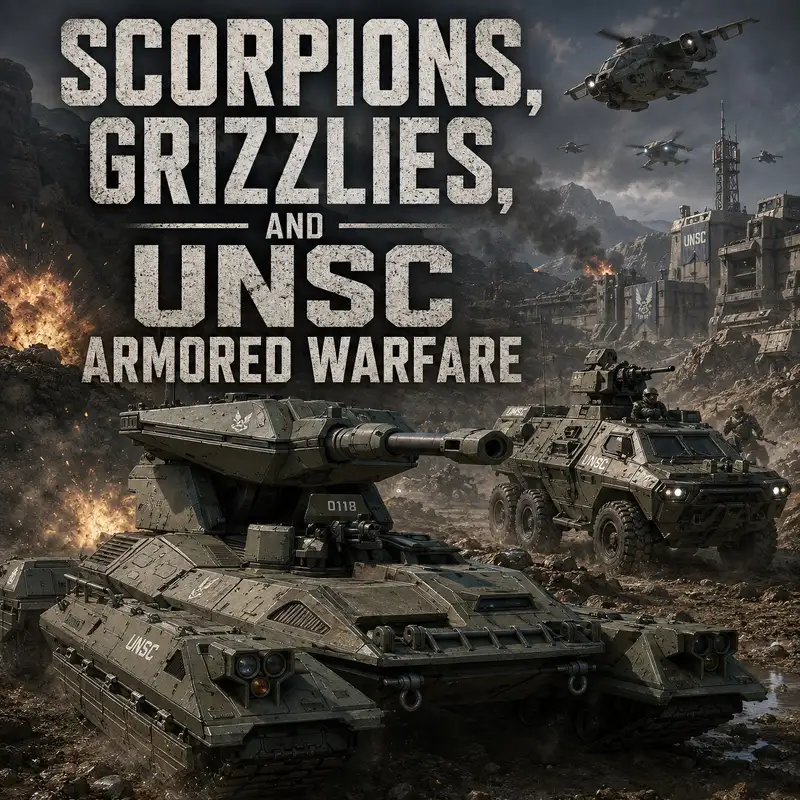
Scorpions, Grizzlies, and UNSC Armored Warfare
Two Grizzly tanks reached the Forerunner structure on Harvest after the infantry position around it had begun to collapse. Their mission was not to seize ground for its own sake. They had to reach Professor Ellen Anders and Sergeant John Forge, break the Covenant blockades between them and the extraction zone, and keep firing long enough for a Pelican to lift the survivors away. When the aircraft departed, the tanks remained behind to cover it. The armored force had completed the mission. The crews had not been promised a convenient road home.
That action captures the central problem of United Nations Space Command armored warfare. A tank can break a defensive line, protect an evacuation, and destroy enemy vehicles. It cannot control orbit, create heavy-lift capacity, repair itself after the supply column disappears, or make an extraction aircraft return. The Scorpion became humanity’s armored workhorse because it balanced firepower, mobility, cost, and transport. The Grizzly showed what happened when that balance shifted toward armor and guns.
The M eight-oh-eight Scorpion entered production in twenty-two eighteen, more than three centuries before the fighting on Zeta Halo. The earliest models differed substantially from the vehicles used during the Human-Covenant War, but the core design survived. Chalybs Defense Solutions had created a main battle tank adaptable enough to absorb new armor, weapons, sensors, and control systems without requiring the United Nations Space Command to replace its entire armored force every time technology improved.
Its longevity was partly a product of colonial warfare. Before the Covenant arrived, Scorpions fought in the Insurrection, guarded military installations, supported security operations, and faced other human armored vehicles. Rebels also captured and used them. The tank was therefore not designed around plasma mortars, hovering vehicles, or alien infantry protected by energy shields. Like much of humanity’s arsenal, it entered the extinction war carrying the assumptions and political history of an earlier internal conflict.
The Scorpion’s distinctive four-track arrangement was central to its usefulness. Each track unit operated through an independent computer-controlled suspension, allowing the vehicle to cross rubble, broken ground, and obstacles that could disable a less adaptable chassis. Damage to one track assembly did not automatically remove every means of movement. That mattered on colonies where military roads were incomplete and on alien installations whose builders had not considered human tank dimensions when arranging the landscape.
This mobility did not make the Scorpion light. Wartime M eight-oh-eight models were heavy vehicles requiring substantial transport and recovery support. A Pelican could carry one beneath its fuselage, allowing commanders to place armor near a landing force without waiting for a conventional roll-on transport to reach the surface. Every tank delivered that way consumed heavy-lift capacity that might otherwise carry troops, artillery, engineering equipment, or supplies. Air mobility expanded armored reach while making each deployment a logistical choice.
Crew arrangements varied by model and available neural interfaces. An M eight-oh-eight B could be operated by two conventional crew members or by one operator using the appropriate interface, while other variants included separate gunner positions. The small crew reduced the number of personnel exposed when a tank was lost and allowed Spartans to control the vehicle efficiently. It also concentrated workload. Navigation, target acquisition, driving, communications, and weapon employment still had to occur, even when one highly trained person performed several functions.
The main armament of the familiar wartime Scorpion was a ninety-millimeter smoothbore high-velocity cannon. It could fire armor-piercing ammunition against vehicles and canister rounds against exposed infantry. A machine gun handled close threats and targets that did not justify spending a tank round. The combination gave commanders one platform able to attack armor, fortifications, and personnel without turning every tactical problem into a request for another specialized vehicle.
That flexibility was more important than the caliber printed in a technical manual. A tank gun mattered only if the crew could identify the target, reach a firing position, carry the correct ammunition, and survive long enough to fire again. Armor-piercing rounds were poorly spent on dispersed infantry. Canister ammunition did little for a platoon facing a Wraith beyond effective range. Mixed loads gave crews options, but every additional option had to be forecast, loaded, transported, and replenished.
The Scorpion’s ceramic-titanium armor could survive battlefield punishment that would destroy a light vehicle. Some examples endured direct hits from Covenant heavy weapons and remained capable of fighting. That did not make the tank immune to plasma. Covenant fire transferred intense heat, damaged external equipment, weakened armor, and could kill the crew without producing the dramatic turret separation favored by after-action illustrations. Repeated strikes, top attacks, mines, and heavy anti-vehicle weapons remained lethal.
The vehicle’s silhouette created other compromises. Its elevated cannon could engage across broken terrain and fire over some obstacles, but the turret and exposed secondary weapon position were visible targets. Infantry riding on the track housings gained transportation, not protected carriage. They remained exposed to fragments, plasma, small arms, and the sudden changes in direction produced by a driver attempting to avoid all three. The Scorpion could move troops in an emergency. It was not an infantry fighting vehicle.
Used properly, the tank operated as the center of a combined-arms team. Infantry cleared close terrain, protected the flanks, and located enemies hiding where the main gun could not reach. Reconnaissance found routes and targets. Engineers cleared mines, bridged obstacles, and recovered damaged vehicles. Wolverines protected the formation from low-flying aircraft. Artillery attacked positions beyond direct sight. Warthogs screened the advance and carried messages, ammunition, and specialists across the wider battlefield.
This support explains why a Scorpion platoon could dominate one engagement and disappear from the next. Tanks consumed ammunition, power, spare parts, track components, lubricants, and maintenance hours. A damaged vehicle needed a recovery platform or another tank strong enough to tow it. Crews needed sleep, medical care, replacement personnel, and accurate maps. The main gun received the attention. The campaign depended on everything moving behind it.
Arcadia in twenty-five thirty-one demonstrated the Scorpion’s broader role. Tanks from the Spirit of Fire entered Pirth City while Covenant forces attacked the colony and civilians tried to reach evacuation ships. The armor supported movement through the city, then withdrew with surviving forces toward a crater where a firebase could be established. Scorpions later joined the assault on Covenant positions and protected experimental Rhino artillery while it attacked an energy-shield dome.
The sequence matters because the tanks were not acting alone. Pelicans delivered forces. Marines held the perimeter. Spartans reinforced the position. Rhinos applied specialized fire against a shield the Scorpion was not designed to breach. The armored force succeeded by protecting the weapon that could solve the immediate problem, then advancing after that problem changed. Combined arms is often less about every platform firing at once than about one platform keeping another alive long enough to do its job.
Installation Zero Four offered a different kind of armored campaign. Survivors from the Pillar of Autumn were scattered across terrain with no established human logistics network. Pelicans moved personnel and vehicles between temporary positions while the Covenant controlled much of the ring. A delivered Scorpion gave the Marines a way to cross exposed ground and attack fortified positions that would have punished infantry moving alone. The tank’s presence was powerful precisely because heavy armor was scarce.
Scarcity also meant that losing one mattered. There was no local factory producing replacement Scorpions and no armored brigade waiting beyond the horizon. Ammunition expended in one valley could not be assumed available in the next. A tank damaged beyond field repair became salvage on an alien installation. The destruction of the ring ended any debate about recovery. Tactical mobility had been supplied by spacecraft, and the entire supply system vanished with the ship and base that had brought it.
On Earth and the Ark, Scorpions again moved through urban ruins, industrial zones, desert terrain, and Forerunner structures. Their repeated appearance across such different environments was not evidence that the vehicle was ideal everywhere. It showed the value of a platform that human ships already carried, Pelicans could deliver, crews understood, and maintenance sections could support. Armies often retain an old design because the whole institution knows how to keep it moving.
The M eight-fifty Grizzly existed because the Scorpion’s balance was not always enough. First manufactured in twenty-five oh-nine, the Grizzly used a related multi-track layout but carried heavier armor and twin one-hundred-twenty-millimeter cannons. It was one of the heaviest armored vehicles in United Nations Space Command service. Where the Scorpion offered a practical compromise, the Grizzly offered concentrated direct-fire power and the ability to remain in an engagement that would force lighter armor to withdraw.
The twin guns allowed a Grizzly to place enormous force onto one target or rapidly engage several threats. Canister ammunition gave it a severe anti-infantry effect, while machine guns covered targets too close or too dispersed for the main armament. Its armor could endure multiple heavy plasma strikes under favorable conditions. On open ground, one or two Grizzlies could threaten Covenant staging areas and supply columns badly enough that the enemy might commit aircraft or naval fire to remove them.
That last point is both praise and warning. Forcing the Covenant to use a ship against a tank was an impressive local achievement. It also meant the tank had become visible to a weapons system it could not defeat. No amount of frontal armor made a Grizzly safe beneath hostile orbital control. The vehicle could dominate the ground fight and still be destroyed by a commander operating at a higher level of war.
Sergeant Forge became closely associated with the Grizzly because he understood what it could do and pushed to obtain them for the Spirit of Fire. The ship carried a substantial complement despite the vehicle’s cost and transport burden. During the Harvest campaign, Forge’s personally upgraded tanks broke through Covenant blockades and covered the extraction of Anders and surviving Marines. Later, Grizzlies supported the ship’s ground forces inside the shield world known as Trove.
Trove revealed an advantage no firing table captured. The Grizzly’s sealed cockpit protected its crew from direct Flood infection while infantry outside remained vulnerable. The tank could clear a route through combat forms and contaminated ground, providing a moving point of protection during an evacuation. It could not make the Marines walking beside it biologically safe. Armor preserved the crew while the force around them still faced a containment emergency.
The Grizzly’s performance did not produce universal adoption. It was expensive, demanding to maintain, slower than the Scorpion, and difficult to transport. Heavy-lift spacecraft were limited, especially after decades of war had destroyed ships and redirected surviving transport toward reconstruction and emergency supply. A commander could move several lighter assets or fewer Grizzlies. The correct answer depended on the mission, terrain, enemy, and whether the receiving unit could support the vehicle after arrival.
This was the difference between tactical superiority and operational usefulness. The Grizzly could outgun the Scorpion. The Scorpion was easier to place across a theater in larger numbers and sustain through ordinary armored formations. A tank that arrives after the evacuation has ended possesses excellent armor and no remaining mission. The United Nations Space Command continued buying and retaining both because the two designs solved different levels of the problem.
The rest of the armored force existed to keep those tanks from being asked impossible questions. The M nine Wolverine provided short-range air defense against Banshees and other aircraft. The S P forty-two Cobra specialized in anti-armor fire. The M four-hundred Kodiak delivered artillery from behind the direct-fire line. The experimental M one-four-five D Rhino carried a reverse-engineered plasma munition howitzer for targets ordinary guns could not efficiently defeat. Armored personnel carriers moved infantry under protection rather than leaving them on a tank’s exterior.
No commander possessed every vehicle in ideal numbers. A ship carried what fit its mission and hangars. A colony defended itself with whatever had survived earlier deployments. The Spirit of Fire could manufacture some equipment from stored designs and available feedstock, but every vehicle still competed for material, power, and machine time. A force with twenty theoretical vehicle types might begin the battle with the three it could actually build, fuel, and crew.
Air defense was especially important because Covenant doctrine combined ground maneuver with dropships, attack craft, and orbital power. A Scorpion could engage a low aircraft under favorable conditions, but that was not its primary task. Turning the main gun toward a Banshee might expose the tank to the Wraith already firing from the opposite ridge. Wolverines, friendly fighters, and local air superiority allowed tank crews to concentrate on the threats their armor and guns were designed to defeat.
Enemy armor demanded adaptation rather than simple comparison. Ghosts were fast and lightly protected, making them dangerous to infantry and vulnerable when caught in a Scorpion’s firing lane. Wraiths used hovering mobility and plasma mortar fire to attack from defilade and punish fixed positions. Choppers could close aggressively and damage lighter vehicles. Scarabs were mobile siege platforms requiring concentrated fires, sabotage, aircraft, or attacks on vulnerable systems rather than a ceremonial duel with one tank.
The Covenant also forced human crews to consider thermal damage in every repair. A ballistic impact might crack armor or disable a mechanism. Plasma could warp surfaces, destroy sensors, ignite material, and leave components structurally weakened beyond what an exterior inspection revealed. A tank declared mobile after a hit might still have a damaged sight, compromised seal, or track assembly waiting to fail during the next maneuver. Combat effective remained a flexible term, particularly when no replacement vehicle was available.
Human tank crews compensated through positioning and concentration. They used terrain to expose as little armor as possible, fired from ambush, shifted positions before plasma mortars arrived, and combined several guns against the same target. Infantry marked threats and protected blind areas. Artificial intelligence and networked sensors improved target information when communications survived. None of these methods guaranteed victory. They converted a technological disadvantage into a problem that training and coordination could sometimes manage.
The Scorpion’s long history also meant that armored warfare carried a political memory. The same vehicle used to defend civilians from Covenant attack had once entered colonial communities during counterinsurgency operations. Insurrectionists who saw a Scorpion did not necessarily see humanity’s shield. They saw the armored authority of Earth and the United Nations Space Command. The Covenant War changed the target, but it did not erase what the tank had represented before first contact.
After the war, the M eight-twenty Scorpion attempted to modernize the family without abandoning its identity. Introduced in twenty-five fifty-seven, it was far lighter and faster than the older M eight-oh-eight while retaining comparable protection. Its one-hundred-fifty-millimeter electrothermal-chemical cannon broke compatibility with legacy tank ammunition but opened the way for guided rounds and new propellants. The design removed compromises accumulated through centuries of updating the older chassis.
Breaking ammunition compatibility was more than a technical footnote. A unit receiving M eight-twenties needed the correct rounds, loaders, parts, diagnostic equipment, and training. Depots already holding M eight-oh-eight ammunition could not simply change the label on the container. Modernization promised better performance and imposed a transition burden at the same time, which is one reason old and new Scorpions continued serving together.
Postwar industry also experimented with specialized armor packages, environmental variants, experimental ammunition, and directed-energy weapons. These programs showed that humanity had learned from Covenant and Forerunner technology. They did not establish that every tank received a laser cannon or alien-derived protection. A prototype might work brilliantly during a controlled trial and remain irrelevant to an isolated garrison whose most advanced maintenance tool was already being used to repair the communications array.
Grizzlies also remained in service. Army planetary-defense formations retained them after the war, and the Spirit of Fire used them against the Banished on the Ark in twenty-five fifty-nine. Their survival reflected the same logic that preserved the Scorpion. Existing vehicles, trained crews, spare parts, and established manufacturing data retain military value even after a replacement appears. A force cut off from the wider United Nations Space Command had little reason to discard a tank it could still build and support.
By twenty-five sixty, M eight-oh-eight Scorpions were still fighting, including on Zeta Halo. That persistence should not be read as technological stagnation. The Created uprising, the loss of infrastructure, the attack on the Infinity, and the fragmentation of surviving forces made availability decisive again. A modern tank program mattered. A functioning tank already on the ground mattered more.
Scorpions and Grizzlies reveal that United Nations Space Command armored warfare was never about one perfect vehicle. The Scorpion provided the durable center: mobile enough for expeditionary operations, powerful enough for most direct-fire tasks, and common enough to plan around. The Grizzly provided local overmatch when commanders could afford the lift, maintenance, and ammunition. Artillery, air defense, engineers, infantry, recovery crews, and aircraft turned those vehicles into an armored force.
Their limitations were just as important. Tanks could open a corridor but not guarantee evacuation. They could destroy a Wraith but not silence the cruiser above it. They could carry infantry, but not protect riders as an armored personnel carrier would. They could survive plasma and still lose a sensor, track, crew member, or supply line. The United Nations Space Command won armored engagements by connecting machines to institutions, not by pretending armor had made the institutions unnecessary.
The two Grizzlies left behind on Harvest had done exactly what their design and crews were sent to do. They broke the blockades, reached the survivors, and covered the Pelican’s departure. Their final position also exposed the boundary of armored power. The guns could dominate the road. The aircraft still determined who escaped it.