Sedra, Nightfall, and the Alpha Halo Shard
At nine twenty-one in the morning on February seventh, twenty-five fifty-six, a Sangheili Zealot entered a crowded commercial district in Sedra City carrying a device that produced almost no conventional blast. Lieutenant Commander Jameson Locke reached him before he could leave, disabled his energy shielding, and wounded him. The Zealot still completed the mission. He threw himself from an upper level and activated the device as he fell. A red pulse spread through the city. Alien residents remained standing. Humans began to collapse.
The weapon did not destroy buildings or crater streets. It attacked the population inside them. Victims struggled to breathe as their veins darkened beneath the skin. Human blood cells lost the ability to divide normally, and damaged bodies began circulating their own breakdown products. The effect weakened with distance because the agent decayed quickly, but those who received a lethal exposure had no realistic prospect of recovery. Two Office of Naval Intelligence personnel were among the infected. So was Natalie Aiken, the daughter of the officer commanding Sedra’s only organized defense force.
Sedra was an Outer Colony that had survived the Human-Covenant War without being glassed, but survival had not produced gratitude toward Earth. Many Sedrans believed the Unified Earth Government and the United Nations Space Command had abandoned distant colonies while protecting worlds closer to the center. By twenty-five fifty-six, Sedra was largely autonomous. It maintained its own Colonial Guard, relied on a mixture of modern and outdated military equipment, and had no permanent United Nations Space Command garrison. It also occupied a dangerous position between human space, alien traffic, smuggling routes, and renewed Insurrectionist activity.
That political distance mattered as soon as Locke arrived. His Office of Naval Intelligence unit had been sent to investigate refined fissile material and signs of a possible terrorist network. The agents claimed broad authority, demanded access to local sensor records, and expected the Colonial Guard to provide support. Sedran personnel saw another outside organization treating their government as an obstacle. Officially, everyone was protecting the same colony. In practice, the joint effort began with arguments over jurisdiction, equipment, medical access, and which chain of command was entitled to issue orders.
Colonel Randall Aiken had more reason than most to distrust the Office of Naval Intelligence. He had once been Randall Zero Three Seven, a Spartan Two abducted as a child, trained on Reach, augmented, and sent into the Human-Covenant War. After being listed missing during the Battle of Vodin, he built a life among colonists and refused to return when the Office located him. Aiken forced a compromise, endured procedures that reversed part of his augmentation, and left active service. On Sedra, he became a colonial officer and a father.
The captured Axl provided the next lead after Aiken’s interrogation produced more anger than information. Locke could speak the trade language the smuggler understood and learned that the weapon’s source came from a place even Covenant zealots avoided. The material had been mined from a surviving fragment of Installation Zero Four, the first Halo encountered by humanity. That ring had been destroyed in September of twenty-five fifty-two when the Pillar of Autumn’s fusion reactors detonated. Most of the installation broke apart around the gas giant Threshold. One fragment did something no human recovery team had expected. It attempted an emergency slipspace jump.
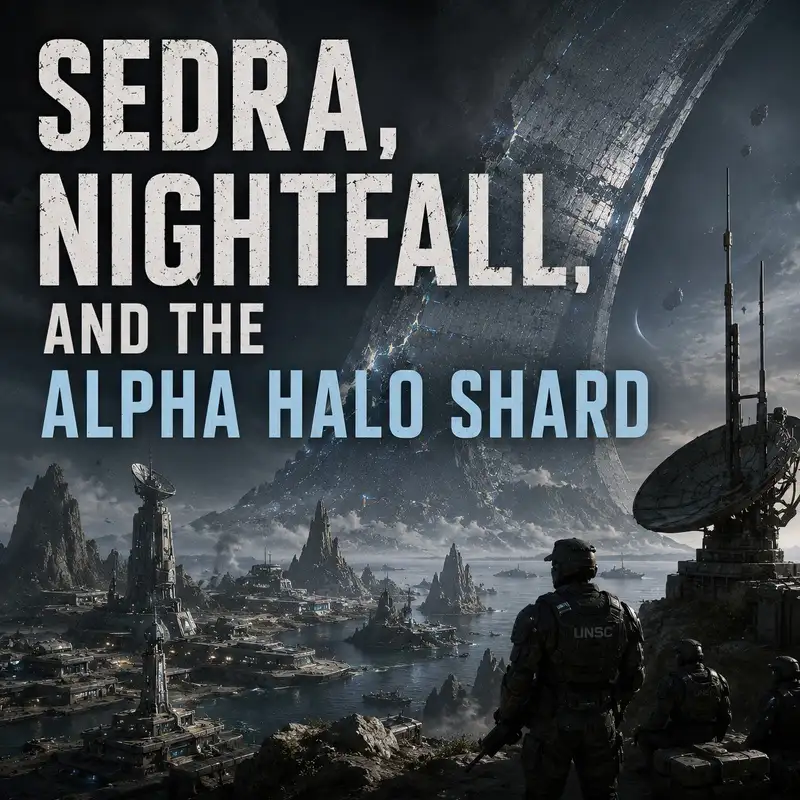
The maneuver only partly succeeded. A section of the ring escaped and reentered normal space near Thotael, a red giant in another system. The fragment, later called Alpha Shard, settled into an unstable orbit. It still generated artificial gravity and retained an atmosphere, while some environmental machinery remained active. Its rotation exposed the surface to sixteen hours of punishing heat followed by sixteen hours of darkness. Daytime temperatures could approach nine hundred degrees Fahrenheit. Night was survivable, though the thin atmosphere required supplemental oxygen. Sunrise would kill anyone still exposed.
The destruction of Alpha Halo also produced an anomalous substance later designated Element One Twenty V. The surviving record does not fully explain the physics. Human analysts concluded that the reactor catastrophe interacting with Forerunner material created an element not found elsewhere in known space. It decayed quickly and required a null-state stasis container. Once refined into a weapon, it selectively compromised human genetic material while leaving other species unharmed. Personnel first called it a bioweapon. Later analysis described it more accurately as a radiological designer agent.
That distinction did not make it less dangerous. The Human-Covenant War had been fought by fleets that could erase cities from orbit. Element One Twenty V offered a smaller faction a different form of strategic leverage. A single courier, one cooperating smuggler, and one willing attacker could produce mass casualties without needing a cruiser, a carrier, or control of local space. The agent also exploited the mixed population that made Sedra useful as a test site. Alien residents became an immediate control group. The weapon demonstrated, in public, that it could kill humans while passing through everyone else.
Locke believed the Sedra attack was probably a trial before use against a more important target. The identity and full structure of the sponsoring organization remained uncertain, but the military requirement was clear. Capturing the attacker was no longer possible. Treating the victims was failing. The only remaining option was source denial. If the material existed only on Alpha Shard, the deposits had to be destroyed before another shipment left. The plan called for a joint force to reach the fragment, capture the miners, identify the extraction site, and destroy it with a HAVOK tactical nuclear weapon.
Aiken insisted that the Sedran Colonial Guard participate. His decision was political. Sedra had been attacked, and handing the response to the Office of Naval Intelligence would confirm every accusation that the colony possessed autonomy only when nothing important was happening. It was also personal. Natalie died before departure. Aiken had spent much of his life resisting institutions that treated people as military resources. He now chose to lead a mission against the source of the weapon that killed his child. Grief sharpened his determination and complicated his command.
The expedition traveled aboard a Sedran D Eighty-One Condor capable of slipspace flight. Locke brought Michael Horrigan, Alistair Estrin, and Gregory Ramos. Aiken led a Colonial Guard detachment including Sergeant Samantha Wisner and Private Talitha Macer, an experienced pilot. The Office personnel wore powered Nightfall armor with better protection and integrated systems than the Sedran suits. The Colonial Guard supplied the transport and local authority. Officially, it was a combined operation. In practice, it was a small group that agreed on the target and little else.
Aiken imposed a single tactical command during the transit. He understood that continuing to speak of Sedrans and Office agents as separate groups would become fatal once they landed. The order did not create trust, but it established a temporary rule. Mission first. Institutional loyalties could resume after extraction. It was a sensible decision and one that proved easier to issue than enforce. The team was entering an unknown Forerunner environment with incomplete reconnaissance, a narrow survival window, and only one primary transport. Their largest vulnerability was already inside the Condor.
The landing initially went according to plan. The Office agents descended using their powered armor while the Sedrans used more conventional methods. Macer remained with the aircraft. The ground element found the smugglers’ Bactrian-class tug and discovered that it was still operational. Nearby horse tracks led away from the vessel. The animals were not a quaint colonial detail. They were a countermeasure. The smugglers had learned that machinery attracted something on the shard, so they used biological transport for the final movement to the mine.
The team followed the tracks and captured Arris Le and Haisal Wari while they extracted the element from a cave. At that point, the stated mission appeared nearly complete. The source was located. The miners were in custody. The HAVOK remained aboard the Condor, ready to destroy the deposit after confirmation. The expedition had achieved surprise and avoided a firefight. Then the aircraft approached for recovery, and the true security system of Alpha Shard revealed itself.
Thousands of worm-like organisms surged across the surface and climbed onto the Condor. They were Thanolekgolo, a specialized form of the same colonial species that could combine into the armored Mgalekgolo formations known to human troops as Hunters. These swarms did not require armor to become dangerous. They sensed active technology and electromagnetic emissions, formed coordinated masses, and could infiltrate machinery. They overwhelmed the Condor, seized control of its systems, and sent it crashing into the terrain. Several Sedrans and the smugglers’ horses were killed during the first attack.
Locke used a holographic camouflage projector to conceal the survivors inside a narrow crevice. The device worked against ordinary visual observation. It failed against creatures attracted to the projector itself. The Thanolekgolo consumed the active equipment and searched the hiding place. Arris finally explained the pattern. Movement and functioning electronics drew them. The survivors shut down their systems and remained still as the worms passed among them. Their most advanced equipment had become a beacon. Alpha Shard had reversed the expedition’s technological advantage in less than a minute.
Later Office analysis suggested the Forerunners may have preserved the Thanolekgolo as part of research into countering the Flood. Their attraction to active machinery might have stripped technology from Flood-controlled forces before conventional troops moved in. The theory remains unconfirmed. On Alpha Shard, the practical effect was clear. Every radio, weapon system, power unit, and flight computer risked summoning the swarms.
The crash transformed a source-denial raid into an extraction crisis. The Condor was missing, the HAVOK was inside it, and the only other spacecraft was the smugglers’ tug. That vessel could carry two people. The survivors still had to recover the nuclear device, destroy the deposits, and escape before sunrise. They also had limited oxygen. To reduce the electronic signature, the Office agents removed their Nightfall armor. They kept portable breathing equipment because the atmosphere could not sustain prolonged exertion. Every kilogram discarded improved concealment while reducing protection, communications, navigation, and medical support.
This was where the mission became known less for its enemy than for the collapse of its people. Sergeant Wisner lost her breather while crossing difficult ground. The unit activated and drew the Thanolekgolo. Ramos tried to pull her free, but the swarm overwhelmed her. Later, another mass approached while imitating her outline. Horrigan threw the captive Haisal toward it to buy time. Estrin then fell from a cliff. The team was being reduced by the environment, the organisms, and decisions made under pressure.
The two-seat tug created what the survivors called lifeboat rules. Once everyone understood that only two people could leave, each oxygen stop became a negotiation over who was still worth saving. Horrigan demanded the remaining supply and turned his weapon on Aiken. Ramos joined him. Locke tried to restore control but could not do so without starting a firefight that might kill the survivors or attract the swarms. Horrigan and Ramos took Arris because the tug required his biometric access, then abandoned Aiken, Locke, and Macer to search for the Condor.
Their betrayal was tactically understandable and strategically self-defeating. Horrigan and Ramos possessed the oxygen, weapons, and prisoner needed to reach the tug. They did not possess the knowledge that the crashed Condor lay in a canyon along another route. Aiken had observed the terrain and guided Locke and Macer toward the wreck. Unit cohesion had failed, but local awareness still mattered. The men who seized the best equipment were not necessarily the men with the best information.
The Condor could no longer return to space, but Macer determined that it could fly far enough to reach the tug. Its power cells were damaged. The emergency cell from the HAVOK could restore enough energy for one final movement. Using it solved the immediate transportation problem and removed the warhead’s remote detonation capability. Someone would have to remain behind and activate the weapon manually. The mission now had two possible outcomes. Everyone could attempt escape and leave the source intact, or two people could survive after a third completed the objective.
Aiken refused to let the decision become an argument. He took beads from Natalie’s necklace and proposed a draw, with one color representing the person who would remain. Locke and Macer accepted because chance appeared more legitimate than rank or force. Aiken had already decided the result. He concealed the evidence that every bead was the safe color and made it appear that he had drawn the losing one. The former Spartan did not win the selection. He falsified it so that the two younger survivors would leave.
The other group reached the tug in worse condition. Arris escaped his restraints. Horrigan betrayed Ramos and left him injured for the worms. Arris activated the vessel, but Horrigan killed him while trying to seize it. The Thanolekgolo then consumed Horrigan before he could board. The sequence was the final demonstration of lifeboat logic. Each betrayal improved one person’s chances for a few moments while destroying the cooperation required for anyone to escape.
Locke and Macer reached the tug after the damaged Condor failed. Macer was injured, and the swarms closed around the spacecraft. Aiken activated the HAVOK. The electronic signal drew the Thanolekgolo away from the tug and toward the warhead. That movement gave Locke and Macer enough time to launch. Aiken remained at the source until detonation. The nuclear blast destroyed the Element One Twenty V deposits and the swarms concentrated around them. It did not restore Sedra’s dead, explain the terrorist network, or make the surviving Halo fragments safe. It completed the objective that remained possible.
Only Locke and Macer returned. The operation was a mission success, an intelligence failure, and a human disaster. The source of the selective weapon was destroyed before another known shipment could be mined. The team had not identified the Thanolekgolo before landing, had not planned for a threat attracted to its own electronics, and had committed the expedition with no redundant extraction craft. Once the Condor was lost, every part of the plan depended on enemy smugglers, shared oxygen, and people continuing to cooperate after learning that most of them could not leave.
The mission also exposed the limits of postwar security. The Covenant had collapsed, but its surviving personnel, equipment, religious extremists, and commercial intermediaries had not disappeared. A Yonhet broker could connect a Sangheili attacker to human smugglers working an ancient installation. A remote colony’s weak border controls could be exploited without a fleet ever entering orbit. Strategic weapons no longer required imperial industry when the galaxy was littered with artifacts, wreckage, and species willing to trade access for profit, belief, or revenge.
Sedra’s political grievances did not cause the attack, but they shaped the response. Suspicion between the Colonial Guard and the Office of Naval Intelligence delayed cooperation and nearly divided the force before departure. At the same time, the Sedrans provided the aircraft, local authority, pilots, and soldiers without whom the mission could not have occurred. The Office provided the investigation, alien-language capability, specialized equipment, and nuclear device. Neither side possessed the complete solution. Their partnership worked only after Aiken stripped away the labels, and it failed again when fear made those labels useful excuses for self-preservation.
Locke survived because he remained useful after the operation stopped resembling its plan. He listened to the smuggler, accepted Aiken’s command, shut down his technology, yielded when a firefight would have made the situation worse, and helped Macer reach the tug. His later recruitment into the Spartan Four program would add augmentation and Mjolnir armor. Alpha Shard had already shown that neither would replace judgment, restraint, or an extraction route.
Macer’s survival mattered for the same reason. She was not the senior commander, intelligence specialist, or former Spartan. She was the pilot who understood what the damaged Condor could still do, how its power could be rerouted, and how to launch the tug under attack. The escape depended on technical competence at the least glamorous end of an operation. Ancient installations attract official histories. A pilot who can make broken machinery move decides who remains alive to write them.
Aiken’s sacrifice completed a life shaped by the difference between service and ownership. The Office of Naval Intelligence had taken him as a child, attempted to reclaim him as an adult, and later returned to the colony he chose as home. He did not die as Randall Zero Three Seven carrying out an Office order. He died as Colonel Aiken, commanding Sedrans and intelligence personnel together, after deciding which lives his final act would protect.
The Alpha Shard was the physical remainder of an earlier victory. Destroying Installation Zero Four stopped the ring from firing and helped contain the Flood outbreak there. Four years later, one escaped fragment had become a mine, a biological refuge, a terrorist supply source, and a battlefield. That is the danger of strategic inheritance in the Halo universe. Ancient weapons do not become harmless when broken. They become smaller, less understood, easier to hide, and available to actors who could never have built them.
Sedra, Nightfall, and the Alpha Shard belong to one postwar history. A neglected border colony offered the test population. Smuggling networks provided access. A Covenant extremist supplied intent. A fragment of Halo supplied the material. The Office of Naval Intelligence and a local defense force supplied the response, then discovered that superior equipment and training could not compensate for incomplete reconnaissance and a single lost aircraft. The mission succeeded because one officer accepted that the objective and the extraction could no longer both include him.
As the smugglers’ tug climbed away from Alpha Shard, Locke and Macer carried no captured superweapon and no clean victory report. Beneath them, a nuclear detonation erased the deposit and the man who remained beside it. Sedra had been attacked by a weapon born from the destruction of Halo. The answer was to destroy part of that inheritance again. Humanity survived the ring once as a functioning machine. On Alpha Shard, it learned that even the wreckage could still choose the terms of the fight.